


A site vulnerability assessment is a structured review of where a location, physical or digital, can be breached, harmed or disrupted, followed by a ranked list of what to fix first. The phrase covers two quite different jobs. One is an automated scan of a website or network. The other is a walk-through of a building, yard or construction site by someone who understands how intruders, staff and emergencies actually behave. This guide explains both, shows where they overlap, and focuses on the physical assessment that property managers, construction managers and healthcare administrators commission.
TL;DR
- “Site vulnerability assessment” means two things: automated scanning of IT systems and websites, and a physical review of premises. You usually need both, done by different people.
- UK guidance from the NPSA says security should follow a site-specific risk assessment, not the purchase of equipment.
- A clean scan is not proof of safety. The NCSC says scanners miss complex weaknesses that human-led testing can find.
- Score impact and likelihood separately on a 5×5 matrix. Multiplying them into one number hides the risks that matter.
- Treat the assessment as a living document: review it after incidents, layout changes and new tenants.
Table of Contents
- Two meanings, one question
- What the UK guidance says about starting point
- What a physical site vulnerability assessment covers
- How to run the assessment: six steps
- Scoring: keep impact and likelihood apart
- Sector differences that change the findings
- Where cyber fits into a physical assessment
- A clean report is not a clear site
- Our perspective
- Turning findings into a security plan
- Questions to ask before you commission a survey
- Working with Nexus
- FAQ
- Sources
Two meanings, one question
Search results for this phrase are dominated by software vendors selling website scanners. That is a legitimate meaning. The NCSC describes vulnerability scanning as an automated process that detects defects in an organisation’s security programme, including patch management and hardening.
If you manage a hospital wing, a building site, a retail unit or a logistics yard, the question is different: where can someone get in, hide, steal or cause harm, and what would that cost you? That is a physical site vulnerability assessment, and it sits inside the wider process of a security risk assessment. We cover the topic in more depth in our guide to security vulnerability assessments.
The two disciplines share a logic. Identify what you need to protect, find the weak points, rank them, fix the worst and re-check. They differ in who does the work and what tools they use.
| Cyber (website, network) | Physical (premises, yard, building) | |
|---|---|---|
| Method | Automated scanning, then human review | Site walk, interviews, incident history review |
| Typical findings | Unpatched software, misconfigurations | Perimeter gaps, poor lighting, weak access control |
| Frequency | Regular, scheduled | Annual, plus after any change or incident |
| Who does it | IT team or specialist provider | Security consultant with site experience |
| Limit | Misses complex, chained weaknesses | Only as good as the surveyor’s knowledge of your operation |
What the UK guidance says about starting point
The NPSA’s security planning guidance states that a site security plan should rest on a site-specific risk assessment covering threat, vulnerabilities and likelihood. It calls a competent site risk assessment the critical first step, because it highlights the particular areas of vulnerability.
The same guidance cautions against buying equipment before the assessment is done. In practice that warning is familiar. A site installs cameras where a camera was easy to mount, not where the gap is, and the real route in stays open. The assessment decides what to buy, not the other way round.
The NaCTSO’s advice for businesses makes the same point from the counter-terrorism side: understand the threats, your vulnerabilities and the resulting business impact first, then decide what to protect and how.
What a physical site vulnerability assessment covers
A proper survey is more than a tour with a clipboard. The areas below are the ones we expect any competent assessor to cover.
Perimeter and boundaries
Fences, gates, walls, hoarding and natural barriers. The question is not whether a boundary exists but whether it delays or detects someone who wants to cross it. For construction sites, HSE guidance on planning, providing and maintaining perimeters and barriers separates the public from the work, which means the same fence serves safety and security.
Access points and access control
Every way in: main gates, pedestrian doors, loading bays, fire exits that double as unofficial entrances. Who holds keys, fobs or codes? How quickly is a leaver’s access removed? The NPSA notes that before installing an automatic access control system you need a comprehensive risk assessment to set the level of security required, because the system is only one element of an overall package.
People and procedures
Guard coverage, patrol timings, visitor sign-in, contractor management, and what happens when an alarm activates. Many weaknesses are procedural: a gate propped open for deliveries, a visitor book nobody checks. Police guidance for construction sites suggests a culture of challenging anyone without correct ID is a simple way of monitoring who is on site.
Detection and response
CCTV coverage, lighting, intruder alarms, and the time between an alert and a trained person arriving. A camera nobody watches is a recording device, not a control. We look at the response side in our guide to keyholding and alarm response.
Interfaces with safety and emergency planning
Security measures must not trap people or block emergency services. NHS Property Services guidance says security risk assessments should be living documents, integrated with fire safety and emergency access. A common error is fitting access control that conflicts with life-safety systems.
How to run the assessment: six steps
- Define the scope and the assets. List what matters most: people, plant, stock, data, reputation, continuity. A hospital ward, a plant compound and a retail stockroom rank very differently.
- Gather history. Pull incident logs, near misses, insurance claims, police reference numbers and guard reports. Patterns of repeated trespass or theft show you where the real exposure is.
- Walk the site, day and night. A site that looks secure at 11am can look very different at 2am. Check lighting, sight lines, blind spots and how people behave at shift change.
- Identify threats and vulnerabilities. Name who might exploit each weakness: opportunist thieves, organised plant theft, disgruntled ex-staff, trespassers, vulnerable people wandering out.
- Score and rank. Use impact and likelihood separately (more on this below), then group findings into urgent, planned and monitor.
- Agree actions, owners and dates. A report with no named owner changes nothing. Give each finding a person, a deadline and a way to confirm it is closed.
Scoring: keep impact and likelihood apart
A frequent mistake is multiplying impact by likelihood into a single score. Practitioners working with NPSA-style methods prefer a 5×5 matrix read on two axes, because the product hides very different risks. Petty theft might score 5 for likelihood and 1 for impact. A bomb threat might be 1 for likelihood and 5 for impact. Both multiply to 5, yet they demand entirely different responses.

Keeping the two scores visible lets you spend on the high-likelihood, low-impact problems with routine controls such as patrols and lighting, while building contingency plans for the rare, severe events. It also gives senior management a clearer picture of which risks they are actually accepting. The NPSA guidance notes that the organisation’s tolerance for each identified risk has to be determined so that the resulting plan is proportionate.
Sector differences that change the findings
Construction sites
The risks are plant and material theft, trespass, vandalism and the danger to unauthorised visitors, including children. The layout changes weekly, so a survey from month one may not describe month six. Under the Construction (Design and Management) Regulations, site managers have obligations to prevent unauthorised access. Our CDM 2015 construction site security plan and construction site security checklist set out how we approach this in practice.
Healthcare facilities
Occupancy risk dominates. Patients with restricted mobility, confused or vulnerable patients, and 24-hour public access all change what “secure” means. Locking a door may be the right control for a pharmacy store and the wrong one for a ward corridor. Fire egress must always be coordinated with access control, as the NHS Property Services guidance stresses. Our healthcare security services are built around this balance between protection and care.

Multi-tenant commercial buildings
Security is a responsibility of the occupier and employer, not only the landlord. NHS Property Services guidance makes this explicit for occupiers, and it applies equally to shared offices and mixed-use blocks. Shared entrances, out-of-hours cleaners and tenant turnover create gaps that no single tenant owns. See our security risk assessment for multi-tenant buildings for how to divide that responsibility.
Retail, logistics and manufacturing
Retail sites face theft and aggressive behaviour at opening hours and stock theft out of hours. Logistics hubs and factories have valuable loads and equipment, plus vehicle movements that complicate access control. Our guidance on manufacturing site security covers protecting critical equipment.

Where cyber fits into a physical assessment
Modern sites are not purely physical. Access control panels, CCTV recorders and alarm systems are networked devices, and the NPSA guidance itself refers to managing the interface between cyber and physical security. A door controller running outdated firmware is both a physical and a digital weakness.
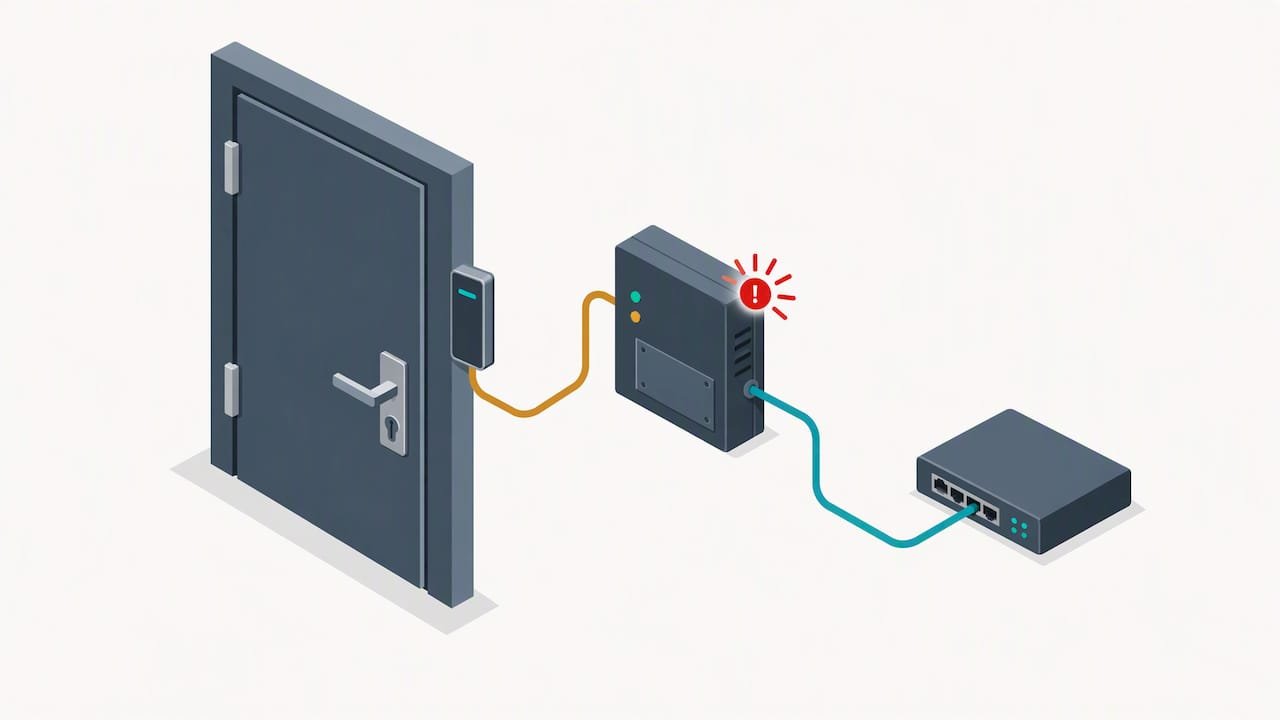
The cyber half has its own rules of thumb. The NCSC treats scanning as a regular, low-cost baseline, and its guidance on keeping on top of the most common threats recommends running scans on a regular schedule so new issues are caught as they arise. A 2025 NCSC review reported by The CIO said a small number of vulnerabilities in products such as Microsoft SharePoint, Ivanti Connect Secure and Fortinet FortiGate caused a disproportionate share of nationally significant incidents, and that critical patches should be applied within 14 days.
Two practical points:
- Scanning is not penetration testing. Scanning is non-intrusive and automated. Penetration testing involves humans actively trying to exploit weaknesses. Use scans regularly and keep budget for periodic manual testing to find the systemic problems scanners miss.
- Warn your IT team first. Scans can trigger intrusion detection systems or lock accounts if they are not configured and communicated in advance.
For the baseline controls expected of UK organisations, the NCSC’s Cyber Essentials overview lists five technical controls: firewalls, secure configuration, security update management, user access control and malware protection. If your concern is purely your website, that is a job for an IT security specialist, not a guarding company. We are honest about that boundary: we assess and secure physical sites and the people and technology around them.
A clean report is not a clear site
The NCSC is clear that a clean scan should not be mistaken for an absence of risk. The same applies on the ground. A survey records a moment in time. It cannot see the contractor who starts next week, the fence panel that fails in a storm, or the new tenant who sets up a night shift.
This is why we treat assessment as a cycle rather than a document. Findings feed into the deployment plan, the deployment generates incident reports, and those reports feed the next review. Sites that skip that last loop tend to repeat the same incidents.
Our perspective
We see the same pattern on many first visits. A client has bought good equipment, but it was bought before anyone defined the risk. The camera points at the front door while the loading bay, which is the real way in, sits in the dark. Our view is that the assessment should come first and the contract second.
We approach site vulnerability work as a combination of people and technology fitted to the individual site. For us that means looking at SIA-licensed guarding, mobile patrols, alarm response and access control together, rather than selling one product to every client. A construction site with a changing layout needs different cover from a hospital with 24-hour public access, and the survey should say so plainly.
We also think a good assessor should be willing to recommend less. If a risk is best handled by fixing a gate latch or changing a procedure, that is what the report should say. Guards are the right answer when presence, challenge and rapid response are what the site lacks, and not otherwise.
— Alex Smith
Turning findings into a security plan
Once risks are ranked, match each to a control type and a cost you can justify.
| Finding | Likely control | Notes |
|---|---|---|
| Repeated out-of-hours trespass | Mobile patrols at irregular times | Set the schedule from incident times, see our guide to patrol schedules |
| Uncontrolled visitors and contractors | Static guard at entrance, sign-in procedure | See our static guard guide |
| Slow response to alarms | Keyholding and alarm response | Agree response times in writing |
| Plant and material theft | Perimeter works, CCTV, guarding | Read construction site CCTV options |
| Weak or conflicting access control | Redesign with fire safety input | Never override egress |
Start with the quick, cheap fixes: lighting, locks, procedures, key control. Then address structural items. Schedule a review date when you sign off the plan, and write down what would trigger an earlier one: an incident, a change of layout, a new tenant or a change of use.
Questions to ask before you commission a survey
- Will the assessor visit at night as well as during working hours?
- Do they review your incident history, not only the physical layout?
- Will they score impact and likelihood separately?
- Do they consider fire safety and emergency access alongside security?
- Will you get a prioritised action list with owners, not just a description of problems?
- Is the assessor independent enough to recommend no purchase at all?
If a supplier cannot answer these clearly, the output is likely to be a sales quote with a report attached.
Working with Nexus
If you manage a construction site, a healthcare facility or a commercial property and want an independent view of where it is exposed, we carry out site security surveys and then provide the guarding, patrols and response to act on the findings. Start with our construction site security and site survey page, or read our business security risk assessment guide if you want to prepare first. You can also contact us through the Nexus Security Services site.
FAQ
What is the difference between a vulnerability assessment and a risk assessment?
A vulnerability assessment finds and lists weaknesses. A risk assessment goes further and weighs those weaknesses against threats, likelihood and impact to decide what matters most. In practice the physical survey and the risk assessment are done together, and the NPSA treats the site risk assessment as the starting point for the security plan.
How often should a site be reassessed?
At least annually, and after any significant change such as an incident, a layout change, new tenants or a change of use. NHS Property Services guidance describes security risk assessments as living documents that need regular review. Fast-changing sites such as construction projects benefit from more frequent checks.
Can an automated scan replace a physical survey?
No. An automated scan only examines digital systems, and the NCSC notes that even for those, scanners cannot find complex weaknesses that human testers can. Physical weaknesses such as gaps in a perimeter or a propped-open fire door need a person on site.
Do I need a security guard after the assessment?
Not always. Some findings are fixed with locks, lighting or procedures. Guards or patrols make sense where the assessment shows a need for presence, challenge or rapid response, and the report should explain why.
Sources
- NPSA: Security Planning Guidance
- NaCTSO: Protective security advice for your business
- NCSC: Vulnerability scanning tools and services
- NCSC: Vulnerability scanning, keeping on top of the most common threats
- NCSC: Cyber Essentials overview
- The CIO: NCSC review
- NHS Property Services: Occupiers guide to mitigating security incidents
- NPSA: Assured automatic access control systems
- HSE: Protecting the public (HSG151)
- Police: Construction site security guidance
Recommended
- Security Vulnerability Assessments: UK Guide
- Business Security Risk Assessment: A Practical UK Guide
- Office Security Checklist UK: A Practical 2026 Template for Safer Workplaces
- Data centre security for UK sites and server rooms


0 Comments