


Preventing cargo theft in the UK comes down to four things: where loads stop, how trailers and loading bays are secured, how drivers and office staff handle information, and how quickly someone responds when something looks wrong. No single lock or camera does it. Thieves look for the weakest point in the chain, and a load is only as safe as its least protected hour.
This guide is for haulage firms, logistics managers, warehouse operators and the people who buy security for them. It covers the methods police are seeing, the controls that make a real difference, and how to set up yard and hub security so that stock stays where it should.
TL;DR
- Freight crime is a large and under-recorded problem: NaVCIS reported 4,879 offences in 2024 with £111.5 million in direct losses, and industry estimates of the wider cost are far higher.
- Most attacks happen when a vehicle is stopped. In 2021, 70% of lorries attacked were parked on roads, laybys or motorway service areas, so route and stop planning is your first control.
- Fraud is catching up with force. Fake delivery instructions, bogus identification and insider help are now part of the picture, so verify every collection and every change.
- Your depot, yard and warehouse need the same discipline as the road: controlled gates, sealed and logged trailers, trained guards and a fast response to alarms.
Table of Contents
- What cargo theft looks like in the UK now
- Start with the biggest gap: where vehicles stop
- Harden the vehicle and the trailer
- Drivers are your first line of defence
- Defend against strategic theft
- Secure the depot, yard and warehouse
- Perspective: what we see on logistics sites
- Choosing guarding, patrols and response for freight sites
- How Nexus can help
- A 30-day action plan
- FAQ
- Sources
What cargo theft looks like in the UK now
For years the image of freight crime was a slashed curtain and a missing pallet. That still happens. Trade press reporting on Aon’s warning in March 2026 notes it is no longer the whole story, with strategic cargo theft becoming more organised and targeted.
The scale
NaVCIS, the police-funded National Vehicle Crime Intelligence Service, reported 4,879 freight offences in 2024 and £111.5 million in direct losses. The All-Party Parliamentary Group for Freight and Logistics puts the true annual economic impact above £800 million once indirect costs are counted. Older estimates vary with method: a government lorry crime leaflet quoted up to £250 million a year, and TAPA EMEA reported a figure of more than €485 million annually following a NaVCIS and NPCC report. The numbers differ, but they point the same way: this is expensive.
There is also a recording problem. NaVCIS and the APPG note that there is no specific national freight crime code, so cargo crime is often logged as generic theft from a motor vehicle or criminal damage. That hides the real scale and makes it harder to argue for police resource. For you, it means your own incident records matter more than the headline statistics.
The main methods
| Method | How it works | Where it bites |
|---|---|---|
| Curtain slashing | A sharp blade opens the side of a curtain-sided trailer and goods are pulled out | Parked trailers at laybys, service areas, industrial estates |
| Hard-side cutting | An angle grinder opens the metal skin of the trailer, a method NaVCIS flagged as new in 2021 | Parked, usually unattended trailers |
| Jump-up theft | Thieves climb onto or enter trailers stopped in traffic or making deliveries. NaVCIS found tobacco was the target in 81% of jump-up thefts | Slow traffic, delivery stops |
| Fuel siphoning | Tanks emptied while the vehicle is parked. 345 fuel thefts were reported in Q2 2026 alone | Overnight parking, depots |
| Strategic theft | Fraudulent delivery instructions, bogus ID, fake carriers and insider collusion | Booking and handover stages |
The last row deserves the most attention from managers. Munich Re’s 2025 cargo theft report describes a surge in sophisticated tactics, including fraudulent carriers, identity deception, cyber-enabled scams and insider collusion. A padlock does nothing against a load that is handed over voluntarily to the wrong person.
The police assessment is consistent. The Serious and Organised Acquisitive Crime Threat Assessment 2026 says offenders operate as networks, move quickly across policing boundaries and increasingly use technology. Treat the threat as organised, not opportunistic.
Start with the biggest gap: where vehicles stop
The single largest weakness in UK cargo security is a lack of secure places to park. NaVCIS’s problem profile for England and Wales points to a significant shortage of lorry parking and says existing parking security standards are typically not enough to deter criminals. Estimates of the shortfall range from roughly 4,700 to 11,000 spaces nationwide. FleetPoint’s July 2026 coverage shows the same message is still being pushed: operators are urged to prioritise safe stopping locations.
Police guidance recommends using only secure facilities that meet TAPA or Park Mark standards. NaVCIS notes that standard motorway service areas and roadside laybys are high-risk, and that there are extremely few TAPA-accredited secure lorry parks in the UK.
That last point is awkward, because it means perfect compliance is often impossible. So plan for it rather than pretend:
- Build routes around secure stops. Schedule driver hours so a secure or well-lit, staffed site is reachable before the legal limit forces a stop. The trade press piece on hours running out makes the link directly: drivers who run out of hours stop wherever they can.
- Rank your fallback stops. Where a secure park is not reachable, agree with drivers a short list of the least bad alternatives and tell them which to avoid.
- Never leave loaded trailers unattended on roadside or industrial-estate land if it can be avoided. A loaded trailer dropped overnight at an unguarded yard is a target.
- Keep high-value and theft-attractive loads off long, unplanned stops. Tobacco, as the jump-up figure shows, is a particular magnet.
- Record every stop. A log of where trailers have stood gives you data nobody else is collecting for you.
Harden the vehicle and the trailer
Choose the right trailer for the load
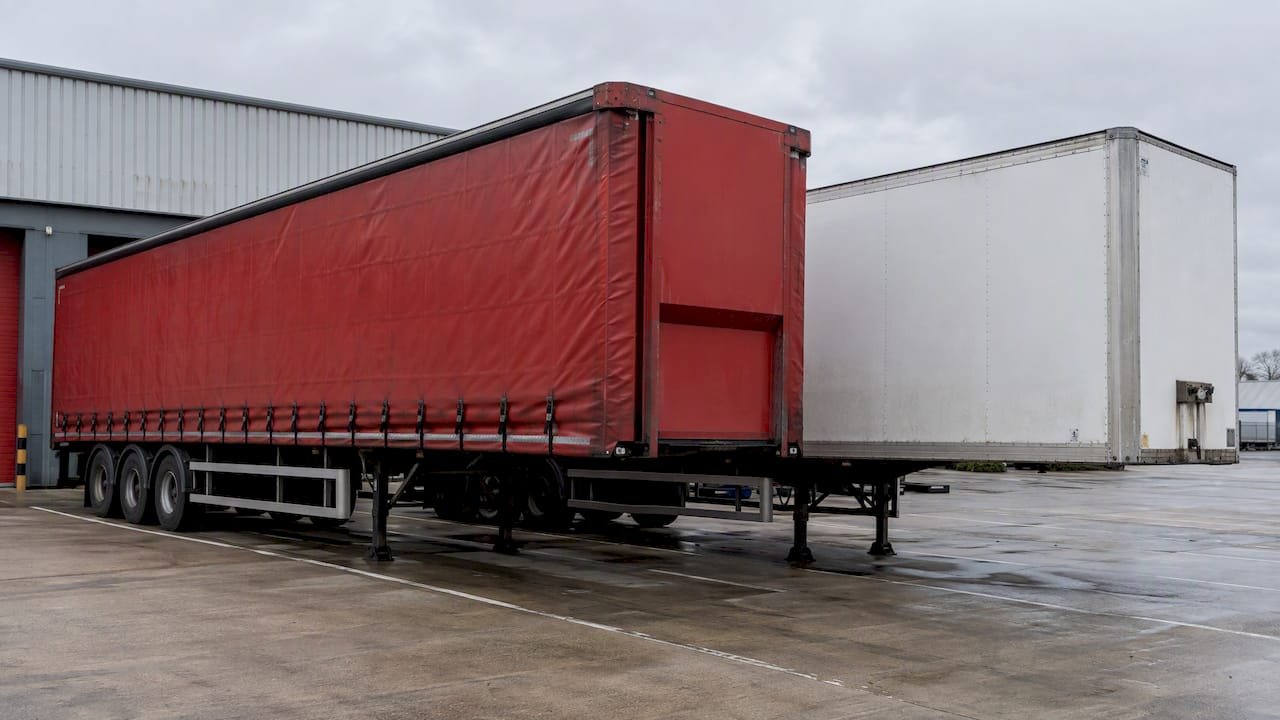
Curtain-sided trailers are far easier to attack than hard-sided ones. For high-value loads, the guidance gathered by NaVCIS favours hard-sided trailers, slash-resistant tarpaulins, and rear-facing cameras or escort vehicles to cover the vulnerable rear area where most attacks happen. Hard sides are not immune, as the angle-grinder method shows, but they raise the effort and the noise.
Locks, seals and access
NaVCIS’s annual cargo crime update recommends up-to-date load area access locking systems and tamper-proof seals that show whether a load has been opened. Its later prevention advice notes that gaining entry to trailers remains the most common method of cargo theft, usually by curtain slashing.
A workable standard looks like this:
- Numbered seals applied at the loading bay, with the number recorded on the paperwork and checked by the driver and again at delivery.
- High-security rear door locks and an immobiliser or cut-off that is not obvious from outside.
- A walkaround check by the driver every time the vehicle has been left, even briefly.
- Fuel caps that lock, and a habit of parking so the tank side is not easily reached.
- Tracking on both tractor and trailer, with someone actually watching the alerts out of hours. A tracker nobody monitors recovers nothing quickly.
The point of seals is not that they stop a determined thief. It is that they stop an unnoticed theft. A broken seal at a transfer point tells you where to look and who held the load.
Drivers are your first line of defence
Guidance reported from police crime-prevention material stresses that drivers should never discuss loads or routes, should keep their whereabouts private, and should follow company security checklists. If stopped by anyone other than a marked police vehicle, they are advised to stay inside the locked cab with the engine running.
Turn that into a one-page briefing that every driver, including agency drivers, signs for:
- Do not talk about the load, destination or schedule in cafes, on social media or on open radio.
- Take keys when leaving the cab, even for a minute, and drive with doors locked.
- Plan stops ahead, and do not change a delivery point on a phone call or message without checking with the office through a known number.
- Report anything odd, such as a van that has followed you or a person photographing the trailer, straight away. Early warning is how patterns are spotted.
- Know exactly what to do if approached, and who to call.
Also look after the person. Drivers who are worn out, short of hours and stuck without safe parking make poor security decisions through no fault of their own. Fixing the schedule is a security measure.

Defend against strategic theft
Because fraud now sits alongside force, your office controls need as much thought as your trailer locks. Munich Re lists fraudulent carriers, identity deception, cyber-enabled scams and insider collusion among the tactics that grew in 2024. NaVCIS likewise describes fraudulent delivery instructions, bogus identification and insider help as a rising part of UK cargo crime.
Practical controls:
- Vet every subcontractor. Check company registration, insurance, operating licence and references before first use, and re-check periodically. Do not rely on an email address or a phone number supplied in the booking.
- Verify the driver at collection. Match photo ID to the booking, confirm the vehicle registration against what you were told, and call the haulier on a number you already hold.
- Lock down changes. Any change to collection time, delivery address or contact should need a second person’s approval and a call-back.
- Limit who sees what. Load values and routes should be shared on a need-to-know basis, including inside your own business.
- Screen staff and agency workers for sensitive roles, and rotate access so no one person controls a whole load from booking to dispatch.
- Watch your digital footprint. Freight exchange accounts, shared inboxes and tracking portals are all places where information leaks.
A customer or carrier pressing you to release a load quickly, with a plausible reason, is the signature of this type of crime. A mandatory pause for verification costs minutes and can save a whole consignment.
Secure the depot, yard and warehouse
A large share of freight loss happens at fixed sites: yards where trailers are dropped, bays where loads are staged, and warehouses where pallets sit between jobs. The aim is to make it hard to enter, hard to move unnoticed and easy to prove what happened.
A layered approach
- Perimeter. Fencing, controlled gates and lighting that matches the camera coverage. Check the gaps: back corners, shared boundaries, and drainage or rail access are classic weak spots.
- Access control. One vehicle gate, one pedestrian route, and a log of every visitor and driver. Pre-booked arrivals only, with ID checked against the booking.
- Yard management. Loaded trailers parked in a visible position, doors facing a wall or another trailer where practical, with a record of seal numbers when they arrive and leave.
- Goods-in and goods-out. Separate staging areas, a count at handover, and nobody left alone with high-value stock.
- Detection. CCTV that is actually watched or monitored, intruder alarms, and a response plan that names who attends and how long they take.
- People. Vetted staff, a clear route for reporting concerns, and visible guarding at peak risk times.
Our own guides go deeper on the building side: warehouse security measures that prevent stock loss, warehouse security services in the UK and logistics hub security. If someone will be watching screens and taking alarms, the security control room procedures guide sets out how that should work.
Match the control to the risk
| Risk at your site | Sensible first response |
|---|---|
| Loaded trailers left overnight in the yard | Staffed gate or manned presence, seal log, lit and camera-covered parking |
| Quiet site with periodic out-of-hours risk | Scheduled mobile patrols plus alarm response |
| Busy goods-in with many visiting drivers | Gate control, ID checks, visitor log, trained guard |
| Suspected insider involvement | Access review, audit trail, separation of duties, discreet investigation |
| Multiple tenants or shared yards | Joint risk assessment and agreed access rules |
Perspective: what we see on logistics sites
We provide security for businesses, properties, construction sites, healthcare facilities, logistics hubs, data centres and commercial buildings, and the pattern on freight sites is consistent: the weak point is rarely a missing gadget. It is a gap between two things that were each bought separately. A good gate system with a guard who has not been told what a genuine collection looks like. Cameras with nobody assigned to act on them. A seal procedure on paper that nobody checks at the bay.
That is why we focus on joining technology and people together. In practice that starts with a survey of the site to find where loads are actually exposed, then deciding which risks need a person on the ground, which need a patrol, and which need detection and response. Guards need clear post instructions covering who may collect what, who authorises exceptions, and what to log. Where a change of provider is involved, we also support TUPE transition so that the people who already know the site are not lost in the handover.
Our advice to any operator: write down your last three near misses or losses, trace each one back to the exact minute control was lost, and spend your money there first. Most firms find it was a handover, not a break-in.
— Alex Smith
Choosing guarding, patrols and response for freight sites
Three service types matter most for cargo, and each answers a different problem.
Manned guarding is for places where loads are present and vulnerable, such as a gatehouse at a busy hub, a loading bay with high-value stock or a yard with loaded trailers overnight. A guard checks identity, enforces the seal and visitor procedures, and deters people who are scouting. Look for SIA-licensed staff and a written assignment brief.
Mobile patrols suit sites that do not justify a full-time presence but need regular, unpredictable visits. The key is the schedule: random timings are harder to exploit than fixed ones, and visits should be tied to the periods you identified as risky. Our guide on setting the right mobile patrol schedule explains how, and what mobile patrols are for UK businesses covers the basics.
Alarm response closes the loop on detection. An alarm is only useful if someone can get there quickly, check it and decide whether to call police.
Whatever you buy, put the service levels in writing. Response times, patrol frequencies, reporting and what happens when a guard is absent should be in the contract; our security services SLA guide shows what to include. Ask also for incident reporting that you can use: dated, specific and consistent, because as the lack of a national freight crime code shows, good records are what turn isolated losses into a pattern police can act on.
How Nexus can help
If you want an outside view of where your loads are exposed, we start with a site security survey and a vulnerability assessment, then build guarding, patrols and response around what it finds. See our construction and site security survey service, SIA-licensed manned guarding and mobile patrol security. To understand the assessment process first, read our security vulnerability assessments guide. Pricing is quoted per site after a survey, as it depends on the hours, location and risk.
A 30-day action plan
Week 1: find the facts. Collect every loss, near miss and suspicious approach from the last 12 months. Map each to a location, time and stage: road, yard, bay or office.
Week 2: fix the cheap things. Brief drivers, introduce or tighten seal logging, add call-back verification for changes and collections, and review which secure stops your routes can use.
Week 3: test the site. Walk the perimeter at night. Try the gate, check camera views, time an alarm response, and see whether someone can walk into goods-in without being challenged. A business security risk assessment gives a framework.
Week 4: decide and contract. Choose which risks need people, patrols or technology, and write the service levels into contracts. Share what you learn with your insurer, as the quality of your controls may affect cover. Check the position with your broker, because policy terms differ.
Also consider joining the industry conversation. TAPA EMEA is running a UK freight crime risk and resilience conference with speakers from law enforcement agencies, and the standards it promotes are the ones police point operators towards.
FAQ
Where does cargo theft happen most often in the UK?
Mostly where vehicles are stopped and unattended. In 2021, 70% of lorries attacked were parked on roads, laybys or motorway service areas. Depots, yards and delivery stops are also targeted, and fraud at the booking stage can mean a theft is never visible at the roadside.
How do I stop my lorry or trailer being targeted?
Use secure, accredited parking where you can, avoid leaving loaded trailers unattended, and fit high-security locks and tamper-proof seals. For high-value loads, hard-sided trailers or slash-resistant tarpaulins, rear cameras and tracking all make an attack harder. Drivers should lock the cab, take the keys and check the trailer after every stop.
What is the best way to prevent warehouse theft?
Control who can enter, record what goes in and out, and make sure someone is responsible for acting on alarms and camera alerts. Combine perimeter and gate control with trained guards and, for quieter hours, patrols and alarm response. Vet staff and agency workers too, since insider help features in strategic theft.
What is strategic cargo theft?
It is theft by deception rather than force: fraudulent delivery instructions, bogus ID, fake carriers or insider collusion lead to a genuine load being handed to criminals. The defence is verification, including checking carriers, confirming drivers against bookings and requiring a call-back for any change.
Who should I tell if cargo is stolen?
Report it to the police straight away, and tell your insurer. NaVCIS, the police-funded freight crime intelligence service, collects freight offence data, and clear records from you help it identify patterns. Because freight crime is often recorded as general theft, say plainly that it involves a commercial load.
Sources
- NaVCIS: Freight crime
- NaVCIS: Freight crime prevention techniques
- NaVCIS: Freight crime problem profile for England and Wales, 2022
- NaVCIS: Annual cargo crime update 2020
- FleetPoint: Cargo crime threat rises across UK and Europe
- trans.info: When hours run out, hauliers are left open to cargo theft
- GOV.UK: Lorry crime prevention leaflet
- Serious and Organised Acquisitive Crime Threat Assessment 2026
- TAPA EMEA: Freight crimes cost UK economy
- TAPA EMEA: UK Freight Crime Risk and Resilience Conference
- National Business Crime Centre
Recommended
Written with help from BabyLoveGrowth


0 Comments