

Site teams should stop work, move clear of immediate danger and notify the site supervisor during a power outage. Waiting for the lights to return leaves machinery, access routes and personnel without a controlled response.
Effective power failure safety depends on clear responsibility, an accurate headcount and decisions based on the site’s emergency plan. The response must reflect the work underway, the systems affected and the hazards created by losing electricity.
Start by protecting people, then establish what can safely remain occupied, what needs specialist attention and who can authorise a restart.
Key takeaways
- Stop affected work immediately, and secure equipment only where the operator can do so without additional exposure.
- Treat electrical equipment and cables as potentially live, regardless of whether lights, tools or machinery have stopped.
- Account for workers, subcontractors, visitors, delivery drivers and anyone working alone, using records available without mains power.
- Follow the site’s agreed response, and keep people out of dark, flooded or otherwise unsafe areas.
- Notify the site supervisor, then contact the electricity network operator or emergency services according to the circumstances.
- Restart only after competent assessment, restoration of necessary safety systems and clear authorisation for the work concerned.
A short interruption still requires a controlled response. Its duration does not establish whether the cause is harmless or whether the affected equipment remains safe.
Start with a clear power failure safety response
A loss of supply changes the working conditions immediately. The first instruction should stop affected activities before people start investigating, moving equipment or finding another power source.
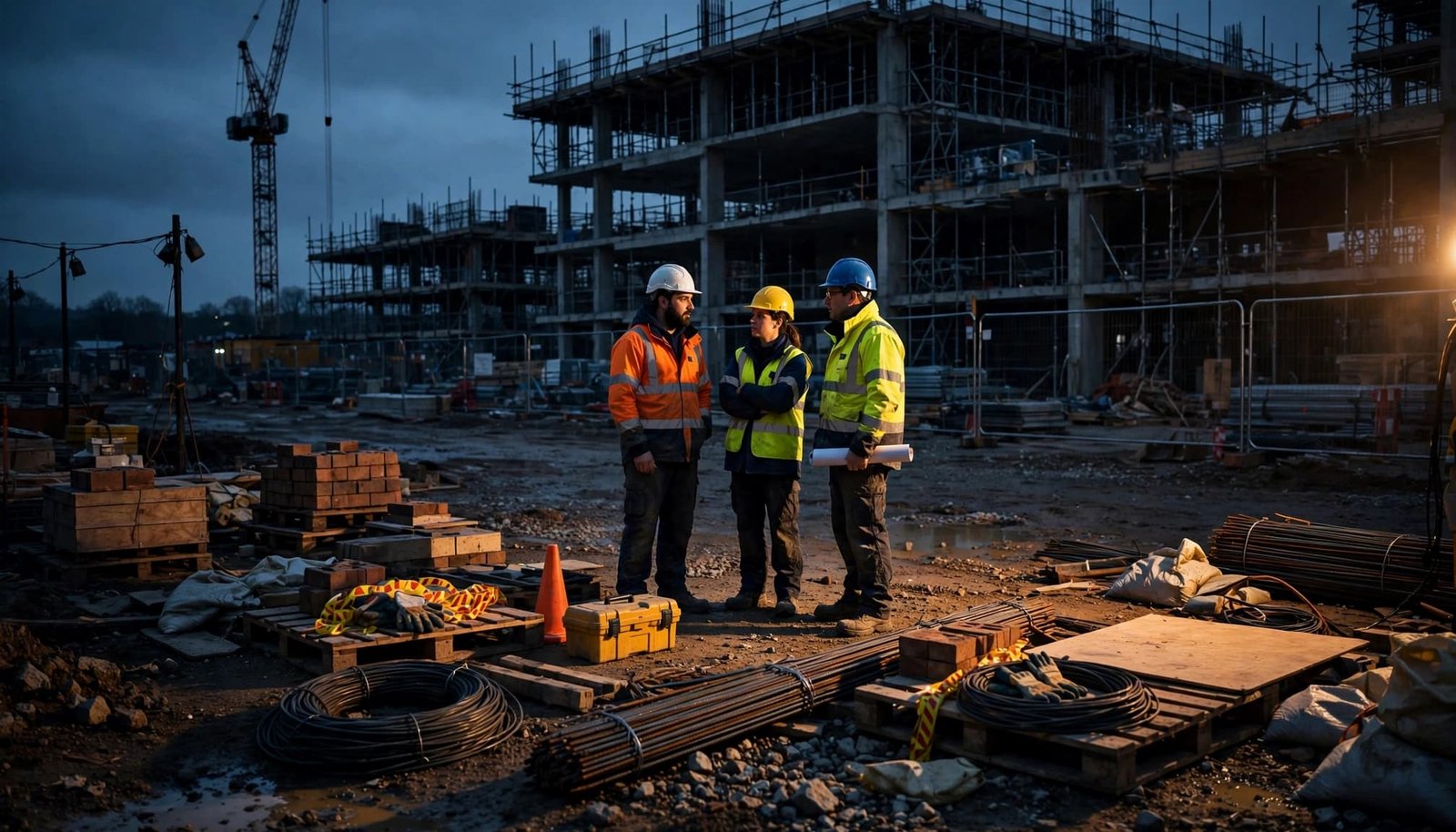
Stop the task without creating another hazard
Operators should follow the equipment’s safe stopping procedure where this remains possible. Release operating controls, stop movement and use an accessible emergency stop where the circumstances require it.
Don’t reach into machinery, cross an unlit working area or approach damaged equipment to complete a shutdown. Leaving a machine untouched may be safer than trying to secure it.
Keep other people clear of blades, rotating parts, suspended loads and equipment that could move unexpectedly. A machine that has stopped running can still contain stored mechanical, hydraulic or pneumatic energy.
The supervisor should suspend associated activities as well. Cutting, lifting, excavation and vehicle movements may depend on lighting, extraction, communications or other systems affected by the same failure.
Give one immediate instruction
Use the agreed radio channel, alarm method or direct instruction to tell crews what has happened and where to remain. Keep the message short enough to repeat accurately.
State the affected area, the action required and the safe destination where movement is necessary. Use flashlights (torches) only on a route already assessed as safe. A light doesn’t make an unsafe route safe.
Workers should report their position and any immediate problem through their supervisor. Reports of trapped people, smoke, damaged cables or failing pumps need priority over questions about finishing a task.
Don’t allow individuals to return for tools, phones or personal belongings. Those movements can undermine both the headcount and the initial effort to keep people away from danger.
Treat electrical dangers as live until assessed
A blackout does not prove that a circuit is isolated. Supplies may return unexpectedly, and batteries, generators, solar panels or other connected sources may still energise parts of an installation.
Keep clear of damaged equipment and fallen wires
Do not touch downed wires, damaged cables, broken distribution equipment or anything in contact with them. Keep other people away and report the location without approaching to obtain photographs.
Low-hanging lines can also present a danger. Electricity can pass through nearby equipment or across a gap, so visible separation alone is not evidence of safety.
UK Power Networks’ overhead-line safety advice tells people to stay at least 10 metres away from damaged, low-hanging or grounded equipment. Follow the network operator’s instructions and the site exclusion arrangements.
A worker already inside a danger area should avoid improvised escape or rescue actions. Give emergency services the location, equipment involved and position of anyone at risk.
Keep water, excavation and electrical damage separate
Do not enter flooded areas where electrical equipment or cables may be present. Floodwater can conceal damaged installations, open excavations, unstable ground and other hazards.
Where a failure follows excavation, treat a cable strike as a possible cause. Stop nearby work, prevent access and report what happened without uncovering, moving or attempting to repair the service.
The HSE’s guidance on avoiding underground services also addresses damage affecting nearby services. A cable incident may create fire or explosion risks beyond the original excavation.
Electrical isolation and testing belong to competent, authorised people. They need to identify relevant supplies, prevent reconnection and establish whether the equipment is dead before electrical work begins.
Darkness and stopped machinery do not establish safe isolation. Electrical safety requires control of the supply, not an assumption about its condition.
Assign command and keep communications working
The site emergency plan should identify who leads the response and who takes over when that person is absent. An outage should not leave several supervisors issuing conflicting instructions.
Give decisions to named roles
The site supervisor or appointed incident lead should coordinate the response, set exclusion areas and decide whether work remains suspended. Subcontractor supervisors should account for their crews and report task-specific hazards.
A competent electrical person should assess installation faults and electrical recovery requirements. Security personnel should manage access, support accountability and report observations within their agreed responsibilities.
These roles may sit with fewer people on a small project. The responsibilities still need to be explicit, particularly where a lone security officer cannot cover the entrance, assembly point and perimeter simultaneously.
HSE’s guidance on the Electricity at Work Regulations explains electrical safety duties. Apply relevant legislation and local requirements alongside the site plan, rather than assuming one response fits every project.
Use a communication method that still works
Do not assume the usual systems remain available. Wi-Fi, internet telephony, radio chargers, access-control terminals and office computers may depend on the failed supply.
Use the agreed backup method and assign someone to pass messages between supervisors where necessary. Keep emergency contact numbers, site plans and essential personnel records available offline.
Each update should distinguish confirmed information from an unresolved report. Record who issued the instruction, which areas it covers and whether the recipient acknowledged it.
The wider security incident response plan should connect these decisions with access control, external contacts and recovery arrangements. A contact list is useful only when the people listed understand what they are expected to do.
Account for everyone on site
A headcount requires more than counting people at the gate. It requires a clear record of who was present, where they were working and whether they have reached safety.

Reconcile records with named people
Use worker registers, subcontractor returns, visitor logs and delivery records to establish expected occupancy. Electronic access records can support the process, but they should not be the only available source.
Each trade supervisor should report their crew’s status to the incident lead. Include people working in cabins, roofs, basements, remote compounds and separate phases of the project.
Account for delivery drivers and visitors who may have remained in vehicles or followed a different route. An assumption that they have left is not a confirmed departure.
Record anyone who leaves the assembly area after being counted. Unrecorded departures and independent attempts to return can create false missing-person reports or conceal an actual gap.
Report missing people without sending others into danger
Where someone is unaccounted for, establish their name, last known location, task and any relevant access information. Pass those details to the incident lead immediately.
Do not send workers into dark structures, flooded rooms, confined spaces or electrically hazardous areas to complete a search. A missing-person report does not authorise an improvised rescue.
Contact the person by radio or telephone where possible, without treating a ringing phone or unanswered message as evidence of their location. Give responders facts and clearly identify what remains unknown.
Include anyone needing evacuation assistance in the accountability arrangements. Their support should follow an agreed plan, with suitable people and equipment, rather than relying on whoever happens to be nearby.
Decide whether to evacuate or restrict access
Power failure does not produce the same evacuation decision on every site. The incident lead should follow the site’s established procedures and assess whether people can remain safely in their current locations.
Use routes that remain safe
Evacuate where continued occupation creates unacceptable risk, or where the site’s arrangements require it. Smoke, electrical damage, inadequate escape lighting and failed safety systems may make continued occupation unsafe.
Do not enter a dark area to see whether the normal route is usable. Use a known safe alternative and report any route that cannot be assessed without exposure.
Do not use passenger lifts during an emergency evacuation. Construction hoists and other lifting equipment require their own operating and rescue arrangements; workers should not improvise access or release procedures.
Visitors and people unfamiliar with the project need clear directions. A route that regular trades can recognise in daylight may be confusing when lighting, doors or access controls have changed.
Keep the assembly point usable
The designated assembly point should remain clear of traffic, suspended loads, electrical hazards and emergency vehicle access. Reaching the usual location does not make it suitable under changed conditions.
Move the group where smoke, damaged lines, flooding or an expanding exclusion area affects the planned position. Tell all supervisors and responders about the change.
Keep crews together and prevent people drifting towards vehicles, cabins or the site entrance. The incident lead needs a stable headcount and a clear route for emergency services.
Security controls must support escape. Do not chain gates, block doors or remove temporary access arrangements while those routes remain necessary for evacuation or responder access.
Notify the right people with useful information
Notify the site supervisor immediately, even where the interruption appears to affect the wider neighbourhood. A network outage can still leave the project with separate lighting, plant and access problems.
Calls should follow the incident’s actual risks.
| Situation | Contact and immediate purpose |
|---|---|
| Fire, serious injury, trapped people or immediate danger to life | Call 999 and describe the emergency, location and safe access point. |
| Power cut or electricity-network safety concern in Great Britain | Call 105 to reach the electricity network operator. |
| Power cut or network emergency in Northern Ireland | Contact NIE Networks on 03457 643 643. |
| Suspected fault within the site installation | Notify the incident lead and the appointed competent electrical person. |
The electricity network operator handles faults on the supply network. An electricity supplier handles customer accounts and related enquiries.
Eligible domestic customers can ask their supplier about the Priority Services Register for extra support during a home supply interruption. This doesn’t replace the site’s response.
These contacts address different responsibilities. Reporting a supply failure does not replace an emergency call where people are in immediate danger.
The Energy Networks Association identifies 105 for network safety concerns, including damaged underground cables and substations. Northern Powergrid’s cable safety advice also distinguishes network reporting through 105 from emergencies requiring 999.
Give the exact site address, postcode, entrance and caller’s number. Large projects should identify the relevant gate and any access restrictions, rather than relying on the postal address alone.
Describe what failed, when it happened and what was happening immediately beforehand. Report smoke, flooding, excavation, damaged equipment and affected personnel without presenting an unconfirmed cause as fact.
Assign someone to meet responders at a safe access point. Keep routes open and provide current information about excavations, temporary roads, overhead restrictions and areas that remain inaccessible.
Record call times, reference numbers and instructions. An estimated restoration time may help planning, but it does not authorise continued work or establish that the site installation is safe.
Secure machinery only where it is safe
Equipment should be left in a condition that limits foreseeable movement and unauthorised use. That instruction does not justify entering a hazardous area or attempting an unfamiliar shutdown.
Keep operators within their procedures
Operators should use the machine’s established stopping and securing arrangements where conditions allow. Park mobile plant, apply appropriate controls and manage keys under the site’s agreed procedure.
Do not assume electrically powered equipment has no remaining energy. Hydraulic pressure, raised attachments, springs and moving components may still present hazards after the supply stops.
Where equipment cannot be secured safely, isolate the surrounding area and report its condition. Record the machine, location, remaining hazard and person responsible for arranging specialist support.
HSE’s guidance on electrically powered equipment covers equipment condition and safe precautions. Routine user checks do not authorise workers to open electrical enclosures or investigate internal faults.
Treat lifting and elevated access separately
Suspended loads, construction hoists and powered access equipment need task-specific decisions. The appointed lifting personnel or equipment specialist should direct the response within the relevant plan.
Keep people away from the load path and any area where movement or falling material could occur. Do not attempt to lower, release or support a load using improvised methods.
A person stranded in a hoist or elevated platform should use the agreed communication and rescue arrangements. Colleagues should not climb the structure, force doors or operate unfamiliar emergency controls.
Hot works and powered processes also need a safe suspension. Stop the activity, maintain required fire precautions and report any unfinished condition that could create danger after the crew leaves.
The supervisor should include these unresolved conditions in the incident handover. “Work stopped” does not explain whether a raised load, hot surface or inaccessible operator still needs attention.
Assess the safety systems affected by the outage
The most obvious loss may be lighting, but other failures can make a work area unsuitable for occupation. Assess the systems that make the task safe, not merely those needed to run the tool.
Identify dependence on ventilation, pumps and alarms
Mechanical ventilation may control dust, fumes or atmospheric conditions. Where it stops, suspend dependent work and follow the relevant task or confined-space arrangements.
Dewatering pumps may protect excavations, access routes or electrical equipment. Their failure can introduce risks that increase over time, even where the initial outage produces no visible flooding.
Assess fire detection, alarm communication and other emergency systems against the site plan. A panel operating on backup power doesn’t prove that every detector, sounder or communication link remains available.
The supervisor should assign each affected system to a responsible person. Record whether it remains operational, has limited backup or requires the area to be closed. Identify anyone on site who relies on medical equipment, and agree safe support or an alternative if its power supply is affected.
Distinguish backup indication from usable protection
A green indicator or live screen provides limited evidence. It may show that one component has power without demonstrating that the whole system can perform its required function.
Security cameras can remain powered whilst their network connection or recorder is unavailable. Access-control equipment may behave differently at individual doors or gates after a supply interruption.
The same distinction applies to lighting. A few illuminated fittings don’t establish adequate coverage of stairs, edges, changes in level or the complete escape route.
Use the system’s established assessment and testing arrangements. Where a necessary safety function can’t be demonstrated, restrict the dependent activity rather than assuming the backup will last.
Plans for alarm systems and response should identify who receives faults and what action follows. An alert that nobody receives can’t support the intended response.
Use temporary power through a competent plan
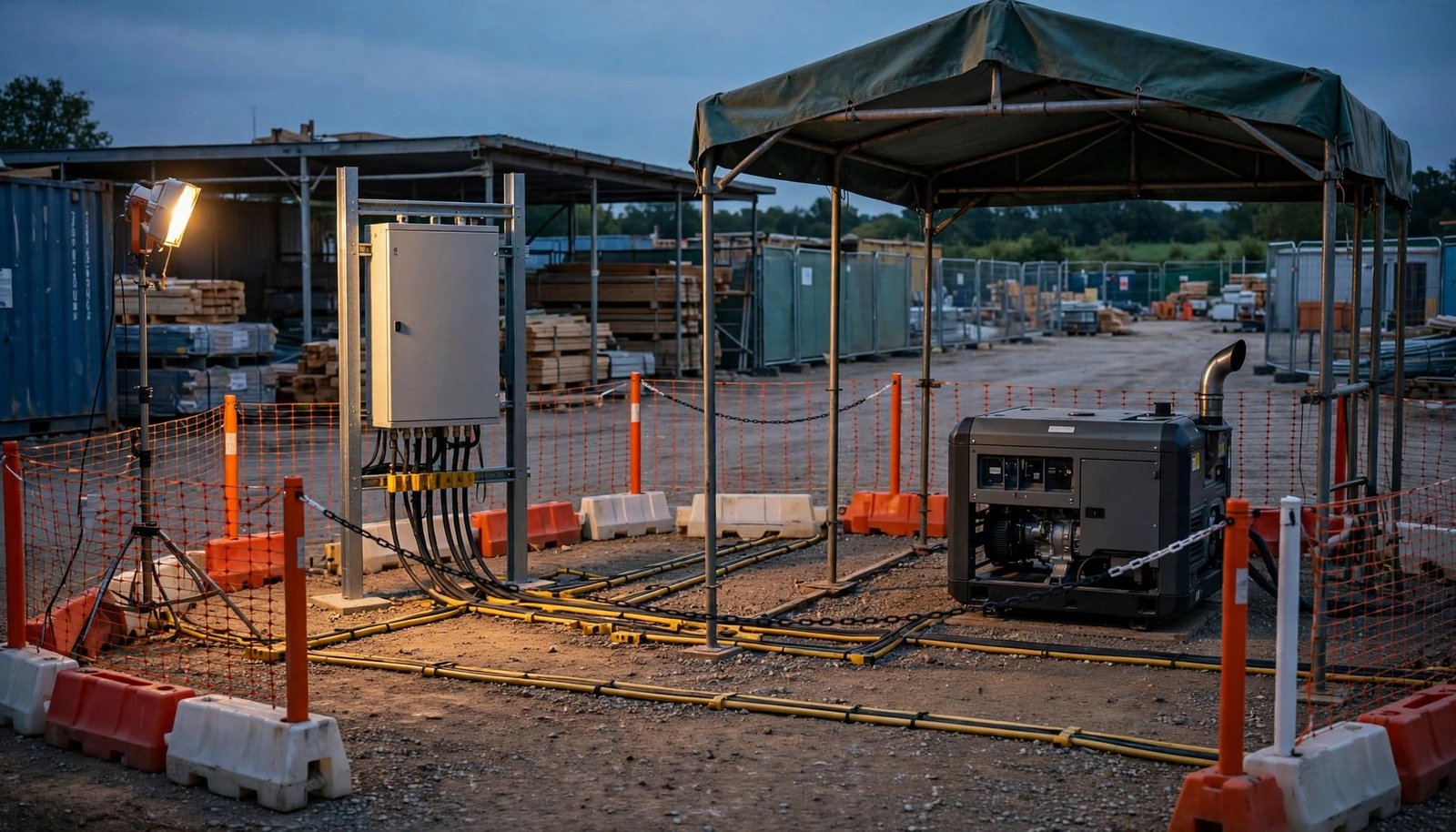
A generator can restore selected functions, but its presence does not make a stopped site ready to operate. Temporary power needs an assessed installation, suitable equipment and clear operating responsibility.
Decide which functions need power first
The incident lead should identify the functions that need backup power for safe withdrawal, emergency response or controlled site protection. These priorities may differ from the activities causing the greatest programme delay.
Give the competent electrical person the expected loads and operating conditions. They should determine whether the proposed generator, distribution equipment and protective arrangements are suitable. A portable power station may suit selected low-load needs. A competent person must assess its capacity, compatibility and safe use; it isn’t an automatic substitute for an assessed temporary installation.
Do not connect an improvised supply because a plug appears to fit. Generator connection, earthing and protective measures depend on the system and require competent assessment.
HSE lists HSG141, Electrical safety on construction sites, amongst its health and safety guidance publications. Temporary supplies belong within the project’s electrical safety arrangements, rather than an informal response agreed at the generator.
Control exhaust, fuel and temporary cables
Combustion generators produce carbon monoxide and need suitable outdoor positioning with adequate ventilation. Do not run them inside cabins, basements, enclosed structures or other spaces where exhaust can accumulate.
Positioning must account for nearby doors, windows, air intakes and occupied areas. An outdoor location alone does not establish that exhaust cannot enter a building.
Manage refuelling, fuel storage, weather exposure and access according to the equipment instructions and site arrangements. Keep unauthorised people away from the installation.
Temporary cables can obstruct escape routes, create trip hazards or become damaged by vehicles. Their routing and protection should form part of the assessed setup.
Portable lighting also needs task-appropriate selection and positioning. A torch can support safe movement along an assessed route; it does not automatically provide adequate lighting for construction work.
Maintain site security without obstructing safety
A power failure can affect cameras, alarms, lighting and powered gates at the same time. The security response should identify the actual gaps before replacing failed systems with additional patrols.
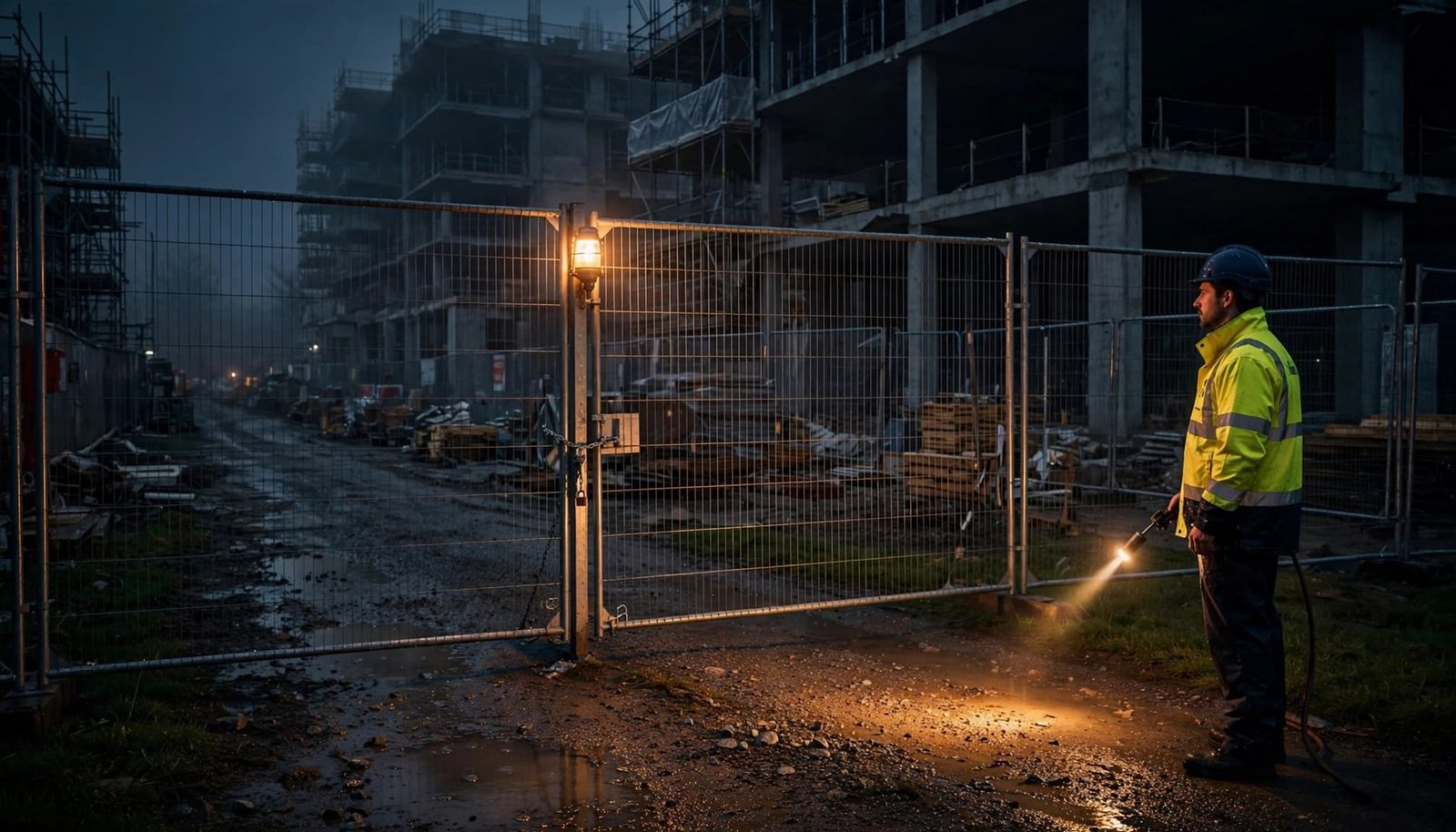
Control access manually where necessary
Security personnel should establish which gates and doors remain usable, which have released and which cannot be operated safely. Keep emergency escape arrangements separate from measures intended to prevent entry.
Pause routine deliveries where vehicle movements would interfere with evacuation or emergency access. Record essential arrivals and departures manually if the normal system is unavailable.
Visitors, subcontractors and returning workers should receive the same clear instruction about restricted areas. Familiarity with the site does not authorise re-entry during an incident.
The wider construction site security plan should define these arrangements before an outage. Boundary control, occupancy records and safe evacuation depend on coordinated decisions.
Protect assets from safe positions
Assess gates, fencing, storage compounds and exposed materials without entering dark or otherwise unsafe areas. A security officer should report an inaccessible section rather than complete a patrol through it.
Secure tools, fuel, keys and plant only where this can be done safely. Record any assets left exposed and the temporary measures assigned to protect them.
Where monitoring is unavailable, additional guarding or patrols may be appropriate. Their scope must reflect safe routes, available communications and the hazards that remain.
Do not reduce public protection while concentrating on theft. Open boundaries can expose passers-by to excavations, unstable materials, vehicles and incomplete structures.
A locked compound may protect equipment, but it does not resolve an open pedestrian gap elsewhere. Security personnel should report each defect against its location and consequence, with a named person responsible for action.
Manage a prolonged outage as a controlled shutdown
A longer interruption requires a deliberate decision about closure, retained staffing and site protection. Keeping people waiting indefinitely can create fatigue, confusion and unrecorded departures.
The incident lead should assess whether safe occupation can continue without normal lighting, welfare facilities, communications and emergency systems. Where those conditions cannot be maintained, arrange a controlled departure.
Use site records to identify whether a welfare cabin has a fridge or freezer for food or temperature-sensitive supplies. If temperature control is affected, follow site procedures and don’t enter an unsafe area to check appliances.
Record who remains, why they remain and which areas they may enter. Essential staffing should reflect the work that can be performed safely, rather than the number of people available.
Notify incoming shifts, delivery coordinators and affected subcontractors. A closed site can still receive vehicles and workers unless someone changes the arrival arrangements.
Establish a handover covering electrical hazards, inaccessible areas, unsecured equipment, failed monitoring and expected specialist attendance. Give the incoming responsible person the current contact details and authority limits.
Out-of-hours security patrol checks and reporting should reflect the changed conditions. Normal patrol routes may be unsuitable where lighting, communications or access equipment have failed.
Do not send a lone worker to reset equipment without an assessed task and suitable support. An outage attendance can involve electrical damage, flooding, intruders or an inaccessible entrance.
Set a review time and a clear escalation route. Weather, rising water, exhausted batteries or changing public access can make the site less safe after the initial shutdown.
Before the final crew leaves, reconcile the personnel register and identify the person responsible for the next inspection. A site should not become unattended through a series of individual departures.
Verify conditions before authorising a restart
Restored electricity establishes that a supply is available. It does not establish that machinery, access routes or safety systems are ready for normal use.
Where safe, unplug appliances that aren’t needed and follow equipment procedures to reduce the risk of a surge affecting sensitive equipment.
Assess the installation and the work area
The competent electrical person should assess the affected installation and any reported damage, water ingress or abnormal operation. Inspection and testing should reflect the circumstances of the failure.
Maintain isolation where equipment remains defective or its condition is unresolved. Do not repeatedly reset protective devices to see whether a fault has disappeared.
Supervisors should assess the work area separately. Check routes, excavation conditions, lighting, ventilation, temporary works and any task left incomplete when power failed.
A machine may remain unusable even after the electrical installation is released. Its operator needs to establish that guards, controls, interlocks and other required functions are available.
Report systems that failed to recover properly, including alarms, cameras, access controls and communications. Recovery should be demonstrated through the appropriate arrangements, not assumed because an indicator has illuminated.
Release work in a controlled sequence
The incident lead should authorise work by area or activity where conditions differ across the project. One clear zone does not justify reopening the whole site.
Tell supervisors which restrictions remain and which permits or task assessments need review. Work involving lifting, hot works, confined spaces or isolation may require a separate release.
Before restarting machinery, clear people from danger zones and follow the operating procedure. Equipment should not resume unexpectedly whilst workers are inspecting, repositioning or clearing it.
Brief affected crews on the cause where known, changes made and any temporary arrangements. Include subcontractors returning after the initial interruption.
Record the authorising person’s name, the time, the areas released and any remaining conditions. Partial recovery needs a clear boundary between permitted work and continuing restrictions.
Supply restoration and permission to restart are separate decisions. The first may come from the network; the second depends on the site’s condition.
Where the cause remains uncertain, record that limitation. Do not convert an unexplained recovery into a confident account of what failed.
Record the incident and improve the next response
The incident record should explain what happened, how people were protected and what remained unresolved. A note stating “power restored” leaves most operational decisions undocumented.
Preserve a usable sequence of events
Record the time of failure, affected areas, work underway and the first instructions issued. Include the headcount position, external calls, exclusion areas and any assistance provided.
Separate observations from conclusions. “Distribution board tripped” describes an observed condition; it doesn’t identify the underlying cause without further assessment.
Retain relevant alarm records, maintenance findings and access information. Photograph damage only where this can be done safely and without disturbing equipment or entering a restricted area.
Record the restart decision and any outstanding repairs. Assign each corrective action to a named role, with a completion date and a clear description of the required outcome.
The record should also capture actions that worked. An offline register, usable emergency route or clear responder handover provides evidence of functioning arrangements.
Test the arrangements against current site conditions
Review whether communications worked without office power and whether all personnel could be accounted for. Identify any gap involving visitors, delivery drivers, lone workers or people needing assistance.
Use practical exercises to test changed gates, phased handovers, temporary roads and out-of-hours staffing. An arrangement that worked during groundworks may be unsuitable during fit-out or partial occupation.
The principles of physical security incident exercises apply here: test decisions, handovers and actual access arrangements, rather than discussing an ideal response around a table.
Include electrical danger recognition in inductions. SSEN’s electrical safety resources reinforce reporting electrical hazards and keeping the response focused on safety.
Keep emergency contacts and records available offline, and prepare an emergency kit with flashlights (torches), a battery radio and spare batteries. Maintain suitable emergency lighting and make equipment defects visible in the handover process. Preparation should produce usable records, accessible equipment and known responsibilities.
Update the emergency plan after the review. Findings have limited value until the relevant controls, briefings and responsibilities change.
Frequently asked questions
Does every power failure require a full evacuation?
No universal rule applies to every construction site. The incident lead should follow the site’s established procedures and assess escape routes, lighting, electrical hazards and the availability of necessary safety systems.
A limited interruption may allow people to remain in a known safe area. Failed protection, smoke, flooding or unsafe access may require evacuation or a wider exclusion area.
Can crews continue using battery-powered tools?
Battery power only addresses the tool’s supply. The task may still depend on adequate lighting, dust extraction, ventilation, communications or emergency arrangements affected by the outage.
The supervisor should assess those dependencies before permitting work. A working cordless tool does not establish that the surrounding activity is safe to continue.
Should someone reset the main breaker?
Only a competent, authorised person should assess the installation and decide whether resetting is appropriate. A protective device may have operated because of a fault that remains present.
Workers should report observations and keep clear of damaged equipment. Repeated resets or opening distribution equipment without authorisation can expose people to electrical danger.
Who should authorise work to restart?
The person identified in the site’s agreed arrangements should coordinate the release, supported by competent electrical assessment and the relevant task supervisors. Responsibilities depend on the project’s management arrangements.
The decision should address the area, machinery and safety systems concerned. Record any continuing restrictions and communicate them before crews resume work, rather than relying on the return of lighting as permission.
Make the restart as controlled as the shutdown
Power failure safety requires a clear sequence: stop affected work, protect people, establish accountability and assign the necessary specialist response. A restored supply is only one part of recovery.
Keep damaged electrical equipment, unsafe areas and unresolved tasks under control until competent assessment supports their release. Follow local requirements and the site’s agreed procedures throughout.
The standard is practical: everyone accounted for, hazards assigned to named people and permission to restart based on the conditions that exist.


0 Comments