


What Are Mobile Patrols for UK Businesses?
If you manage a commercial site, warehouse, office, retail unit, vacant building, or mixed-use premises, you may not need a guard standing at one entrance all day and night. What you may need instead is a flexible security presence that checks the site at the right times, tests vulnerabilities, responds to alarms, and helps reduce risk without the cost of permanent on-site deployment. That is where mobile patrols come in.
For many UK businesses, mobile patrol services sit in the practical middle ground between relying only on locks and CCTV, and paying for a full-time fixed guard. They are designed to deter opportunistic crime, support out-of-hours security, improve site oversight, and provide visible reassurance across one site or several locations.
At Nexus Security Serviceses Ltd, we see mobile patrols as a useful option for organisations that need dependable protection, but not necessarily a constant on-site officer. Used well, they strengthen security, improve response capability, and give facilities teams and business owners clearer control over what happens when buildings are quiet.
What mobile patrols actually are
Mobile patrols are security visits carried out by trained officers who travel between sites or patrol larger premises. Instead of remaining fixed in one place, officers inspect access points, walk external areas, check internal zones where required, confirm that buildings are secure, and respond to incidents or alerts.
In practice, mobile patrol security services often include:
Scheduled patrol visits
Random patrol visits
Locking and unlocking buildings
Perimeter and access-point checks
Alarm response
Welfare or lone-worker checks
Incident reporting
Escalation to keyholders, emergency services, or management when needed
This makes them especially useful for businesses that are vulnerable outside normal working hours, businesses with large footprints, or businesses with multiple sites that need routine but not continuous physical presence.
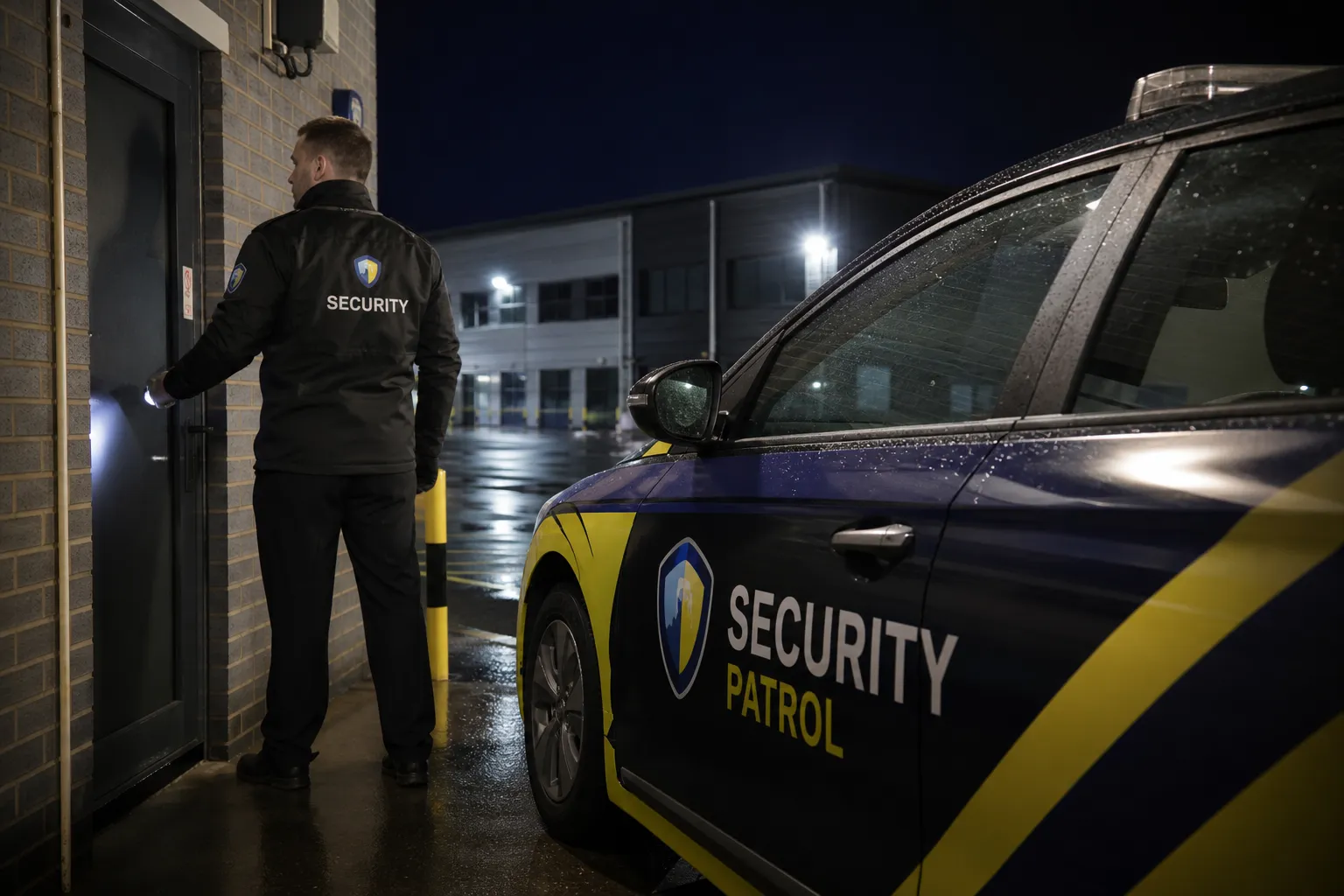
Why businesses choose mobile patrol security
Competitor articles consistently focus on deterrence, cost efficiency, flexibility, and alarm response. Those are valid points, but many gloss over the buyer’s real question: when is a mobile patrol the right operational fit, and when is it not?
The reason businesses increasingly use mobile patrol security is simple: many sites do not need a full-time guard, but they do need regular, professional oversight that can adapt to risk.
The main benefits
Visible deterrence
A marked patrol vehicle, routine officer presence, and irregular visit patterns can discourage trespassers, thieves, and vandals. Criminals are less likely to target a site when they cannot predict whether it will be checked.
Better value for lower-risk or part-time-risk sites
If risk is concentrated overnight, on weekends, during shutdowns, or at shift changes, patrols can provide coverage where it matters most without paying for 24/7 static guarding.
Wider site coverage
Patrols are useful on sites with yards, car parks, loading bays, perimeter fencing, multiple entrances, or detached buildings. They are also useful across geographically separate sites.
Faster escalation when something is wrong
If an alarm activates or a site issue is reported, a mobile officer can attend, assess the situation, and escalate appropriately. That helps avoid unnecessary risk to staff or keyholders.
Practical operational support
A good patrol is not just “someone driving by.” It can include checks that support safety and continuity, such as finding an unsecured door, signs of forced entry, lighting failure, water leaks, blocked exits, or evidence of trespass.
For businesses comparing patrols with other guarding options, it helps to understand the wider difference between mobile and fixed coverage. Our guide to static vs mobile security guards in the UK explains where each model fits best.
How mobile patrols work in practice
Although every contract should be site-specific, most mobile patrol security services follow a similar structure.
1. Site assessment
Before patrols begin, the security provider should understand:
The type of premises
The operating hours
Known crime or trespass risks
Vulnerable access points
Alarm and CCTV setup
Keyholder arrangements
Any health and safety considerations
Lone-worker or occupancy patterns
This matters because a patrol plan for a small office is very different from one for a warehouse, industrial unit, or vacant commercial property.
2. Patrol instructions are agreed
These instructions should define:
Patrol times or patrol windows
Whether checks are scheduled, random, or blended
Which areas must always be checked
Whether officers enter the building or inspect externally only
Lock and unlock responsibilities
Alarm response procedure
Reporting requirements
Escalation contacts
3. Officers attend the site
A patrol may involve:
Driving the perimeter
Parking and conducting a foot patrol
Inspecting gates, shutters, fences, doors, and windows
Confirming lights or equipment are operating normally
Checking for signs of intrusion or damage
Verifying access control points are secure
Logging findings digitally or in a patrol report
4. Findings are recorded and escalated
Professional mobile patrol security guards should document each attendance clearly. That can include arrival time, checks completed, exceptions found, photos, incident notes, and actions taken.
5. Patrol plans are adjusted as risk changes
A good security plan is not static. Patrol frequency may need to change during stock peaks, refurbishments, site closures, staffing shortages, seasonal crime trends, or incidents nearby.
Scheduled vs random patrols
This is one of the most important buying decisions, and many articles mention it without explaining the difference properly.
Scheduled patrols
These happen at agreed times or within fixed windows. They are useful when:
You want lock-up confirmation every evening
Staff start or finish at predictable times
You need routine compliance checks
A site has recurring vulnerabilities at known hours
Random patrols
These happen at varying times. They are useful when:
You want unpredictability
The main goal is deterrence
Opportunistic trespass or theft is the concern
Criminals may watch routines before acting
Blended patrol plans
For many businesses, the best answer is a combination. For example:
Scheduled lock-up at 20:00
Random patrol between 23:00 and 02:00
Scheduled unlock at 06:00
Alarm attendance as required
That approach balances reliability with unpredictability.
When mobile patrols are a better fit than a fixed guard
Not every site needs a dedicated guard at all times. In many cases, mobile patrols are the smarter option operationally and financially.
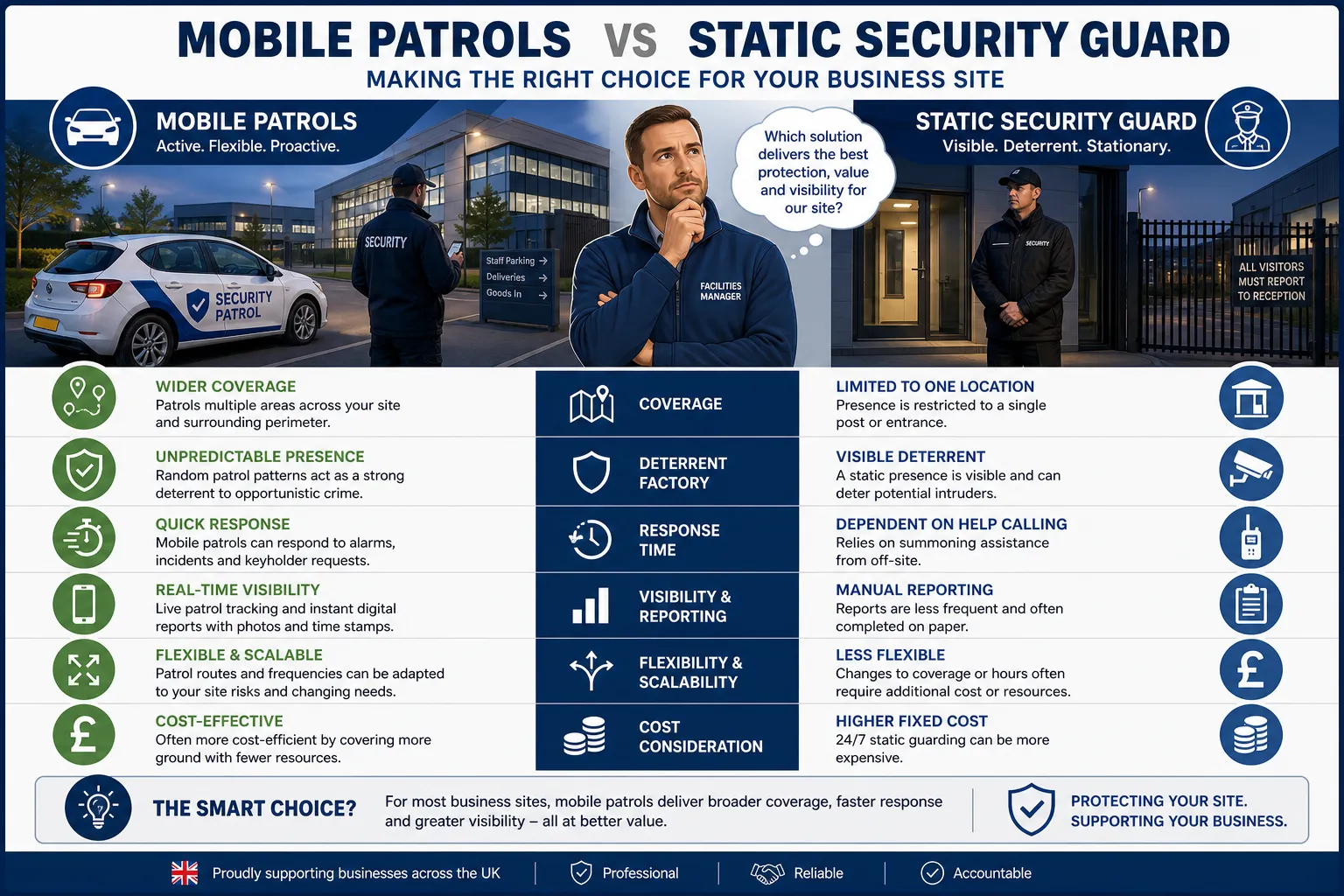
Mobile patrols tend to suit:
Offices empty overnight
Small to mid-sized commercial premises
Multi-site businesses
Retail parks and industrial estates
Yards, parking areas, and external perimeters
Vacant or intermittently occupied buildings
Businesses that need lock/unlock support
Sites where alarm response is a priority
Fixed guards tend to suit:
Busy receptions and public-facing entrances
High-value sites with continuous footfall
Premises requiring ongoing access control
Complex environments with constant contractor movement
Sites needing immediate on-the-spot intervention throughout the day
Venues and operations with continuous safety supervision needs
A simple comparison helps:
Requirement | Mobile Patrols | Fixed Guard |
|---|---|---|
Out-of-hours checks | Excellent | Good |
Constant on-site presence | Limited | Excellent |
Cost efficiency for lower-risk periods | Excellent | Lower |
Large perimeter coverage | Excellent | Good |
Reception/access management | Limited | Excellent |
Randomised deterrence | Excellent | Moderate |
Multi-site flexibility | Excellent | Limited |
Continuous incident handling | Moderate | Excellent |
Patrol frequency: how often should a business be checked?
There is no universal answer. The right frequency depends on risk, occupancy, site layout, asset value, and operating hours.
Factors that influence patrol frequency
Is the building empty overnight?
Has the site experienced recent theft or trespass?
Are there exposed yards, fuel stores, tools, stock, or vehicles?
Is the area isolated or poorly lit?
Does the business open early or close late?
Are there lone workers present?
Is the building vacant or under refurbishment?
Is there monitored CCTV or a live alarm connection?
Typical examples
Site type | Common patrol approach |
|---|---|
Small office | Lock-up check plus 1 random overnight patrol |
Warehouse | Multiple overnight patrols plus alarm response |
Retail unit | Closing check, random night patrol, morning unlock |
Vacant property | External and internal checks several times weekly or nightly |
Multi-site operator | Scheduled route with randomised supplementary visits |
The right provider should be able to explain why a certain frequency is recommended rather than offering a one-size-fits-all package.
What lock and unlock checks usually include
Lock and unlock services are often one of the most valuable parts of mobile patrol services, especially for businesses that do not want staff arriving early, leaving late, or taking responsibility for site security alone.
Lock-up checks may include:
Securing doors, shutters, and windows
Setting alarms
Checking that nobody remains on site unexpectedly
Confirming fire exits are unobstructed
Verifying lights or non-essential equipment are switched according to site procedure
Inspecting vulnerable perimeter points before departure
Unlock checks may include:
External inspection before entry
Confirming there are no signs of forced access
Disarming alarms where authorised
Opening agreed access points
Confirming the premises are safe for staff arrival
Escalating if anything appears disturbed or unsafe
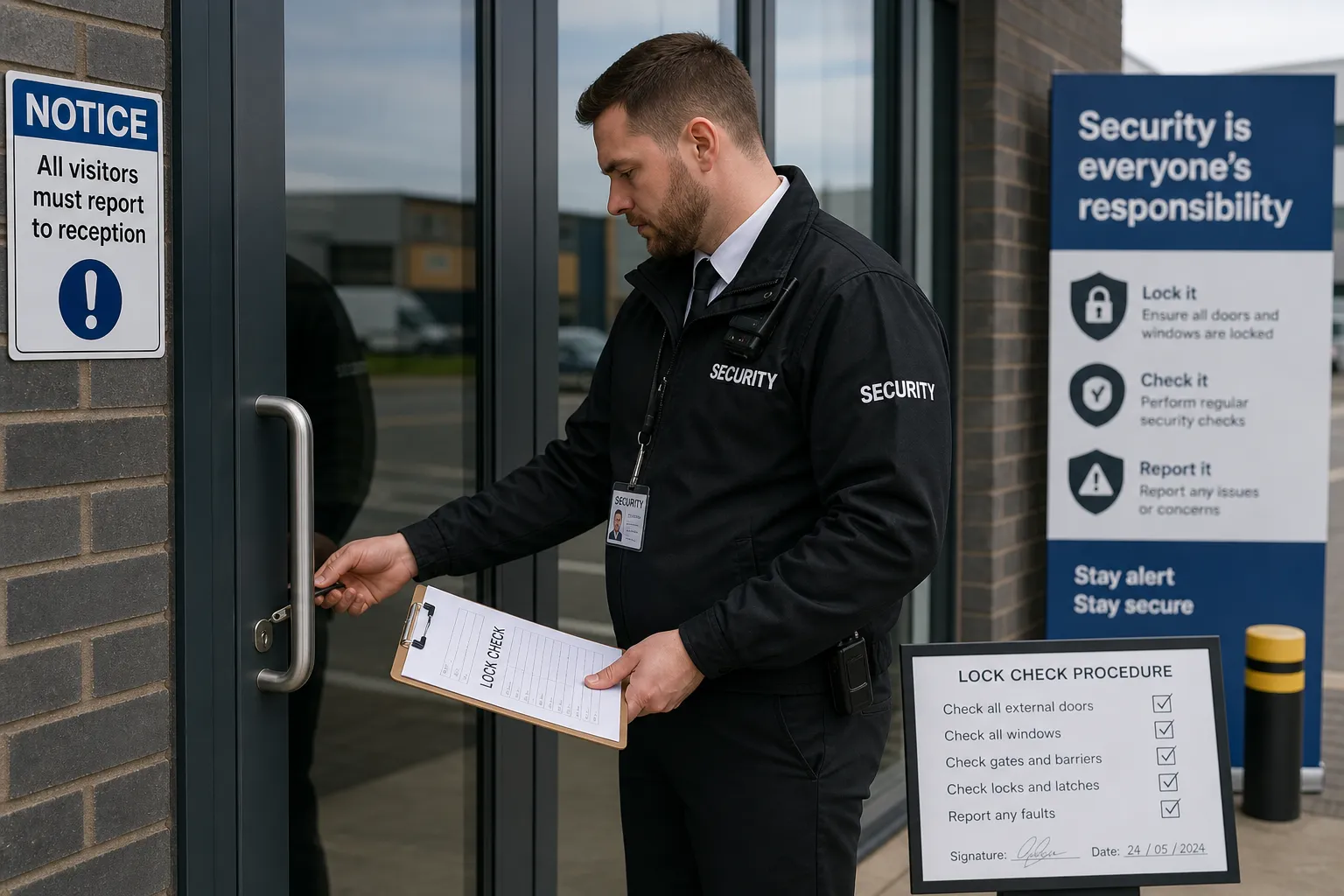
This service reduces risk for employees and adds accountability to opening and closing procedures.
Alarm response: what buyers should expect
Alarm response is often mentioned as a benefit, but buyers should look closely at how it actually works.
When an intruder or fire-related alert is triggered, the mobile response officer may attend to:
Inspect the site externally
Enter if authorised and safe to do so
Check for signs of intrusion, damage, or false alarm causes
Liaise with police, fire services, or keyholders
Secure the site if possible
Report the incident and next steps
Important buyer questions about alarm response
Who receives the alarm first?
What is the target response arrangement?
Does the provider attend with keys?
Under what conditions will police be contacted?
What happens if the site is found insecure?
Will I get a report with times and actions taken?
Are false alarms handled differently from confirmed activations?
For sites with higher exposure to out-of-hours threats, alarm attendance works best when paired with broader keyholding security services, so the response is controlled, documented, and does not rely on staff travelling to site at risk.
Lone-worker considerations
This is a content gap in most competitor articles, even though it matters to buyers. Some businesses use patrols not only to protect buildings, but also to support people working alone.
When lone-worker issues arise
Early opening or late closing staff
Warehouse teams on split shifts
Engineers or maintenance staff on quiet sites
Cleaners working out of hours
Reception or admin staff alone at opening time
Personnel at partially occupied commercial premises
How patrols can help
Mobile patrols can support lone-worker risk management by:
Attending during opening or closing periods
Providing reassurance presence during vulnerable times
Carrying out welfare checks
Responding if contact is lost or an issue is reported
Checking that routes, entrances, and car parks are safe
They are not a replacement for a full lone-worker policy, but they can form part of one. For some businesses, a short-duration patrol at the right time materially improves staff safety.
Where mobile patrols are especially effective
Mobile patrols are particularly useful where risk is intermittent, spread across a large area, or concentrated outside business hours.
Strong use cases include:
Commercial offices
For buildings empty at night but still vulnerable to break-ins, tailgating risks, or unsecured access points.
Warehouses and logistics sites
For yards, loading zones, external storage areas, and perimeter checks. These environments often benefit from a wider warehouse security strategy rather than relying on one measure alone.
Retail parks and standalone shops
For closing-time checks, deterrence, and response to alarms or suspicious activity.
Construction and refurbishment sites
For out-of-hours access control, perimeter inspections, and theft reduction where equipment or materials are exposed.
Vacant properties
For regular inspections, evidence of occupancy control, and early identification of trespass, damage, leaks, or deterioration.
Parking and external areas
For anti-social behaviour prevention, lighting checks, and visibility in areas where static presence is not always justified.
What mobile patrols do not replace
A useful guide should also explain the limits.
Mobile patrols do not automatically replace:
Full-time reception or gatehouse cover
Continuous access control at busy sites
High-footfall public interaction
Detailed internal supervision throughout the day
Specialist crowd control or event roles
Compliance processes that require permanent staff oversight
If your site needs constant human presence, patrols may be only one layer of protection. The best providers will say this openly rather than trying to fit every site into the same model.
What to ask before hiring a mobile patrol provider
This is where buyers often make better decisions. Instead of focusing only on price, ask questions that show whether the service will actually work on your site.
Questions about operations
How do you assess my site before recommending patrol frequency?
Are patrols scheduled, random, or mixed?
What exactly is checked during each attendance?
Do officers patrol on foot as well as by vehicle?
How are incidents recorded and reported?
Questions about people and compliance
Are officers properly licensed for the role?
What sector or site experience do they have?
How are lone-worker and health and safety risks managed during patrols?
What supervision and quality checks are in place?
Questions about alarm and keyholding arrangements
Do you offer keyholding and alarm response?
Who attends if an alarm activates?
What is the process if the site is insecure?
How are keys controlled, logged, and protected?
Questions about reporting and accountability
Will I receive digital patrol reports?
Are exceptions photographed and timestamped?
How quickly are incidents escalated?
Can patrol patterns be changed if risk changes?
Questions about fit
When would you recommend a static guard instead?
What type of client or site is not right for patrols?
How do you integrate patrols with CCTV, alarms, and access control?
A credible provider should welcome these questions.
Common mistakes buyers make
Choosing based on price alone
A cheaper patrol that rarely gets out of the vehicle, follows predictable routes, or provides weak reporting may create the appearance of security without much real value.
Not defining the patrol scope
If “patrol” is not clearly defined, expectations drift. One client may expect a perimeter walk and internal checks, while the provider only intended a drive-by presence.
Using fixed schedules only
Predictable timing can reduce deterrent effect. A measure of randomness usually improves outcomes.
Failing to review after incidents
If trespass, theft, or alarm activations occur, the patrol plan should be reassessed. Security should adapt to evidence.
Ignoring integration with other controls
Patrols work best alongside alarms, CCTV, lighting, access control, and sound opening/closing procedures.
A practical decision framework
If you are unsure whether mobile patrol security services are right for your business, ask:
Is the site unoccupied or lightly occupied for long periods?
Are risks mainly out of hours rather than continuous?
Would visible but intermittent attendance be enough to reduce risk?
Do you need lock/unlock or alarm response support?
Do you need coverage across more than one building or location?
Would a full-time guard be excessive for current risk levels?
If the answer to several of those is yes, patrols are likely worth considering.
How Nexus Security Serviceses Ltd approaches mobile patrol planning
At Nexus Security Serviceses Ltd, we treat patrol work as part of practical risk reduction, not just a checkbox service. The right approach depends on the environment: a warehouse with exposed loading bays, a vacant property vulnerable to trespass, a corporate site needing secure opening and closing, or a construction project facing theft and unauthorised access all require different patrol priorities.
That is why effective mobile patrol security should be tailored around:
Site-specific vulnerabilities
Occupancy patterns
Access control needs
Known crime exposure
Safety risks for people on site
Clear reporting and escalation procedures
This allows businesses to use physical security resources efficiently while maintaining dependable oversight.
Final thoughts
Mobile patrols are not simply “guards who visit sometimes.” When properly planned, they provide visible deterrence, flexible out-of-hours protection, practical lock and unlock support, structured alarm response, and an adaptable layer of security for commercial premises across the UK.
For many businesses, they are the right answer when risk is real but does not justify permanent on-site guarding. The key is to match patrol design to actual site conditions, ask the right operational questions, and work with a provider that understands how security functions in the real world.
If you want a practical assessment of whether patrols, keyholding, manned guarding, or a blended approach is the right fit for your site, Nexus Security Serviceses Ltd can help you evaluate the risk clearly and build a proportionate solution around it.
FAQ
Who is the biggest security company in the UK?
Large national and international providers operate across the UK, and market position can vary depending on whether you measure revenue, workforce, contracts, or service lines. For most buyers, the more important question is not who is biggest, but which provider offers the right operational fit, clear reporting, and reliable site-specific coverage.
What is the main purpose of patrolling?
The main purpose of patrolling is to deter crime, detect problems early, and confirm that a site is secure. A patrol helps identify unauthorised access, damage, unsafe conditions, or alarm issues before they escalate.
What are the three aims of patrolling?
The three core aims are to prevent incidents, observe and identify risks, and respond or escalate appropriately. In business settings, that often means reducing theft and vandalism, checking vulnerable areas, and ensuring rapid action if something is wrong.
What is the purpose of patrolling?
The purpose of patrolling is to provide a visible and practical layer of security across premises that do not always need constant fixed guarding. It supports site oversight, out-of-hours protection, alarm attendance, and safer opening and closing procedures.
What are the five types of patrols?
In a business security context, common patrol types include scheduled patrols, random patrols, vehicle patrols, foot patrols, and alarm response patrols. Some providers also combine these with lock and unlock visits or welfare checks depending on site needs.
What are the five rules of patrolling?
Five sensible patrol rules are to follow clear instructions, remain observant, vary routines where appropriate, record findings accurately, and escalate issues promptly. For businesses, consistency, accountability, and safe response procedures matter as much as visible presence.


0 Comments