

TL;DR
TL;DR: The strongest UK retail loss prevention plans combine store design, trained staff, CCTV, tagging, incident reporting, stock controls and clear repeat-offender procedures. Start with a risk review, fix high-loss areas first, and use professional guarding where deterrence, evidence capture or staff safety need stronger support.
Retail theft feels more organised, more visible and more disruptive than many shop teams were trained to handle. The best retail loss prevention strategies UK retailers can use in 2026 are not single fixes, they are layered controls that make theft harder, errors easier to spot and incidents safer to manage. Retail loss prevention: the practice of identifying and addressing causes of inventory shrinkage, including theft, fraud and mistakes in store operations, as summarised by Wikipedia. For retailers that need trained support alongside in-house controls, NEXUS SECURITY SERVICESES LTD can help turn a written plan into daily prevention on the shop floor.
Table of Contents
What is retail loss prevention?
Retail loss prevention is the structured process of reducing shrinkage caused by shoplifting, employee theft, supplier errors, admin mistakes, refund abuse and operational gaps. In UK retail, it should protect stock, margin, colleagues and customers without making the store feel hostile or difficult to shop.
A good plan answers three questions: where are losses happening, why are they happening and who is responsible for acting when risk appears. I prefer this practical definition because it pushes teams beyond cameras and tags into process, training and evidence.
Key insight: Loss prevention is not just security. It is a joint operating model between store management, stock control, HR, facilities, security officers and local police.
The common mistake is treating every loss as theft. Some shrink comes from mis-scans, delivery discrepancies, poor returns controls or unrecorded wastage. If those causes are not separated, managers can spend money in the wrong place.
Core loss prevention terms
| Term | Meaning for UK retailers |
|---|---|
| Shrinkage | Stock or margin lost before it becomes a legitimate sale |
| External theft | Shoplifting, organised theft or fraudulent activity by customers or third parties |
| Internal theft | Theft, discount abuse or process manipulation by staff or contractors |
| Operational loss | Loss caused by errors, wastage, miscounts, poor receiving or weak admin |
| Deterrence | Visible measures that make offenders believe detection is likely |
| Apprehension policy | Written rules on if, when and how staff or security may intervene |
For background reading on structured retail protection, Nexus also publishes practical guidance under retail loss prevention topics.
Where should UK retailers start?
UK retailers should start with a risk review that maps loss by product, location, time, staff process and offender pattern. That review should produce a short action plan, not a long report that sits in a folder.
Begin with your highest-loss categories and your highest-risk moments. In many stores, that means opening, closing, self-checkout, refunds, fitting rooms, stock deliveries, quiet aisles and busy seasonal periods. The aim is to see the store the way an offender sees it.
I would start with a 30-day baseline. Pull stock adjustments, voids, refunds, CCTV incidents, staff reports and delivery discrepancies into one view. If the data is messy, that is useful information in itself.
The first 30 days checklist
- List the top 20 lost products by value and unit count.
- Walk the shop floor at opening, peak trade and closing to spot blind spots.
- Check till exceptions such as refunds, voids, no-sales and manual discounts.
- Review CCTV coverage at entrances, exits, tills, stockrooms and high-risk aisles.
- Compare deliveries against purchase orders before stock reaches the sales floor.
- Interview staff privately about repeated risks, intimidation and unclear procedures.
- Create one incident log that every manager uses the same way.
- Set three priority fixes for the next month, with owners and dates.
For wider planning methods, the security strategies resource hub is useful when loss prevention needs to sit inside a wider premises security plan.
Which controls reduce shrinkage fastest?
The fastest controls are the ones that change offender behaviour and staff behaviour at the same time. In practice, that means better sightlines, clear staff presence, effective CCTV, secure displays, tagging on high-risk products and consistent reporting.
No single control works everywhere. A small convenience store needs different controls from a fashion retailer, supermarket or multi-site chain. The table below gives a practical starting point.
Control priorities by retail format
| Retail format | Highest-risk areas | Best first controls | When to add guarding |
|---|---|---|---|
| Small shop | Entrance, alcohol, tobacco, tills, blind aisles | Mirrors, clear counter view, staff greeting, locked cabinets, incident log | Repeated intimidation, lone working, evening trade |
| Supermarket | Self-checkout, spirits, meat, cosmetics, exits | CCTV, EAS tags, receipt checks where lawful, shelf layout, exception reporting | Peak theft times, organised groups, staff safety concerns |
| Fashion store | Fitting rooms, premium rails, returns desk, exits | Garment tags, fitting-room controls, floor hosts, refund rules | Repeat offenders, high-value stock, busy sales periods |
| Multi-site retailer | Inconsistent process, staff turnover, weak data | Standard reporting, regional audits, shared offender alerts, KPI reviews | Hotspot branches, launches, high-risk locations |
A retailer that wants a joined-up service can use retail security services to combine deterrence, customer-facing presence and incident support. The best results come when guards are briefed on store-specific loss patterns, not just placed at the door.
How should store layout deter theft?
Store layout should deter theft by improving visibility, slowing easy exit routes and placing high-risk goods where staff can naturally observe them. The goal is not to trap customers, it is to remove easy opportunities.
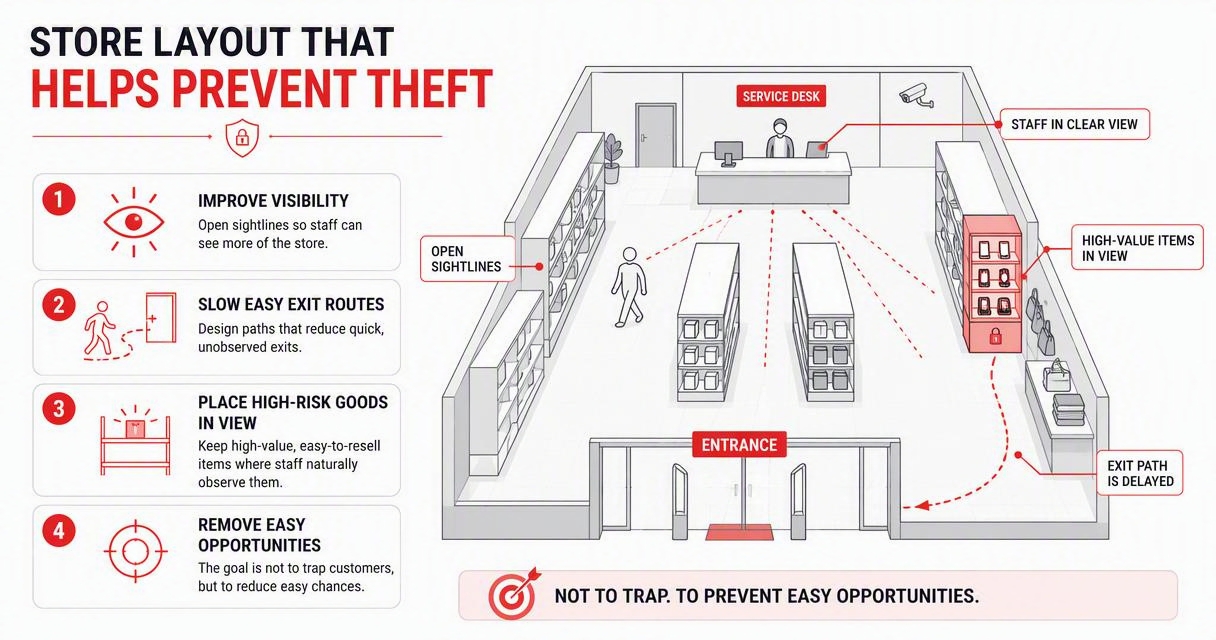
High-value, small and easy-to-resell items should not sit in deep blind spots. Place them near service points, main aisles or staffed zones. Keep promotional displays tidy because messy stock makes concealment easier and stock counts less reliable.
Lighting also matters. Dark corners, high shelving and cluttered seasonal displays create concealment. I like simple changes first: lower fixture heights, clean sightlines from the till and remove unnecessary posters from windows.
Practical rule: If a colleague cannot see a high-risk bay during normal customer service, that bay is probably in the wrong place.
Entrance design should support greeting and observation. A genuine welcome from staff can deter opportunistic theft because it signals attention. For stores with repeated risks, a professional site survey from NEXUS SECURITY SERVICESES LTD can identify layout changes before retailers spend on extra equipment.
How do staff prevent shoplifting safely?
Staff prevent shoplifting safely by using awareness, service-led deterrence, clear escalation rules and accurate reporting. They should not be expected to act like police officers, chase suspects or take unnecessary personal risks.
Training should be short, repeated and practical. New starters need to know what suspicious behaviour can look like, but they also need to avoid profiling. Behaviour matters more than appearance.
Useful signs include repeated scanning of staff positions, large empty bags, unusual interest in cameras, working in pairs to distract staff, frequent fitting-room visits or selecting high-value items without normal browsing. These are prompts for service and observation, not proof.
A safe staff response sequence
- Observe behaviour, not personal characteristics.
- Offer customer service with a calm greeting or product help.
- Move into a visible position without blocking exits.
- Alert a manager or security officer using the agreed code.
- Record details immediately after the incident.
- Preserve CCTV and receipts if a report may be needed.
- Debrief colleagues so patterns are shared quickly.
Training should also cover aggression. If a person becomes threatening, staff safety comes first. For retailers reviewing roles and responsibilities, this guide to retail security guard services in the United Kingdom explains where professional officers can support store teams.
What role do CCTV, EAS and tagging play?
CCTV, electronic article surveillance and tagging support loss prevention by deterring theft, creating evidence and helping managers investigate patterns. They work best when they are maintained, visible and linked to a response process.
CCTV should cover entrances, exits, tills, self-checkout areas, stockroom access, delivery points and high-value bays. Poor camera angles waste money. A camera pointed at the top of someone's head rarely helps after an incident.
EAS gates and product tags are useful for high-risk categories, but they need discipline. If tags are not applied consistently, offenders learn which items are unprotected. If alarms are ignored, the system becomes background noise.
Video analytics and AI-assisted alerts are becoming more common in 2026, especially around self-checkout and suspicious dwell patterns. I would still treat them as decision-support tools, not replacements for trained staff. Human review remains important for fairness, accuracy and context.
Useful industry video
This video is useful because it shows loss prevention as an operations role, not just a security role. That distinction matters for UK retailers that need better reporting, cross-team communication and consistent branch standards.
How should retailers report incidents?
Retailers should report incidents in a consistent format that captures what happened, when it happened, who was involved, what evidence exists and what action followed. Good reporting turns isolated events into patterns that managers can act on.
A strong incident log should separate suspected theft, confirmed theft, refund abuse, aggression, trespass, criminal damage, stockroom loss and delivery discrepancy. Lumping everything into "theft" makes analysis weak.
Reports should be completed as soon as possible while details are fresh. Include CCTV camera numbers, till receipt IDs, product SKUs, descriptions, vehicle details where lawful and names of witnesses. Avoid emotional language. Stick to observable facts.
Evidence principle: If the report cannot be understood by someone who was not there, it is not detailed enough.
For multi-site retailers, consistent reporting is the difference between spotting organised activity and missing it. Shared templates help regional managers compare branches fairly and support police engagement when repeat incidents build a clear pattern.
How should repeat offenders be managed?
Repeat offenders should be managed through lawful identification, evidence retention, staff briefings, exclusion procedures and police or local partnership reporting where appropriate. The process must be controlled, factual and privacy-aware.
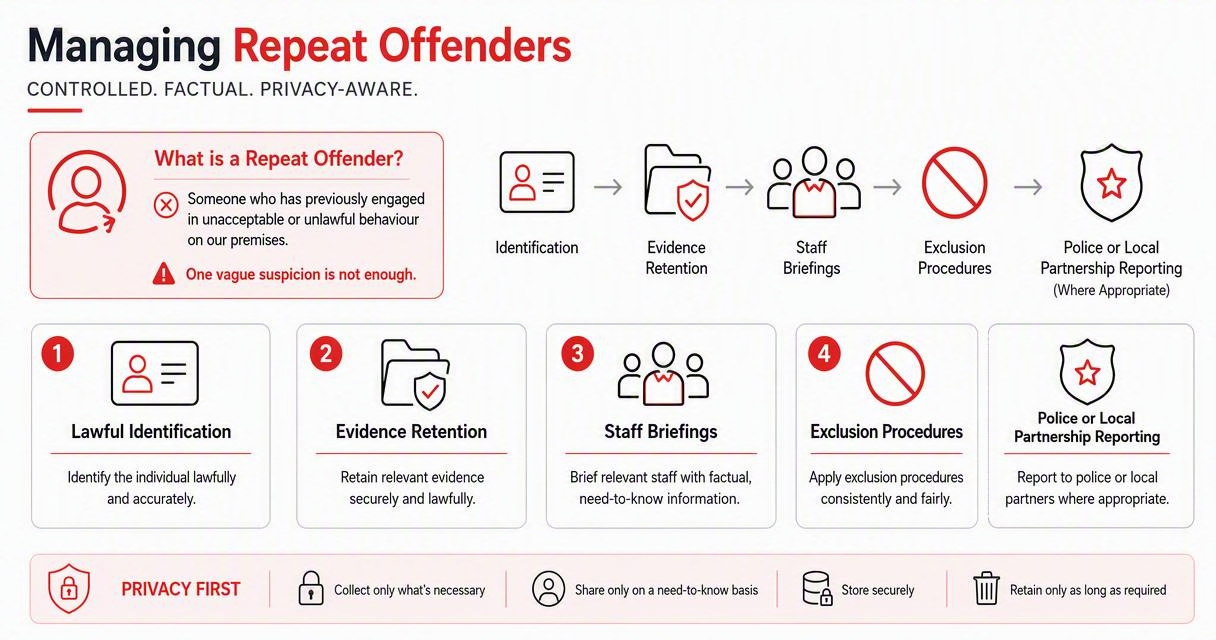
Start by defining what counts as a repeat offender. One vague suspicion is not enough. A useful threshold might be multiple recorded incidents, CCTV-supported evidence or confirmed links across nearby stores. Keep records secure and limit access to staff who need them.
Store teams should know the difference between observation, refusal of service, exclusion and intervention. Any exclusion notice should be handled by authorised managers or security personnel, and staff should never be left to improvise during a confrontation.
Local retail crime partnerships can help where they operate, especially for town centres and shopping districts. Still, each retailer remains responsible for lawful data handling and proportionate action.
NEXUS SECURITY SERVICESES LTD can support repeat-offender procedures by aligning officer briefings, evidence packs and escalation routes with the retailer's policy. For more risk planning guidance, see the security strategy and risk management section.
What should each retailer type prioritise?
Small shops, supermarkets and multi-site retailers should prioritise different controls because their risks, budgets and staffing models differ. The mistake is copying a large-chain approach into a small store, or leaving a growing chain with branch-by-branch habits.
A small shop often needs visibility, lone-worker safety and simple stock discipline. A supermarket usually needs self-checkout controls, category protection and data-led exception reporting. A multi-site retailer needs consistency, dashboards and regional accountability.
Format-specific checklist
- Small shops: keep tills visible, protect high-value goods, reduce blind spots, greet every entrant, record incidents in one book or system, review lone-working risk.
- Supermarkets: monitor self-checkout, protect spirits and cosmetics, check refund patterns, use clear floor-walking routines, review CCTV daily for hotspots.
- Fashion retailers: control fitting-room item counts, tag premium garments, watch refund abuse, position staff near exits during busy periods.
- Multi-site retailers: standardise incident categories, compare shrink by branch, share offender alerts lawfully, audit tagging compliance, train managers the same way.
- Licensed or late-trading stores: plan closing procedures, staff escape routes, panic alarms, conflict training and door support where risk justifies it.
I recommend reviewing this checklist monthly, not annually. Retail patterns change quickly around school holidays, local events, paydays and seasonal promotions.
What should retailers expect in 2027?
Retailers should expect loss prevention in 2027 to become more data-led, more integrated with operations and more focused on staff safety. The future is not just more cameras, it is better use of the information retailers already collect.
Three shifts are already visible. First, self-checkout controls will keep improving because scan avoidance and barcode switching are process problems as much as security problems. Second, retailers will connect CCTV, till exceptions and stock data more often. Third, guarding will become more targeted, with officers deployed by risk pattern rather than habit.
AI tools will help flag unusual behaviour or transaction patterns, but they need governance. Retailers should document who reviews alerts, how false positives are handled and how personal data is protected. Poorly governed systems can damage trust with customers and staff.
The practical advantage will go to retailers that combine people, process and technology. If a store has weak reporting, even advanced systems will produce noise. If staff are trained and data is clean, modern tools can be genuinely useful.
Retail loss prevention strategies UK checklist
A strong UK loss prevention checklist should be simple enough for store managers to use weekly and structured enough for senior teams to compare across sites. Use the list below as a working template, then adapt it to your format and risk level.
- Risk review: identify top loss categories, times, locations and methods.
- Layout: remove blind spots and place high-risk stock in visible areas.
- People: train staff on service-led deterrence, escalation and reporting.
- CCTV: confirm coverage, image quality, retention and retrieval process.
- Tagging: apply EAS or hard tags consistently to high-risk products.
- Stock control: check deliveries, wastage, transfers and stock adjustments.
- Till controls: review voids, refunds, discounts and no-sale activity.
- Incident reporting: use one template across managers and branches.
- Repeat offenders: keep lawful evidence packs and agreed escalation routes.
- Professional support: deploy security officers where risk, value or safety justify it.
If you want help applying this checklist to a live store, visit nexussecurityserviceses.com and review the services that match your site type, risk profile and opening hours.
FAQ
What is the best loss prevention strategy for a small UK shop?
The best strategy for a small UK shop is a simple layered plan: clear sightlines, staff greeting, protected high-value stock, working CCTV, a consistent incident log and safe escalation rules. Small shops should focus on practical controls that staff can follow every shift, rather than expensive systems that no one maintains.
Should retail staff stop suspected shoplifters?
Retail staff should follow the employer's policy and prioritise safety. In most cases, they should observe, offer customer service, alert a manager or security officer and record evidence. Chasing, physical intervention or blocking exits can create serious safety and legal risks if staff are not trained and authorised.
Does CCTV prevent retail theft by itself?
CCTV helps deter theft and provides evidence, but it does not prevent loss by itself. It works best with visible staff presence, good layout, tagging, reporting and a clear response process. Cameras should be checked regularly for image quality, coverage and retrieval so footage is useful when needed.
How often should a retailer review shrinkage?
Retailers should review shrinkage indicators monthly and investigate serious spikes immediately. Fast reviews help managers catch repeat patterns in products, shifts, refunds, deliveries or locations. Multi-site retailers should compare branches using the same categories so regional teams can spot unusual trends and support stores fairly.
When should a retailer use professional security officers?
A retailer should use professional officers when theft is repeated, staff feel unsafe, high-value products are exposed, incidents involve aggression or busy periods need visible deterrence. Guarding works best when officers receive store-specific briefings, know the escalation policy and feed incident intelligence back to managers.
Conclusion
Effective retail loss prevention strategies UK teams can rely on in 2026 are practical, measured and repeatable. Start with your loss data, fix layout and process gaps, train staff, tighten CCTV and tagging, then add professional support where risk justifies it. If you want a store-specific review rather than a generic checklist, speak with NEXUS SECURITY SERVICESES LTD and head to nexussecurityserviceses.com to plan the next step.
Generated by EarlySEO.com


0 Comments