

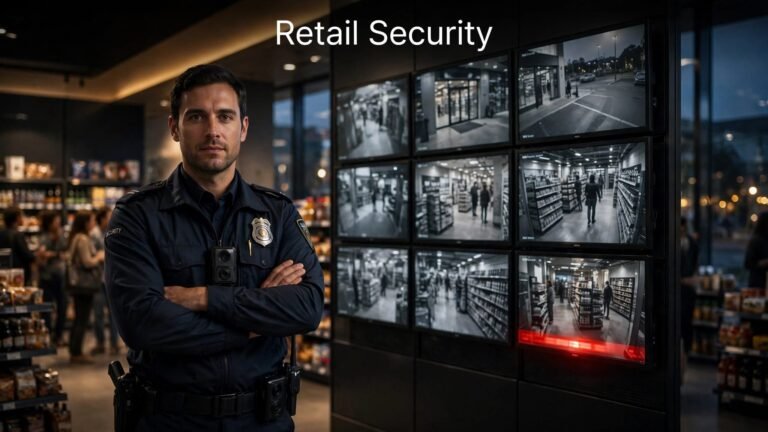
A stolen item is frustrating. A violent incident, a frightened colleague, or a customer wrongly accused of theft is a far more serious failure.
Good retail security services use proportionate security measures to protect stock and people, while also protecting evidence, trading standards and the calm retail environment customers expect when they enter your store. The aim is not to turn a shop into a guarded compound. It is to make criminal behaviour harder, staff safer and incidents easier to deal with properly.
That starts with an honest risk assessment of your own premises.
Key Takeaways
- Base retail security services on a documented risk assessment, using incident data to identify vulnerable areas, times, products and processes.
- Combine trained, properly licensed security officers with effective CCTV, access control, reporting procedures and everyday store controls.
- Put safety, proportionate intervention and evidence preservation ahead of stock recovery, and never rely on assumptions about how a person looks or behaves.
- Choose a security provider with clear role boundaries, measurable standards, proper supervision and regular monthly reviews against actual store risks.
Put security decisions behind evidence
Retail crime is not one problem with one answer. A city-centre convenience store, a shopping centre, a large supermarket, a jewellery boutique and a retail park unit will all face different patterns of loss.
The scale is difficult to ignore. The BRC Crime Report 2026 reports 1,600 incidents of violence and abuse against shopworkers each day. It also identifies delivery theft as a growing issue, with losses exceeding £100 million. Check the report’s publication date, title and figures before presenting it as current evidence.
Security decisions shouldn’t be based on a vague feeling that “theft seems worse lately”. Record what is happening, where it happens and when.
Start with a four-week picture
Review at least four weeks of incidents before changing rotas, buying equipment or appointing a provider. Use the findings to complete a risk assessment covering asset protection, staff safety and business continuity.
Record thefts, attempted thefts, abuse, refund fraud, delivery discrepancies, damage, trespass and repeat offenders. Group theft, wastage and process losses within the retail shrinkage picture.
Map each incident by time, zone, product, staffing level and delivery activity. Ask practical questions:
- Are losses linked to a certain aisle, zone, product range, entrance or till point?
- Does risk rise at opening, school finishing time, late trading or deliveries, particularly when staffing is low?
- Are lone workers left exposed when colleagues are dealing with stock or queues?
- Does the evidence suggest opportunistic theft, organized retail crime, poor stock control, or a mixture?
A clear pattern often reveals an ordinary weakness. A blind spot near a high-value display, an unlocked stockroom door or a rushed delivery handover can create more loss than a lack of guards.
Security measures should respond to recorded behaviour, not assumptions about how a person looks, dresses or speaks.
How retail security services should work in practice
An effective service combines visible deterrence with calm, routine operational support. A guard standing by the door without a briefing, radio contact or reporting process is decorative. They may look reassuring, but they can’t deal with the actual risks on site.
Retail security officers should receive assignment instructions covering the store layout, high-risk goods, emergency exits and staff welfare arrangements. They also need radio contact and clear authority limits. The escalation procedure and clear handover with managers should confirm who can make decisions during an incident.
Manned guarding and customer-facing presence
Uniformed security guards can discourage theft and anti-social behaviour across a busy retail environment. They are especially useful at entrances, self-service areas and high-value displays. In a shopping centre, their visible presence gives staff a clear person to call when a situation starts to deteriorate.
That presence is a limited but useful deterrent against crime, not a replacement for wider security measures. Good positioning should support customer service rather than disrupt the customer journey. In luxury retail, premium service may require a quieter approach than ordinary floor presence.
Friendly greetings, active observation and sensible positioning work better than following customers around the shop. Officers shouldn’t block exits, make accusations without evidence or create a confrontation over low-value stock.
Loss prevention is broader than apprehensions
Dedicated work in this area examines how goods leave the business without payment or proper recording. That includes shoplifting, fraudulent returns, internal theft, wastage, delivery shortfalls and process failures.
A specialist in this area may spend more time reviewing stock variances, checking refund patterns, auditing receiving procedures and preserving CCTV clips. A floor officer is more likely to manage the live environment. Larger stores often need both functions, with clear boundaries between them, and apprehensions shouldn’t be the main measure.
Choose properly licensed and trained people
Ask the provider to identify the licence required for each role performed by retail security officers. It should explain role boundaries for security personnel and how cover is arranged if somebody is absent. “Our staff are trained” is not enough; ask what training they have completed, when it was refreshed and how performance is checked.
The Security Industry Authority regulates front-line security work, and the Government’s guidance on whether an SIA licence is required explains when an SIA licence is required. Verify that relevant front-line staff are SIA licensed. This is a baseline, not a substitute for site-specific training, supervision, insurance or data protection compliance.
Check the role, not only the badge
The guidance explains that a security guard licence covers security guards protecting premises or property. This includes preventing theft, damage, unauthorised access or disorderly behaviour.
Contracted officers will usually need the appropriate SIA licence for their duties. CCTV operation can require a Public Space Surveillance licence when work involves watching the public or identifying individuals.
In-house arrangements can differ. A manager should not assume that direct employment removes every licensing or data protection requirement. Check proposed duties against current SIA guidance and seek professional advice where the role is unusual or mixed.
Training should match the retail setting
Conflict management matters in every store. Conflict resolution skills are particularly important where staff face alcohol-related disorder, refusal of service, queue disputes or repeat theft.
Check refresher dates, first aid training, radio use, incident report writing and escalation procedures. Training should also cover staff welfare, health and safety and emergency procedures.
A capable officer should be trained to:
- communicate without escalating the situation;
- use access control procedures around restricted stockrooms and staff-only areas;
- use the radio correctly and call for support early rather than trying to manage a crowd alone;
- protect colleagues, customers and emergency exits;
- understand when physical intervention is prohibited and when specialist support is required;
- write a factual report that can be used by police, insurers or senior management.
Luxury retail also needs discretion. An officer in a premium store may be dealing with high-value items, personal shoppers, private appointments and customers who expect attentive service. The standards are not softer. They are more exacting.
Set firm limits on intervention
Security guards aren’t police officers. They have no general power to search people, demand personal details, confiscate property or detain somebody because they seem suspicious.
Store policy should require security measures to prioritise safety over stock recovery. No item is worth an injury, a wrongful detention claim or a member of staff carrying fear home after a shift.
Observation comes before accusation
Train staff to focus on conduct and evidence so shoplifting prevention remains proportionate. They can note a person concealing goods, bypassing a till, removing tags or working with another individual. They should not act on ethnicity, disability, age, clothing, postcode, language or a general feeling that someone “does not belong”.
If theft is suspected, the officer or manager should assess the risk. Where safe, they may observe, retain relevant CCTV and contact police. If there is violence, a weapon or a credible threat, staff should withdraw, preserve evidence and contact police. They shouldn’t pursue anyone who becomes abusive or leaves quickly.
Detention and reasonable force need legal care
In England and Wales, a security guard may share the public’s limited citizen’s arrest powers. Strict conditions apply. The Sentencing Council’s shoplifting guidance addresses sentencing, not the full scope of private-security powers. Only reasonable force may be used when detaining someone.
Citizen’s arrest, detention and reasonable force are legally sensitive, not routine shoplifting tactics. Any physical intervention brings legal and safety risk. Your policy should state who may intervene, when police must be called and when intervention is prohibited. It should explain how medical help is requested.
Staff may use access control to secure restricted areas and preserve routes and exits. They can’t use it as a pretext for unlawful searches. These points are operational guidance, not legal advice. Have a solicitor review the policy, particularly if you operate across England, Wales, Scotland and Northern Ireland.
Use CCTV as an evidence system, not wallpaper
CCTV surveillance should function as an evidence system, supporting clear decisions rather than simply recording activity. Retail security systems work best when camera positions reflect real routes, behaviour and decisions. Well-planned surveillance systems should cover entrances, tills, high-risk displays, service corridors, goods-in areas and external loading points where appropriate.
Where practical, integrate retail security systems with tills, door alarms or other store alerts.
Poorly positioned cameras only create false confidence. A clear view of a person’s face is not much use if it cannot show the item, the relevant transaction or the route taken through the store. Cameras are only one part of wider security measures, alongside staffing, access restrictions and store procedures.
Get the data protection basics right
Retail CCTV processes personal data. Document a lawful basis, display clear signage and set a retention period that reflects the system’s purpose. Restrict footage access through role-based permissions and access control, keep audit trails, and provide a process for subject-access requests.
The Information Commissioner’s Office provides a CCTV checklist for small premises, which is useful for independent retailers reviewing a limited system. Check that the linked CCTV guidance remains current before relying on it.
Keep a simple footage disclosure log. Record who requested footage, why it was released, who approved it and how it was transferred. Use secure transfer methods, and don’t casually share clips in staff WhatsApp groups or on social media.
Use analytics and body-worn video carefully
Modern surveillance systems can flag unusual movement, queue build-up, line crossing or activity in restricted areas. These alerts can help an operator focus attention, but they don’t prove theft, intent or identity.
Analytics, facial recognition and body-worn video require human review and a documented assessment, with specialist legal or data-protection advice where appropriate. An alert must never be treated as proof of theft or identity.
Body-worn video can support evidence and discourage abuse, but it also records personal data at close range. The ICO’s body-worn video guidance sets out the data protection issues that need attention, so check that the linked guidance remains current. Officers should know when recording starts, how customers are informed and how footage is stored.
Make incident reporting part of the shift
A security plan fails when important information stays in someone’s memory, on a crumpled note or in an informal message. Reporting must be quick enough for a busy shop floor, but detailed enough to help later.
Use one agreed incident form across the store or estate. Everyone involved, including retail security officers, should complete or contribute to it. The manager should review reports daily and share relevant information at shift handovers.
Record facts that can be checked
Use this manager’s checklist for each report:
- Date, time, location, witnesses and staff involved
- Behaviour observed, action taken and footage reference
- Police incident number, injury, damage and evidence preservation
Reference CCTV or footage from the store’s surveillance systems clearly. Save relevant clips, photographs and till records in line with your data policy. If police are called, preserve evidence before displays are reset or cleaned.
Descriptions should be factual. “Placed two bottles in a bag and passed the final point of payment” is useful. “Looked dodgy” is not.
Reports can also show where procedures, staffing or layout are weakening security measures. Review recurring issues and update the operating plan when needed.
Escalate the right issues
For an emergency response, call 999 where there is immediate danger to life, serious violence, a weapon, fire or an urgent medical need. Staff should never pursue violent suspects. Emergency services take priority over stock recovery.
Use 101 or the relevant online reporting route for non-emergency crime, where appropriate. Check current police guidance first, as online reporting isn’t suitable for every incident.
Report patterns as well as single incidents. Repeat vehicle registrations, similar refund fraud, delivery discrepancies and organised retail crime may look minor in isolation. Joined-up records give police and area managers a clearer picture.
Match the security model to your store
Retail stores should not all buy the same package by default. A national chain, independent retailer or shopping centre unit has different exposure and operating needs.
The right answer depends on loss exposure, trading hours, staff numbers, layout, local crime patterns, organized retail crime and the cost of disruption. Officer coverage should reflect risk and trading hours, so the number of retail security officers may vary between sites and shifts.
The British Retail Consortium’s operations data places the annual cost of retail crime, including theft and prevention measures, at more than £1.5 billion. Spending should still be measured against your own losses and risks.
| Store type | Practical priority | Suitable starting point |
|---|---|---|
| Independent convenience store | Staff safety, visible deterrence, tills and alcohol sales | Peak-time officer cover, panic alarm, good till sightlines and incident log |
| Fashion or department store | Fitting rooms, returns, high-value items and multiple exits | Targeted loss prevention reviews, CCTV coverage and trained floor-based security |
| Luxury retail | High-value stock, appointments, discreet service and targeted theft | Experienced officers, access control for stock and careful evidence handling |
| Large supermarket or retail park unit | Volume theft, self-service tills, delivery activity, wide floor space and organized retail crime | Manned guarding, retail security systems, surveillance systems, strong goods-in controls, access control and clear radio procedures |
Treat the table as a starting point, not a fixed package. A documented risk assessment should determine hours, coverage, technology and escalation arrangements. Security solutions may combine people, systems and process controls. This matters where organized retail crime involves coordinated theft across people or locations.
The sensible calculation is not “what do security guards cost?”. It is “what does the complete risk cost us, and which security measures reduce it without creating a worse problem?”
Include contract fees, management time, staff absence after incidents, stock loss, equipment, false alarms and reputational harm. Safety outcomes should not be treated as a line item that has to pay for itself.
Buy a service you can actually manage
A contract for retail security services needs more than a price, a uniform and a promise of cover. It should define what officers will do, what they won’t do, how incidents are reported and who takes responsibility when standards slip.
Ask providers for sample assignment instructions, training records and supervision plans for retail security officers. These should cover access control, how the security provider supervises and replaces staff, and subcontractor arrangements. Ask how equipment, reporting and officer activity work together across retail security systems. Request insurance, licence verification, DBS checks or vetting arrangements where relevant, and references from comparable sites. Include luxury retail environments and stores facing organized retail crime, then verify each licence directly.
Set measurable standards from day one
Agree useful measures for security guards: attendance at the agreed time, briefing quality, complete reports and response times. Also measure evidence handling, welfare concerns, escalation, police reference numbers, safe stock recovery, repeat incidents and staff feedback.
Avoid rewarding officers only for detentions or recovered goods. That can create the wrong pressure and encourage unsafe decisions. Good security is often uneventful because a problem was spotted early, dealt with calmly or prevented by better store routines.
Review the arrangement every month
Meet the security provider, store manager and relevant area manager each month to review incidents, officer conduct and surveillance systems. Check camera faults, footage access, access control for keys, restricted areas and system permissions. Discuss staff feedback, safety outcomes, loss figures and changes to trading hours or layout.
Ask one direct question: “What has changed because these security measures are in place?” If the answer is vague, look at the evidence and change instructions, coverage times or supervision. Where improvement remains unclear, decide whether to retain or replace the security provider.
Build security into ordinary store management
Across retail stores, the strongest security measures are often unglamorous. Locked cages, disciplined access control for keys and staff-only doors, properly counted deliveries, good lighting, tidy sightlines and staff who know whom to call all reduce opportunity. These basics also make unusual activity easier to spot, especially where organized retail crime targets predictable routines.
Security also belongs in new-store planning, refits and promotional events. During a refit, plan retail security systems such as cameras and alarms alongside the layout. A busy shopping centre may need extra thought around shared entrances and customer flow, while an appointment-led luxury retail display may require discreet protection. A temporary high-value display near an exit can create a problem before the first customer arrives.
Before an event, review the display location, exit routes, staffing, delivery timing, temporary access permissions, radio coverage and customer flow. Check access control around stock cages, delivery areas and temporary displays. Managers should brief security officers on these changes, as well as new products, late openings, expected crowds and staff shortages.
Officers should report weak points factually, without waiting for a serious incident, but shouldn’t redesign controls or take unsafe action. A store that treats security as somebody else’s job will always have gaps. A store where staff, managers and security personnel share clear routines has fewer surprises.
Frequently Asked Questions
What do retail security services include?
Retail security services can include manned guarding, loss prevention, CCTV monitoring, access control, incident reporting and support with delivery or stock controls. The right combination depends on the store’s layout, trading hours, loss exposure and local crime patterns.
Do retail security officers need an SIA licence?
Front-line security work will usually require the appropriate SIA licence, depending on the duties performed. Managers should check each role against current SIA guidance and confirm that relevant officers are licensed, trained and properly supervised.
Can a security guard search or detain a customer?
Security guards do not have a general power to search people, demand personal details or detain someone merely because they seem suspicious. Detention and reasonable force involve legally sensitive conditions, so store policies should set clear limits and be reviewed by a solicitor where appropriate.
How should retailers use CCTV?
CCTV should be planned as an evidence system, with useful coverage of entrances, tills, high-risk displays, goods-in areas and relevant routes. Retailers must also address lawful processing, signage, retention, access permissions, disclosure records and secure footage transfer.
How should a store measure security performance?
Useful measures include attendance, briefing quality, incident-report completeness, response times, evidence handling, staff welfare and repeat incidents. Avoid rewarding officers only for detentions or recovered goods, as this can encourage unsafe decisions and overlook prevention.
A safer store is a better-run store
The purpose of retail security services is not to catch every offender. They should reduce opportunity for retail crime, protect people and leave a reliable record when something goes wrong.
Start with your real risks, appoint properly trained people and make safe, proportionate action the rule; security guards are only one part of a safer operating model. Visible security measures work best when backed by sensible procedures and reliable evidence rather than confrontation.
Customers should notice a well-run shop. They should not have to feel the tension behind it.


0 Comments