


Choosing the wrong security model does not just cost money. It leaves identifiable gaps that experienced opportunists exploit within days. Whether you are managing a construction site under CDM 2015 requirements, running a multi-unit retail operation, or overseeing a corporate facility with controlled access points, the decision between static security guards UK services and mobile patrol coverage determines your baseline risk exposure. Both models use SIA-licensed officers and both deter crime, but they operate on fundamentally different mechanisms. Understanding those mechanisms, rather than defaulting to the cheapest quote, is what separates an adequate security plan from a robust one.
Table of Contents
- Quick Takeaways
- How Each Model Works
- Static Security Guards: Where They Outperform
- Mobile Security Patrols: Where They Outperform
- Head-to-Head Comparison
- Sector-Specific Guidance for UK Businesses
- Layered Security: Combining Both Models
- SIA Compliance and Accreditation: What to Check
- Frequently Asked Questions
- References
Quick Takeaways
Key Insight | Explanation |
|---|---|
Static guards suit fixed, high-risk access points | Constant presence enables immediate incident response and tight access control, which is critical for construction gatehouses, corporate receptions, and retail entrances with high footfall. |
Mobile patrols deliver unpredictability at lower cost | Randomised patrol routes make it significantly harder for criminals to identify patterns. This is more effective than a predictable single-guard schedule at a low-risk site. |
Cost differential is substantial | Static guarding typically runs from £16 to £25+ per hour per officer. Mobile patrol visits are priced per visit, often in the range of £35 per attendance, making them substantially cheaper for sites that do not require continuous cover. |
SIA licensing applies to both, but the licence category differs | Static guards require a Security Guard licence under the Private Security Industry Act 2001. Keyholding and alarm response functions held by mobile patrol officers also carry their own SIA licensable activity requirements. |
Construction sites often need both models | A static guard manages the gatehouse and access control during the working day, while mobile patrols cover out-of-hours perimeter checks when a full-time overnight presence is disproportionate to risk. |
Incident records from static guards carry legal and insurance weight | Static officers are trained to keep detailed logs of every incident, which can be critical for insurance claims, disciplinary procedures, or legal proceedings. |
Combining both models creates a layered posture | Running static guards during operational hours with mobile patrols overnight provides continuous deterrence without the full cost of 24/7 static staffing. |
How Each Model Works
Static security guarding places a dedicated, SIA-licensed officer at a fixed position for the duration of their shift. That position may be a reception desk, a construction site gatehouse, a retail floor entry point, or a corporate lobby. The officer does not move between properties. Their entire attention is focused on one site, one set of access points, and one set of operational protocols.
Mobile patrol security works on an entirely different operational logic. Trained officers travel between one or more locations in marked or identifiable vehicles, conducting scheduled or randomised inspections. A single mobile patrol officer can cover multiple client sites within a shift, checking doors, windows, perimeters, and alarm points, then filing a site status report after each visit. This distributed coverage model is what makes mobile patrols cost-efficient relative to static deployment.
The critical distinction for decision-makers is response time versus coverage breadth. A static guard can respond to an incident at their site in seconds. A mobile patrol officer, by design, is elsewhere when an incident occurs and must travel to attend. That response gap is the central trade-off this comparison must honestly address.


Static Security Guards: Where They Outperform
Immediate On-Site Response
Static guards eliminate travel time from the incident response equation entirely. When an unauthorised person attempts access, a fire alarm activates, or a confrontation develops on the retail floor, the officer is already there. This immediacy is not replicated by any remote technology or patrol service, and for high-footfall or high-risk environments, it is the primary operational requirement.
Beyond deterrence, the physical, permanent presence of a uniformed officer carries significant psychological weight. Staff feel safer. Visitors behave differently. Potential offenders make a different calculation when they see a trained officer stationed at the point of entry rather than an occasional patrol vehicle in the car park.
Access Control and Front-of-House Duties
Static guards routinely perform functions that extend well beyond deterrence. Signing in visitors, checking deliveries, verifying contractor credentials on a construction site, managing vehicle access, and monitoring CCTV feeds are all functions that integrate naturally into a static post. For businesses that need tight access control as part of their operational or compliance requirements, these duties are inseparable from the security function itself.
Pro tip: On construction sites where CDM 2015 applies, a static guard at the gatehouse who is briefed on the site’s construction phase plan can enforce contractor induction requirements and verify SIA credentials before site entry. This directly supports principal contractor compliance obligations, not just security outcomes.
Detailed Incident Records
Static officers are trained to maintain comprehensive logs of every incident, visitor movement, and access event during their shift. These records carry weight in insurance claims, legal proceedings, and internal disciplinary processes. Mobile patrols do submit site status reports after each visit, but the continuous log kept by a static officer provides a granular audit trail that intermittent patrol reports cannot replicate.
Mobile Security Patrols: Where They Outperform
Cost-Effective Coverage Across Large or Multiple Sites
Mobile patrols are the more cost-efficient solution for businesses that cannot justify a full-time static presence but still require a physical security deterrent. A per-visit pricing model, where each patrol attendance is charged individually, means businesses pay for coverage that matches their actual risk window rather than staffing a post around the clock regardless of threat level.
For businesses managing multiple properties, a business park, a portfolio of retail units, or a chain of commercial premises, mobile patrols can cover all sites within a contracted route. A single static guard covers one site. A single patrol officer can cover several within the same shift window, making the operational economics very different at scale.
Unpredictability as a Deterrent
Random patrol scheduling introduces an element that static guarding structurally cannot provide: unpredictability. Planned routes inspect vulnerable locations, but random patrols eliminate the predictable timing that experienced criminals use to time their activity around a guard’s schedule. For low-to-medium risk sites where the threat profile is opportunistic rather than targeted, this unpredictability often provides equivalent deterrence to a static presence, at a fraction of the cost.
Alarm Response and Keyholding Integration
Mobile patrol services integrate naturally with keyholding and alarm response contracts. When an alarm triggers at an unoccupied premises, a patrol officer attends promptly to secure the site, reset the alarm, and file a report. This means the business owner or facility manager is not called out in the early hours to respond to what is frequently a false alarm. Keyholding and alarm response can be added to a patrol contract at a relatively modest additional monthly cost, providing reactive coverage alongside proactive patrol visits.
Pro tip: If your site is vacant between 10pm and 6am and experiences infrequent but unpredictable alarm activations, a keyholding and alarm response contract paired with two to three scheduled patrol visits per night will almost always deliver better risk-adjusted value than a permanent overnight static guard for that risk profile.
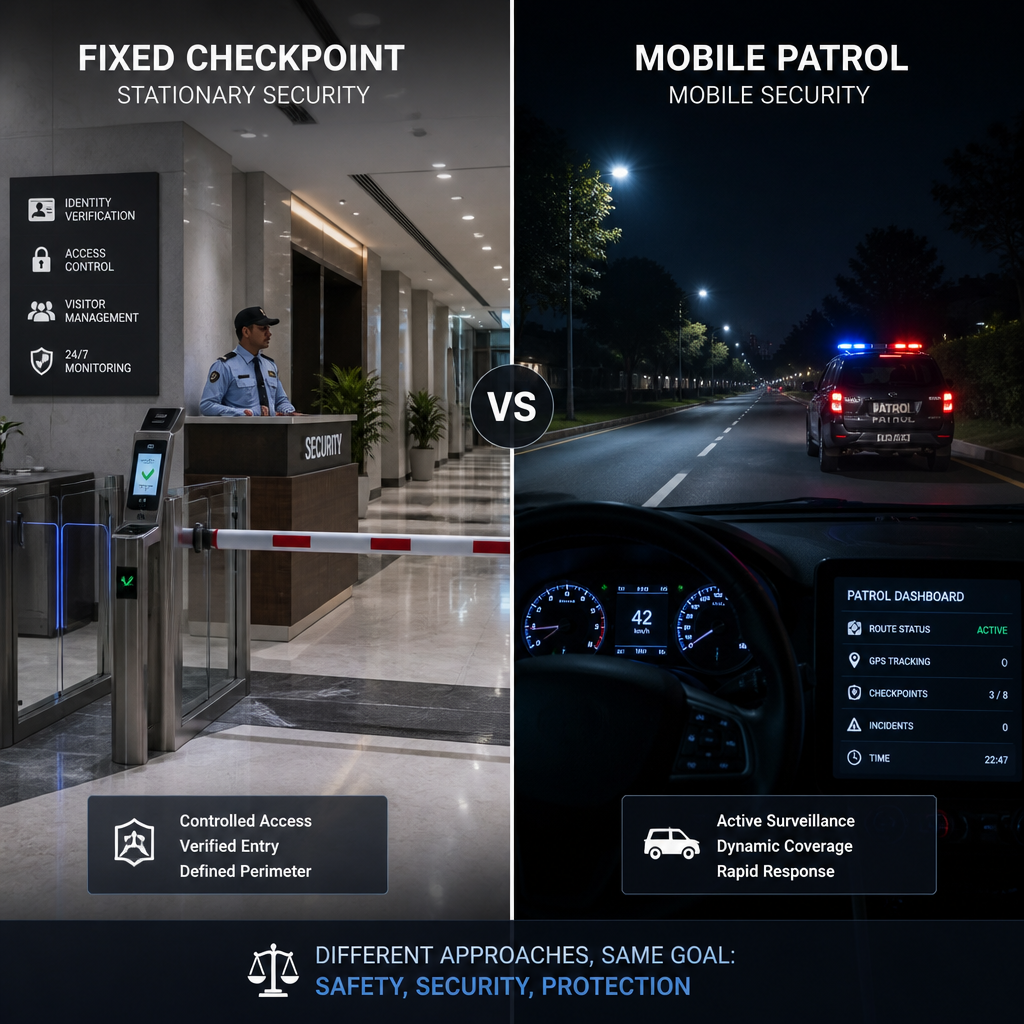
Head-to-Head Comparison
Criterion | Static Security Guards | Mobile Security Patrols |
|---|---|---|
Deployment model | Fixed position, one site, full shift duration | Travelling officer covering scheduled stops across one or multiple sites |
Incident response time | Immediate. Officer is on-site at all times | Delayed by travel time from previous patrol location |
Deterrence mechanism | Continuous visible presence at a fixed point | Unpredictable patrol pattern across the site perimeter or estate |
Access control capability | Full. Visitor management, contractor verification, vehicle access | Limited to checks during patrol window only |
Typical cost structure | Hourly rate per officer. Rates commonly from £16 to £25+ per hour depending on site type, location, and shift pattern | Per-visit pricing. Individual patrol visits commonly around £35 per attendance; combined patrol and keyholding packages available monthly |
Multi-site coverage | One guard, one site | One officer can cover several client sites per shift |
Best fit for | High-footfall retail, construction gatehouses, corporate receptions, event venues, vacant property with high theft risk | Business parks, low-to-medium risk commercial properties, out-of-hours vacant sites, properties requiring keyholding coverage |
SIA licence required | Security Guard licence (manned guarding) | Security Guard licence, plus keyholding licence if performing that function |
“The right choice depends on several factors, including the size of your site, the level of risk, your budget, operating hours, and the type of protection your business requires. In many cases, organisations benefit from combining both approaches to create a layered security strategy that balances cost with comprehensive protection.”
Sector-Specific Guidance for UK Businesses
Construction Sites
Construction sites present some of the most demanding security requirements of any commercial sector. Plant machinery, copper wiring, fuel, tools, and building materials attract organised theft. The site’s physical footprint changes weekly as the build progresses, making static perimeter control a shifting requirement. During working hours, a static guard at the site entrance manages contractor access, enforces induction requirements, and monitors vehicle movements in and out. This is essential where CDM 2015 obligations require the principal contractor to control site access.
Out of hours, a mobile patrol combined with an alarm response contract typically provides proportionate protection. Full overnight static staffing is warranted where the site holds exceptionally high-value plant or materials, or where the location has a documented history of targeted theft. For most construction sites, the combination model is the operationally correct and commercially sound approach.
Retail Businesses
Retail security requirements centre on loss prevention, customer safety, and staff protection during operational hours. A static guard positioned at the store entrance or on the retail floor addresses all three simultaneously. They prevent shoplifting, manage difficult customers, control entry during busy periods, and support staff when incidents escalate. Retail guarding during trading hours is one of the clearest use cases for static deployment.
After trading hours, when the store is empty, a mobile patrol visit to check that the premises are secured and the alarm is set provides cost-effective protection without the expense of an overnight static post that serves minimal additional purpose for an empty building.
Corporate Facilities and Office Buildings
Corporate environments require controlled access, professional front-of-house representation, and rapid incident response. A static guard at the main reception combines these functions into a single post. For multi-building corporate campuses, static guards at primary entry points paired with mobile patrols covering car parks and secondary access routes creates a coverage model that matches the site’s geometry and risk profile.
Vacant and Unoccupied Properties
Vacant properties attract squatters, vandalism, and metal theft. The risk profile is intermittent rather than continuous, which makes a permanent static post disproportionate in most cases. Mobile patrols with keyholding and alarm response coverage is the standard approach for vacant commercial properties, providing visible deterrence through regular visits and a guaranteed response capability when the alarm activates. Nexus Security Services provides dedicated vacant property securing services precisely calibrated to this risk profile.
Layered Security: Combining Both Models
The most effective security postures for mid-to-large commercial operations rarely rely on a single model. A static guard during business hours covers the period of maximum footfall, maximum access control demand, and highest likelihood of an incident requiring immediate physical intervention. Mobile patrols overnight cover the period where the deterrence benefit of an occasional visible check outweighs the cost of continuous static staffing.
Layering also applies to technology integration. Static guards monitoring CCTV feeds cover blind spots that no single officer can watch in person. Mobile patrols paired with alarm response mean that a triggered sensor is met with a physical presence, not just a remote notification. For clients of Nexus Security Services, combining static manned guarding with scheduled mobile patrols and access control creates a security architecture that addresses the full risk cycle across operational and out-of-hours periods.
A common mistake in layered security planning is treating the two models as interchangeable alternatives rather than complementary tools. Static and mobile coverage address different threat windows and different mechanisms of deterrence and response. Budget decisions should be driven by a documented risk assessment, not by defaulting to whichever option appears cheaper in isolation.
SIA Compliance and Accreditation: What to Check
In the UK, security guarding and keyholding are licensable activities under the Private Security Industry Act 2001. Every officer performing static guarding duties must hold a valid SIA Security Guard licence. Officers performing keyholding functions as part of a mobile patrol contract must hold the appropriate SIA licence for that activity. These are not optional standards. Using unlicensed personnel exposes a business to legal liability and invalidates many commercial insurance policies.
SIA licensing and company-level accreditation are separate matters. The SIA licenses individual officers. The SIA Approved Contractor Scheme (ACS) is a voluntary quality assurance framework for security companies. Holding ACS accreditation signals that a company’s operational standards, management systems, and service quality have been independently assessed. When shortlisting providers, confirm both: that every deployed officer holds a current SIA licence, and that the company holds relevant accreditations that verify organisational quality standards.
A common and costly mistake is selecting a provider based on price alone without verifying current SIA licence status for each officer on the proposed deployment roster. SIA licences must be renewed, and a lapsed licence means the officer is legally prohibited from working in that role. Responsible security providers, including Nexus Security Services manned guarding operations, maintain current licence verification as a baseline operational requirement, not an optional quality measure.
Frequently Asked Questions
What is the main difference between a static security guard and a mobile patrol officer?
A static security guard is deployed at a fixed location for the entire duration of their shift, providing continuous on-site monitoring, access control, and immediate incident response. A mobile patrol officer travels between one or more sites on a scheduled or randomised route, conducting inspections at each location for a limited time before moving on. The core trade-off is response time versus coverage breadth and cost efficiency.
Are static security guards more expensive than mobile patrols?
Yes, in most cases. Static guarding is priced on an hourly rate per officer, commonly ranging from £16 to £25+ per hour depending on site type, location, and shift pattern. Mobile patrol visits are typically priced per attendance. For sites that do not require continuous cover, mobile patrols deliver substantially lower monthly costs. The right comparison is not hourly rate but total monthly cost relative to the risk profile the service is actually addressing.
Do static security guards need an SIA licence in the UK?
Yes. Any officer performing static manned guarding duties under a contract that involves protecting premises, property, or people against theft, damage, or unauthorised access is performing a licensable activity under the Private Security Industry Act 2001. A valid SIA Security Guard licence is a legal requirement, not an optional quality marker. Always request to see current licence documentation before any officer begins deployment at your site.
Can mobile patrols respond to alarms at my premises?
Yes. Mobile patrol services commonly integrate with keyholding and alarm response contracts. When your site alarm activates, the patrol officer attends to investigate, secure the premises, and file an incident report. This combination removes the burden of out-of-hours alarm attendance from the business owner or facility manager and ensures a trained, licensed officer responds rather than an untrained keyholder. Confirm response time commitments with your provider before signing a contract.
What security model is best for a construction site?
Most construction sites benefit from a combination approach. A static guard at the site entrance during working hours manages access control, enforces CDM 2015-related induction requirements, and monitors contractor and vehicle movements. Out of hours, mobile patrols with alarm response coverage provide deterrence and reactive capability at a cost that is proportionate to the overnight risk profile. Sites holding exceptionally high-value plant or with a documented history of targeted theft may justify full overnight static cover.
How do I decide which service my business needs?
Start with a documented risk assessment that identifies your threat profile, the hours of greatest vulnerability, your site’s physical footprint, and whether you need continuous access control or periodic deterrence checks. High-footfall, high-risk, or access-controlled environments where immediate incident response is non-negotiable point toward static guarding. Lower-risk, large-area, or out-of-hours sites where cost efficiency is a genuine constraint point toward mobile patrols. For most mid-to-large commercial operations, a layered approach combining both provides the most defensible risk posture.
If you manage a commercial, retail, corporate, or construction facility in the UK, share what security challenges have shaped your decision between static and mobile coverage in your operation.
We would love your feedback and any insights you would share with others. What perspective would you add?


0 Comments