

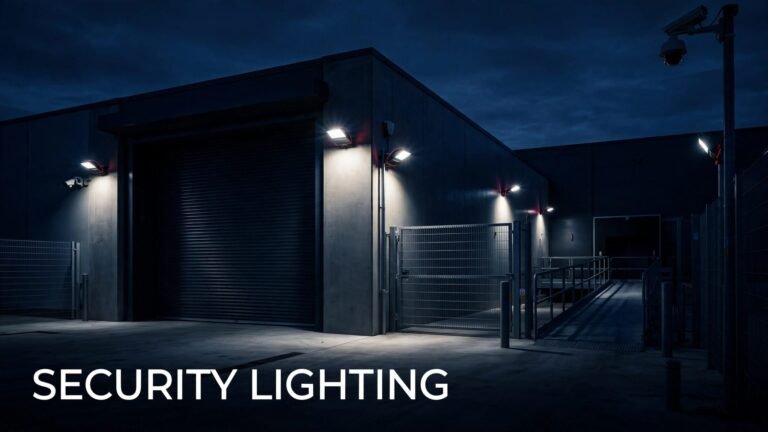
Security lights fitted after a break-in can feel like a sensible answer. If they throw glare into a neighbour’s bedroom, miss the rear gate and wash out a CCTV image, they are not.
Proper commercial security lighting supports safer access, clearer surveillance and a more credible deterrent. It doesn’t prevent crime on its own, and brighter isn’t always better.
The practical task is to light the right parts of commercial premises, only when needed, without creating a planning, nuisance or ecology problem.
What security lighting can and cannot do
Security lights make a premises feel occupied and make potential intruders easier to spot. They also improve visibility for staff, visitors and drivers using entrances, walkways and loading areas after dark.
Deterrence depends on the wider security strategy
A well-lit access point is harder to approach unnoticed. The wider security strategy should combine cctv cameras, secure gates, access control and clear sightlines.
A badly placed floodlight can do the opposite. It may illuminate an intruder’s route, leave a blind spot behind a skip, or cause camera flare that removes useful detail.
Together, these measures make lighting a more effective deterrent.
Security lighting is not a substitute for physical security. It is one part of a working site routine, alongside locks, CCTV, alarms and proper access control.
Safety is part of the brief
Security is not only about theft. Uneven ground, delivery vehicles, steps and side entrances all create risk when staff are arriving early or locking up late.
Start with the actual activity on site. A car park used until 10pm needs a different arrangement from a warehouse yard that only opens for scheduled deliveries. The fitting, mounting height, brightness and operating hours should follow that reality.
Start with a commercial site lighting audit
Do not begin with a catalogue of fittings. For commercial properties, walk the site after dark with the people who open, close and work there.
Record the weak points first
Mark every entrance, gate, roller shutter, loading bay, pedestrian route, bin store, fuel area and external plant compound. Include blind spots where someone could wait unseen, such as recessed doors, high fencing, parked vehicles or dense planting.
Check the lighting from the road, neighbouring land and inside adjacent buildings. A light can appear controlled from the yard but become intrusive when viewed from a first-floor flat.
Take photographs and note the existing security lights and controls, including whether fittings use passive infrared. Record where cameras lose detail. This gives a lighting designer or contractor something more useful than “make the back brighter”.
Look at the site as a working system
Ask who needs light, when they need it and what they need to see. A driver reversing into a loading bay needs even, downward light. A rarely used emergency gate may only need a triggered light and a camera view.
A proper audit also identifies unnecessary fittings, failed sensors and lights left on because nobody knows how to adjust them. Those small faults are ordinary, but they cause many of the complaints and energy costs that follow.
Design commercial security lighting in layers
Floodlights used as a single high-output solution are a blunt instrument. Layered lighting gives each part of the premises enough usable light without turning the whole boundary into permanent glare. Good lighting design treats each area according to its specific needs.
Light the perimeter with restraint
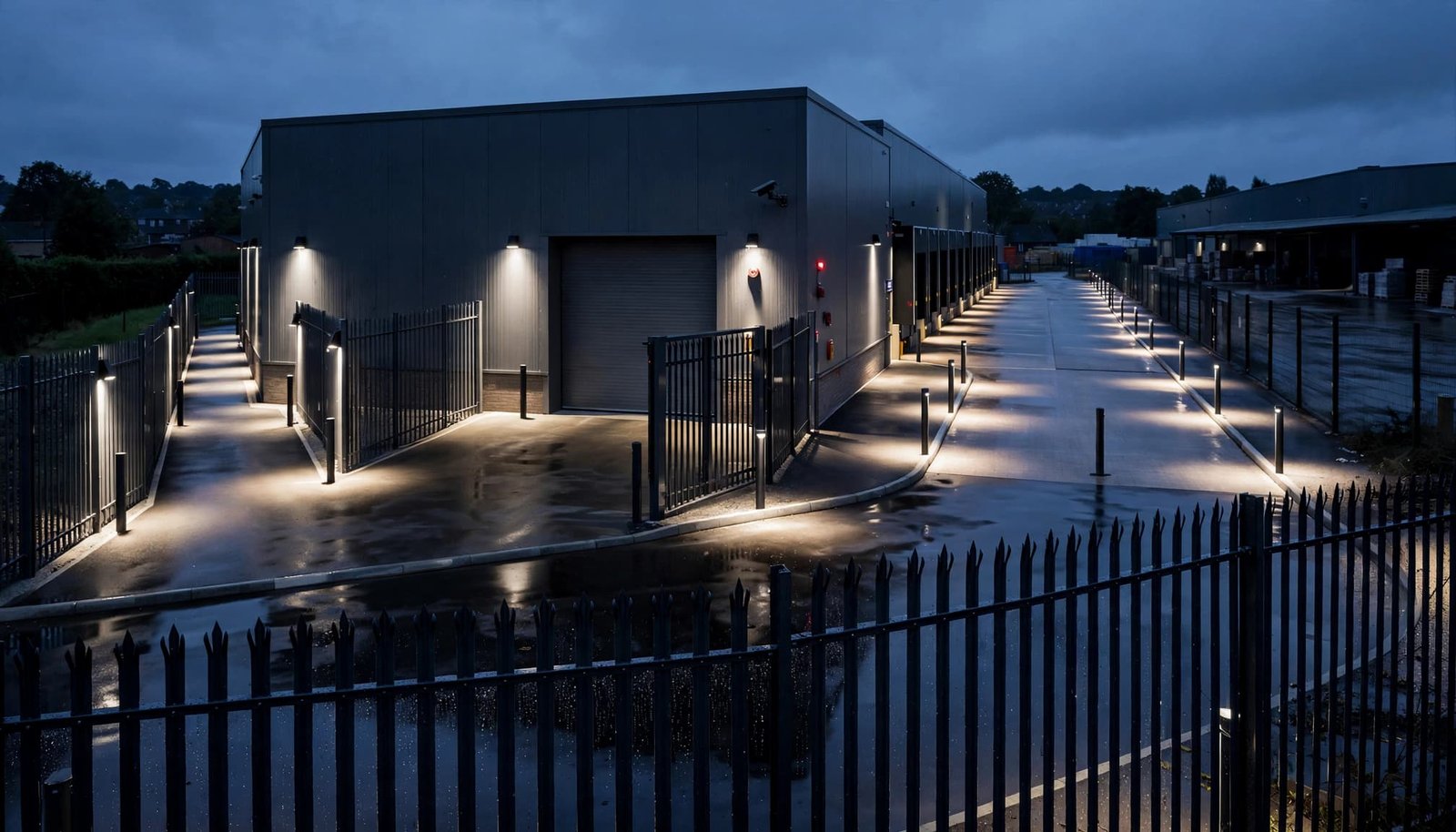
Perimeter lighting should help staff see gates, fences and approaches. Direct fittings inwards and downwards, rather than towards public roads, neighbouring gardens or open sky.
Wall-mounted lights can work well for compact sites. Columns may suit larger yards or car parks, but they are more visible structures and may raise different planning questions. Don’t use light to compensate for a damaged fence or an uncontrolled access point.
Give entrances and routes their own treatment
Main doors, staff entrances, delivery doors and external steps need clear, reliable light. These are places where people handle keys, badges and equipment, so uniform coverage matters more than dramatic brightness.
Loading bays need careful positioning. Mounting lights too close to the bay can create sharp shadows behind vehicles. Positioning them too high or directly facing a camera can reduce visibility through glare.
Remove blind spots without causing spill
Stand where a camera is mounted and check the view when the lights operate. Reflections from roller shutters, wet paving and vehicle bodywork can all affect footage.
Use shielding, louvres, baffles or a changed mounting angle before increasing output. The Planning Portal’s external lighting advice also advises setting PIRs and timers so passing pedestrians or traffic don’t repeatedly trigger the lights.
Choose controls that match the premises
Modern LED lights are usually the sensible starting point for a new security lighting installation. Suitable security lights provide instant illumination, use less energy than older lamp types and allow better control of output and operating hours.
PIR and microwave sensors are not the same
Passive infrared, or PIR, sensors detect changes in heat moving across their field of view. PIR lights are useful at doors, walkways and smaller approaches, but coverage can be affected by movement angle and site conditions.
These sensors detect movement differently and can cover wider or less direct approaches. They may also trigger through lightweight materials or respond to activity beyond the boundary if poorly set up. Neither is automatically the better option. Test each sensor in its real location, with normal traffic and weather.
Timers, photocells and dimming reduce waste
A photo-electric switch can bring lights on as daylight fades. Timers can set an end time, while motion sensors and smart lighting can keep basic orientation light low and increase it when activity occurs.
Solar-powered lights may suit some locations, but assess reliability, battery performance, winter daylight and camera requirements before using them commercially.
This is more convincing than leaving every fitting on all night. It improves energy efficiency, reduces running costs, limits disturbance and makes unusual light activity more noticeable.
Choose a colour temperature that gives usable recognition without harsh blue-white glare. The right choice depends on the setting, camera performance, nearby homes and ecology, not a fashionable specification.
Pair lighting with visible CCTV
Lighting should be planned with surveillance systems, not installed after them. A visible camera and a maintained, controlled light make a stronger deterrent than either item alone.
Ask your CCTV provider to review exposure, infrared use and the effect of triggered lights. A sudden blast of light can overexpose an image. A camera may need a different angle, different settings or a separate, softer source of illumination.
For wider site protection, commercial CCTV and security support can help bring lighting, surveillance and day-to-day site procedures into one practical plan.
Planning, neighbours and light pollution
There is no blanket UK answer to whether external security lighting needs planning permission. The position can depend on the building, location, fixture type, poles or brackets, mounting method, brightness, hours of use and whether commercial properties are involved.
England: planning and statutory nuisance
In some cases, exterior lighting itself may not be development, but associated structures and larger schemes can require consent. This is more likely at commercial premises, including car parks, industrial estates and sites with prominent external equipment.
Light spill can also become a statutory nuisance, and nuisance lighting may prompt complaints. GOV.UK lists shop and office security lights among common causes of complaints, and its light pollution guidance is clear that direction and impact matter.
A local authority must investigate complaints where artificial light may amount to a statutory nuisance. This is general guidance, not legal advice, so read how councils handle light nuisance complaints before assuming a neighbour has no grounds to object.
Wales and Scotland have their own policy context
In Wales, check the local development plan and whether the site lies near a dark-sky area, protected landscape or sensitive habitat. Wildlife considerations are particularly important at exposed rural and edge-of-settlement sites. Welsh Government guidance puts it plainly: use the right light, in the right place, at the right time. Its dark-skies planning guidance is particularly relevant to these locations.
Scotland has separate nuisance provisions under the Public Health etc. (Scotland) Act 2008. Its security-light nuisance guidance addresses excessive illuminance and glare from domestic and commercial sources.
Listed buildings, conservation areas and Northern Ireland
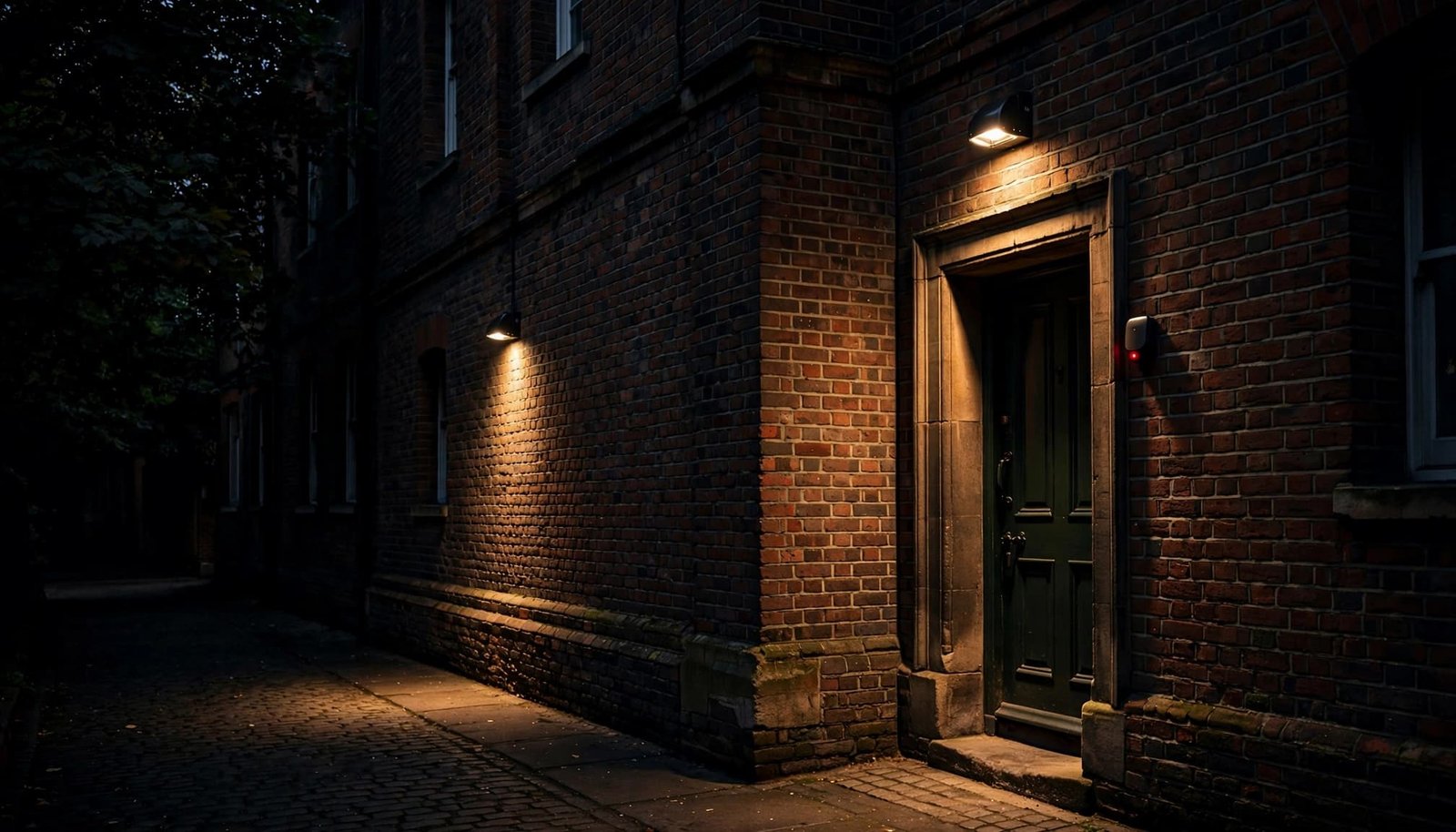
A discreet fitting can still affect the character of a listed building. Fixing a cable run, bracket or box to historic fabric may need listed building consent, even if the proposed light seems modest. Check the listed building consent guidance before work begins.
Conservation areas need the same care with appearance, cable routes and visible equipment. In Northern Ireland, planning and heritage requirements should be checked with the relevant local authority before ordering fittings. Local policy and the building’s status will decide the position.
A practical installation checklist
The best time to prevent glare, neighbour complaints and wasted spend is before the electrician arrives.
Work through these steps in order
- Walk the property after dark and map security risks, staff routes, camera views and existing blind spots.
- Separate entrances, delivery areas, pedestrian routes and boundaries into their own lighting tasks.
- Choose inward-facing, downward-directed fittings with shielding where needed.
- Set operating hours, timers, photocells, dimming and motion sensors around real site use. Choose PIR lights that use passive infrared detection where they suit the risk.
- Test the scheme from neighbouring land, public highways and CCTV viewpoints.
- Check planning, listed building, conservation area, ecology and landlord requirements with the local authority before installation.
- Keep drawings, product details, settings, a maintenance schedule and maintenance records in the site file.
Questions to ask before signing off
Ask the lighting designer where light will fall outside the boundary, what will happen when a sensor fails, and how camera images have been tested at night.
Ask the local authority whether the proposal needs permission or consent, which local lighting policies apply, and what information it expects with an application. Provide site plans, elevations, fitting details, mounting heights, operating hours and a clear explanation of control measures.
Include wildlife considerations in the ecology assessment. Avoid lighting trees, water, hedgerows and likely bat routes unless there is a clear operational reason and appropriate advice has been taken.
Key takeaways
- Commercial security lighting works best as part of a wider system, not as a stand-alone answer to crime.
- Layered, downward lighting gives better coverage than a few permanently bright floodlights.
- PIR lights, timers, photocells and dimming support smart lighting, helping control energy use, glare and unnecessary operation.
- Camera views should be tested with the final lighting arrangement, not assumed.
- Planning, heritage, nuisance and ecology checks belong at the start of the project.
Frequently asked questions
Do security lights deter burglars on commercial premises?
They can make access and suspicious activity more visible, especially alongside visible cctv cameras, secure boundaries and controlled entry points. They can support crime prevention, but can’t guarantee it, and poorly aimed lighting may create blind spots or help an intruder see more clearly.
Do LED security lights need planning permission?
Not automatically. Permission can depend on the site, building, fitting, mounting arrangement, columns or brackets, operating hours and local planning policy. Listed buildings, conservation areas and sensitive locations need early checks with the relevant authority.
How do you prevent light spill and glare?
Use the minimum suitable output, direct light downwards and inwards, and fit shields or louvres where needed. Check the result from homes, roads and public spaces. Sensors, timers and dimming can also stop lights operating longer than necessary.
The standard to work towards
Good security lighting is controlled, purposeful and tested after dark. It gives staff and cameras the visibility they need without treating neighbours, wildlife or the night sky as somebody else’s problem.
The strongest scheme is rarely the brightest one. It is the one that puts useful light exactly where the security risk is.


0 Comments