

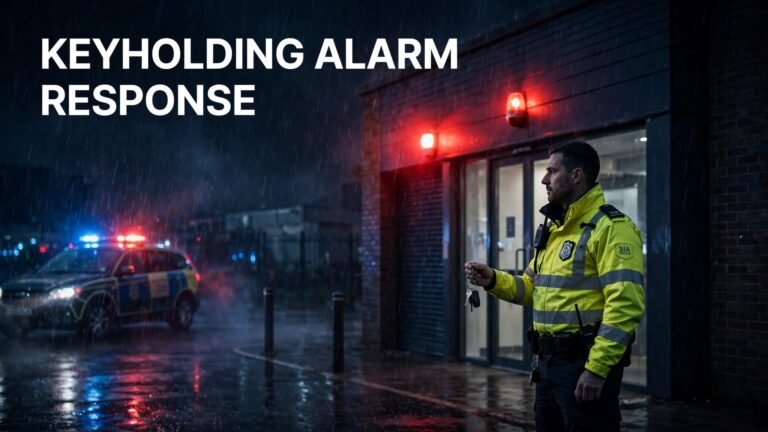
An alarm at 02:13 is not a minor operational inconvenience. It is a decision about who holds the keys, who attends the business premises, and who carries the risk if something has gone wrong.
A properly arranged keyholding alarm response service gives businesses a controlled alternative to waking an employee and sending them alone to a dark, potentially compromised site. The important part is not the badge on the patrol vehicle. It is the process behind it.
Key takeaways
- Alarm monitoring receives and assesses a signal, keyholding protects access credentials, and alarm response services put a trained person at the property.
- Sending an employee to an alarm call-out isn’t automatically unlawful, but it creates health and safety duties that must be properly assessed and managed.
- Ask for written response expectations, a full schedule of attendance charges, and clarity on what happens after a false alarm.
- Check for SIA licensed security officers, BS 7984 compliance, and whether the provider is ACS accredited or NSI approved. Verify what each approval covers.
- A security provider can coordinate locksmiths, glaziers and other emergency repairs, but only where this is included in the contract.
What keyholding alarm response actually means
These alarm response services are often grouped together, which can make procurement needlessly vague. A security provider may combine several functions for business premises, but they remain connected without being equivalent.
Alarm monitoring detects the problem
Alarm monitoring usually means an alarm receiving centre receives and assesses signals from intruder alarm activations, fire, panic or technical alarms. The operator follows agreed instructions, which may include contacting nominated people, checking verification information or escalating the activation.
Alarm monitoring does not mean somebody is already driving to the building. If the system is unmonitored, an audible siren may alert neighbours or deter an intruder, but it won’t automatically produce an out-of-hours attendance.
Keyholding protects access and response enables attendance
A key holding service stores the keys, fobs, alarm codes and site instructions needed to enter and secure a property. The service should hold them securely and limit access to authorised staff.
Alarm response is the physical attendance, unlike mobile security patrols, which follow scheduled routes rather than responding to a specific alarm. A security officer receives the instruction, travels to the site, enters where safe, investigates the cause and supports site security.
For a retail unit, that might mean resetting a faulty detector and locking up again. For a warehouse with a forced roller shutter, it may mean protecting the scene, contacting the police where appropriate, arranging an emergency repair through approved repair contractors and remaining on site until it is secure.
How a keyholding alarm response works at night
A sensible arrangement for alarm response services is built around clear information. The security provider needs accurate contacts, access details, alarm instructions, hazard information and authority to make decisions when nobody from your business can answer.

The control room checks the activation
When a signal reaches a 24/7 control room, the operator reviews the instructions for that site. They may contact the alarm company, review verification details or call nominated contacts before dispatching an officer.
This matters because false alarms cost money and waste time. A response provider should not treat every activation in exactly the same way. A recurring sensor fault at an empty office requires a different response from verified intruder alarm activations or a signal from several zones.
The NSI guidance on keyholding and alarm response describes the service within the BS 7984 framework, including controlled procedures for attendance and site security.
The officer assesses, enters and reports
On arrival, the officer should first assess site security, checking for forced entry, broken glass, fire, hazards or people nearby. They should not walk blindly into a building because an alarm panel says there is a fault.
If entry is safe, the officer checks the property according to the site instructions. They identify the activation point where possible, look for damage, reset the alarm if authorised, and contact the control room with updates. Where a confirmed incident requires escalation, approved repair contractors may be contacted, while emergency services are called only where appropriate.

The final job is not merely leaving the site. It is confirming that doors, shutters, gates and alarms are secure, then providing a written incident report. The resulting comprehensive report should record arrival and departure times, actions taken, people contacted, faults found and any outstanding risk.
A fast attendance is useful, but a clear record of what happened afterwards is what allows a facilities manager to repair faults, challenge charges and identify repeat issues.
Why businesses outsource alarm call-outs
An employee may know the building well, but familiarity is not a safety plan. Outsourced alarm response services can reduce the need for employees to attend isolated or compromised business premises at night. Attendance can involve confrontation, damaged access points, poor lighting, faulty electrics, fire alarms or a person still inside.
Lone working must be managed properly
There is no general legal ban on lone working in the UK. However, employers must assess the risks and put suitable controls in place. Section 2 of the Health and Safety at Work etc. Act 1974 places a general health and safety duty on employers to protect employee health, safety and welfare so far as reasonably practicable.
For alarm response, managing lone worker risks means more than handing someone a set of keys and a mobile phone. You would need to consider training, communications, travel, escalation, personal safety, authority to enter, fatigue and what happens if the employee does not return a call.
Outsourcing changes the risk, not your responsibilities
A professional security provider changes the exposure faced by staff and reduces the need to send office managers, directors or maintenance staff to out-of-hours incidents. It also stops the same person being expected to work a full day after a 03:00 call-out.
It does not remove all responsibility. Your business still needs accurate site records, a current contact list, clear authority levels and a sensible process for reviewing incidents. A provider cannot make decisions properly when its instructions are months out of date.
Standards and credentials worth checking
Accreditations can support good practice and relevant security standards, but they don’t replace basic questions about staffing, coverage and escalation.
Ask about BS 7984:2016
BS 7984:2016 is the current British Standard reference for keyholding and response services. It covers matters such as attendance requests, site inspection, identifying alarm causes, preserving potential evidence and making premises secure.
Ask a provider how its procedures meet the standard. A useful answer will cover key storage, officer instructions, attendance records, incident reporting and audit trails under BS 7984. A vague claim that it is “fully compliant” isn’t enough.
The standards overview is a useful starting point when comparing the language used in security proposals.
Check licences and contractor approval
SIA licensed security officers undertaking licensable guarding work should hold the appropriate Security Industry Authority licence. Ask how the provider checks licences, vetting, training and renewals, rather than accepting a logo on a brochure.
The SIA Approved Contractor Scheme and NSI approval can offer additional assurance about a company’s assessed processes. Check whether the organisation is ACS accredited or NSI approved, then verify its current status and relevant scope. Neither status guarantees a response time, local coverage or a particular insurance outcome.
These are useful indicators, but neither tells you whether the nearest officer can attend your premises within the service level needed for effective site security.
Ask who covers your postcode after midnight, whether the service is delivered directly or subcontracted, and which security provider remains accountable if the response is late.
What keyholding and alarm response costs in the UK
Indicative costs for alarm response services at commercial properties vary by location, building type, key quantity, alarm complexity and service level. London, high-risk sites and short contractual response targets commonly cost more.
For illustration, a current keyholding buyer’s guide reports typical setup fees of £50 to £150, monthly cover of £20 to £50 per site, and attendance at £25 to £60. Other providers quote annual cover of roughly £250 to £600, plus £40 to £100 per activation.
| Cost element | What it may cover | What to clarify |
|---|---|---|
| Setup fee | Key collection, site survey and instructions | Is each extra keyholder or location charged? |
| Monthly or annual retainer | Secure key storage and 24/7 availability | Does it include any call-outs? |
| Attendance charge | Officer travel and initial time on site | Is VAT, mileage or a minimum period extra? |
| Extended attendance | Waiting for police, locksmiths or managers | What is the rate after the included period? |
The headline monthly price is rarely the full cost. A low retainer can be reasonable, but check whether the security provider includes call-out, mileage, report, cancellation and extended-attendance fees.
False alarms and repairs need their own terms
Ask whether the provider can distinguish between unverified intruder alarm activations, confirmed intrusions and technical faults before dispatch. You also need to know who can authorise an alarm engineer, locksmith or emergency glazier, and who may contact repair contractors.
Some providers coordinate these trades. Others will contact your approved contractor list. Neither approach is automatically better, but the contract should state who gives approval, what spending limit applies, and who stays at the premises while work is arranged.
Insurance terms should be checked with your broker or insurer. Professional keyholding may support a stronger risk-management approach, but it doesn’t guarantee a premium reduction or satisfy every policy condition.
How to choose the right provider
The best security provider isn’t necessarily the one promising the shortest response times on a sales page. When comparing alarm response services, choose coverage that is realistic for your location. A claimed 15-minute response may be realistic near a staffed patrol route, but not for a rural property during severe weather.
Request an honest service-level agreement
Ask for the response target in writing, including how it is measured. Clarify whether the clock starts when the alarm activates, when the control room receives the signal, or when the officer is dispatched.
You should also ask:
- Which officer or team does your security provider assign overnight, at weekends and on bank holidays?
- How are simultaneous or repeated intruder alarm activations handled?
- Does the provider use mobile security patrols for alarm attendance, or is patrol cover separate?
- Are vacant property inspections included, or do they require a separate agreement?
- Are lock and unlock services available under a separate agreed scope?
- Is the provider NSI approved for the relevant scope? Approval should be checked carefully and doesn’t guarantee a 15-minute attendance.
- What happens if the first responder is dealing with another incident?
- Will you receive arrival, departure and incident-report times after every attendance?
- Can the officer reset your specific alarm panel, or must an engineer attend?
- What is the escalation route if an officer finds evidence of entry or cannot secure the site?
Test the practical details
Ask to see a sample incident report with personal data removed. It should be factual and useful for reviewing site security, not a one-line note saying “site checked”.
Review the provider’s process for updating codes after staff leave, collecting replacement keys, handling alarm engineer access and arranging approved repair contractors. These ordinary details are where otherwise good arrangements go wrong.
The OMS keyholding and alarm response guide also sets out useful points to cover before appointing a provider.
Frequently asked questions
Is it legal to send my own staff to alarms?
It can be legal, but it isn’t a casual favour to ask of an employee. You must assess the lone-working risks and put suitable controls in place. For many businesses, outsourcing is more proportionate, particularly when alarms occur overnight or at isolated premises.
Are all security officers SIA licensed?
Not necessarily. Ask the provider to confirm that SIA licensed security officers hold the appropriate licence for the duties they carry out. Also check their vetting, training and supervision arrangements, including who oversees alarm response outside normal office hours. If relevant, verify whether the organisation is NSI approved for the required scope. This does not replace checking individual licensing or guarantee a particular response time.
Can keyholders arrange emergency repairs?
They can, if the service agreement gives them authority to contact and manage approved contractors. Agree spending limits and named contractors in advance. If a shutter is damaged at 04:00, nobody should be debating the approval process while the building remains exposed.
A controlled response beats a hurried call-out
A managed alarm response service is more than holding a spare set of keys. Reliable alarm response services support property security by linking alarm receipt, safe attendance, site security and accurate reporting.
For UK businesses, the strongest arrangement sets clear response expectations, explains costs transparently and keeps usable records. It must work when business premises are empty and usual decision-makers are unavailable. That is where proper security arrangements can provide peace of mind.


0 Comments