

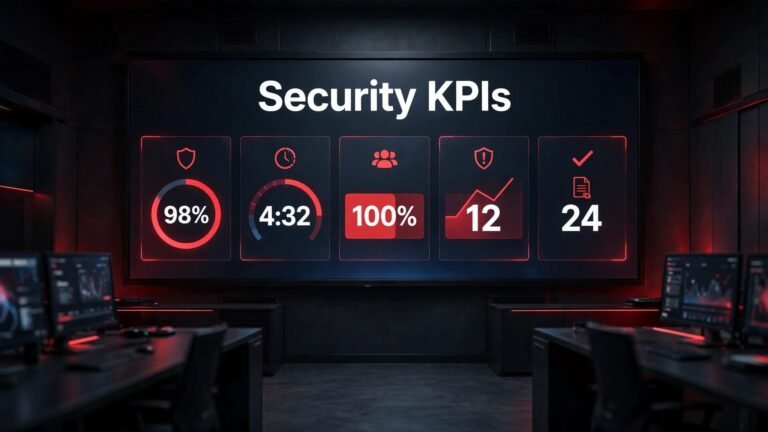
A security contract can look thorough and still leave you with no reliable way to judge whether the security services are working to agreed security contract performance standards. “Professional guards”, “rapid response” and “full cover” sound reassuring. They are not security contract KPIs.
A useful contract makes performance visible in ordinary, auditable details: who arrived, when they arrived, whether patrols took place, how incidents were handled, and when reports reached the client. That is where supplier performance becomes real.
Key Takeaways
- Make every security contract KPI specific and auditable, with an agreed target, data source, reporting period, owner and response when performance falls short.
- Track operational performance such as shift coverage, punctuality, verified patrol completion, incident response times and report timeliness against the contract’s risk profile and scope.
- Use objective evidence for quality and compliance, including training and licence checks, supervision records, complaint trends, report audits and consistent client feedback.
- Review financial measures alongside service levels. Overtime, temporary cover, invoice accuracy and cost movement can reveal pressure on the service before standards visibly decline.
- Agree the data trail and corrective-action process in advance. Service credits should support proportionate remedies and improvement, not encourage providers to hide or reclassify failures.
What makes a security contract KPI enforceable?
A KPI is not a vague statement of intent. It is one of the agreed key performance indicators used to assess whether a supplier is meeting the requirement. Every KPI needs a target, a data source, a reporting period, an owner and a response when performance falls short.
Separate KPIs, service levels and service credits
A security service-level agreement (SLA) sets the service level expected, such as a staffed reception between 07:00 and 19:00. A KPI measures performance against that requirement, such as the percentage of shifts started on time.
Service credits are a commercial remedy that may apply when agreed service levels are missed. They are not the KPI itself, and they shouldn’t be treated as a substitute for fixing the problem.
The Contract Management Playbook recommends SMART measures: specific, measurable, achievable, realistic and timebound. It is sensible advice for private security contracts as well as public ones.
Replace aspirations with evidence
“Maintain a professional appearance” is an aspiration. “At least 98% of sampled officers meet the agreed uniform standard each month, evidenced by supervisor inspection records” is measurable.
That distinction matters when a contract is under pressure. A facilities manager shouldn’t have to argue about impressions after an avoidable failure. The contract should show the agreed evidence, the target and the action due.

Operational security contract KPIs to track
These operational KPIs show whether security officers are where they should be, doing the agreed work, and responding properly when something goes wrong. They should reflect the site’s risk profile, operating hours and contract scope. They test contract compliance against the agreed scope, rather than impose universal targets.
| KPI | Practical measurement method | Useful review point |
|---|---|---|
| Shift fill rate | Filled shifts divided by scheduled shifts x 100 | Weekly and monthly |
| Punctuality rate | On-time starts divided by all scheduled starts x 100 | Monthly |
| Patrol completion rate | Verified patrols divided by scheduled patrols x 100 | Daily and monthly |
| Incident response time | Time of officer attendance less time of alert | Per incident and monthly |
| Report timeliness | Reports submitted within deadline divided by total reports x 100 | Monthly |
The figures are only useful if both parties agree what counts. A “filled” shift may mean an officer booked in advance, or an appropriately licensed officer physically on site at the required start time. Those are not the same thing.
Shift fill rate and punctuality
A shift fill rate measures staffing coverage. Punctuality measures whether the officer started when required. Track coverage, punctuality, attendance and absence rates, and relief arrangements. A provider can fill every shift on paper while still sending officers late, moving people between posts, or relying heavily on last-minute cover.
Effective guard management should support accurate rostering and reliable relief arrangements. A 100% target may be appropriate where a post cannot be left unattended. Yet it should not turn into decorative reporting. If a genuine short-notice absence creates a gap, record it, record the interim controls, and show how long the gap lasted.
A perfect monthly percentage that contains no missed-shift log is not strong performance evidence. It is a reason to ask harder questions.
Patrol completion and response times
Patrol completion should be based on verified checkpoints, not a supervisor’s verbal assurance. Agree whether a missed checkpoint, late patrol, failed scan or altered route counts as non-compliance.
Incident response time also needs a clear starting point. For an alarm activation, is the clock triggered by the monitoring-centre alert, the officer’s radio call, or arrival at the location? The answer belongs in the contract.
Reports and escalation
Set deadlines for routine logs, incident reports and serious-incident escalation. A report delivered days later can still be well written, but it cannot support an immediate operational decision.
Include a separate requirement for report completeness. Missing time, location, action taken, witness details or escalation reference should be recorded as a quality failure, not quietly corrected without trace.
Quality KPIs and compliance measures that matter
Security services are people-led. Quality can still be evidenced objectively. Evidence should cover people, records and client experience, not attendance alone.
Training, licensing and presentation
Track training compliance against the role. This might include site induction, safeguarding, conflict management, fire procedures, data protection or control-room protocols. Measure completion before deployment and record expiry dates.
Guard management should link deployment checks with supervision and documented SIA licence verification. Uniform compliance can be monitored through documented supervisor checks. A photograph is not always necessary, particularly where privacy or site restrictions apply, but the method should be consistent.
Complaints and report quality
Measure the complaint rate using substantiated complaints, then consider it alongside guard hours worked and audit findings. This gives context when the contract expands or shrinks. Don’t use complaints alone as a performance score, because a well-managed team may record more issues simply because it reports honestly.
Monthly client feedback can help, provided the questions are fixed and scored consistently. Pair it with a sample audit of incident reports, handover notes and visitor records. The issue is not whether documents look polished. It is whether they are complete, factual and usable.
Financial KPIs should sit beside service levels
A low invoice is not a low-risk service. Financial KPIs help you spot the pressures that often appear before standards slip: persistent overtime, unexplained additional hours and recurring invoice disputes.
Watch overtime and temporary cover
Measure overtime hours as a proportion of total worked hours. Also track agency or temporary cover separately. Neither is automatically a breach, especially during mobilisation or unexpected absence, but a repeated pattern can point to weak recruitment, poor rostering or inadequate relief cover.
Compare these figures with missed patrols, lateness and complaints. One measure on its own rarely tells the whole story.
Check invoice accuracy and cost movement
Invoice accuracy can be measured as correctly billed items divided by total audited items. Review hours, rates, approved variations, relief cover and expenses against the roster and agreed rate card.
Cost per guard hour can be useful for budget control, but it should never be used alone to judge value. A cheaper model may remove supervisory time, training days or relief capacity that the site genuinely needs.
Build an auditable data trail
A KPI without a dependable source becomes a monthly debate. Digital checklists, patrol verification systems, time and attendance records, control-room logs and incident platforms can provide dependable data sources for practical contract management. This works best when the data is reviewed, not merely collected.
Agree the evidence before the first shift
For each measure, record the source system, data owner, checking responsibility, retention period and exception process in an audit checklist.
For example, an officer may miss a checkpoint because police have restricted access after an incident. The patrol should still show as missed or delayed, with the reason and supervisor approval recorded. Removing the event from the data conceals the operational picture.

Audit the source records, not only the dashboard
A monthly dashboard should be supported by sample checks. Match a selection of rostered shifts to time-and-attendance records. Compare patrol exceptions with incident logs. Check whether report timestamps match the contract deadline.
Matching source records and documenting exceptions improves reporting transparency. This is where facilities management teams often find ordinary but important failures: a missed clock-in, a patrol completed outside its window, or a report signed off without all the required facts.
Set a regular meeting cadence. Monthly reviews work for most contracts, with immediate escalation for serious incidents and a fuller quarterly review for trends, staffing and cost.
Use service credits without encouraging silence
A financial consequence can focus attention. Used badly, it can reward a provider for reclassifying incidents, disputing timestamps or keeping small failures out of the record.
Make the remedy proportionate
Tie credits or price adjustments to verified failure, severity and recurrence. A short late arrival at a low-risk daytime post shouldn’t be treated like a prolonged absence at a high-risk, lone-worker location.
Set sensible caps and escalation procedures. Serious or repeated failures should follow a defined escalation route, rather than relying only on an automatic deduction. The purpose isn’t to create a punitive scorecard. It’s to provide a fair commercial response where the client hasn’t received what it’s paying for.
Require correction, not just compensation
Every material KPI miss should produce a corrective action: the cause, immediate control, named owner and completion date. Trend review and root-cause analysis support continuous improvement, while repeat failures should trigger a formal improvement plan and senior review.
This isn’t legal advice. Contract wording, remedies, audit rights and termination rights should be checked against the procurement route, risk allocation and the advice available to your organisation.
Public-sector KPI rules need closer attention
Private businesses can adopt the same disciplined approach without a publication duty. Public procurement contracts may carry additional statutory requirements under the Procurement Act 2023.
When KPIs must be set and published
For most public contracts with an estimated value above £5 million, public procurement rules require contracting authorities to set at least three KPIs. The GOV.UK guidance on key performance indicators explains the definition, exceptions and publication requirements.
The right measures remain contract-specific. A guarding contract may need attendance, response and reporting measures. A technology-heavy security contract may need system availability, fault resolution and access-control accuracy.
Assessment and public reporting
Relevant public-contract performance must be assessed at least every 12 months, including on termination. The formal categories include Good, Approaching Target, Requires Improvement, Inadequate and Other.
The guidance on Contract Performance Notices sets out the reporting framework. Quarterly reviews are still a better operating rhythm for a live security service. Waiting a year to address missed coverage is plainly too late.
Frequently asked questions
Why is 100% staffing coverage not always the right KPI?
It may be right for a critical post, but it needs supporting measures. Track punctuality, the length of any uncovered period, relief staff qualifications and the controls used during absence. A headline figure without those details can hide the real risk.
What are leading and lagging security indicators?
Leading indicators show conditions that may cause a future failure, such as overdue training, high overtime or unfilled relief roles. Lagging indicators record what has already happened, such as missed patrols, complaints or slow incident response.
Both are needed. Lagging data shows the failure. Leading data gives the contract manager a chance to intervene earlier.
How should a KPI failure change the contract review?
Start with the source evidence, then agree the cause and corrective action. Repeated problems may require a revised staffing plan, extra supervision, retraining, a service credit or a formal improvement plan. Record decisions and due dates in the meeting minutes.
A contract should make security performance visible
The strongest security contract KPIs are ordinary on purpose. They show whether posts were covered, patrols took place, incidents were handled properly and records were delivered when needed.
Good contract management does not depend on impressive language. It depends on clear evidence, honest reporting and action when the data says the service is falling short.


0 Comments