

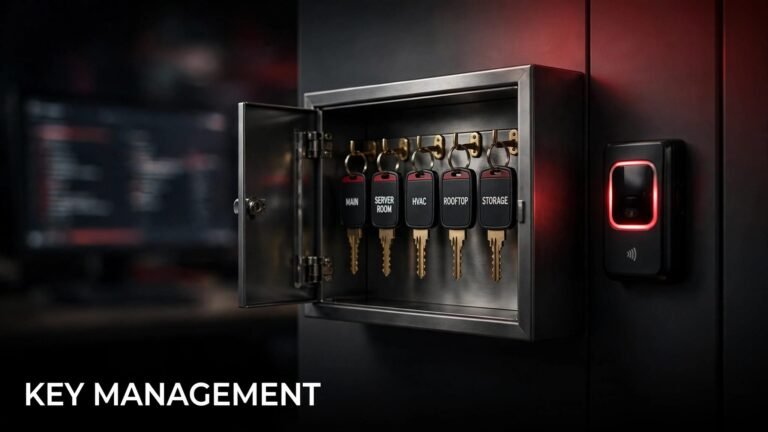
A lost key can expose more than a locked room. It can create uncertainty about who entered, which areas remain secure, and whether a costly rekeying exercise is now necessary. Commercial building key management gives property owners and facilities teams a controlled way to protect people, assets, tenants and operational areas.
The strongest policy is not based on a cabinet or software alone. Good risk management combines least-privilege access, secure storage, complete records, prompt deactivation and regular review. Start by identifying and reducing security risks, then choose technology that supports the policy.
A commercial building key management policy starts with risk
A policy should explain who may hold a key, which approvals are required, how access is recorded and what happens when a key is lost, returned or no longer needed. It should link physical keys, electronic credentials and permissions to documented risk management. It should cover employees, tenants, contractors, suppliers, cleaners, security officers and emergency personnel.
The policy also needs a named owner. In a multi-tenant building, ownership may sit with property managers, the facilities manager or the security lead, with specific responsibilities delegated to authorised staff.
Identify the areas that need protection
Map the building by sensitivity rather than treating every door in the same way. Reception areas, plant rooms, server rooms, roof access, electrical cupboards, document stores and tenant-only spaces have different risks.
The National Protective Security Authority recommends identifying sensitive assets, reviewing access control and maintaining a robust visitor entry and exit process. Its guidance on building protection and secure key control is useful when reviewing mechanical locks, a master key system and electromechanical arrangements.
A zoning model can help. Open, staff-only, restricted and highly restricted areas should have different approval requirements. Shared workspaces may need defined zones and physical access points between them, as outlined in the NPSA’s shared workspace guidance.
Set a clear access standard
Least privilege should be the default. A contractor who needs access to an air-handling unit doesn’t need a master key for every office. A tenant representative may need access to one suite, but not the building’s communications room.
Use written approval for higher-risk keys and set expiry dates for temporary access. The policy should also separate duties where practical. The person requesting access should not always be the person approving it, issuing the key and checking the record.
Why physical keys still matter in commercial buildings
Electronic access control is useful, but it doesn’t remove the need for physical keys. Commercial properties often retain mechanical keys for master key systems, fire doors, utility areas, plant rooms, lift controls and emergency overrides.
The NPSA describes automatic access control as a way to control who goes where, and when, around a site. That supports a wider security architecture, but it doesn’t make every physical lock unnecessary.
Master keys need tighter control
A master key can open several doors, so its loss affects more than one room. It should have a named custodian, a defined issue process and a record showing every handover.
Where electronic monitoring isn’t available, store high-risk master keys in mechanical key cabinets with access limited to authorised staff. Don’t leave them in an ordinary drawer or an unmonitored key box. Segregate duplicate keys and lower-risk stock in separate mechanical key cabinets, then inspect and record them under the same controls.
A master key system should also be reviewed when leases change, departments move or the building layout is altered. Unused cylinders and old copies create unnecessary exposure.
Fire, utilities and emergency overrides are separate cases
Some keys exist because the building must remain serviceable during an outage, incident or maintenance visit. Others support access to areas that may be needed by the fire and rescue service. Their handling should be agreed with the building’s fire-safety arrangements, not improvised by the person on duty.
Documented arrangements support an organised emergency response, rather than relying on whoever is on duty. Review local laws, fire codes, lease terms, insurance requirements and applicable security standards with qualified professionals. The rules may differ according to the building’s use, height, occupation and jurisdiction.
Build a hybrid model for physical and electronic key management
A paper register can record a key issue, but it depends on accurate handwriting, immediate updates and staff remembering to make the entry. Key tracking systems provide a clearer record of issues, returns and exceptions.
Electronic key management adds authentication, alerts and a searchable audit trail, but electronic key control doesn’t replace sound key control. A badly configured system can record poor decisions very efficiently.
Use electronic control where activity is frequent or sensitive
Electronic key cabinets can secure individual keys in monitored compartments. For lower-risk areas, mechanical key cabinets may be proportionate where electronic monitoring isn’t necessary.
Users may authenticate with a PIN, rfid key fobs, smart terminal or another approved method, depending on the system and the building’s risk assessment.
The useful question is not whether a platform has every available feature. Ask whether it can record:
- who requested, approved, removed and returned each key;
- the date and time of every transaction;
- the key’s identity, location and current status;
- overdue returns, forced access and failed authentication;
- changes to permissions and administrator activity.
The National Protective Security Authority’s guidance on automatic access control systems provides a sound starting point for considering access technology alongside the wider building-security system.

Connect key control to the wider security process
Key management should align with staff onboarding, contractor approval, visitor registration and access-control changes, while automated systems trigger alerts without replacing human approval. If an employee leaves, their access card may be disabled immediately, but any physical keys must also be recovered or cancelled.
Review smart terminal administration alongside permissions and authentication failures. Where systems are integrated, restrict data sharing to what is needed. A key cabinet doesn’t need unrestricted access to every HR record. Define who can view audit data, how long records are retained and how access is removed when responsibilities change.
What a modern key management system should contain
A practical key management system has three parts: secure storage, controlled permissions and reliable records. Electronic key management should connect physical-key records with electronic credentials. Electronic key control should keep electronic credentials and physical key issue separate, but coordinated.
| Control area | Minimum policy question | Useful system feature |
|---|---|---|
| Storage | Where is each key held? | Locked compartment, mechanical key cabinets or controlled key cabinet |
| Identity | Who can remove it? | PIN, RFID fob, biometric or approved authentication |
| Approval | Who authorised the issue? | Role-based workflow and approval record |
| Tracking | What happened to it? | Time-stamped audit trail |
| Exceptions | What happens if it is late or lost? | Alerts, escalation and incident log |
The system should support role-based permissions, data export, administrator logs and clear retention settings. Key tracking systems and cloud-native software may help teams manage multiple buildings and integrate with wider security systems. Ask how the software handles encryption, backups, service availability, data location and offline operation.
Supplier due diligence should include current security certifications where relevant, independent assurance, penetration-testing arrangements and a documented process for vulnerability management. Don’t accept a logo or general claim as proof that the system meets your organisation’s requirements.
Write the policy around least privilege and accountability
The policy should work during an ordinary Tuesday, not only during an audit. Keep the operating rules clear enough for a duty manager when a contractor arrives before the facilities team.
Control the full key lifecycle
The process should cover request, approval, issue, use, return, loss, replacement, review and disposal. Every key should have a unique identifier that reveals no sensitive information if seen by an unauthorised person.
Temporary access needs an end date. When the work is complete, the key should be returned and the record closed. Electronic key management should support offboarding, but disabling a credential doesn’t recover a physical key. If a key isn’t returned on time, the system or responsible person should escalate the matter rather than letting the exception disappear.
Lost keys require a documented risk assessment. This should consider the possibility of unauthorized access and the areas affected. The response may include a search, incident report, security review, cylinder replacement or rekeying. The policy should state who can make that decision and who pays the rekeying costs under the lease or service contract.
Review people, permissions and records
Run regular reconciliations between the key register, key cabinets, physical stock and current personnel records. Investigate missing keys, unexplained duplicates, overdue items and access that no longer matches a person’s role.
Contractors should be verified before issue, briefed on restrictions and required to return keys at the end of each visit. Property managers should oversee tenant turnover, including key recovery, electronic credential deactivation and checks for unauthorised copies. The same discipline applies at handover.
Audit results should go to an accountable manager. A record that nobody reviews is storage, not control.
Coordinate emergency access with fire safety
Emergency access needs speed, but speed doesn’t justify an unplanned collection of shared keys. Agree the arrangement in advance, document it as part of the building’s emergency response, and test it with relevant responsible persons and emergency contacts.
Confirm responsibilities and building information
GOV.UK guidance helps identify the responsible person or persons under fire-safety legislation and states that they should be competent. The guide for people with duties under fire safety legislation should be considered alongside advice from a competent fire-safety professional. These duties remain authoritative when coordinating the key process with wider building security.
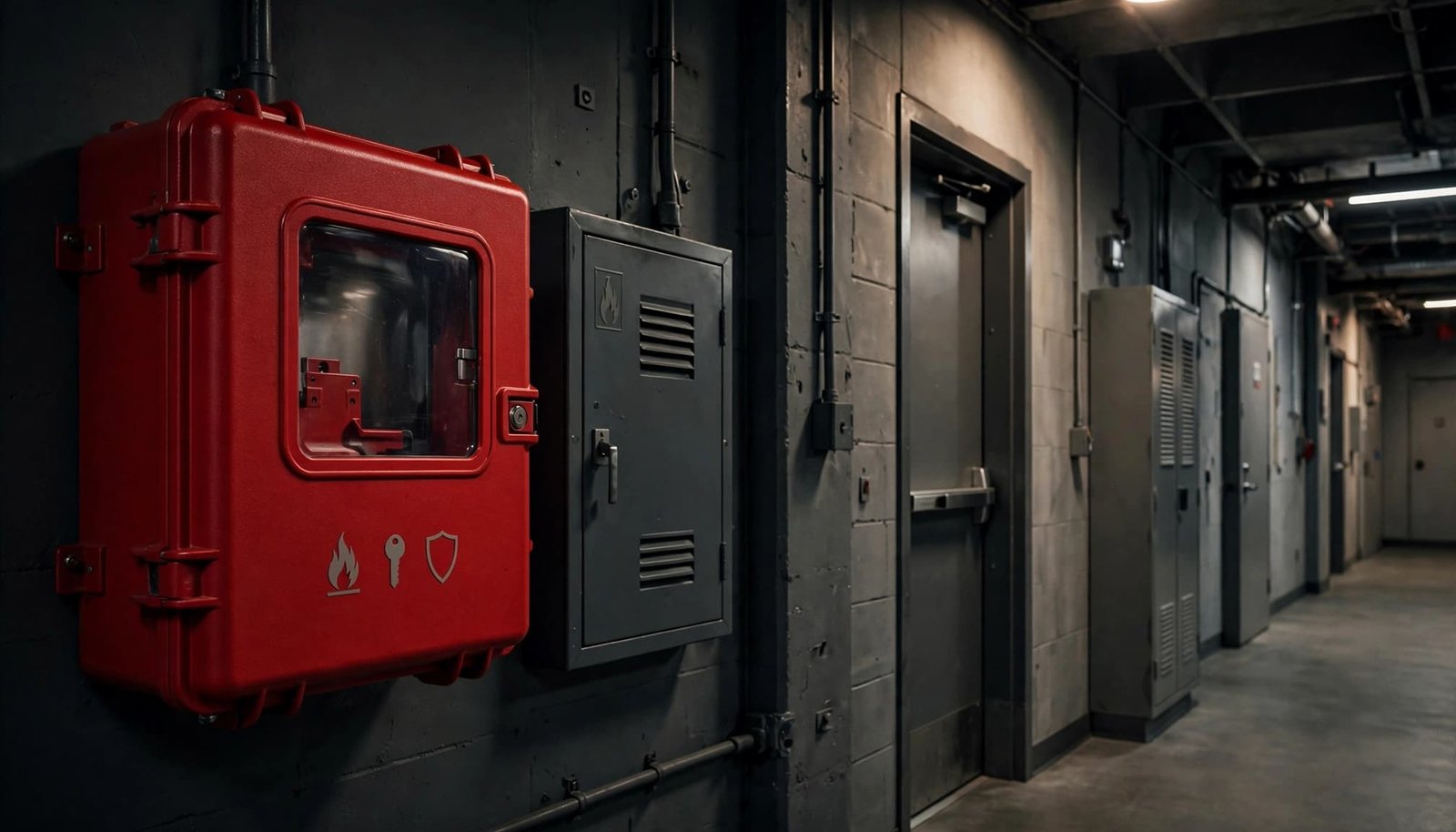
For high-rise buildings in England, the Fire Safety England Regulations 2022 include requirements for a secure information box in or on the building. The GOV.UK fact sheet on secure information boxes should be checked for the applicable requirements.
Use emergency key arrangements carefully
An emergency key grab kit may hold agreed keys, access cards, plans or other information for first responders. It should not become a general-purpose box for spare keys.
Keep access restricted, record inspections and confirm that contents match the current building. Test the route, contact procedure and access arrangements under controlled conditions. Any change to locks, tenants, fire doors or building layout should trigger a review.
Implement and review the policy in stages
Start with an inventory of keys, locks, key cabinets, users, contractors and sensitive areas. Record the current position honestly, including missing keys, shared credentials, duplicate copies and registers that aren’t being maintained.
Next, classify risks and choose controls proportionate to them. A small office may need a controlled cabinet and a disciplined register. A multi-tenant site with plant rooms, shared services and frequent contractors may benefit from electronic key management and key tracking systems. These improve visibility, but don’t replace clear authorisation.
Pilot the process in one building or zone. Train reception, security, facilities and tenant contacts before expanding it. Faster contractor issue and return processes can improve operational efficiency without weakening controls. Review the first audit after 30 or 60 days, then set a recurring review schedule based on risk.
Key takeaways
- Physical keys remain part of many commercial security systems, particularly for master key systems, utilities, plant rooms and emergency access.
- Least privilege should govern both electronic credentials and physical key issue.
- Every transaction needs a complete record, including approval, issue, return and exceptions.
- Staff, contractors and tenants should lose access promptly when their role or contract ends.
- Emergency arrangements must be coordinated with fire-safety duties and checked regularly.
- Technology should support a clear policy, not disguise the absence of one.
Key management policy FAQs
What is best practice for commercial building key management?
Best practice is a documented lifecycle: identify the key, approve access, issue it securely, record every transaction, recover it promptly and review exceptions. Apply least privilege, separate approval from issue where practical, and audit the register against the physical keys.
Why do buildings still use physical master keys?
Physical keys can provide dependable access to plant rooms, utilities, fire-related areas and emergency overrides, including situations where electronic systems are unavailable. Their wider reach makes them high-risk items, so master keys need stronger storage and accountability than ordinary office keys.
How does electronic key control reduce rekeying costs?
It reduces the chance that a missing key remains unreported or that nobody can confirm who held it. A complete audit trail helps the responsible manager assess the affected doors and choose a proportionate response. It doesn’t remove the need for rekeying when the risk justifies it.
What should a supplier prove?
Ask for clear information about authentication, role-based permissions, audit records, alerts, encryption, backups, data retention, service resilience and administrator controls. Request evidence of relevant security certifications and independent testing, then compare the answers with your own policies, contracts and risk assessment.
Conclusion: make every key accountable
A dependable key management policy is specific about people, doors, approvals, records and exceptions. It combines physical security with electronic key management where that adds genuine accountability, rather than treating a new cabinet as a complete answer.
The standard is straightforward: authorised people receive only the access they need, every transaction is recorded, access is promptly recovered or deactivated when the reason ends, and emergency arrangements are ready without becoming uncontrolled. That is how commercial building key management supports security, operational continuity and everyday work.


0 Comments