


Every construction site must secure its perimeter, control access, deploy effective lighting and CCTV, secure plant, and assign clear responsibility under CDM 2015. These are not optional extras. They form the statutory and practical baseline that police guidance and the Health and Safety Executive expect every principal contractor to meet, and the checklist below turns that baseline into action you can take today.
TL;DR:
- Securing the perimeter with at least 2 meters high hoarding, proper fencing, and regular maintenance is crucial to deter intruders.
- Managing site access with a single staffed gate, photo ID checks, and controlled key issuance reduces unauthorized entry risks effectively.
- CCTV placement must focus on recognition quality, and footage retention should last at least 31 days to support investigations or prosecutions.
- Using variable patrols and clear escalation procedures for security personnel enhances deterrence and timely response to incidents.
- Responsibility for site security lies with the principal contractor, who must document security measures and regularly review them throughout the project.
Table of Contents
- Your prioritised construction site security checklist
- Perimeter controls: hoarding, fencing and anti-climb measures
- Access control: managing gates, sign-in and subcontractor entry
- Designing CCTV and lighting that actually deter and convict
- Security personnel and response: roles, patrols and escalation
- Protecting plant, tools and materials through every phase
- Governance and responsibilities: who actually owns site security
- Turning the plan into a working monthly routine
- Practitioner perspective: what good site security looks like in practice
- How NEXUS SECURITY SERVICESES LTD can strengthen your site today
- Sources
- FAQ
Your prioritised construction site security checklist
Work through these in order, not all at once. Each carries a rough timeframe and the risk it addresses.
- Lock and inspect the perimeter (today) — check every gate, panel and lock; unsecured hoarding is the single easiest entry point for opportunist thieves.
- Immobilise plant and remove keys (today) — machinery left with keys in the ignition accounts for a disproportionate share of overnight theft claims.
- Set a sign-in regime (this week) — a simple register with ID checks creates an audit trail that helps both safety compliance and police investigations.
- Test lighting and CCTV coverage (this week) — gaps in illumination are where cameras fail to capture usable evidence.
- Brief your security provider on patrol patterns (this week) — static or mobile, patrols only work if timing and routes are unpredictable.
- Review storage compounds monthly — check locks, fencing and stock reconciliation to catch shrinkage before it becomes a pattern.
Perimeter controls: hoarding, fencing and anti-climb measures
Hoarding is your site’s first and most visible deterrent, and National Business Crime Centre guidance recommends a minimum height of 2 metres, rising higher where local crime data or site value justifies it. A fence that appears flimsy invites testing; one that looks solid and monitored usually deters attempts to breach it.
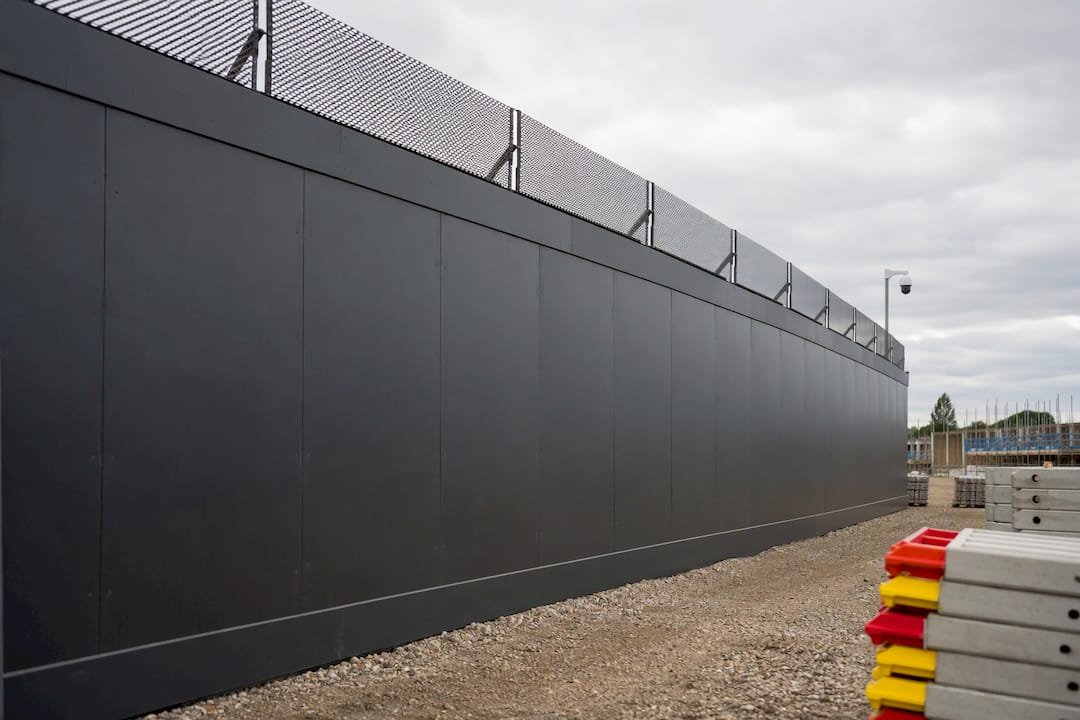
Design matters as much as height. Chamfered corners, no recessed panels, and clear sightlines along the boundary remove the hiding spots that let intruders work unseen. Sectional fencing feet can also create trip hazards on uneven ground, so check placement against your own site layout rather than assuming a standard configuration will fit.
Maintenance is where most sites fall down:
- Walk the full perimeter weekly, not just at incidents.
- Log every repair with date, location and cause.
- Replace damaged anti-climb toppers immediately rather than at the next scheduled visit.
- Consult your local Designing Out Crime Officer before finalising layout on higher-risk urban sites, as Secured by Design advises.
Pro Tip: Photograph your hoarding line at handover and after every storm. A dated photo record settles insurance disputes far faster than a verbal description of “it was fine last week”.
Access control: managing gates, sign-in and subcontractor entry

Fewer entrances mean fewer things to watch. Where the site layout allows it, separate pedestrian and vehicle routes so drivers are not distracted by foot traffic and pedestrians are not routed through reversing plant.
A working access regime needs several layers working together:
- A single, staffed pedestrian gate with a visible sign-in point.
- Photo ID checks against a pre-approved contractor list, not just a name in a book.
- Electronic access such as fobs, PINs or turnstiles for high-turnover trade sites, though biometric systems rarely suit sites with rotating subcontractor gangs.
- Visitor escorting for anyone outside the regular workforce, logged in and out.
- Strict key control, with a single custodian and a signed log for every issue and return.
Our guide to access control for business sites covers the electronic options in more depth if you are weighing fobs against a manned gate.
Designing CCTV and lighting that actually deter and convict
Camera placement only works if the footage is usable. Home Office Surveillance Camera Commissioner guidance sets the technical bar: cameras positioned for recognition quality, not just wide-area coverage, and footage retained long enough to support a prosecution if one follows. Many sites keep footage for barely a week; a 31 day retention window is a more realistic minimum where charges might follow a theft.
Worth knowing: worksite security guidance from the D9 government information paper groups CCTV with lighting, guarded patrols and plant immobilisation as the core measures every site should combine rather than rely on individually. Source: D9 Worksite Security Paper
Practical points for making the two systems work together:
- Position lighting to avoid glare directly into camera lenses, which blinds footage at exactly the moment it matters.
- Portable, solar-powered CCTV units suit sites without a permanent power supply.
- Remote monitoring adds a live response layer that recorded-only footage cannot offer.
Security personnel and response: roles, patrols and escalation
A security guard’s job is deterrence and observation, not directing lorries or checking scaffold tags. Conflating security duties with traffic marshalling dilutes both roles and leaves gaps in coverage.
Decide your model based on site risk and layout:
- Static guards suit single-entrance sites with high footfall or valuable stored plant.
- Mobile patrols suit larger or multi-plot sites where a roaming presence covers more ground.
- Combined coverage works best through the finishing phase, when fit-out materials raise the value of what’s on site.
Patrols need variable timing and routes; a predictable 10pm walk-round trains thieves rather than deterring them. Every guard should receive a site-specific briefing covering lone-worker protocols and a clear escalation path to police for anything beyond routine observation. Our overnight security guide sets out how static and mobile coverage typically combine after dark.
Pro Tip: Ask your provider for incident logs, not just attendance sheets. A guard who reports three attempted breaches a month is doing more for you than one who reports nothing at all.
Protecting plant, tools and materials through every phase
Theft risk shifts as a project progresses. Early phases lose diesel and hand tools; finishing phases lose copper, sanitaryware and fit-out materials worth far more per item.
- Design compounds with a single access point and their own internal lighting and CCTV overlap.
- Immobilise plant with steering locks, removed keys, and clamps on smaller machinery that can otherwise be lifted onto a trailer in minutes.
- Store fuel and hazardous materials in locked, bunded containers away from the main compound.
- Use short-term secure storage or lockable containers for high-value finishing items rather than leaving them palletised in the open.
- Join a local Business Crime Reduction Partnership, which shares intelligence on stolen plant and improves recovery rates when equipment is tagged and reported.
Governance and responsibilities: who actually owns site security
Legal responsibility does not sit with the security guard on the gate. Under CDM 2015 Regulation 13(4)(b), the principal contractor must take reasonable steps to prevent unauthorised access to the site, and that duty then cascades down through the site manager to every subcontractor working within the boundary.
A Security Aspects Letter, issued early and revisited as the project changes, gives everyone on the security chain a single reference point for who is responsible for what, and when.
Practical steps to formalise that chain:
- Issue a Security Aspects Letter (SAL) at project start and update it at major phase changes.
- Involve a Designing Out Crime Officer during design, not after a break-in.
- Document the security ownership chain from client through to individual subcontractors, in writing, not by assumption.
NPSA guidance makes the same point from a different angle: security designed in at the planning stage costs less and works better than security bolted on after a loss.
Turning the plan into a working monthly routine
- Today — lock every gate, immobilise all plant left overnight, and plug any obvious lighting or camera gap with a temporary unit.
- This week — formalise the sign-in regime, brief your security provider on patrol expectations, and notify the local police or Designing Out Crime Officer that works are underway.
- This month — inspect the full hoarding line, test every alarm and camera, review the past month’s incidents, and update the Security Aspects Letter to reflect any changes.
Pro Tip: Put the monthly review on the same calendar as your health and safety audit. Security drifts fastest when it’s treated as a separate task rather than part of routine site management.
Practitioner perspective: what good site security looks like in practice
A proper engagement starts with a site survey, not a quote. A provider worth contracting will walk the boundary, note weak points in writing, and propose coverage matched to the actual risk profile rather than a standard package. Ask for measurable KPIs in the proposal: patrol frequency, response times, incident reduction targets. A brief that cannot be audited against real numbers is not a brief you can manage against later.
Reduced incident reports and improved client satisfaction ratings are the outcomes worth measuring quarter on quarter. When evaluating tenders, focus less on marketing language and more on whether the provider can show how they report, escalate, and adjust patrol patterns as a site changes shape.
— Alex
How NEXUS SECURITY SERVICESES LTD can strengthen your site today
A professional security provider can give site managers a single point of contact for the entire security chain, from static guards and mobile patrols through to monitored CCTV and key control, rather than piecing together separate suppliers for each element.
A site security survey from NEXUS SECURITY SERVICESES LTD starts with a walk of the perimeter and access points, followed by written recommendations you can use directly in your Security Aspects Letter. Reporting is built around measurable outcomes, not just attendance, so you can track incident trends and patrol coverage over time rather than taking assurances on faith. If your site has gaps in perimeter coverage, storage security, or patrol consistency, the construction site theft prevention page sets out how a review works and how to book one for your site this month.
Sources
- HSE — Construction: public protection and site security (CDM duty)
- Secured by Design — Construction site security guide
- National Business Crime Centre — Construction site security guidance
- D9: Worksite security v1.1 — government information paper
FAQ
What security is needed on a construction site?
At minimum, a secured perimeter of at least 2 metres, controlled single-point access, lighting and CCTV with recognition-quality coverage, immobilised plant, and a named person responsible for security under CDM 2015.
What are the HSE requirements for construction site security?
The HSE requires principal contractors to take reasonable steps to prevent unauthorised access under CDM 2015 Regulation 13(4)(b), including perimeter checks, immobilising plant, and removing ladders from excavations when the site is unattended.
Who is responsible for construction site security?
The principal contractor holds the primary statutory duty under CDM 2015, but responsibility cascades down to the site manager and every subcontractor working within the boundary, ideally documented in a Security Aspects Letter.
Is there security at construction sites?
Most active sites use some combination of static guards, mobile patrols, monitored CCTV and access control, with the mix chosen according to site value, location and phase; NEXUS SECURITY SERVICESES LTD tailors this combination to each site’s specific risk profile.


0 Comments