

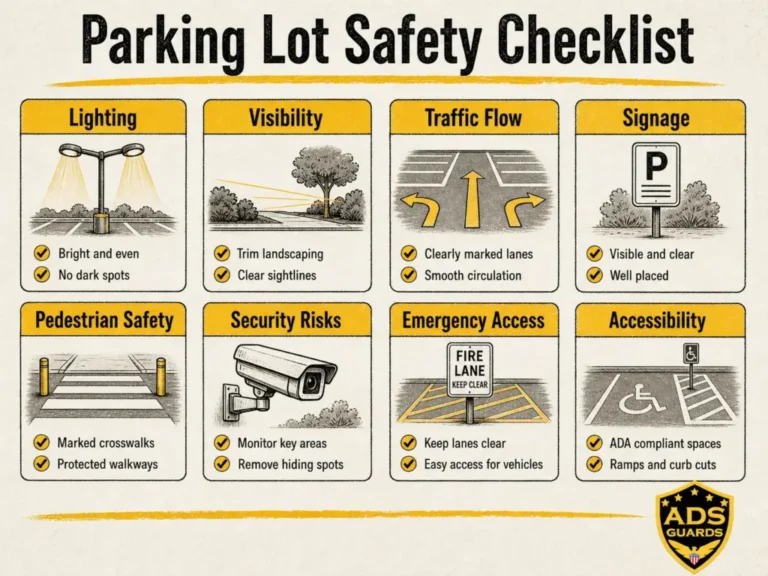
Effective parking lot security combines glare-free lighting, environmental design, CCTV with analytics, controlled access, visible patrols, and a maintenance regime tight enough to keep every control working. No single measure carries the load. A site that installs cameras but neglects lighting, or fits an ANPR barrier without a verification protocol, has bought equipment instead of security. The technology only earns its cost when a maintenance and monitoring operation sits behind it, and the Park Mark pathway offers a credible route to prove the whole system holds together.
TL;DR:
- Improving parking lot security requires a layered approach with lighting, environmental design, CCTV analytics, access controls, and patrols working together.
- Immediate measures include fixing lighting, removing obstructions, and adding temporary signage, while long-term plans focus on layout redesign and accreditation pursuit.
- Camera selection must match site geometry, with specific types for entrances, open areas, and license plate recognition, and should meet technical specs for night, weather, and evidence export.
- Effective CPTED strategies involve natural surveillance, removal of hiding spots, and clear pedestrian routes, with simpler design tweaks often outperforming costly electronic upgrades.
- Regular maintenance, clear incident response, staffed patrols, and formal monitoring are essential to prevent neglect, false alarms, and equipment failure from undermining actual security.
Table of Contents
- What a parking lot security plan should include: short, medium and long-term actions
- Cameras and surveillance: which types to use, what analytics add, and how to specify them
- Lighting and CPTED: designing out crime and improving camera performance
- Access control and physical barriers: ANPR, gates, bollards and emergency access
- Staffing, monitoring and incident response: patrols, remote operators and escalation
- Maintenance and service levels: SLAs and routines that keep controls effective
- Compliance and accreditation: Park Mark, police liaison and data protection
- Budgeting and procurement: cost drivers, OPEX vs CAPEX and a procurement checklist
- Nexus Security Services: practitioner checklist and outcomes
- What usually fails, and the sensible priorities for facility teams
- How Nexus can help: request a site survey and operational brief
- Sources
- FAQ
What a parking lot security plan should include: short, medium and long-term actions
Most facilities teams inherit a car park rather than design one, which means the plan has to work in layers. Immediate fixes cost little and buy time; longer-term investment closes the gaps that quick wins cannot reach.
Immediate actions (this week):
- Walk the site at dusk and note every dark spot, obscured corner, and dead camera angle.
- Repair or replace failed lighting and clear overgrown planting blocking sightlines.
- Add temporary signage warning that the area is monitored, even before new cameras arrive.
- Introduce short-term manned checks at known trouble spots while permanent fixes are scoped.
Short term (weeks to months):
- Reposition or add CCTV to cover recognised blind spots, and switch on analytics where the hardware supports it.
- Install or upgrade access control at vehicle entry points, prioritising areas with repeat incidents.
- Tamper-proof exposed cabling, camera housings, and control panels.
Long term (months to years):
- Redesign layout where communal, unallocated bays create anonymity, since allocated visitor parking measurably reduces vehicle crime compared with shared rear courts.
- Pursue Park Mark accreditation as a structured way to formalise the whole programme.
- Commission a monitoring and maintenance contract with defined service levels rather than relying on ad hoc callouts.
Track incident reports, maintenance response times, and repeat-offence locations as your core KPIs. Loop in your local police crime-prevention adviser early. Their view on hotspots and known offending patterns often reshapes the priority order more usefully than any generic checklist.
Cameras and surveillance: which types to use, what analytics add, and how to specify them
Camera choice should follow the site’s geometry, not a supplier’s default package. Fixed cameras suit entrances, payment points, and choke points where a stable, predictable view matters more than flexibility. PTZ cameras earn their cost in large, open lots where an operator needs to follow activity across a wide area, but they are only as good as the person controlling them, since an unmonitored PTZ typically parks on one view and misses everything else. Panoramic or multi-sensor cameras cover broad bay areas efficiently with fewer poles and less cabling. LPR/ANPR cameras belong at entry and exit lanes, angled and mounted specifically for plate capture, not repurposed general-view units.
Analytics genuinely worth paying for include ANPR matching against permit lists, loitering detection near payment points, and object-left or object-removed alerts near high-value zones. Treat people-counting and generic “AI detection” claims with some caution. They perform well in supplier demonstrations and less reliably in low light, rain, or a busy multi-storey with reflective surfaces.
Specification details that determine whether a system actually works:
- Mounting height and angle calibrated for the analytic in use, particularly for ANPR plate capture
- Infrared for general night coverage, white light where colour identification of clothing or vehicles matters
- Vandal-resistant, weatherproof housings rated for outdoor exposure (IP66 or higher)
- Bandwidth and storage sized for continuous recording, not just motion-triggered clips
- Timestamp synchronisation across all cameras and access control devices, essential for evidence
Pro Tip: Ask any supplier to demonstrate footage export in the exact format your local police force accepts. A system that produces beautiful live views but exports proprietary, unplayable files is worthless the moment you need evidence.
Lighting and CPTED: designing out crime and improving camera performance
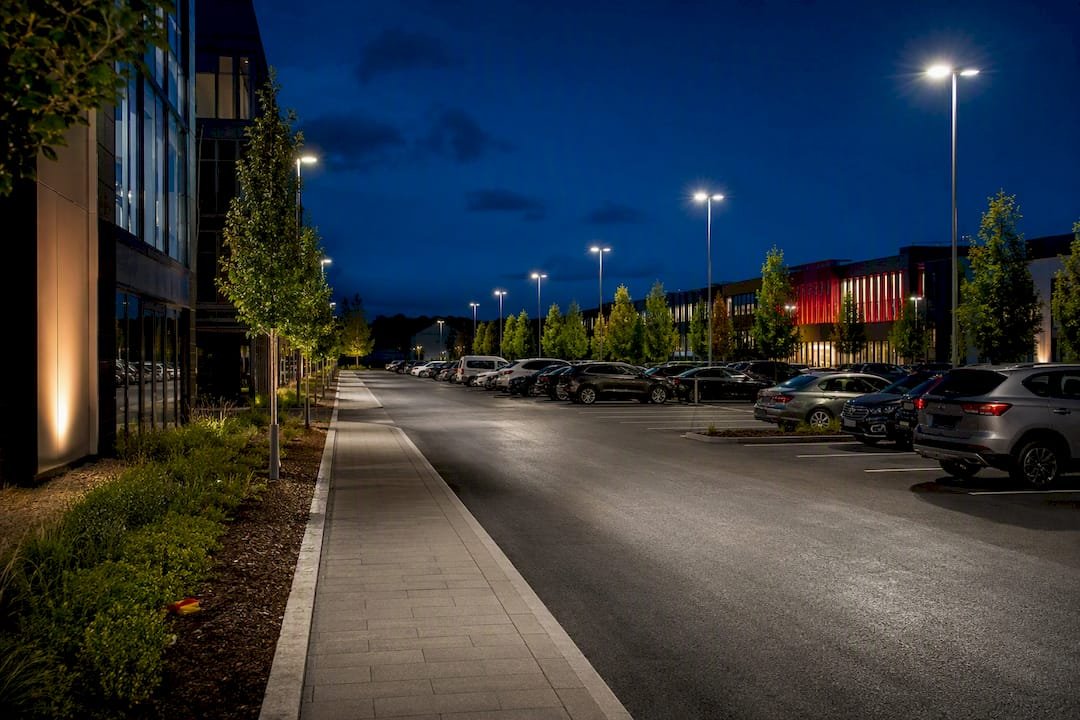
Lighting decides whether your cameras can actually see anything. Glare-free, even illumination across bays, walking routes, and payment points removes the shadows offenders rely on and improves how confident people feel walking to their car after dark. Good lighting specification avoids the common mistake of over-lighting entrances while leaving the far corners of a lot in near darkness, and it avoids placing fittings where they backlight a camera and blind its sensor.
Crime Prevention Through Environmental Design (CPTED) works alongside lighting rather than instead of it. CPTED research treats space, physical devices, and management activity as one system, and the strongest results tend to come from getting the space right before adding devices on top. Practical CPTED measures for a parking lot include:
- Maximising natural surveillance from adjacent buildings, reception desks, or main pedestrian routes
- Removing or lowering planting and structures that create blind corners or hiding spots
- Using low-maintenance ground cover that will not regrow into a sightline problem within a season
- Marking clear, well-lit pedestrian routes that separate people from reversing vehicles
A same-day site walk, done at both midday and after dark, is usually enough to build a dark-spot and concealment map. Prioritise fixes where a blind spot overlaps with a payment point, a pedestrian route, or a low-traffic corner, since that combination is where opportunistic offending concentrates. One detail facilities teams consistently underestimate: even simple design changes, such as removing a wall section or cutting back overgrown hedging, often outperform an expensive camera upgrade at a fraction of the cost.
Access control and physical barriers: ANPR, gates, bollards and emergency access
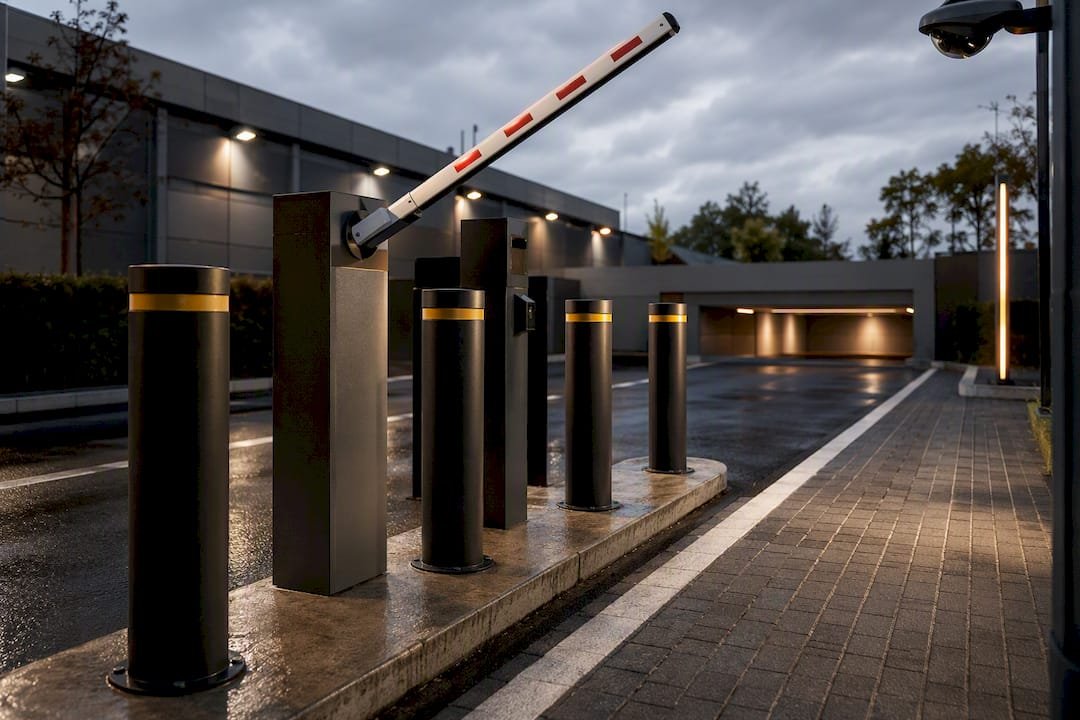
ANPR works best as a permit-control and audit tool rather than a stand-alone deterrent. It reliably flags unregistered vehicles and creates a timestamped record of every entry and exit, but its accuracy depends entirely on plate legibility, meaning poor lighting, dirty plates, or extreme camera angles will produce misreads that undermine confidence in the whole system.
Physical barriers each carry trade-offs worth weighing before you specify:
- Rising-arm barriers are cost-effective and familiar to drivers but vulnerable to tailgating unless lane design forces single-vehicle entry.
- Bollards suit pedestrian-priority zones and low-speed vehicle exclusion but do nothing to manage traffic flow.
- Full-height turnstile gates cut tailgating risk significantly but need careful thought for emergency vehicle access.
- Intercom-linked lanes reduce tailgating by forcing a verification pause before the barrier lifts, particularly effective for visitor or contractor entrances.
Every barrier needs a fail-safe mode that opens automatically on power loss or fire alarm activation, and this needs testing on a schedule, not just specified once and forgotten. A technical brief for any access control supplier should cover integration with your existing CCTV and ANPR platform, full logging of every open and close event, and an agreed service level agreement for fault response.
Staffing, monitoring and incident response: patrols, remote operators and escalation
Technology without guardianship underperforms. Industry evidence points to formal surveillance and visible presence reducing vehicle crime more effectively than passive recording alone, which is why the staffing model deserves as much planning attention as the hardware spec.
- Compare your options honestly. Uniformed on-site staff offer the strongest visible deterrent and immediate response but cost the most. Mobile patrols cover multiple sites at lower cost with less continuous presence. Remote monitoring scales cheaply across many cameras but depends entirely on operator response speed.
- Set clear verification rules. Define exactly what triggers an alert escalation to a human, and what counts as confirmed activity versus a false positive, to stop operators drowning in noise.
- Randomise patrol timing. Predictable patrol routes get learned and worked around within weeks; varying the route and timing keeps the deterrent effect genuine.
- Track the right numbers. Response time from alert to physical intervention, false alarm rate, and outstanding maintenance tickets tell you more about real performance than incident counts alone.
Pro Tip: A remote operator who has never walked your site will misjudge what looks suspicious. Insist on a site induction, even a short video walkthrough, before go-live.
Maintenance and service levels: SLAs and routines that keep controls effective
A broken barrier or a flickering light does more damage than the fault itself. Practitioner guidance is blunt about this: neglected equipment signals to offenders that nobody is watching, echoing the “broken windows” effect seen across wider crime prevention work.
A defensible maintenance routine covers:
- Scheduled lighting checks and prompt bulb or fitting replacement, not a reactive-only policy
- Camera lens cleaning and focus verification, since a dirty or misfocused lens defeats analytics silently
- Periodic ANPR recalibration, particularly after any camera repositioning
- Firmware updates applied on a fixed cycle rather than left indefinitely
- Evidence integrity checks confirming footage exports correctly and timestamps stay synchronised
Contracts should specify mean time to repair, a monitoring uptime guarantee, and a fixed reporting cadence, with penalties for missed SLAs and a periodic joint review to test response drills against real scenarios.
Compliance and accreditation: Park Mark, police liaison and data protection
Park Mark is the UK’s recognised benchmark for safer parking, and assessors examine both management procedures and physical measures rather than ticking a hardware checklist. The British Parking Association’s own guidelines set out layout, signage, lighting, and surveillance expectations, and recommend contacting your area manager before applying so gaps get flagged ahead of a formal assessment.
Key considerations:
- Accredited assessors and your local police crime-prevention adviser will often spot design flaws a supplier’s spec sheet misses entirely.
- Demonstrable crime levels at or below local benchmarks are typically required for accreditation to succeed.
- GDPR governs CCTV and ANPR retention periods, signage requirements, and the lawful basis for processing footage; specifics vary by use case, so involve legal review rather than relying on generic templates.
- Well-organised, timestamped evidence logs make the difference between a usable investigation file and a wasted incident.
Budgeting and procurement: cost drivers, OPEX vs CAPEX and a procurement checklist
Total cost of ownership always exceeds the installation invoice. Camera and barrier hardware is often the smallest long-term line item once monitoring contracts, maintenance visits, and eventual replacement cycles are added up.
- Model the full cost. Include installation, ongoing monitoring, scheduled maintenance, and a realistic replacement timeline, typically five to seven years for outdoor camera hardware.
- Choose OPEX or CAPEX deliberately. CAPEX purchase suits sites wanting asset ownership and predictable long-term costs; OPEX-based managed services suit sites wanting monitoring, maintenance, and upgrades bundled into one predictable monthly figure without a large upfront outlay.
- Build a procurement checklist. Cover a documented risk assessment, a written requirements specification, integration needs with existing systems, agreed SLAs, evidence of supplier competence, and clear evidence-handling procedures.
- Pilot before scaling. Trial a new control on one zone, measure incident and false-alarm data over a defined period, then expand only once the operational model proves itself.
Nexus Security Services: practitioner checklist and outcomes
A specialist security services provider offers comprehensive solutions across retail, corporate, and construction sectors, addressing theft prevention, event management, and 24/7 surveillance. The approach pairs technology with trained personnel and a maintenance loop, aimed at reducing incident reports and improving client security satisfaction over the life of a contract.
When surveying a site, the assessment typically covers:
- Lighting coverage across bays, routes, and payment points
- Sightlines and concealment points affecting natural surveillance
- Camera coverage gaps and analytics suitability
- ANPR lane design and permit logic
- A patrol plan matched to the site’s actual risk profile, not a generic template
What usually fails, and the sensible priorities for facility teams
Most parking lot security failures trace back to the same three causes: neglected maintenance, an over-reliance on passive recording nobody watches in real time, and poor sightlines that no camera angle can fully compensate for. Add a fourth: buying equipment before defining who verifies an alert and who fixes a fault, and you get a system that looks impressive on a spec sheet and does very little in practice.
The sensible order of operations reverses how most projects actually run. Do the risk assessment first, on paper, before any supplier conversation. Fix sightlines and lighting next, since design fixes frequently outperform electronic upgrades at lower cost. Only then move to specification and a pilot, with maintenance SLAs locked in before go-live rather than negotiated afterwards as an afterthought.
— Alex
How Nexus can help: request a site survey and operational brief
An operational security partner may cover manned patrols, integrated monitoring, and maintenance planning under one contract, rather than leaving clients to coordinate a camera installer, a monitoring centre, and a maintenance contractor separately.
A proper site survey should produce a written risk assessment, a prioritised list of quick wins you can act on immediately, and a clear proposal covering system integration and service level agreements before any hardware gets ordered. That sequencing matters: it stops you paying for cameras before the layout and lighting issues that undermine them get fixed. If theft, vandalism, or repeat incidents are already a problem on your site, request a survey through our construction and site theft prevention page and get a written brief covering exactly what your car park needs, in what order, and at what service level.
Sources
The Park Mark safer parking award sets the UK benchmark most facilities teams should aim for, since it formalises both management procedure and physical security standard in one accreditation. The British Parking Association’s assessment guidelines give the detailed layout, signage, and surveillance criteria assessors actually check against. For layout and sightline decisions, planning-out-crime guidance explains how CPTED principles apply specifically to parking design. For the operational side, a practitioner’s guide to car park security covers maintenance routines and evidence handling in practical detail.
- Park Mark safer parking award (Bromley Council)
- Car parking and crime briefing (University of Huddersfield ePrints)
- How to light outdoor car parks (DW Windsor)
FAQ
What is the single most cost-effective first step?
A dusk-and-dark site walk to map dead lighting and concealment points, since design and lighting fixes often deliver better results than new equipment, at far lower cost.
Do I need Park Mark accreditation to have effective security?
No, but pursuing it forces you to document management procedures and physical measures against a recognised national benchmark, which most ad hoc setups never do.
Is CCTV alone enough to deter theft?
No. Passive recording without monitoring or patrols consistently underperforms compared with visible guardianship paired with technology.
How often should lighting and cameras be inspected?
Lighting checks and lens cleaning should sit on a fixed schedule, not a reactive one, because neglected equipment signals a lack of oversight that emboldens opportunistic offending.
Should I choose OPEX or CAPEX for my security contract?
CAPEX suits teams wanting outright ownership; OPEX suits those wanting monitoring, maintenance, and upgrades bundled into one predictable cost, which is why many facilities teams default to a managed service model like those provided by professional security service companies.


0 Comments