

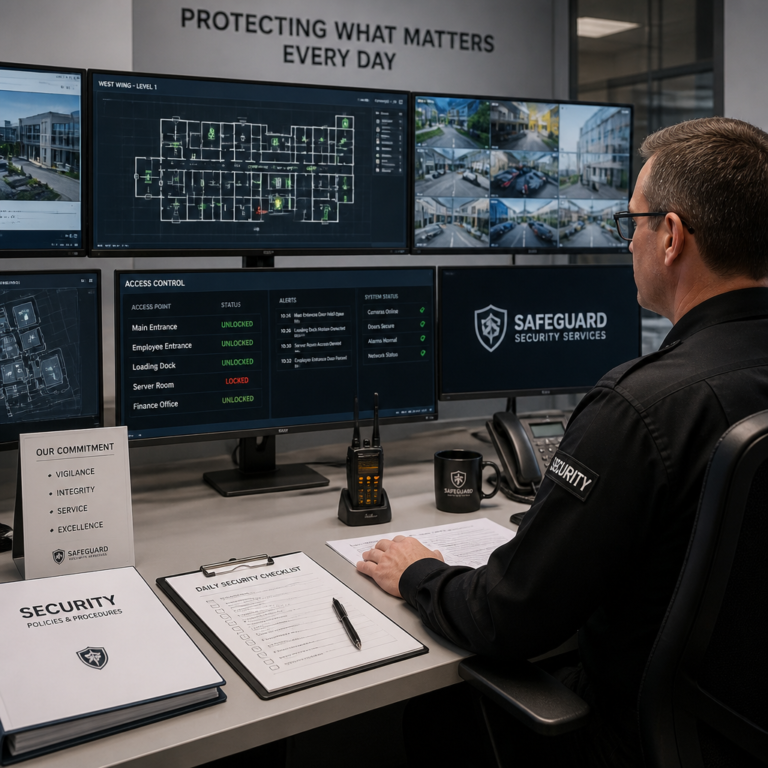
Most UK businesses that end up with the wrong security provider say the same thing: they focused on price and assumed the rest would follow. It rarely does. Choosing a manned guarding UK provider is a procurement decision with real operational consequences. A poor choice means unvetted officers on your site, gaps in patrol coverage, zero understanding of your sector’s risks, and a provider that disappears the moment something goes wrong. This guide cuts through the noise and tells you exactly what to look for, what to question, and what to walk away from, whether you are managing a construction site, a corporate facility, or a retail portfolio.
Table of Contents
- Why Provider Selection Matters More Than You Think
- Quick Takeaways
- SIA Licensing and Regulatory Compliance
- Sector-Specific Experience Is Non-Negotiable
- Comparing Manned Guarding Service Models
- What a Credible Commercial Security Provider Looks Like
- Red Flags That Disqualify a Provider Immediately
- How to Structure Your Evaluation Process
- Frequently Asked Questions
- References
Why Provider Selection Matters More Than You Think
Manned guarding is not a commodity. The officers deployed to your site represent your brand, exercise legal authority over access, and are often the first responders to incidents that could become costly, dangerous, or reputationally damaging. The security guard company UK businesses tend to overlook is not the one with the flashiest proposal. It is the one that quietly delivers consistent, trained personnel shift after shift without drama.
The UK manned guarding sector is crowded. There are hundreds of registered providers, from large nationals to regional independents. Size alone tells you very little about quality. Some of the largest players in the market are known for high officer turnover, generic deployment, and account management that vanishes after the contract is signed. Some smaller, specialist providers deliver measurably better outcomes precisely because they understand your sector and can be held directly accountable.
The question is never simply “can they provide guards.” It is whether they can provide the right guards, consistently, with the sector knowledge and oversight structure your site actually requires.
Quick Takeaways
Key Insight | Explanation |
|---|---|
SIA licensing is the legal baseline, not a differentiator | Every legitimate manned guarding provider in the UK must deploy SIA-licensed officers. If a provider presents this as a selling point above anything else, keep looking. |
Sector experience separates good providers from adequate ones | A provider with no construction site experience should not be managing CDM 2015 compliance or securing a live build. Ask for verified references from your specific sector. |
Officer vetting depth varies significantly across providers | BS 7858 screening is the industry standard for vetting. Confirm your provider applies it to every officer, including relief and temporary cover personnel. |
Mobile patrols and static guarding serve different purposes | Static guards provide continuous presence and access control. Mobile patrols cover larger or multi-site footprints cost-effectively. Most commercial sites need a considered mix of both. |
Contract transparency reveals how a provider operates | Providers who cannot clearly explain officer-to-supervisor ratios, escalation procedures, and incident reporting formats before signing are not operationally mature. |
Account management quality predicts long-term service consistency | Ask who your named account manager will be and how often they will visit your site. A provider with no named contact structure is operating reactively, not proactively. |
Price pressure is the leading cause of security failure | Providers quoting significantly below market rate are cutting somewhere. That cut typically lands on officer pay, training quality, or supervision frequency. |
Understanding these seven points alone will save you from the most common and costly mistakes UK facility managers and construction companies make when procuring manned guarding. The sections below give you the structure to act on each one.
SIA Licensing and Regulatory Compliance
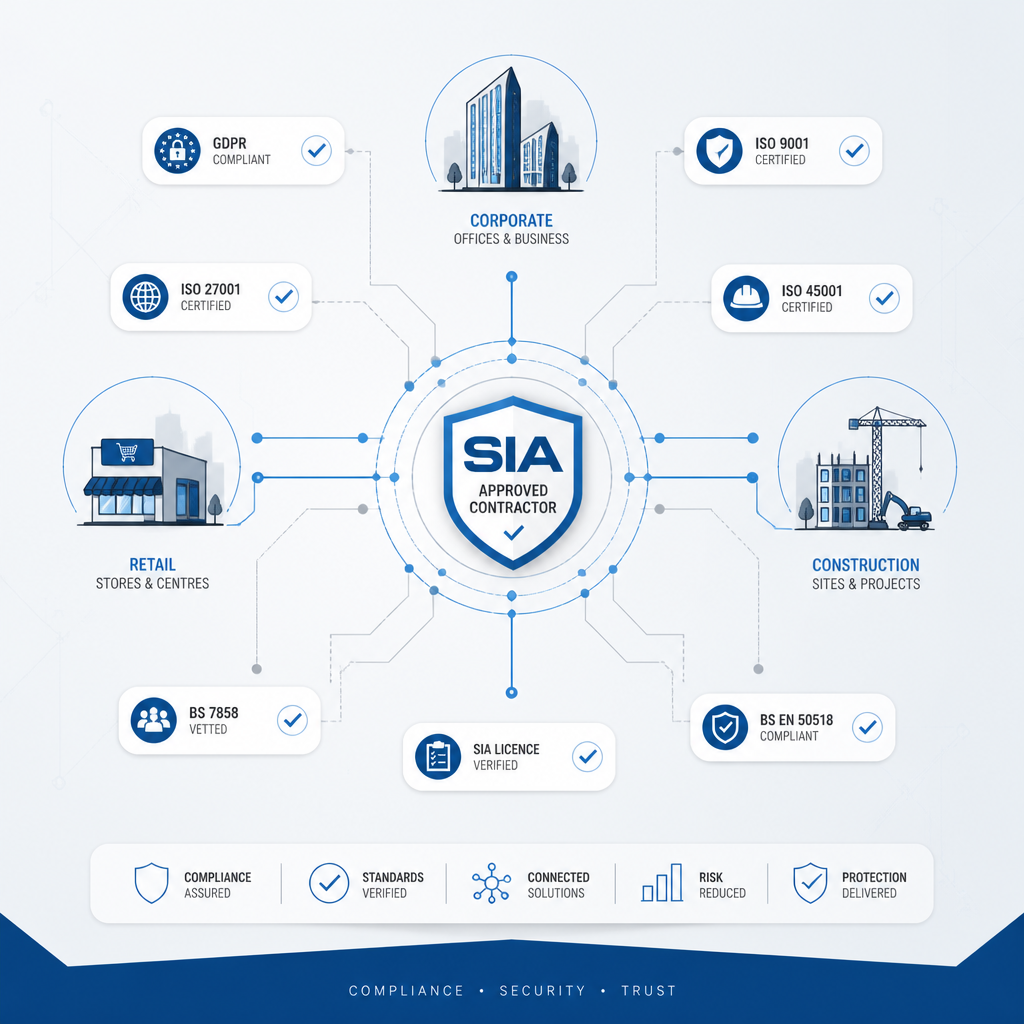
The Security Industry Authority (SIA) is the UK regulator for the private security industry. Any individual providing manned guarding services in the UK must hold a valid SIA licence. This is a legal requirement, not optional best practice. Before you engage any provider, verify that every officer they propose to deploy carries a current, valid SIA Door Supervisor or Security Guard licence relevant to the role.
How to Verify SIA Licences Before Deployment
The SIA provides a free online licence checker at the official SIA website. Use it. Do not accept a provider’s assurance that their officers are licensed without checking at least a sample yourself, particularly for any new mobilisation. Licences expire and officers sometimes continue working after their licence lapses if the provider’s internal compliance checks are inadequate.
Beyond individual officer licensing, look at whether the provider holds the SIA’s Approved Contractor Scheme (ACS) status. ACS accreditation means the company has been independently assessed against SIA quality standards covering management systems, officer welfare, training, and operational delivery. It is not a guarantee of excellence, but it does indicate a minimum standard of organisational maturity that unaccredited providers cannot demonstrate.
CDM 2015 Compliance for Construction Sites
If you are procuring security for a construction environment, compliance goes beyond the SIA. The Construction (Design and Management) Regulations 2015 (CDM 2015) create specific health and safety obligations on site. A provider working in construction must understand how their officers fit within that framework, including reporting lines to the Principal Contractor, emergency procedures, and site access control requirements.
Most general commercial security providers have no meaningful CDM 2015 awareness. If you ask a provider’s sales representative to explain how their officers operate within a CDM 2015 compliant site and they hesitate, that tells you everything you need to know about their construction capability.
Pro tip: Ask every shortlisted provider to confirm in writing how they verify SIA licence renewals for existing deployed officers, not just at the point of hire. The answer to this one question separates compliant providers from those running on paperwork alone.
Sector-Specific Experience Is Non-Negotiable
A commercial security provider that claims to serve every sector equally is almost certainly serving none of them particularly well. Security risks, operational protocols, and compliance requirements differ substantially between a retail environment, a corporate headquarters, a construction site, and an event venue. The officer behaviours, access control approaches, and incident escalation procedures that work in one context can actively create problems in another.
Construction Site Security
Construction sites present a specific combination of risks: plant and materials theft, unauthorised access from trespassers or protesters, fire risk from improper hot works, and subcontractor access management across shifting working hours. An effective provider for this environment trains officers in site-specific access control, understands how to manage multiple subcontractor workforces, and knows when to escalate to the Principal Contractor rather than handle a situation independently.
Providers like Nexus Security Services that specialise in construction site protection bring direct knowledge of CDM 2015 compliance and the rhythms of a live build environment. That operational familiarity is worth paying for. A guard who has never worked a construction site will underperform on one, regardless of their SIA licence.
Retail and Corporate Security
Retail environments require officers trained in customer interaction, conflict de-escalation, and loss prevention protocols without alienating legitimate shoppers. Corporate facilities demand officers who understand visitor management, professional conduct, and the sensitivity of the premises they are protecting.
When evaluating a provider for retail or corporate deployment, ask specifically about the training modules their officers complete beyond SIA licence requirements. Ask whether officers receive sector-specific briefings before deployment. Ask who briefs them on your site’s specific risks, layout, and escalation contacts. A provider who cannot answer these questions in detail has not thought about your site as an individual deployment. They have thought about filling a roster.

Comparing Manned Guarding Service Models
Not every security requirement calls for the same deployment model. Understanding the operational differences between service types lets you match your actual risk profile to the right solution, rather than buying whatever the provider defaults to recommending.
Service Model | Best Suited For | Key Considerations |
|---|---|---|
Static Guarding | High-value sites, controlled access points, corporate receptions, construction site gates, retail entrances | Continuous visible presence; officer is fixed to a location. Ideal where deterrence and access management are the primary need. Cost reflects the continuous deployment hours. |
Mobile Patrols | Multi-site portfolios, vacant properties, large perimeters, out-of-hours commercial premises | One officer covers multiple locations at scheduled or random intervals. More cost-effective for low-footfall hours. Less suitable where real-time access control is required continuously. |
Event Security | Corporate events, public gatherings, product launches, venue security | Requires crowd management training, conflict resolution skills, and coordination with venue management and emergency services. Provider must demonstrate specific event experience, not just general guarding capability. |
In practice, most commercial sites benefit from a hybrid approach: static guarding during operational hours when access control is critical, combined with mobile patrols for out-of-hours coverage. A provider who only pushes one model regardless of your site’s actual risk profile is either not listening or does not have the operational range to offer alternatives.
A visible, trained security presence continues to deter criminal activity by preventing theft, vandalism, and unauthorised access, providing a level of deterrence and control that cannot be replicated by surveillance alone.
Pro tip: Request a written site risk assessment from any provider before they recommend a service model. If they propose a deployment without first conducting or requesting one, their recommendation is based on their sales margin, not your security requirements.
What a Credible Commercial Security Provider Looks Like
Beyond licensing and sector experience, there are structural indicators that separate operationally credible providers from those who win contracts and then underdeliver. These are things you can assess before signing anything.
Officer Vetting Standards
BS 7858 is the British Standard for screening individuals in security environments. It covers identity verification, employment history checks, criminal record checks, and right-to-work verification. Any provider serious about quality applies BS 7858 screening to every officer, including relief staff brought in to cover absences. Ask directly whether their vetting process applies to all cover officers. Many providers apply rigorous vetting to permanent staff but bring in agency relief staff with minimal background checks. That is where compliance gaps happen.
Supervision and Quality Oversight
A provider with no clear supervision structure for deployed officers is not a provider managing a security service. They are a staffing agency. Ask for the officer-to-supervisor ratio. Ask how supervisors conduct quality checks, how frequently, and what happens when an officer underperforms on your site. A credible provider has documented answers to all of these questions and can show you their incident reporting format, duty log requirements, and escalation chain without hesitation.
Technology Integration
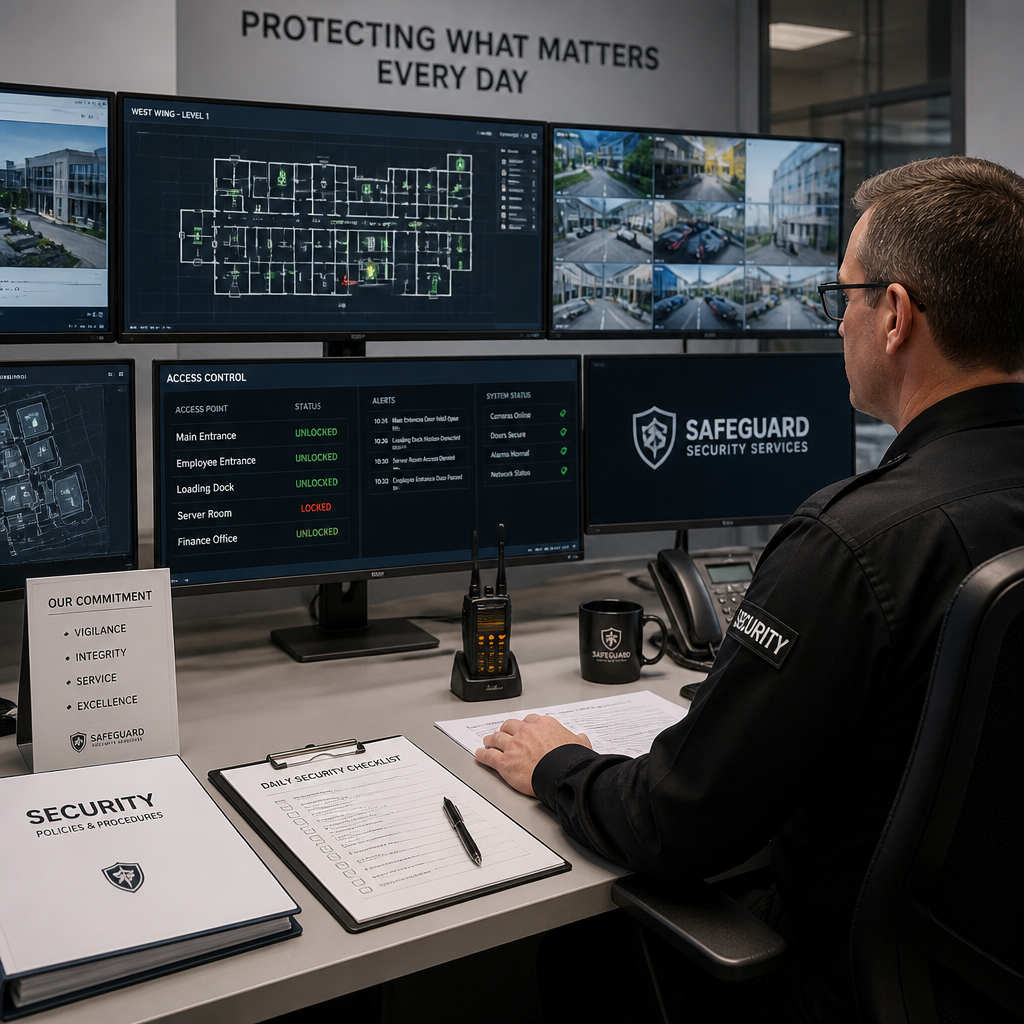
Modern manned guarding providers use technology to support and verify officer deployment, not replace it. This includes GPS-tracked mobile patrols, electronic duty logging, real-time incident reporting to clients, and guard tour monitoring systems. Ask any provider what technology their officers use during deployment and how you as the client receive incident reports. If the answer is a handwritten log and a phone call, consider whether that meets your operational and legal documentation requirements.
Red Flags That Disqualify a Provider Immediately
Some provider behaviours should end the conversation before it progresses further. Recognising them early saves time and protects your site.
A provider who cannot confirm SIA licence validity for specific named officers prior to deployment is not operationally ready. A provider who cannot name your dedicated account manager during the procurement conversation has no account management structure. A provider who quotes a price significantly below comparable market rates without explaining where that cost saving comes from is cutting corners on officer pay, training, or supervision. Officers paid below the real living wage have high turnover. High turnover means your site regularly receives unfamiliar officers who do not know your layout, your escalation contacts, or your specific risk points.
Providers who rely entirely on subcontracted officers rather than directly employed personnel present a different set of risks. Accountability becomes diffuse, vetting standards become inconsistent, and the provider cannot guarantee that the officers who arrive on your site have been trained to their stated standard.
Finally, be cautious of providers who cannot provide verifiable references from clients in your sector. Testimonials on a website prove nothing. A named contact at a comparable business who will take your call and speak honestly about service delivery is the only reference that counts.
How to Structure Your Evaluation Process
Procurement decisions made under time pressure consistently produce poor outcomes. If you are replacing an existing provider or procuring security for a new site, build enough lead time to run a proper evaluation process. Four to six weeks is a realistic minimum for a single-site procurement. Multi-site contracts warrant longer.
The Questions That Reveal Operational Reality
Ask every shortlisted provider the following and compare the quality and specificity of their answers: How do you manage officer absences and ensure cover at short notice? What is your process when an officer makes an error on site? How do you communicate incidents to clients and in what timeframe? What training do officers receive beyond their SIA licence? Who is our named account manager and how often will they visit our site?
Weak, vague answers to these questions indicate a provider who has not thought carefully about operational delivery. Specific, documented answers indicate a provider who runs a real operation.
Site Visit Before Contract Award
Any provider worth contracting will conduct a thorough site visit before proposing a solution. They should be assessing access points, identifying risk areas, understanding your operational hours and workforce patterns, and asking questions about your specific concerns. A provider who quotes without visiting your site is guessing. Their solution will reflect that.
Nexus Security Services, for example, offers sector-specific expertise across construction, retail, corporate, and event environments across the UK, bringing the kind of site-level understanding that general providers cannot replicate. That operational specificity matters when your site has particular compliance requirements or non-standard risk profiles.
Frequently Asked Questions
What is the difference between SIA-licensed guarding and ACS-accredited providers?
SIA licensing applies to individual officers and is the legal minimum for anyone providing manned guarding services in the UK. ACS (Approved Contractor Scheme) accreditation applies to the company as a whole and indicates that the organisation has been assessed against SIA quality standards covering management, training, welfare, and operational delivery. Choosing an ACS-accredited provider gives you an additional layer of assurance that the company is operationally organised, not just capable of supplying licensed individuals.
How do I verify that a security guard holds a valid SIA licence?
The SIA provides a free public licence checker on their official website. You can search by licence number or officer name. Use it before deployment for any new officer assigned to your site, and periodically for longer-term deployments. Licences expire on a fixed date and providers do not always flag renewal gaps proactively.
Should I choose a national security company or a specialist regional provider?
Neither size alone is a reliable indicator of quality. Large nationals have scale and sometimes broader technology infrastructure, but they also carry the risk of impersonal account management and high officer turnover. Specialist regional or sector-focused providers often deliver more consistent, accountable service precisely because they cannot afford to lose a client. The right answer depends on your site’s complexity, your sector’s specific requirements, and how much direct accountability you need from your provider day to day.
What is BS 7858 and why does it matter for manned guarding?
BS 7858 is the British Standard that sets the requirements for screening personnel employed in environments where the security of people, property, or information matters. For manned guarding, it covers identity verification, right-to-work checks, employment history, and criminal record screening. It matters because the standard of vetting determines the reliability and trustworthiness of the officers on your site. Providers who apply BS 7858 rigorously to all deployed personnel, including relief and temporary cover staff, operate at a measurably higher standard than those who apply it selectively.
What should a manned guarding contract include as a minimum?
A credible manned guarding contract should specify officer licensing and vetting requirements, service hours and coverage model, officer-to-supervisor ratios, incident reporting timelines and formats, KPIs and performance review periods, substitution and cover procedures, termination and notice periods, and named account management contacts. Any provider resistant to including these as contractual commitments rather than verbal assurances is protecting their operational flexibility at your expense.
How can I tell if a manned guarding provider genuinely understands construction site security?
Ask them directly about CDM 2015 and their officers’ role within a compliant site. Ask how they manage subcontractor access logging. Ask what their protocol is when an unauthorised individual is found on site outside working hours. Ask who their officers report to in an emergency and how that integrates with the Principal Contractor’s emergency procedures. A provider with genuine construction experience will answer these questions fluently and specifically. A provider without it will generalise.
If you have recently evaluated or switched manned guarding providers for your UK business, share what made the difference in your decision, your experience helps other facility managers avoid the same mistakes.


0 Comments