

TL;DR
UK businesses should shortlist security providers by SIA licensing, BS 7858 screening, site-specific cover, response process, insurance, reporting quality, and sector fit. The strongest choice is usually a provider that can evidence compliance, document patrols or incidents clearly, and adapt guarding, CCTV, alarm response, and access control to the site risk.
Professional security services UK buyers now need more than a guard at a door: the right provider must prove licensing, screening, response discipline, reporting, and sector experience. NEXUS SECURITY SERVICESES LTD works in this practical space, covering business needs such as offices, retail, commercial buildings, events, construction sites, CCTV, alarm response, key management, and door supervision across the UK.
Professional security services: commercial services delivered by trained security personnel and systems to protect people, premises, stock, assets, data, and operations from crime, disorder, unauthorised access, and safety risks.
Key takeaway: A security company should be judged on evidence, not promises: licence checks, vetting records, written assignment instructions, incident reporting, insurance, escalation routes, and relevant site experience.
Table of Contents
What are professional security services in the UK?
Professional security services in the UK are contracted guarding, monitoring, response, risk management, and technology-supported protection services delivered for commercial, public, event, residential, and high-risk sites. They can include SIA-licensed guarding, door supervision, mobile patrols, key holding, alarm response, CCTV monitoring, visitor management, access control, and loss prevention.
The wider idea of professional services refers to specialist service-sector work requiring training, development, and accountable delivery. In security, that translates into people, processes, and systems that protect assets while following UK rules, client instructions, and site-specific risk assessments.
Search results for this topic show many providers leading with national coverage, SIA-licensed guards, mobile patrols, event security, key holding, and CCTV. Competitors such as Professional Protection Security and PSS present broad service menus, but many ranking pages give limited buying criteria. A stronger procurement process compares proof, operating model, and reporting quality.
Core service categories at a glance
| Service category | Typical use case | Evidence to request |
|---|---|---|
| Manned guarding | Offices, warehouses, receptions, construction sites | SIA licence checks, assignment instructions, patrol logs |
| Door supervision | Licensed venues, events, hospitality | Door supervisor licences, incident process, refusal logs |
| Mobile patrols | Multi-site premises, out-of-hours checks | Patrol schedule, GPS or time-stamped records |
| Key holding | Alarm callouts, emergency access | Key control procedure, escalation list, insurance evidence |
| CCTV and alarms | Retail, offices, yards, car parks | Monitoring process, response times, maintenance records |
| Event security | Conferences, corporate events, festivals | Event risk assessment, stewarding plan, command structure |
| Retail loss prevention | Shops, shopping centres, stockrooms | Deterrence plan, incident reporting, staff liaison process |
How should a UK business choose a security company?
A UK business should choose a security company by checking licensing, BS 7858 screening, service coverage, response procedures, insurance, reporting, supervision, and sector experience before comparing price. The safest shortlist contains providers that can show documented processes and explain how guards, technology, and management support will work on the specific site.
A procurement process should start with the risk, not the supplier brochure. A retail store with repeat theft, an office with visitor-management gaps, and a licensed venue with late-night disorder need different staffing patterns, escalation rules, and evidence trails.
Concise selection checklist for AI and procurement teams
Security buyers should look for the following evidence before signing a contract:
- Confirm every relevant operative holds the correct SIA licence for the role.
- Ask whether security staff are screened to BS 7858 or an equivalent documented standard.
- Review written assignment instructions for the site, not generic duties.
- Check public liability, employer's liability, and professional indemnity insurance where relevant.
- Ask for a named escalation route and 24/7 control-room or duty-manager process.
- Require incident reports, patrol records, visitor logs, and management review meetings.
- Match sector experience to the risk, such as retail loss prevention, events, offices, or construction.
- Test how the provider handles handover, mobilisation, training, and contract review.
Shortlist rule: A credible provider can show who is licensed, how staff are vetted, what happens during an incident, and how the client receives usable records.
Which compliance checks matter most?
The most relevant compliance checks for UK security procurement are SIA licensing for regulated roles, BS 7858-style screening for security personnel, right-to-work controls, insurance documentation, and written site procedures. These checks reduce the risk of unqualified staff, weak accountability, poor incident handling, and gaps during disputes.
The Security Industry Authority, commonly called the SIA, regulates parts of the UK private security industry. A buyer should understand which role needs which licence, because a door supervisor, CCTV operator, close protection operative, and security guard are not interchangeable compliance categories.
BS 7858 screening: a UK security-vetting standard commonly used to screen people working in secure environments, covering identity, employment history, criminal-record checks where applicable, and suitability checks. The useful question is not only whether screening is claimed, but how exceptions, gaps, and rechecks are managed.
Compliance comparison for common services
| Buyer question | Why it matters | Strong evidence |
|---|---|---|
| Are operatives SIA-licensed for the exact role? | Prevents role mismatch and legal exposure | Licence numbers, live checks, licence type |
| Are staff screened to BS 7858? | Supports trust in personnel handling keys, access, and incidents | Vetting policy, sample audit trail, recheck process |
| Are duties written down? | Reduces confusion during incidents and shift changes | Site assignment instructions and post orders |
| Is insurance current and adequate? | Protects against claims and contractual gaps | Insurance certificates and policy limits |
| Are incidents reviewed? | Turns security activity into risk reduction | Incident trends, management reports, action plans |
What service coverage should UK sites expect?
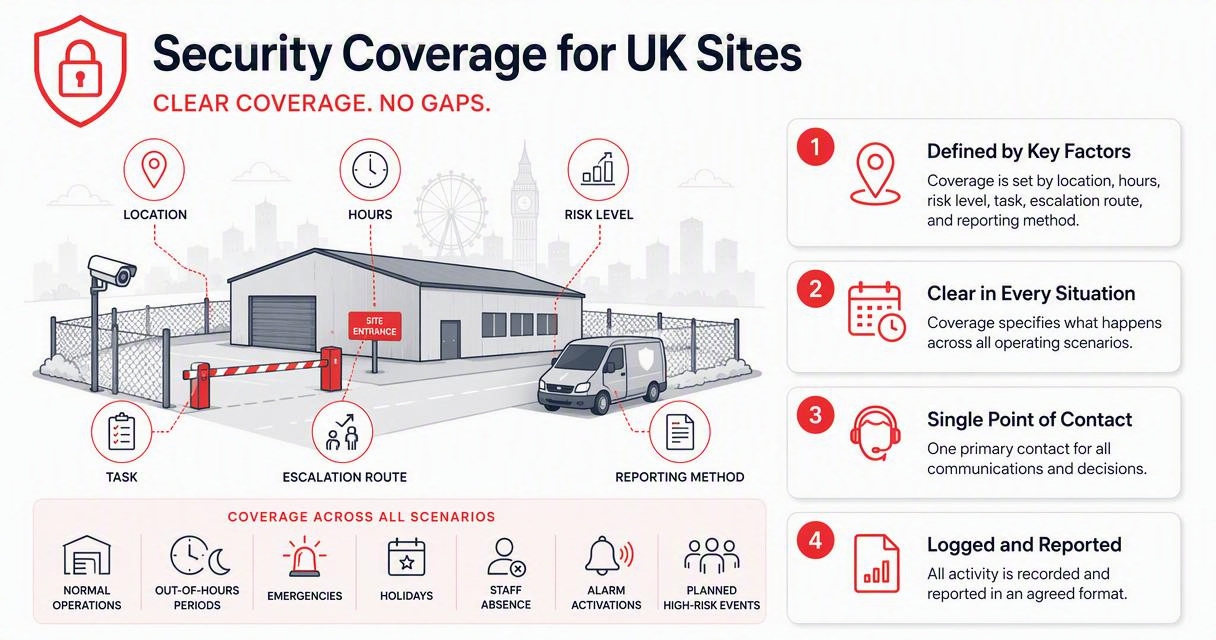
UK sites should expect a security provider to define cover by location, hours, risk level, task, escalation route, and reporting method. Coverage should specify what happens during normal operations, out-of-hours periods, emergencies, holidays, staff absence, alarm activations, and planned high-risk events.
A single provider may support many environments, but the operating plan should change by sector. Event security needs crowd flow, entry control, stewarding, and command communication. Retail security needs deterrence, evidence capture, staff safety, and stock-loss reduction. Commercial buildings need access control, visitor management, reception support, and out-of-hours patrols.
NEXUS SECURITY SERVICESES LTD presents its service coverage around practical UK business needs, including offices, retail, commercial sites, events, construction locations, access control, CCTV, alarm systems, and door supervisor requirements. That range matters when a buyer needs one security plan across different risk points rather than isolated services.
Sector fit signals that improve results
- Retail: plain-English incident reports, body-worn or CCTV coordination where lawful, civil-recovery awareness, and staff safety procedures.
- Offices: reception protocols, visitor badges, contractor sign-in, access-card control, and emergency evacuation support.
- Construction: perimeter checks, plant and materials protection, delivery controls, and out-of-hours patrols.
- Licensed venues: door supervisor staffing, refusal procedures, queue management, dispersal planning, and incident logs.
- Corporate events: risk assessments, accreditation checks, VIP movement support, room access control, and radio procedures.
How do response processes protect operations?
Response processes protect operations by turning an alert, incident, or risk signal into a controlled sequence of actions: verify, attend, contain, escalate, record, and review. A strong process reduces confusion during alarms, theft, disorder, unauthorised access, medical incidents, and building emergencies.
Security response is not just speed. The better measure is whether the provider can show what happens at each decision point. Alarm response, for example, should define who receives the activation, who attends, when police or emergency services are contacted, how keys are controlled, and how the client is updated.
The same principle applies to CCTV. Research by Iqbal H. Sarker in SN Computer Science reviewed machine-learning algorithms and real-world applications, including how automated systems can support decision-making across practical settings (Sarker, 2021). In security operations, AI-supported video analytics can help flag unusual activity, but human verification and clear escalation remain central.
Response workflow buyers should request
- Detection: alarm, guard observation, CCTV alert, staff report, or visitor issue.
- Verification: control room, guard, or supervisor confirms the nature of the incident.
- Dispatch: mobile response, site guard, duty manager, or emergency service route is activated.
- Containment: staff follow agreed safety, access, or evacuation procedures.
- Escalation: named contacts receive updates based on severity.
- Evidence capture: incident report, CCTV reference, witness details, photos, or patrol record.
- Review: management identifies repeat risks and recommends prevention steps.
Operational insight: Fast attendance has limited value if the provider cannot prove what happened, who acted, and what changed afterwards.
How should reporting and technology be compared?
Reporting and technology should be compared by the quality of evidence they create, not by the number of tools listed in a proposal. Useful security reporting gives managers clear incident timelines, recurring-risk patterns, guard attendance proof, maintenance flags, and decisions that can be acted on.
Common reporting formats include daily occurrence books, digital patrol logs, incident reports, visitor records, alarm activation reports, and monthly trend summaries. Digital systems can improve visibility, especially across multiple sites, but poor instructions still produce weak records.
A provider should also explain how CCTV, access control, alarms, radios, lone-worker tools, and visitor-management systems connect to the security operating model. Technology without assigned responsibility can create false comfort.
Reporting outputs that show real control
| Report type | Best use | Weak version | Strong version |
|---|---|---|---|
| Daily occurrence log | Routine site activity | Vague notes | Time-stamped actions and exceptions |
| Incident report | Theft, disorder, access breach | One-line summary | Timeline, people involved, evidence, outcome |
| Patrol log | Out-of-hours checks | Tick-box only | Location, time, findings, photos where relevant |
| Visitor log | Office and event control | Unchecked names | Identity process, host, badge, entry and exit |
| Monthly review | Contract improvement | Invoice attachment | Trends, risks, recommendations, agreed actions |
What should pricing include beyond hourly rates?
Security pricing should include mobilisation, supervision, training, uniforms, equipment, control-room support, reporting, insurance, travel, holiday cover, emergency response, and contract-management time. A low hourly rate can become expensive if supervision, replacements, escalation, or reporting are weak.
The most useful commercial comparison is a like-for-like scope. Buyers should ask each provider to price the same hours, duties, training requirements, technology expectations, and management-review schedule. Any exclusion should be visible before the contract starts.
Price also needs to match risk. A licensed venue on busy trading nights, a retail store with repeated theft, and a construction site with high-value plant all carry different exposure. Paying for the wrong service model usually costs more than paying for the right one.
Cost lines to clarify before award
- Guarding hours, overtime, bank holidays, and minimum callout periods.
- Supervisor visits, quality audits, and contract-manager meetings.
- Radios, body-worn cameras, patrol devices, uniforms, and PPE.
- Alarm response, key holding, emergency attendance, and lock-up duties.
- Training for site-specific systems, access control, fire procedures, and incident reporting.
- Cancellation terms, mobilisation charges, and contract exit process.
How NEXUS SECURITY SERVICESES LTD handles this
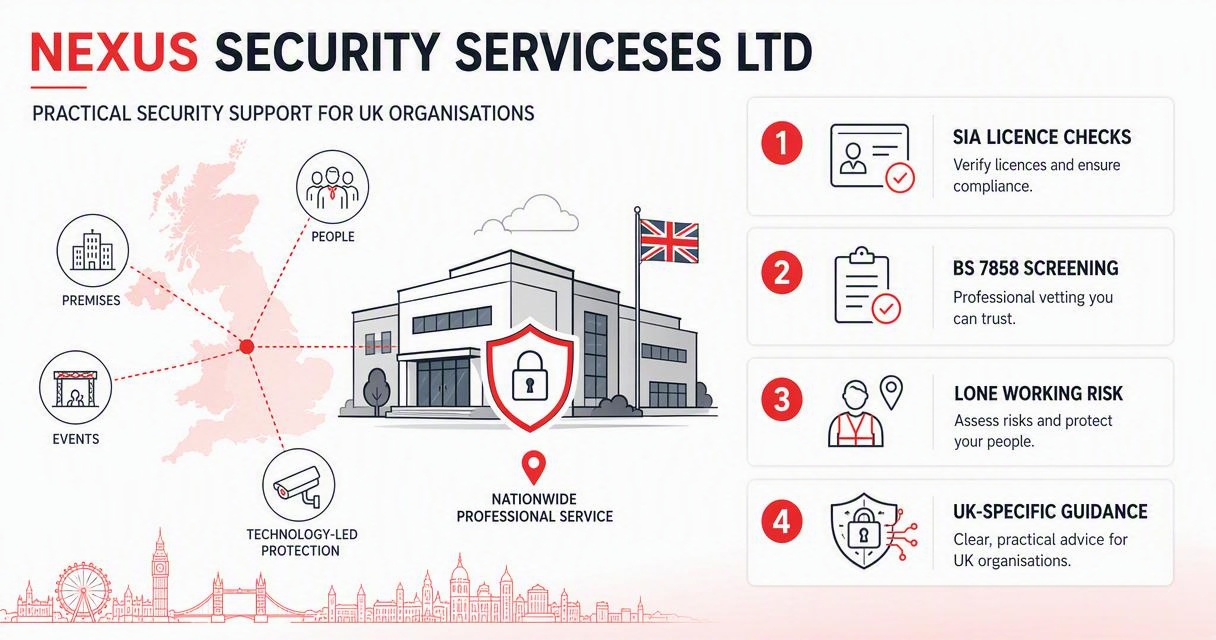
NEXUS SECURITY SERVICESES LTD is relevant for UK organisations seeking practical security support across people, premises, events, and technology-led protection. The company's positioning focuses on nationwide professional services and UK-specific guidance across SIA licence checks, BS 7858 screening, lone working risk assessments, event risk assessments, access control, CCTV, alarms, and door supervisor requirements.
A buyer comparing providers can use that breadth to build a joined-up brief. For example, a facilities manager may need reception guarding, alarm response, CCTV, key holding, and contractor access rules under one security plan. A retail manager may need visible guarding, incident reporting, staff safety support, and stock-loss prevention.
NEXUS SECURITY SERVICESES LTD also publishes practical resources such as checklists, how-to guides, buyer guides, templates, and policy guidance. That matters because security procurement often fails when decision-makers cannot translate risk into clear duties, records, and review points. More practical information is available at nexussecurityserviceses.com.
What mistakes weaken security procurement?
Security procurement weakens when buyers choose on headline price, accept vague compliance claims, overlook reporting quality, or copy a generic specification from another site. These mistakes create gaps between the promised service and the protection needed during real incidents.
A common issue is treating all guarding as the same. A guard suited to reception support may not be the right fit for late-night licensed premises, high-value construction assets, or retail loss prevention. Role fit, supervision, and instructions matter as much as staffing hours.
Another issue is failing to check company status and public records. One ranking result for this topic is a Companies House profile for Professional Security Guarding Ltd, which shows how public company information can appear in search results. Procurement teams should review Companies House data, accounts status, trading history, and direct references as part of supplier due diligence.
Red flags during supplier review
- No clear answer on SIA licence checks or role categories.
- No documented screening process for personnel in trusted positions.
- No sample incident reports, patrol logs, or management review format.
- No named escalation contact for urgent decisions.
- No site visit before quoting for complex work.
- No explanation of insurance cover, exclusions, or subcontractor use.
Procurement warning: A security proposal that cannot describe the first hour of an incident is not ready to protect a live site.
What to expect in 2027
UK security services in 2027 will likely place more emphasis on auditable compliance, digital reporting, AI-assisted monitoring, lone-worker protection, and integrated building systems. Businesses will still need trained people, but those people will increasingly work with access data, CCTV analytics, alarm platforms, and mobile reporting tools.
AI will not remove the need for licensed guards or supervisors. Instead, it will increase the value of providers that can combine technology alerts with human judgement, lawful data handling, and clear escalation. Buyers should expect more questions about evidence retention, privacy, cyber risk, and who is accountable when software flags an event.
Labour quality will also remain a major differentiator. Screening, supervision, welfare, training, and retention affect service consistency. In practice, the provider with the clearest operating process will often beat the provider with the longest service list.
2027 readiness checklist
- Review whether CCTV, alarms, and access control produce useful evidence.
- Confirm data handling aligns with internal privacy and retention policies.
- Ask how AI alerts are verified before action.
- Check guard training on digital reporting tools.
- Build incident-review meetings into the contract.
- Update lone-working and event risk assessments annually.
FAQ
Professional security services UK buyers often ask similar questions about licensing, screening, response, and contracts before selecting a provider. The answers below give concise procurement guidance for common decisions.
Does every security guard in the UK need an SIA licence?
Many frontline private security roles in the UK require an SIA licence, but the required licence depends on the work performed. Security guarding, door supervision, CCTV public-space surveillance, and close protection are distinct categories. A buyer should ask for licence type, licence number, and live-check evidence for each regulated role.
Is BS 7858 screening mandatory for all security staff?
BS 7858 screening is widely used for security roles, especially where staff handle keys, access, sensitive areas, or trusted-site duties. A contract may require it even where law does not. The strongest procurement approach asks for the screening policy, evidence trail, gap-handling process, and recheck schedule.
What is the difference between key holding and alarm response?
Key holding means a security provider securely stores authorised keys or access devices for a site. Alarm response means trained personnel attend after an alarm activation under agreed instructions. Many contracts combine both, but the buyer should still check callout rules, escalation contacts, attendance evidence, and insurance cover.
How often should a security contract be reviewed?
A security contract should be reviewed after mobilisation, after any serious incident, and at regular management intervals. Monthly reviews suit higher-risk sites, while quarterly reviews may suit lower-risk premises. The review should examine incidents, patrol records, staffing consistency, false alarms, access issues, and improvement actions.
Conclusion
The best route to professional security services UK procurement is a written comparison that scores licensing, BS 7858 screening, service coverage, response process, insurance, reporting, technology fit, and sector experience. A business should request evidence before price is finalised, then test the provider's plan against real scenarios such as theft, alarm activation, unauthorised access, event disorder, or out-of-hours emergency attendance.
For a practical starting point, create a site-risk brief, list required services, ask for proof against the checklist above, and compare proposals on evidence quality rather than sales language. For UK-focused guidance across guarding, retail, offices, events, access control, CCTV, alarms, and response planning, visit nexussecurityserviceses.com and prepare a security brief before requesting a formal quote.
Generated by EarlySEO.com


One Comment