


An industrial estate can have excellent individual units and still be an easy target through its shared roads, yards and entrances. Industrial estate security works when the estate is managed as one operating environment, not as a loose collection of tenants with separate alarms.
The practical question is not which product to buy first. It’s who owns the risk, who responds at 02:00, and whether every tenant follows the same routine. This approach supports industrial estate security plans and wider commercial property security, with shared site security measures built around clear ownership and consistent procedures.
Key Takeaways
- Treat common areas, access roads, vacant units and shared CCTV as estate responsibilities, with clear written boundaries for each tenant.
- Match controls to the actual risk. A barrier gate may matter more than extra cameras if unauthorised vehicle entry is the recurring problem.
- Give every incident a route: record it, preserve evidence, notify the right people and review what failed.
- Fund shared measures openly, with agreed service standards, access permissions and a review date.
A camera covering a blind corner is useful. A camera that nobody is authorised to review after an alarm is only evidence after the event.
Start With a Proper Risk Assessment
A proper industrial estate security assessment should establish what is protected, where the weaknesses are and who must respond. Begin with a daytime and after-dark walkaround. Bring the managing agent, a tenant representative, maintenance contractor and security provider where possible. Each will spot a different weak point.
Record what is already there, what doesn’t work, and where responsibility changes hands. Avoid vague descriptions such as “rear boundary insecure”. State the location, condition, risk and required action.
Map the estate as people actually use it
Mark vehicle entrances, pedestrian gates, loading bays, bin stores, fuel tanks, roof access, vacant units and routes between buildings. Look at blind corners, damaged fencing, overgrown planting and places where a vehicle could wait without being seen. Check the estate’s perimeter security, including fences, boundaries and vulnerable approaches.
Risk profiles vary between business premises and commercial premises. Distribution centre security may depend on constant vehicle movements, while warehouse security and factory security bring different concerns.
Then test ordinary routines. Can a delivery driver enter without challenge? Are contractors expected after office hours? Does a departing tenant still hold access fobs or gate codes? These unglamorous details are often where an otherwise decent system falls apart.
Rank threats by likelihood and impact
For many estates, priority risks include business crime, burglary, attempted ram raids, diesel theft, vandalism, fly-tipping, trespass and theft, illegal access to unoccupied units and anti-social behaviour. A logistics site with 24-hour movements has different exposure from a small estate that closes at 18:00.
Give each risk an owner and a response. A broken perimeter fence needs a repair deadline. Repeated fly-tipping needs evidence, security lighting and a reporting route. An empty unit may need more frequent checks, temporary alarm coverage and a clear key-holder arrangement.
Build an Industrial Estate Security Plan in Layers
A single measure rarely carries the job. Effective industrial security combines suitable security equipment rather than relying on isolated purchases.
Control the perimeter and the entry point
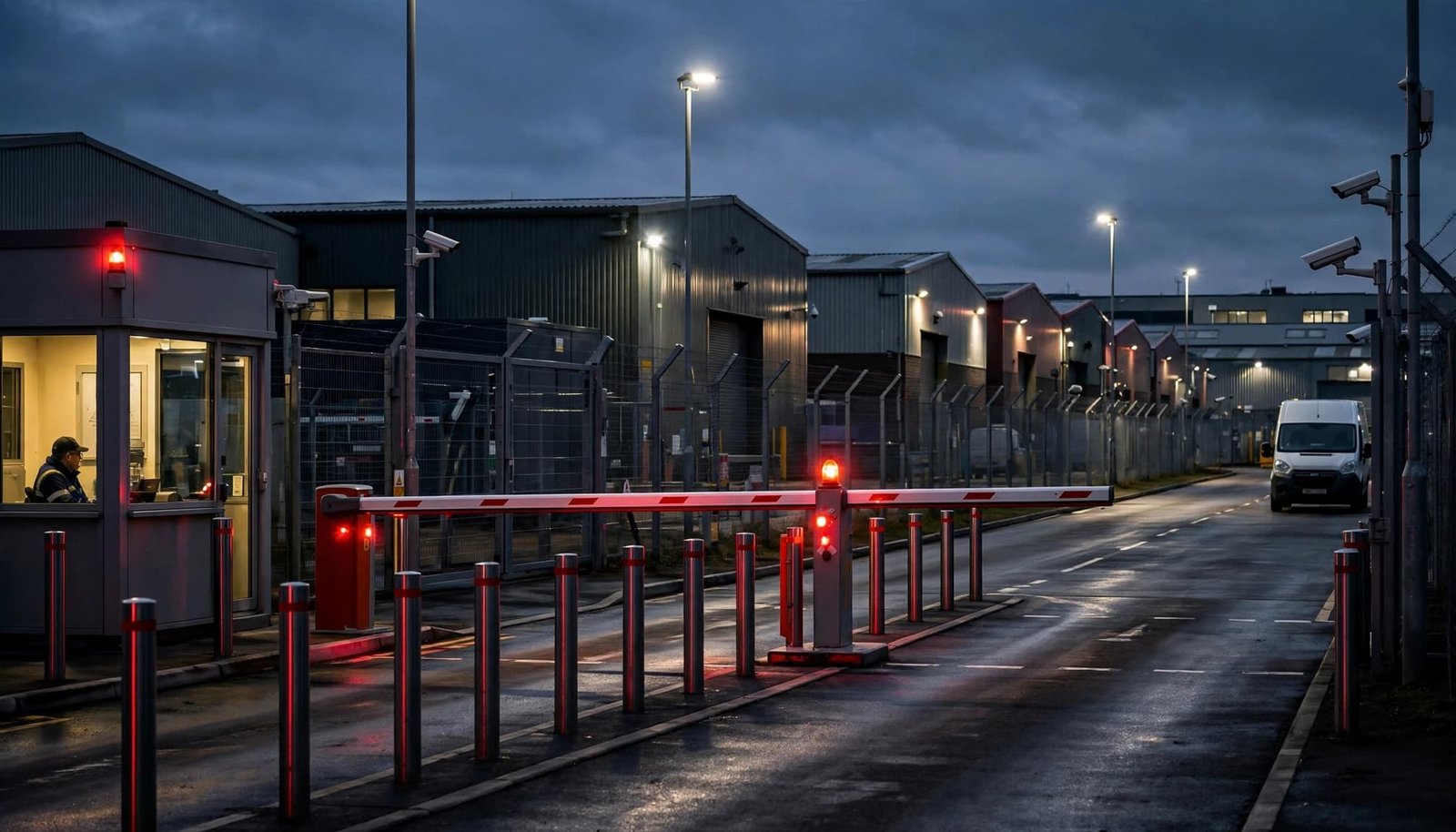
Use fencing, lockable gates, barriers, bollards and access control to make entry deliberate rather than casual. Select this physical security according to vehicle and pedestrian risk, supporting wider perimeter security. Barrier gates with vehicle registration procedures may suit a busy shared entrance. Rising bollards may be appropriate where ram-raiding is a credible concern.
A manned gatehouse is more costly, but it offers a visible point of control. Manned guarding can suit distribution centre security, where 24-hour vehicle movements demand controlled entry. A trained security guard can check deliveries, direct visitors, challenge unusual activity and manage out-of-hours access. It is not decorative security. The gatehouse needs written instructions, contact lists, escalation authority and reliable welfare arrangements.
Remove the easy opportunities
Good security lighting helps staff see hazards and makes site inspections more effective. Position lights to cover gates, yards and pedestrian routes without creating glare for drivers or light spill into neighbouring properties.
Set simple routines for open-up and lock-up. Security staff or nominated tenant contacts should check gates, doors, vacant units, external plant and obvious damage. Record the time, observations and action taken. A consistent log is more useful than a long report written after something has gone wrong.
Use Shared CCTV and Remote Monitoring Properly
Shared CCTV can spread the cost of covering access roads, communal car parks and estate entrances. It only delivers value when ownership of CCTV monitoring, alert assessment and follow-up are agreed.

Agree coverage and response before installation
Place cameras where they answer a clear operational question: who entered, which vehicle used the gate, what happened at the waste area, or whether a response team needs to attend. Agree who owns installation, maintenance and day-to-day operation of related security equipment, and avoid pointing cameras into areas that add little value but create privacy concerns.
Remote monitoring can work well where an operator can assess an activation and follow an agreed response plan. That might mean contacting a key holder, arranging an on-site response or calling emergency services where there is an immediate threat. Test those instructions after installation and after any change in contacts.
Treat CCTV footage as personal data
The estate manager should confirm who is the data controller for shared cameras, how access control limits viewing of recordings and related records, and how requests will be handled. The ICO’s CCTV and video surveillance guidance covers installation, operation, public awareness and signage.
Businesses using CCTV usually need to register with the ICO unless exempt, display clear signage and control access to recordings. GOV.UK’s guidance on using CCTV also states that people will usually be entitled to footage of themselves within one calendar month, free of charge.
Do not set a retention period because another site uses it. The ICO confirms there is no prescribed universal minimum or maximum period. Use a documented period that fits the purpose, then delete footage when it is no longer needed, subject to any live investigation or claim.
Add Patrols, Key Holding and Alarm Response
Mobile patrols are useful where a permanent guard is disproportionate, particularly on estates with vacant units, isolated yards or repeated night-time nuisance. Their value lies in unpredictability and proper reporting, offering an alternative to manned guarding. Procure the combined security services as a defined service with measurable outcomes, not a token drive around the block.
Specify what patrols must check
Set a patrol frequency, but vary the timing within agreed windows. Instructions should cover gates, perimeter checks, vulnerable doors, fire exits, suspicious vehicles, lighting faults and signs of forced entry. Ask for time-stamped records from security patrols, with photographs where appropriate.
Review patrol records against incident reports each month. If the same fence line is being checked without action, the service is not solving the problem. Change the route, repair the weakness or add a stronger physical control.
Keep staff out of avoidable confrontations
Key holding and alarm response mean a trained responder attends after an activation, rather than asking a tenant manager to arrive alone in the early hours. The service should state attendance targets, call-out authority, communication steps and what happens if police attendance is required.
Where a contractor supplies guarding, check that each security guard is suitable for the activity. Security guards protecting property against theft or damage generally require the relevant SIA licence, although direct in-house employment has different rules. Ask the provider for licence verification, supervision arrangements, training records and a clear complaints route.
Put Responsibilities and Funding in Writing
Multi-tenant estates struggle when everyone assumes someone else is dealing with a problem. A short security protocol creates a practical security partnership between the property manager, tenants, contractors and providers. It should sit alongside the estate regulations, service-charge arrangements and contractor agreements.
Give each party a defined role
The property manager should own the estate plan, common-area records, provider performance reviews and tenant communication. Each tenant should secure its own business premises, keep contact details current and report incidents promptly.
Security providers should deliver the agreed security services, follow site instructions, maintain logs and escalate concerns. Contractors need sign-in arrangements, permitted working hours and supervision rules near restricted areas. Emergency contacts should be reviewed quarterly, not left until an alarm goes unanswered.
Make collective spending transparent
Separate shared controls from tenant-specific work at individual commercial premises. Communal barriers, gates, fencing and other physical security may be funded through the service charge if the lease permits it. A tenant’s internal alarm or roller-shutter repair is normally a separate matter.
Share a simple budget note before procurement: the risk addressed, proposed service level, contract term, mobilisation cost, monthly cost and review date. Lowest price isn’t the same as good value if the provider cannot attend, report or maintain the equipment properly.
Create a 90-Day Implementation Routine
The first three months should produce a working plan, not a folder that nobody opens.
- Days 1 to 30: Complete the risk walkaround, confirm emergency contacts, key holding and escalation arrangements, repair urgent defects, and circulate one incident-reporting process.
- Days 31 to 60: Obtain proposals for priority controls, assign ownership for CCTV monitoring, test alerts, confirm the response process, appoint providers, and issue site instructions for guards, patrols and contractors.
- Days 61 to 90: Test alarm response and incident response, run an out-of-hours access control check covering permissions, fobs, codes and route changes, review incident logs for business crime trends, and hold a tenant meeting as part of a security partnership, with the managing agent, tenants and providers confirming changes together.
After that, review the plan quarterly, including remote monitoring, provider performance and incident trends, and after any serious incident, major vacancy, tenant change or alteration to access routes. The ICO’s guidance on data protection principles for surveillance is a sensible reference point when reviewing footage access, retention, signage and governance after system changes.
A Security Plan That Holds Up
The strongest industrial estate security plan is ordinary in the right ways. Gates are checked. Contacts are current. Cameras work. Reports are read. Tenants know who to call.
The same principles support warehouse security, factory security and distribution centre security, but operating patterns still shape the plan.
Security measures should make the estate harder to enter, easier to monitor and quicker to manage when something happens. Clear ownership connects those measures into a functioning industrial security approach.
Frequently Asked Questions
How can an industrial estate reduce burglary and anti-social behaviour?
Use layered controls: secure boundaries, controlled entry, working lighting, CCTV with a defined purpose, patrols and consistent reporting. The estate should also repair visible defects quickly. A damaged gate or fence tells offenders that nobody is paying attention.
Why are randomised mobile patrols effective?
Predictable patrol times can be watched and worked around. Variable attendance makes it harder to judge when the estate will be unattended. Patrols still need defined checks and evidence of completion, otherwise random timing becomes an excuse for poor service.
How should property managers work with police and tenants after an incident?
Preserve footage and access logs, report the incident through the appropriate police route for business crime, and avoid circulating unverified allegations. Tell affected occupiers of business premises what happened, what immediate controls were put in place and what information they need to provide. Review the incident response with the provider, then record any change to the estate plan.


0 Comments