

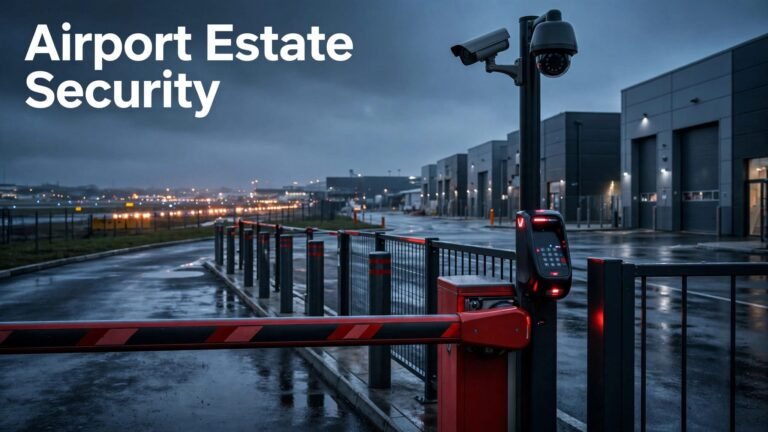
Airport business park security has to deal with more than a locked gate and a few cameras. High traffic volumes, 24/7 operations, logistics activity, vacant units and multiple tenant organisations create a site where ordinary weaknesses are quickly exposed.
As a form of commercial property, airport business parks face distinctive security challenges. The right plan is proportionate, documented and shared. It combines physical security, access control, trained personnel, CCTV, cyber controls and emergency procedures. However, it shouldn’t treat every estate as though it were subject to the airport operator’s own security requirements. Start by establishing the boundary, then assess how the estate actually operates.
Key takeaways for property managers
- Confirm whether the estate sits within an airport’s regulated security perimeter or is subject to airport operator controls.
- Map vehicle routes, pedestrian access, loading areas, vacant units, tenant premises and restricted locations.
- Use proportionate security services, including gatehouse duties, access permissions, CCTV, patrols and remote monitoring.
- Base the number of security officers on duties, coverage and response requirements, not an assumed industry ratio.
- Give every tenant a clear role in incident reporting, evacuation, access permissions and emergency communications.
- Treat networked cameras, barriers and access systems as connected technology that needs proper protection.
Why airport business parks need a separate security plan
An airport-adjacent estate may look like an ordinary property in other commercial environments, but its operating conditions are different. Airport estates may have night-time logistics, early contractor access, freight movements across several shifts, and units that remain vacant for long periods.
Establish the airport and estate boundary
Don’t assume an estate near an airport automatically falls under airport security rules. Site managers should establish whether the property is inside a regulated airport area, subject to an airport operator’s requirements, or operating as a separate commercial estate.
The airport operator, police and other security stakeholders have formal planning arrangements for an airport’s own security environment. The airport security planning quick guide explains that process. It doesn’t turn every neighbouring warehouse or office into an airport facility.
The position can also depend on the premises, activity and applicable legislation. Specialist legal or security advice may be needed before a manager relies on a particular exemption, duty or airport control.
Map people, vehicles and sensitive areas
Begin with an estate plan that shows:
- Public approaches, staff entrances, service roads and emergency access routes.
- Gatehouses, barriers, loading bays, car parks and pedestrian crossings.
- Vacant units, plant rooms, roof access, maintenance hatches and storage compounds.
- Tenants with unusual operating hours, high-value goods or restricted activities.
- Areas where airport-side access, airside boundaries or controlled infrastructure may be nearby.
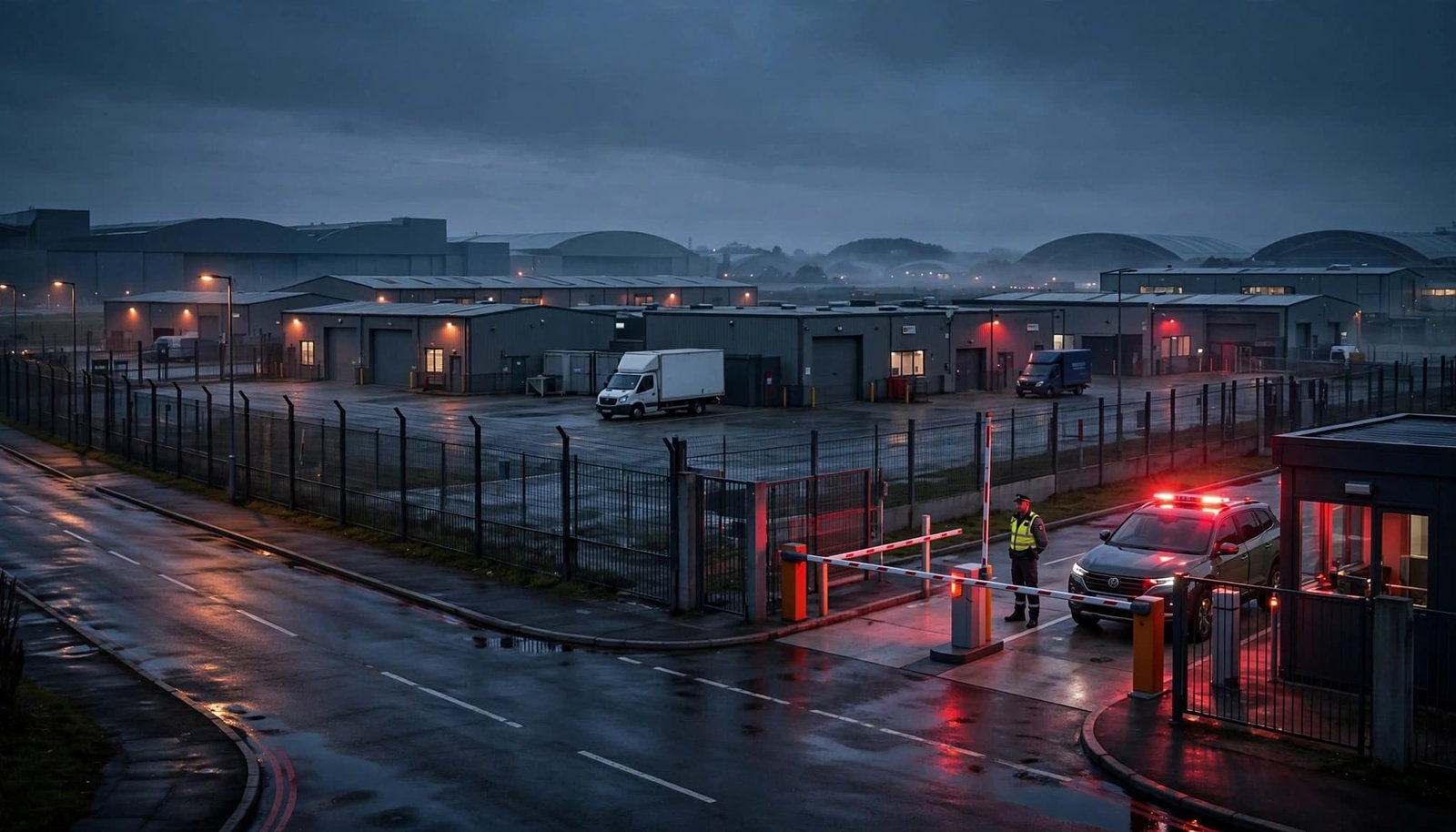
Start with a practical site security audit
Practical security audits should follow the movement of people and vehicles, rather than simply listing security products. Walk the site in daylight, after dark, during deliveries and during a quiet overnight period. Each visit will reveal different weaknesses.
Check the physical estate
Inspect perimeter fencing, gates, lighting, locks, barriers and blind spots. Look for places where someone could climb, hide, force entry or pass unnoticed behind an authorised vehicle.
Review how deliveries are booked and checked. A gatehouse should know who is expected, which tenant they’re visiting, what vehicle they’re using and where it’s permitted to go. Generic verbal approval isn’t reliable visitor management.
Vacant units need their own inspection schedule. Confirm that doors are secured, windows are intact, utilities and plant are safe, and maintenance access points haven’t been disturbed. Empty space shouldn’t become unobserved space.
Test the likely failure points
The audit should examine common security challenges, including unauthorised access, tailgating, theft and vandalism, trespassing, vehicle crime and anti-social behaviour. It should also test insider risks, including former employees whose access hasn’t been removed, contractors with excessive permissions and visitors who move beyond their approved area.
Record each weakness with its location, likelihood, consequence, existing control and proposed action, so the register supports practical crime prevention. A camera that records a gate after an incident may provide useful evidence, but it won’t replace a barrier procedure, a trained officer or a functioning alarm response.
Build a layered business park security model
No single control works across a mixed airport estate. The practical model is layered, with each measure covering a weakness left by another.
Use the gatehouse as an operating point
Gatehouse security should operate as the estate’s access control point. It should support delivery scheduling, visitor identification, contractor sign-in, key control, incident logging and escalation.
Access permissions should be current and specific. A contractor attending one unit should not receive unrestricted access to the entire estate. Temporary passes should expire, and tenant managers should confirm when workers leave.
Traffic management matters as much as identity checks. Separate staff, visitor, delivery and emergency routes where the layout allows. Keep sight lines clear, prevent vehicles waiting across access points and agree a process for abnormal or refused access.
Combine people with technology
Manned guarding is useful where judgement, communication and immediate intervention matter. Security officers can challenge unusual behaviour, manage a busy gatehouse, complete lock-up checks and coordinate with tenants or emergency services.
cctv systems add coverage across entrances, loading areas, yards, pedestrian routes and critical plant. Remote monitoring services can identify alarm activations or suspicious activity outside staffed hours. Each alert still needs a defined response from trained personnel.
Mobile patrol security is particularly useful for large or irregular estates. Patrols can check vacant units, perimeter lines, fire exits, gates and isolated compounds, including out-of-hours. This provides a visible response without continuously staffing every area.
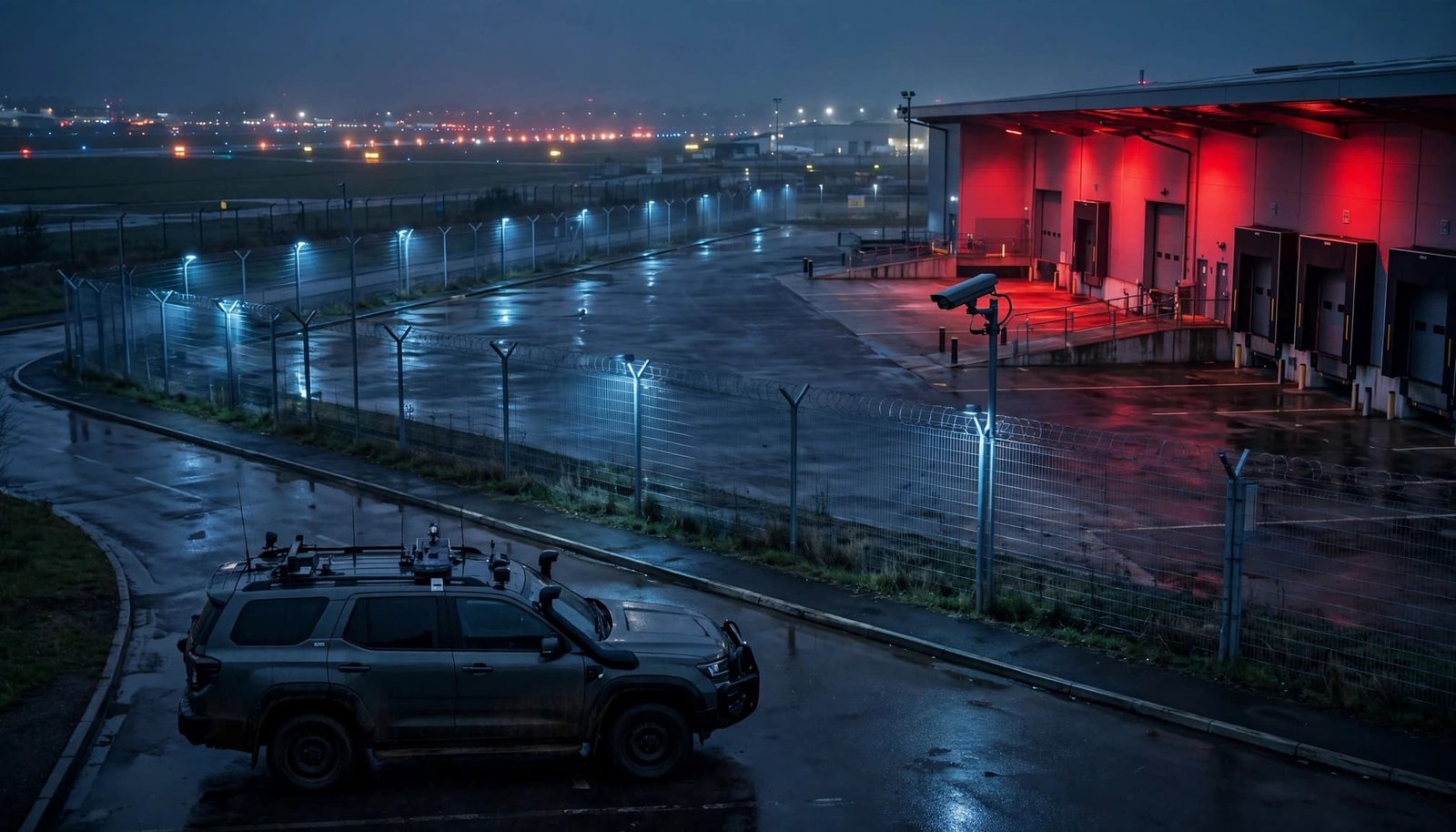
The Network Connected Security Technologies guidance is relevant when cameras, barriers and access systems are connected to networks. They need proper configuration, updates, user permissions and monitoring, not simply installation. These security measures should support trained personnel and defined response procedures, rather than replace them.
Set staffing and response by risk
There is no reliable universal number of security officers for a large business park. The requirement depends on the number of access points, operating hours, patrol route, visitor volume, response time, tenant profile and whether gatehouse duties must continue during an incident.
Define the duties before the headcount
Write down what each shift must actually do:
- Keep the gatehouse open and manage expected traffic.
- Complete patrols, lock-up checks and alarm response.
- Monitor CCTV or receive alerts from a remote monitoring centre.
- Manage contractors, keys, passes and incident records.
- Provide keyholding and alarm response where this forms part of the contracted arrangement.
- Contact tenants, police, fire and rescue services or airport representatives when appropriate.
If one officer is expected to remain at the gatehouse while also patrolling a large estate, the arrangement may fail at the first serious incident. Staffing should reflect the number and capability of security personnel, simultaneous duties, lone-worker controls and the time needed to summon assistance.
Contracted guards carrying out licensable work may require the appropriate Security Industry Authority licence. Check the role, contract and activity rather than assuming that every security worker has the same licensing position.
Agree an escalation plan
Every shift should know what happens when a person refuses access, a vehicle follows another through a barrier, a camera fails, a door is forced or an alarm activates.
Set out who can authorise access, who contacts the tenant, when the police are called, how evidence is preserved and who informs the property manager. Use one incident log with time, location, actions, witnesses and follow-up requirements.
Coordinate emergency preparedness across tenants
An airport business park is one of the multi-tenant sites where an incident can cross occupier boundaries. Fire, suspicious packages, severe weather, power loss, vehicle incidents and security breaches require a coordinated emergency response.
Give each organisation a defined role
The property manager should maintain the estate plan, shared contact list, access arrangements and common-area procedures. Tenants should nominate current contacts, provide out-of-hours details and tell the manager about changes in use, hazardous materials, shift patterns or vulnerable operations.
Emergency information should be available to security officers and authorised responders. Include gate locations, isolation points, tenant names, vacant units, restricted areas and safe assembly arrangements, subject to appropriate information controls.
Test communication, not just alarms
A quarterly email asking tenants to confirm their contact details isn’t the same as a working response plan. Test how a message reaches people during an overnight incident, whether a gate can be opened for emergency services and whether tenants understand who gives instructions.
Carry out tabletop exercises, alarm tests and access-control failure drills. Record actions and close them with an owner and target date. Procedures that exist only in a folder won’t help when normal communications are unavailable.
Treat shared technology as part of the security risk
Shared estates often rely on networked CCTV, barriers, intercoms and access systems as part of their electronic security environment. A weakness in one system can affect more than one tenant.
Separate tenant networks where appropriate, restrict administrative access, use individual accounts and remove permissions promptly when contracts end. Keep current records of connected devices, suppliers, remote-access arrangements and backup contacts.
Airport-related operators may face both cyber and physical security risks. The CAA’s guidance on cyber security strategies is relevant to applicants and licensees within its scope, but it shouldn’t be treated as a generic rule for every neighbouring property.
The NCSC Cyber Assessment Framework guidance provides a useful reference for governance, risk management, protection, detection and recovery. The ICO’s security requirements also cover system and facility security, incident handling, continuity and monitoring.
CCTV and access-control data should be protected as personal data where applicable. Decide who can view footage, how requests are handled, how long records are retained and what happens when a tenant asks for information about an incident.
Review the plan and prove that it works
Security planning isn’t complete when a contractor is appointed. It needs a review cycle linked to actual incidents, tenant changes, construction work, new traffic patterns and changes in airport operations.
Check the service, not only the equipment
Review patrol activity, missed checks, response times, alarm activations, barrier faults, camera outages, visitor logs and access-card changes. Compare mobile patrol security and remote monitoring services against actual coverage and alarm outcomes.
Ask whether the recorded action solved the problem or merely documented it. Walk the site with the security provider, site managers, security officers and tenant representatives.
Jointly test a sample of passes, challenge procedures, emergency contacts, vacant-unit checks and out-of-hours escalation.
Keep governance proportionate
CCTV signage, privacy information, access permissions and retention periods should match the system’s purpose. The ICO’s security guidance for organisations is a suitable reference point, although specialist advice may be needed for a complex estate or sensitive operation.
The property manager should retain a current risk assessment, site plan, tenant responsibilities, contractor checks, training records, incident reports and review actions. That evidence makes the security arrangement easier to manage and easier to challenge when something changes.
Frequently asked questions
What are the main daily risks at an airport business park?
Unauthorised access, tailgating, vehicle crime, theft and vandalism, trespassing and anti-social behaviour are common concerns. Airport estates also face high traffic volumes, night-time logistics, vacant units, restricted-area confusion and risks created by several tenants using shared facilities.
How many officers are needed on each shift?
There is no fixed ratio that applies to every site. Set the number against access points, patrol duties, operating hours, visitor volumes, lone-worker risks and the response arrangement. A plan that requires one person to staff a gatehouse and patrol a large estate at the same time may not be workable.
What does gatehouse security control?
A properly managed gatehouse supports visitor management by checking visitor identification, deliveries, contractors, passes, keys and vehicle movements. It also provides an incident record and a point of contact for tenants, patrol officers and emergency responders.
Why use mobile patrols out of hours?
Mobile patrols provide physical checks across areas that cameras may not cover well, including vacant units, perimeter fencing, loading yards and isolated plant. They can identify damage, open doors, lighting failures and suspicious activity before the next working shift.
Conclusion
Effective business park security is a managed operating system, not a collection of guards, cameras and barriers. Start with the estate’s actual movements, clarify its relationship with the airport, then match people, technology, procedures and response arrangements to the risks.
The strongest plan is specific enough to guide a night officer, a tenant manager and an emergency responder. It must also separate a commercial estate’s responsibilities from those of the airport operator. Review it when traffic patterns, tenant activity, construction work or airport operations change, because business parks rarely stay still and their security challenges change with them.


0 Comments