


A workplace search can protect people, stock, information and premises. Done badly, it can also create a grievance, a discrimination complaint, a data protection problem, or a dangerous confrontation.
A lawful workplace search policy should be necessary, proportionate, consistently applied and documented. Security guards and other private personnel aren’t police officers, and close protection operatives may work under a different protective-security assignment. In most commercial settings, neither role gives staff a general power to force a person, open a bag, or search a vehicle.
This is general information, not legal advice. A solicitor should review policies used in higher-risk workplaces, unionised settings, regulated sites, or cases involving suspected criminal conduct.
Key takeaways
- Make the entry condition clear before someone reaches the gate, reception desk, or loading bay. Consent gained through surprise is poor consent.
- A refusal means no search. The business may refuse entry or take a separate employment step, but force is not the answer.
- Record the reason, consent, method, result, and any escalation. A vague incident note is not an audit trail.
- Treat personal characteristics, disability, religion, sex, privacy and dignity as practical safeguards, not decorative wording in a policy.
- If an item appears suspicious, stop searching it. ProtectUK guidance takes priority over ordinary lost-property procedures.
The legal framework for security search procedures UK
A commercial employer can set reasonable entry conditions for its own premises. That might include bag searches for warehouse staff, vehicle checks at a depot, or visitor screening at a secure office. The condition must be communicated in advance through contracts, visitor terms, signs, booking confirmations and site rules.
The position is straightforward: private security officers normally conduct consent based searches. A person can refuse. Where a search is an entry condition, the practical outcome may be that the person cannot enter or remains in a public reception area.
SIA guidance may help inform licensing, conduct and training. It does not create a power to compel a search or replace the relevant legislation and legal advice. Close protection operatives are not automatically authorised to conduct compulsory employee searches because they provide protective services.
Consent is not a police power
Consent should be voluntary, informed and current. The officer should state what will be searched, why it is needed, and what happens if the person declines. A general phrase such as “searches may take place” is weak when the policy permits a personal search.
Use wording that is clear and unglamorous:
“Entry to this site is conditional on a voluntary search of bags or vehicles. You may refuse, but we may then decline entry or refer the matter to management.”
Consent can be withdrawn. If it is withdrawn halfway through, stop and record what happened. A reasonable suspicion of theft or prohibited items does not create a private power to compel a search. Preserve the situation, contact management, and call the police where there is an immediate lawful reason to do so.
Privacy, equality and proportionality
The Equality Act 2010 prohibits discrimination linked to protected characteristics. A policy that searches only younger workers, people of a particular ethnicity, or contractors from one supplier is difficult to defend.
Consider adjustments before treating refusal as misconduct. A person may need a private space, additional time, an officer of the same sex where reasonably practicable, a support worker, or an alternative method because of disability, pregnancy, faith-based dress or trauma.
Public bodies must also consider Article 8 privacy rights under the Human Rights Act 1998. Private employers should still apply the same sensible discipline: search only where there is a genuine security reason, and do no more than the risk requires.
Apply the right search to the right risk
A search policy should separate people, property, vehicles, lockers and work areas. They are not interchangeable. A bag check at reception is not a licence to examine an employee’s personal phone, open their vehicle, or search a locker without its own stated conditions.
Person searches and bag searches
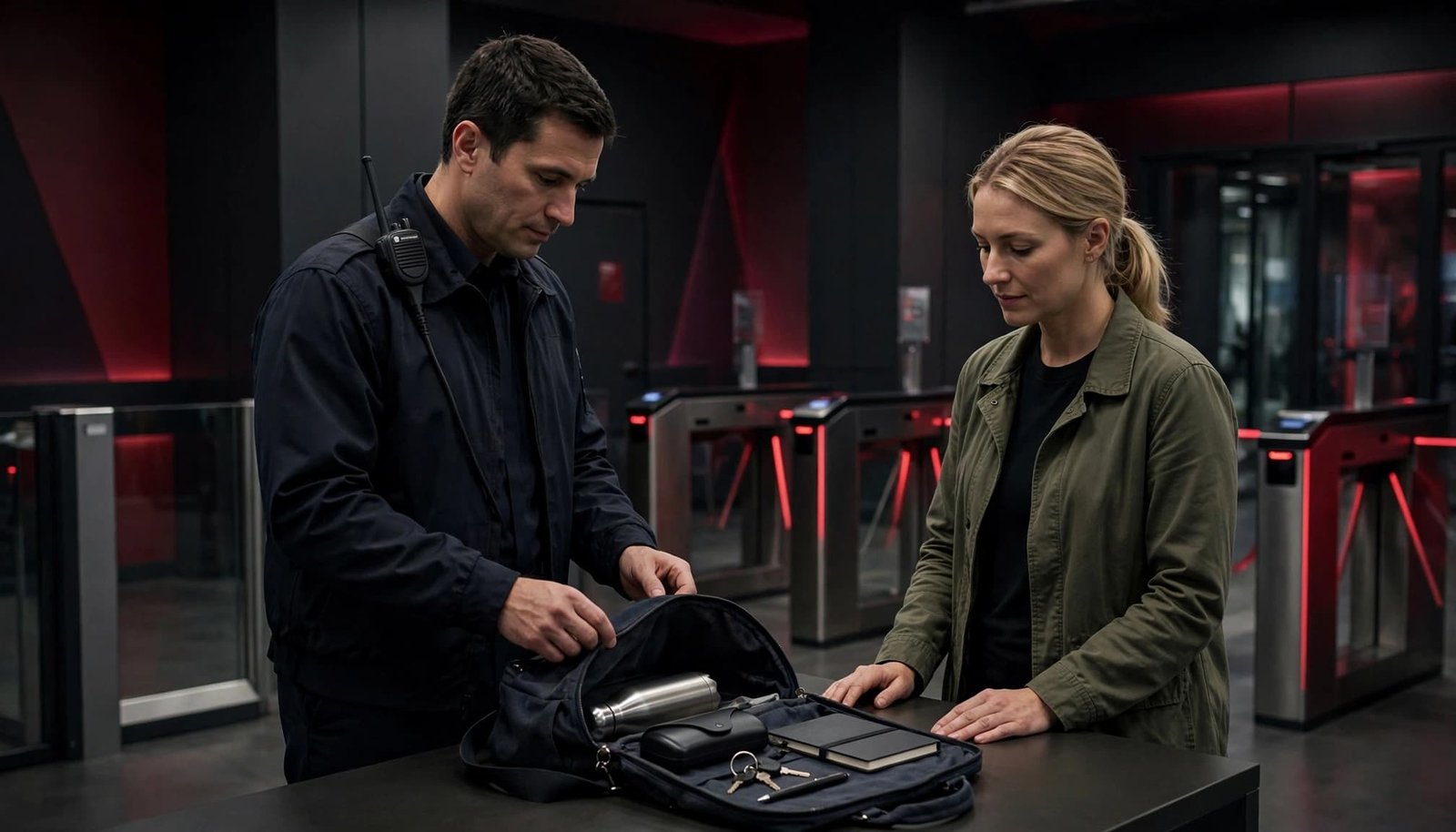
A bag search should normally be visual and hands-off where possible. Ask the individual to open the bag, move items aside and present compartments. Security guards should avoid handling personal belongings unless the person agrees and the reason is clear.
A person search is more intrusive. It needs a stronger justification, a private setting and trained staff. The method, privacy safeguards, trained personnel and escalation route should be set out in assignment instructions. Pat-down searches shouldn’t become routine workplace practice simply because a site has guards on the door.
Close protection operatives shouldn’t substitute for trained workplace-search staff unless their assignment, training and legal basis have been assessed separately. Keep the process calm, observable and respectful. Never use humiliation as a deterrent.
Vehicle, locker and work-area searches
Vehicle searches require the driver’s permission and should happen in a safe, well-lit place. The driver should open the boot, bonnet and internal compartments themselves. Officers shouldn’t enter a vehicle without permission.
A useful vehicle sequence is IBOBU:
- Check the inside of the vehicle.
- Ask for access to the boot.
- Observe the outside, including signs of tampering or concealed items.
- Ask for the bonnet to be opened.
- Check underneath only where it can be done safely.
The IBOBU search method gives staff a repeatable sequence. It doesn’t replace consent, a risk assessment or tailored legal advice.
For lockers and company work areas, distinguish company property from personal possessions. A policy should say who may authorise access, when the employee will be present, and how personal items found during the check will be handled.
When someone refuses a workplace search
Refusal is where poor procedures tend to show themselves. An officer who treats it as defiance can turn a manageable issue into an allegation of assault, harassment or discrimination.
Keep the response controlled
Security officers should give the explanation set out in the assignment instructions, offer reasonable adjustments where relevant, and contact a supervisor. The instructions should also define the escalation process and when police assistance is appropriate.
Do not block someone in, grab their belongings, intimidate them, or use force to obtain compliance. Where there is an immediate threat to safety, move people away and contact the police. Ordinary disagreement about a bag check is not an emergency.
The Health and Safety Executive expects employers to assess significant workplace risks and put controls in place. That includes foreseeable aggression towards staff. Use the HSE’s risk assessment guidance when setting staffing levels, body-worn camera rules, safe rooms and escalation arrangements.
Separate security action from HR action
Refusal may be relevant to an employee’s contractual duties, but it is not automatic misconduct. The employer should consider why the person refused, whether the rule was properly communicated, and whether an adjustment was needed.
Acas advises employers to consider whether a worker had a valid reason for refusing a search during a fair investigation. Its workplace investigation guidance is a useful baseline before any disciplinary decision.
Security staff should report facts, not conclusions. Write “employee declined a bag search and stated they required a same-sex officer”, not “employee acted suspiciously”.
Records, CCTV and digital visitor systems
British Standard 7499 is an industry benchmark for static guarding and mobile patrol services. It is not legislation, but it supports the reliable record keeping a commercial client should expect.
A search log should allow a manager to see what happened without guessing. The fields below set minimum recording requirements, not an invitation to collect excessive personal data.
| Record field | What to capture |
|---|---|
| Who and when | Officer, person or vehicle reference, date, time and location |
| Why | Entry condition, random selection, incident, or stated concern |
| Consent and method | Consent given, declined or withdrawn, plus the search type used |
| Result | Items found, no items found, property returned, or access refused |
| Escalation | Supervisor, HR, police, witness, incident number and follow-up |
Keep the record factual and limited
Search logs, visitor records, CCTV clips and access-control data can contain personal data. The Data Protection Act 2018 and UK GDPR apply.
Collect only what the site needs. Set a retention period. Limit access to authorised managers. Give people clear privacy information before their details are logged, not after a complaint arrives.
Consent to the physical search is not automatically consent to process personal data. The organisation needs a separate lawful basis for its records.
Technology does not remove the judgement call
Visitor management software can record consent, time-stamp a check and link a search log to an access pass. That is useful, provided staff still make a real decision rather than ticking through a screen.
The ICO says worker monitoring must be lawful, necessary and proportionate, with workers told what is monitored and why. Read the ICO’s guidance on monitoring workers before introducing analytics, facial recognition or biometric access systems. Biometric recognition requires a data protection impact assessment.

Suspicious items are not routine search findings
Potential explosive devices, weapons or unknown packages aren’t items to inspect more thoroughly. Security officers must recognise the concern, protect people and pass control to emergency services.
Use HOT, then the 4 Cs
ProtectUK uses the HOT principles to assess whether an item is Hidden, Obviously suspicious, or Typical for its location. If concern remains, follow the 4 Cs:
- Confirm the item is unattended or concerning without touching it.
- Clear people from the immediate area.
- Communicate with management, security control and emergency services.
- Control access until police or other responders take over.
ProtectUK’s guidance on unattended and suspicious items states that a potential risk to life should be reported promptly. Reports involving explosive devices should be passed promptly to emergency services. Call 999 where there is immediate danger.
Do not rely on a generic “five Cs” poster
Some local policies use five Cs, often adding “cordon” or “check”. That wording is not a universal national procedure. A site should use the current method in its counter terrorism plan, with the current ProtectUK method taking priority over local posters.
Do not touch, move, open, photograph closely, or place a radio next to an item. Officers should follow the agreed evacuation route and assembly-point plan set out in site-specific assignment instructions, alongside police instruction. Those instructions should also cover access-control arrangements and emergency contacts. Distances and cordons depend on the item, site and advice from emergency services.
Training and policy checks that stand up
A reliable procedure is built before an officer has to use it. Training should ensure security officers understand consent limits, equality duties, reasonable adjustments, conflict management, search boundaries, evidence preservation and emergency escalation. Drills involving suspected explosive devices should cover recognition, isolation, evacuation and escalation, not inspection. Accurate reporting should be part of every exercise.
Employer checklist
- Put entry conditions and search requirements in employment contracts, visitor terms and site notices.
- Set out which searches are random, intelligence-led or mandatory for entry.
- Give officers written assignment instructions and a clear supervisor route.
- Provide private search areas, appropriate PPE, radios and welfare support.
- Consider British Standard 7499 alongside site-specific controls and risk assessments.
- Use SIA guidance as an operational reference for licensing, conduct and training expectations. It isn’t a substitute for the legal framework or tailored legal advice.
- Review the policy against the legal framework, including statutory duties, contracts, consent, privacy, equality and data protection.
- Review refusals, complaints and search data for inconsistent patterns.
- Require periodic security compliance checks across HR, facilities, security and employee representatives.
- Test whether assignment instructions remain aligned with the current risk assessment.
- Test the procedure with HR, facilities, security and employee representatives.
Know when to bring in specialists
A routine security team can carry out agreed entry checks. Close protection operatives may have specialist protective training or equipment, but that doesn’t automatically authorise workplace searches or technical surveillance.
Where there is a credible concern about listening devices, hidden cameras or information theft, commission a competent specialist after a documented threat assessment. Define the rooms, systems, access permissions, evidence handling and reporting requirements in writing. Ordinary security personnel shouldn’t investigate suspected listening devices without that specialist support.
FAQ
Can a security officer search an employee without consent?
Usually, no. A private security officer has no general power to force a search. The employer may make consent a condition of entry or employment, but refusal requires a controlled response and any HR action must be fair.
Can we search bags at random?
Yes, where a properly communicated site policy permits random selection and it is applied consistently. Random must mean genuinely random, not a label used to disguise selective treatment.
What should an officer do if prohibited items are found?
Stop the search, preserve safety, record the facts and follow the escalation procedure. Do not make accusations that go beyond what the officer has seen.
Do CCTV recordings need to be retained forever?
No. Keep them only for the stated security purpose and retention period. Restrict access and delete them securely when they are no longer needed.
A lawful search is a controlled conversation
The strongest workplace security arrangements are not built on intimidation. They are built on clear entry conditions, trained officers, respectful treatment and records that show what actually happened.
When a person says no, the procedure should still work. That is the real test of security search procedures UK in a commercial workplace.


0 Comments