

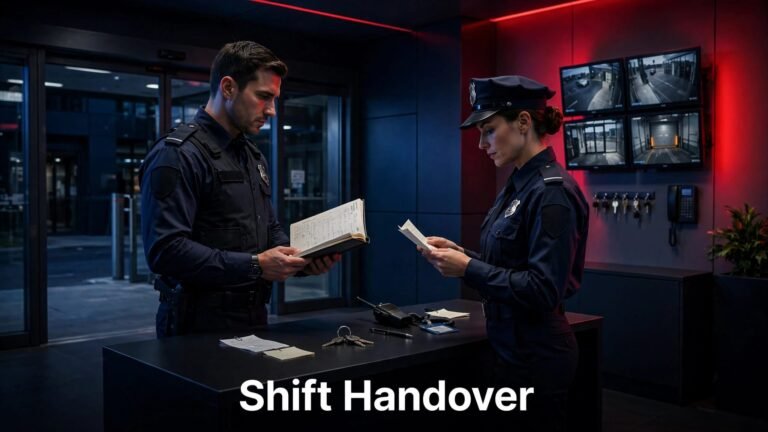
A security post is never truly unattended when concise pass-on notes capture the right information. The danger sits in ordinary gaps: an alarm left unexplained, a contractor still on site, a faulty door nobody mentioned, or an unaccounted key.
Proper security guard handover procedures protect continuity between shifts. They give the incoming guard a clear picture of the site, its current risks, and actions that cannot wait until morning.
For offices, warehouses, retail premises, construction sites and mixed-use properties, a handover should include a review of the site log book. It should be treated as part of the shift, not an informal chat at the gate.
Key Takeaways
- Treat every handover as a transfer of responsibility, supported by a reviewed site log book, clear pass-on notes and face-to-face confirmation.
- Record live incidents, open alarms, access changes, people remaining on site, missing or damaged equipment, patrol exceptions and all outstanding actions with times and named owners.
- Complete equipment, access-control, CCTV, alarm and key-register checks together, recording faults, interim controls and escalation details rather than vague descriptions.
- Use controlled paper or digital records with appropriate access, confidentiality and retention arrangements; digital systems support continuity but do not replace human verification.
- Supervisors should provide adequate overlap, audit records across all shifts and challenge repeated shortcuts so responsibility is never left unclear.
Why security guard handover procedures matter
A handover is the transfer of responsibility between security personnel, not simply the exchange of a radio and a set of keys. The outgoing guard knows what has happened. The incoming guard needs enough accurate information to take control without guessing.
The Health and Safety Executive’s guidance on shift handover describes three connected stages: preparation by the outgoing worker, the handover exchange, and cross-checking by the person taking over. That model fits commercial security work well. It is especially important in a high-security facility.
Handover is a safety-critical conversation
A missed detail can leave a site exposed. It may be a welfare concern in an office, a vulnerable access point at a warehouse, an unresolved shoplifting incident, or plant left unsecured on a construction project.
The strongest handovers are face-to-face, two-way and supported by pass-on notes, even when manual handovers are used. The incoming guard should ask questions. The outgoing guard should confirm what has been understood. A rushed signature without that exchange is decorative, not accountable.
The handover record is evidence of what was known at the time. It must be clear enough for a supervisor or client to understand hours later.
Roles must be clear before the shift begins
The outgoing guard updates the site log book, reports live issues and returns or accounts for all issued items. The person taking over reads the record, checks the site condition and accepts responsibility only after questions are answered.
The security supervisor sets the standard. They must provide enough overlap between shifts, check records, follow up missing information and deal with repeated shortcuts. Client post orders, emergency plans, security protocols and contract requirements always take priority over a general process.
What every security handover report must contain
A useful report is factual, time-stamped and easy to follow. The site log book should show what happened, what was done, who was told and what still needs attention.
Pass-on notes must align with the formal incident reporting record, so the incoming guard receives the same current information.
Do not write “all normal” when there was an alarm fault at 02:15 or a delivery vehicle waiting for clearance. The detail matters.
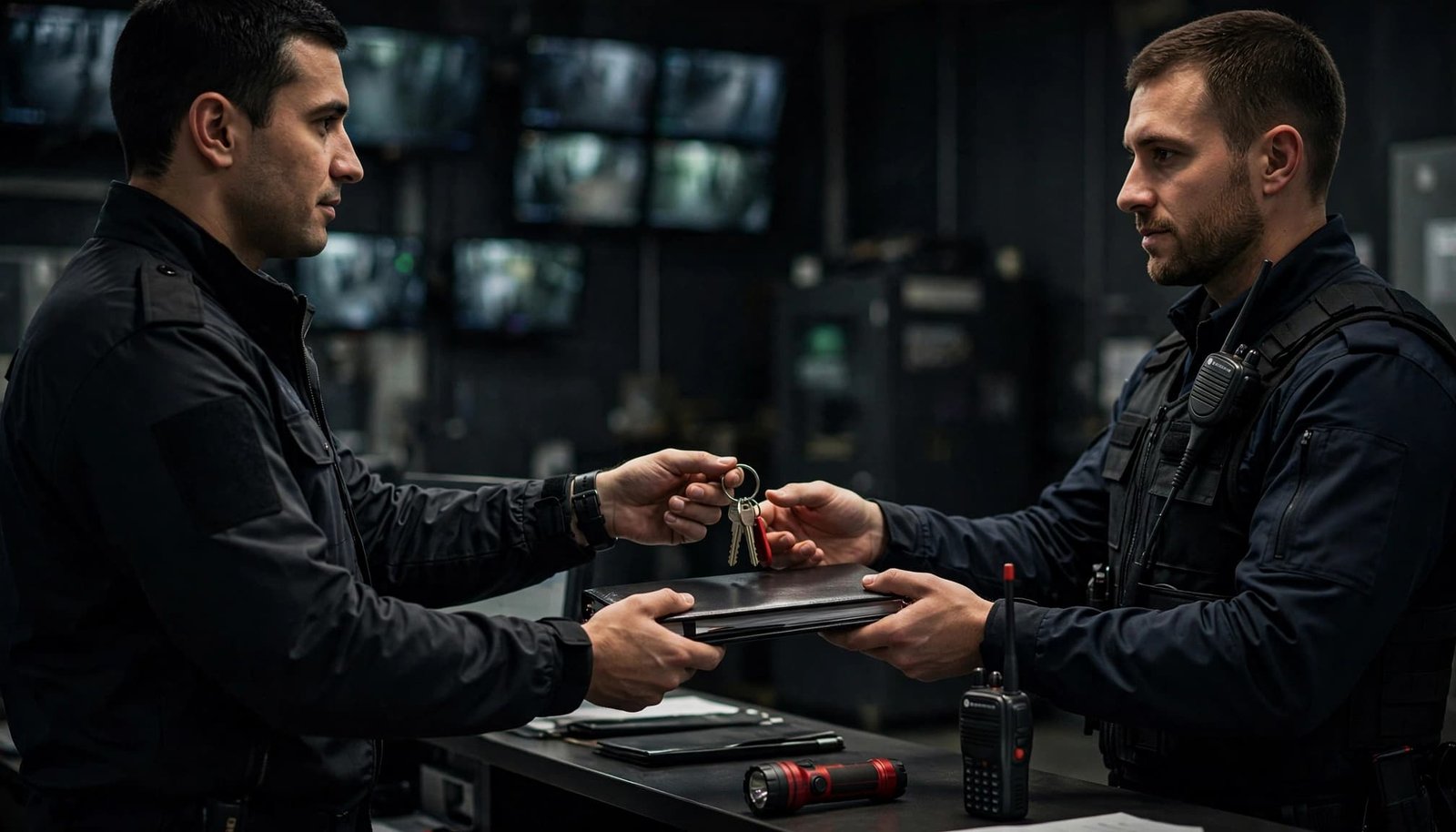
Incidents, risks and unfinished actions
Pass-on notes should cover all security incidents, even where police, emergency services or the client have already been contacted. Record the incident reference number where one exists, the name or role of the person notified, and the next required action.
Never omit a live threat, a fire or intruder alarm activation, a medical incident, a police attendance, damaged perimeter fencing, suspicious behaviour, or a person who has been refused access. These are not details for the next guard to discover during a patrol.
A concise note could read:
“02:15, loading-bay door alarm activated. Door secured, no entry found. Engineer ticket logged with facilities. Door remains on manual check every hour until repair. Duty manager informed at 02:32.”
That gives the incoming guard a time, location, action, current risk and reporting line.
Access control, people and property
Record temporary access control permissions, contractor movements, lone workers, late deliveries, visitors remaining on site and any changes to patrol routes. If a contractor has been granted after-hours access, the note should state who authorised it, which area is open and when access expires.
The key register should account for keys, fobs, passes and vehicle keys. Record possession, return, damage and the person responsible for each item. Supporting maintenance reports should be linked where faults or repairs affect security controls.
It is sensible to include the following fields:
| Register entry | What should be recorded |
|---|---|
| Date and handover time | The actual time responsibility changed |
| Outgoing and incoming guard | Full names and signatures or verified digital acknowledgement |
| Key and access-item count | Items issued, returned, missing or damaged |
| Open incidents | Reference, location, action taken and next action |
| Equipment status | Faults, battery levels and replacements needed |
| Access changes | Temporary permissions, contractors and restricted areas |
| Patrol status | Completed and missed patrol checkpoints, with follow-up required |
| Task assignments | Named owner and due or review point for each open action |
| Supervisor escalation | Name, time and instruction given |
The key point is simple: the register must show both possession and responsibility.
A repeatable shift handover procedure
A written standard operating procedure stops handovers becoming dependent on personal habits. It should align with site post orders and security protocols, stating where handover occurs, how much overlap is required, which documents must be reviewed and who can accept the post.
Prepare records before the relief arrives
The outgoing guard should update pass-on notes throughout the shift. Reconstructing eight or twelve hours of activity in the final five minutes produces vague records and forgotten times.
Before relief arrives, complete incident reporting, record task assignments and their owners, reconcile the key register, and identify relevant maintenance reports. Read the previous handover first. An unresolved issue may have been passed through several shifts.
If an incident is still developing, contact the supervisor before the shift ends. Don’t leave the relieving officer to decide whether a serious matter has been escalated.
Exchange information at the post
Conduct the handover at the security desk, gatehouse or control room, not in a car park or through a message group. This applies to manual handovers, while a high-security facility may require tighter overlap, logging and escalation.
Review the site log book together and cover the live risks first. A sensible order is:
- Confirm who is on site, including contractors, visitors and any lone workers.
- Discuss security incidents, alarm activations, access problems and patrol exceptions.
- Count keys, passes, radios and other controlled equipment together.
- Check CCTV, alarms, access control and communications equipment for faults.
- Confirm the person taking over understands the outstanding actions and escalation route.
The NPSA control-room guidance identifies communication, logging, escalation and handover as connected control-room functions. Commercial sites benefit from the same discipline, even where there is only one officer on duty.
Minimum equipment checks at shift change
Security equipment is often assumed to work until the moment it is needed. A short inspection is more reliable than an assumption.
Check radios are charged, on the correct channel and able to transmit. Test the torch, panic alarm or lone-worker device where issued. Confirm body-worn video, mobile phones and patrol-scanning devices are operational under the site’s policy, recording the equipment status. Follow the site’s security protocols when testing panic alarms, lone-worker devices and body-worn video. A high-security facility may also require stricter device-control or access requirements.
Review the status of intrusion alarms, fire panels, CCTV and other surveillance systems, access control doors, gates and barriers. Note faults with their exact location and report status, not vague phrases such as “CCTV issue”. Cross-reference the fault or engineer ticket against relevant maintenance reports.
For an office, that may mean a staff entrance that does not lock, requiring a temporary access check or controlled entry. For a warehouse, it may be a camera covering the loading bay, with an additional patrol until restored. For a retail premises, it may be a staff entrance that does not lock, requiring supervised access. For a construction site, it may be a perimeter gate with a failed magnetic lock, requiring a temporary guard or controlled opening. Record the exact location, fault, interim control and reporting status in the site log book until repair is confirmed.
Paper records and digital handover systems
Paper site log books remain common because they are familiar, simple and available during a network outage. Controlled manual handovers can also use paper records, including visitor logs and pass-on notes. They can create predictable problems, including illegible writing, missing pages, late entries and weaker incident reporting.
A handwritten record is not automatically poor. An unstructured one is.
What digital records can improve
Digital handovers can timestamp each note and identify its author and location. They can attach photographs where client policy permits, notify supervisors of incidents, and link the key register with access and patrol information. Recorded identity and acknowledgement create an audit trail for open actions.
The practical value is continuity. A supervisor can see an unresolved patrol checkpoint or alarm fault without waiting for the next paper log book review. A digital occurrence book approach can also bring patrol tracking and handover records into one controlled process.

Digital does not remove responsibility
A system cannot confirm that a guard understood an instruction. It cannot correct a false report or notice that the wrong key was counted.
The exchange still needs a competent outgoing guard, an attentive incoming guard and supervisor oversight. Use role-based access, secure devices and approved retention arrangements. Avoid recording unnecessary personal details. The system should support proper work, not bury it under forms.
Supervisors must make compliance routine
Skipped handovers usually develop because nobody challenges them. A guard arrives late, the previous guard wants to leave, and the site carries on with a blank line in the log book. That is how ordinary omissions become accepted practice and weaken wider security operations.
Supervisors should audit security personnel across day, evening and overnight shifts. Check pass-on notes in the site log book, confirm signatures match attendance records, and reconcile the key register. Sample security incidents for complete records, and review manual handovers alongside digital entries. Together, signatures, acknowledgements and recorded instructions create a clear audit trail.
Short corrective coaching is often enough for a one-off error. Repeated failures need formal action under the employer’s policy and contract arrangements. Assess performance against the site’s approved security protocols, client requirements and compliance standards, rather than an unsupported universal rule. The standard should be fair but firm: no guard leaves a post until responsibility has been properly transferred or the supervisor has given a recorded instruction.
Client representatives should receive relevant updates through agreed channels. Guards shouldn’t share incident details through personal messaging apps or discuss site matters in public areas.
CCTV, confidentiality and record retention
Security notes often contain personal data. Visitor logs, vehicle registration, access-control events, CCTV references or incident reports may identify someone directly or when combined with other records.
The ICO’s CCTV and video surveillance guidance applies to organisations using surveillance systems that process personal data. Handover notes should contain only what the next shift needs to protect the site and follow the required action.
Keep records factual and restricted
Use names only where necessary. Avoid speculation, insulting descriptions and irrelevant personal information. Write “male visitor refused entry after failing to provide appointment details”, not comments about appearance or assumed motive.
Secure paper logs in the designated cabinet or control room. Limit digital access to authorised personnel. Do not leave reports, CCTV screenshots or visitor records visible on an unattended desk.
Set retention rules with the client
There is no universal UK retention period for CCTV or security records. The ICO’s retention guidance says organisations should define retention periods in advance and keep information no longer than necessary.
CCTV duties can also affect licensing requirements. Managers should check the official SIA licensing guidance against the actual activity, rather than assuming every security licence covers every surveillance role.
AI-assisted notes need human verification
AI writing tools can help guards turn rough notes into clear, professional pass-on notes. They may improve spelling, structure and plain-language wording, particularly after a busy incident.
They must not invent facts, decide whether an event belongs in the site’s incident reporting process, or determine whether escalation is required. A trained guard must check every time, location, action and reference number before a note is submitted.
Never enter confidential client information, CCTV content, access codes or personal data into an unapproved tool. If the client hasn’t authorised its use, don’t use it.
Frequently asked questions
What should never be left out of a handover?
Security incidents, open alarms, access-control faults, missing keys, people still on site and required escalations must always be recorded. Include the current position and the action still required, not only what first happened.
How does a site log book support continuity?
A well-kept site log book gives each guard a chronological record of events, patrols, visitors, faults and instructions. It prevents separate shifts from operating as though each one began with a blank page.
Is a digital handover system required?
No. A paper record can meet a site’s requirements if it is controlled, legible, secure and properly reviewed. Digital systems may improve timestamps, reporting speed and audit trails, but they still need suitable configuration, staff training and active supervision.
A handover is part of the security service
Reliable protection depends on what the incoming guard knows at the start of the shift. Accurate records, face-to-face confirmation and basic equipment checks close the gaps created by vague pass-on notes and hurried exits, supporting operational continuity.
Good security guard handover procedures are practical, consistent and site-specific. They protect the client, support the guard and keep responsibility clear through site-specific security protocols when it matters most.


0 Comments