

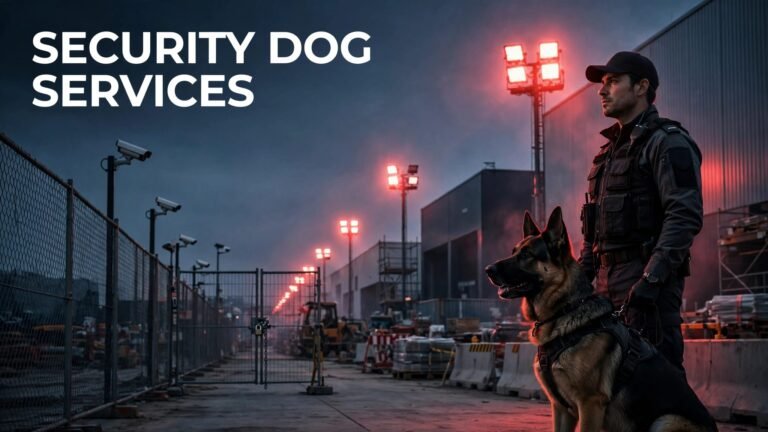
A locked gate and a row of cameras can look reassuring, right up to the point when nobody is watching the alert. Security dog services add a trained, handler-led presence, with commercial security dogs identifying unusual activity during patrols. Properly managed security dogs also provide a visual deterrent, making a site less attractive to opportunists.
They are not a substitute for gates, lighting, CCTV, alarms or sensible site routines. As part of commercial property security, canine security teams work best with clear patrol routes, risk assessments, reporting procedures and effective animal welfare controls. This supports a properly planned security arrangement and an honest view of the risks on site.
Key takeaways for commercial decision-makers
- A security dog is deployed with its trained handler, not hired as a stand-alone guard dog.
- A general-purpose patrol team and a detection dog team carry out different work. The contract should state which service is required.
- Construction sites, warehouses, vacant premises and industrial yards often suit handler-led patrols because boundaries are large and conditions change after hours.
- Public-facing deployments need tighter controls, including separation from attendees, managed routes and a clear incident procedure.
- Check the provider’s training evidence, SIA licensing arrangements, insurance, welfare controls, reporting standards and back-up cover before signing.
- Compare proposals by coverage and operational detail, not by a vague claim that dogs are cheaper than static guards.
How security dog services protect commercial sites
A professional K9 security team brings mobility and observation to sites that may feel empty after closing time. Security dogs also provide a visual deterrent. The dog is part of the security operation, but the handler makes decisions, records concerns and follows the agreed escalation process.
A handler-led patrol, not an unattended dog
The useful description is a security dog patrol team: one appropriately trained dog working with one qualified handler. The handler directs the patrol, reads the dog’s behaviour, controls access around the team and decides when an issue needs reporting.
That distinction matters. A dog can support threat detection by noticing sound, scent or movement before a person does. It can’t assess a contractor’s authority, call a control room or write an incident report, so the handler evaluates and reports the concern.
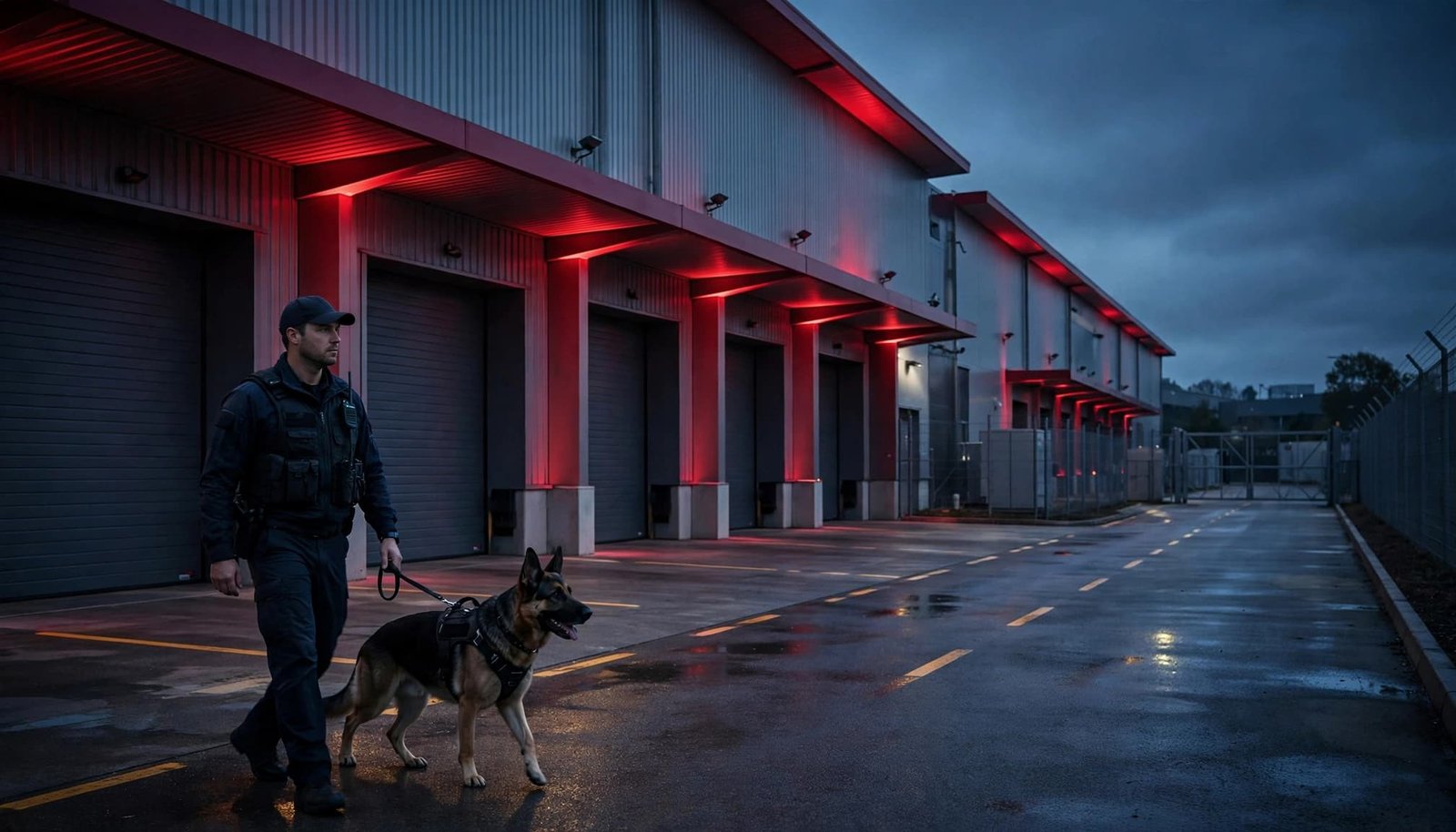
A good patrol plan sets out routes, frequency, visual checks, training, animal welfare and reporting requirements. Loading bays, fuel stores, roof-access points, plant compounds and perimeter gaps need particular attention. They are also where security arrangements often fail, making perimeter protection an important consideration.
Dogs work alongside physical and electronic security
The strongest arrangements connect people, procedures and equipment. CCTV can verify an alert. Access control can show whether a person should be on site. Lighting allows safe patrols and better camera images. Alarm monitoring gives the handler a route to raise an issue promptly.
A patrol dog is not an alarm response plan. It needs radio contact, escalation rules and someone authorised to make decisions when the site is closed.
For broader support around guards, cameras and access arrangements, property managers can also review commercial security services as part of a single site plan.
Security dog patrol teams and detection dogs are different
“Security dog” is often used as a catch-all term. That can create a poor brief and an unsuitable deployment. Ask whether the service uses patrol dog teams, what each dog is trained to do and what the handler manages. The provider should also supply training and assessment evidence, including whether its teams are NASDU approved.
General-purpose dogs for patrol work
General-purpose dogs are used with handlers on manned guarding duties, often at static premises or during mobile patrols. Their work is based on controlled patrol, presence and alerting behaviour. It is not an invitation to use force as a routine response.
The BS 8517-1:2016 code of practice covers recommendations for using general-purpose security dogs within manned guarding services. A provider should be able to explain how its operating procedures reflect this BS 8517 guidance.
In practical terms, this service may suit a warehouse perimeter, a building site with valuable plant, or an industrial estate with repeated trespass concerns.
Detection dogs have a narrower task
Detection dogs are trained to find defined scents, not to conduct a general deterrent patrol. They may be used for controlled searches, depending on the substance or item covered by their training and the client’s lawful purpose. Detection dogs therefore require a defined scent and a lawful purpose.
BS 8517-2 guidance for detection dogs is separate from general-purpose dog practice. This separate BS 8517 guidance reflects the narrower nature of detection work. Don’t assume that a patrol dog can carry out detection work, or that a detection dog team is the right answer for perimeter security.
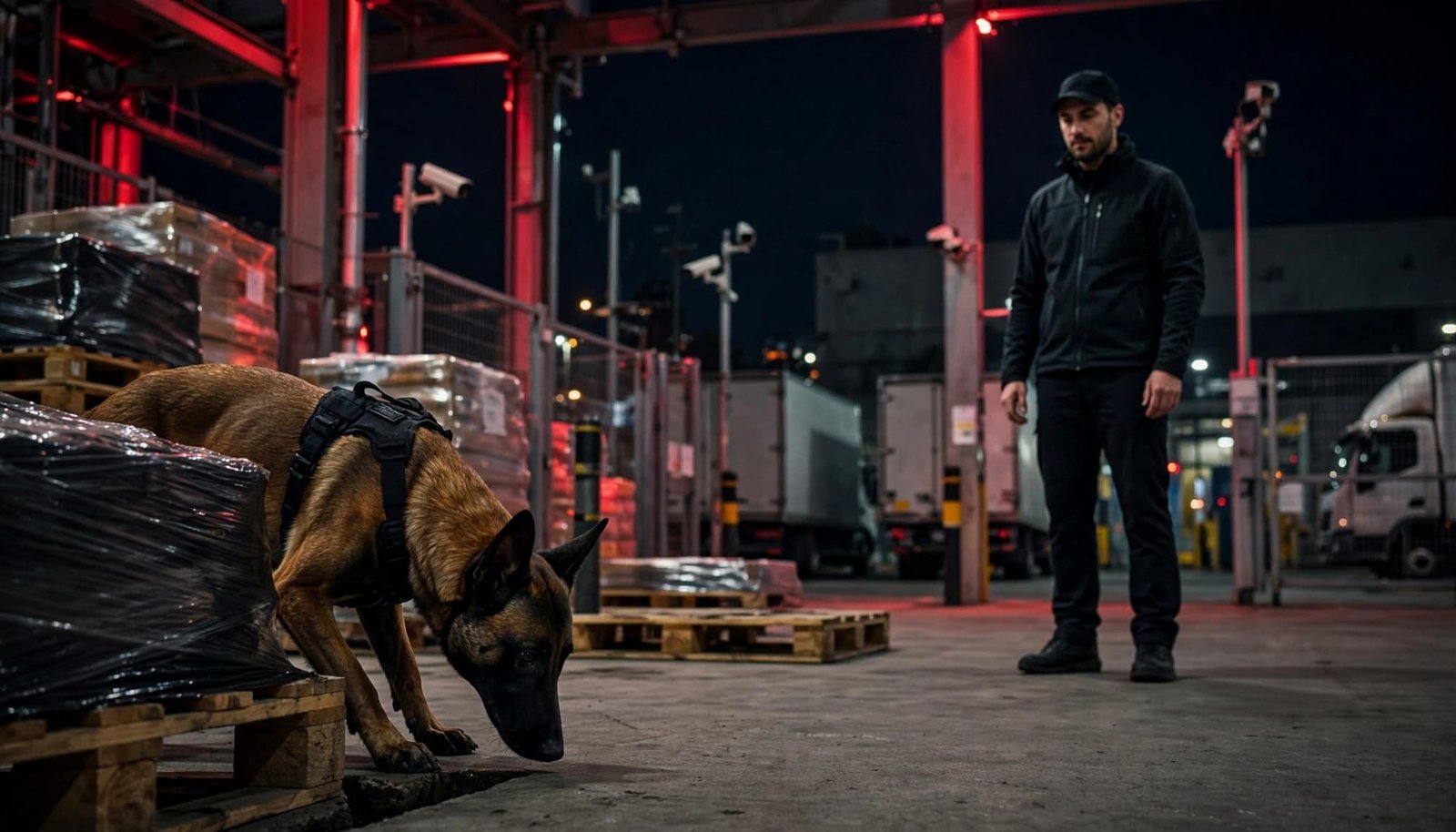
The contract should name the deployment type, distinguishing patrol, detection and trained protection dogs. It should also specify the patrol or search method, operating hours, search boundaries and reporting route. Vague wording leaves too much room for inconsistent practice.
Where security dog teams fit best
Canine security teams are often considered for large, partially open or poorly occupied sites. Security dogs can help where one fixed post cannot provide practical coverage across commercial premises. The right choice depends on the site assessment, risk assessments and the most suitable patrol window. The specification should describe a handler-led role, rather than relying on a vague sales label such as guard dog services.
Construction sites, warehouses and logistics yards
Construction site security is a common use case. Plant, materials and temporary access points can change daily, whilst fencing and lighting may be incomplete. Dog handler patrols can inspect the perimeter, welfare facilities, storage areas and access routes in a practical sequence.
Warehouses and logistics yards present different issues: vehicle movements, late deliveries, contractor access and high-value stock. For warehousing security, the team needs agreed safe routes and clear communication with the duty manager. Routes, breaks and changing site conditions must also support animal welfare. A patrol that cuts across active vehicle areas without planning isn’t professional security.
Vacant buildings, retail estates and industrial units
Vacant property security requires care because the risk isn’t limited to theft. Water damage, broken access points, illegal occupation and fire hazards may be found during checks. A handler should report what they see, not treat every issue as a confrontation.
Retail parks, offices and industrial estates can also benefit during closed hours, particularly where perimeter breaches have become routine. During trading hours, a visible dog team may be inappropriate around customers. The operational answer may be a later patrol window, not a permanent presence at the entrance.
Safety around staff, customers and event attendees
Security dogs don’t need to frighten people to be useful. Their presence should support public safety through calm, controlled and proportionate deployment. A provider that treats public contact as an afterthought isn’t offering a mature service.
Public-facing deployments need a written plan
For event security, establish arrival and departure routes, patrol zones, vehicle access, welfare breaks and handover points before the event opens. Separation from dense queues, children’s activities and alcohol service areas supports animal welfare, alongside controlled movement and proportionate deployment.
Staff and attendees need to know who to contact if they have a concern. Site management should also brief its own team, especially reception staff, stewards and facilities personnel who may encounter the handler during a shift.
Incidents require control, not theatre
The handler should observe, create distance where possible, call for support and follow the agreed reporting process. Police contact, first aid, CCTV preservation and client notification should be set out in the assignment instructions.
No provider should sell its service on guaranteed apprehension of intruders or promise to prevent every loss. The sensible objective is early awareness, controlled action and good evidence after an incident. That’s less dramatic, but it’s what commercial clients need.
Legal compliance, licensing and animal welfare
Compliance is not decorative paperwork. It affects how dogs are deployed, how staff are supervised and how a client manages its own liability.
The Guard Dogs Act and handler control
Under the Guard Dogs Act 1975, a guard dog must not be used at premises without a handler present who is capable of controlling it. Security dog handlers must therefore remain involved, rather than leaving a dog to roam a yard overnight.
Site risk assessments should record public access, shared boundaries, escape routes, delivery activity and any place where the team could meet contractors or visitors. Assignment instructions must then address those risks in plain terms.
SIA licensing, standards and welfare records
There is no separate SIA licence labelled “dog handler”. The SIA’s licensing clarification states that handlers are not exempt where they carry out licensable security activity. The applicable SIA licence depends on the duties being provided, so verify that relevant security dog handlers are SIA licensed.
The Approved Contractor Scheme provides company-level assurance, not a substitute for checking individual competence. Ask whether licenced handlers hold the correct licence for their duties, and verify it.
Training claims also need substance. NASDU approved status may be relevant, but it should sit alongside evidence of handler training, dog assessment, refresher arrangements and operational supervision.
Animal welfare needs equal attention. The Animal Welfare Act 2006 supports the basic duty to meet an animal’s needs. Ask about transport, rest, water, temperature, veterinary care, working hours and what happens if a dog is unfit for duty. A welfare plan protects the dog, the handler and the client.
Comparing cost, coverage and liability
A dog team may reduce the number of people needed for certain patrol tasks, but it isn’t automatically less expensive than standard guards. The comparison only means something when both proposals reflect the same site risks, risk assessments, operating hours, patrol frequency, reporting and response arrangements.
Request like-for-like quotations
Give each provider the same brief: site map, hours, access arrangements, recent incidents, areas of concern and the security measures already in place. Ask whether the provider is SIA licensed, NASDU approved and part of the Approved Contractor Scheme. Then request a written proposal explaining what is included.
Useful points to compare include:
- The number of handler and dog teams on duty, plus their patrol schedule and relief arrangements.
- Whether the price includes supervisory visits, electronic patrol records, incident reports and control-room support.
- What happens if the handler, dog or vehicle becomes unavailable during the shift.
- Whether alarm response, keyholding, CCTV monitoring or extra officers are charged separately.
A cheap quote that leaves the gatehouse uncovered, provides no relief team or limits reporting may cost more once the gaps are exposed.
Check insurance and accountability
Ask for current evidence of public liability and employers’ liability insurance, then confirm the policy scope with the provider. Don’t rely on a logo in a proposal or a broad statement about “full cover”.
For dog teams, ask whether relevant animal welfare records and operational records will be available where appropriate. Clarify who is responsible for site induction, keys, access cards, body-worn camera policy, personal data, incident records and liaison with police.
Privacy matters here. If patrol reports include images, names or vehicle registrations, the client and provider need clear retention and access rules.
Questions to ask before appointing a provider
A polished website is not proof of a reliable deployment. The useful questions are ordinary, direct and slightly awkward. They show whether the provider has thought through the work.
Check whether security dog handlers are SIA licensed and whether the provider is NASDU approved. These checks focus on suitability and controls, not just price.
Can I hire a security dog without a handler?
No. A commercial security dog should work with a capable handler who can control it. The Guard Dogs Act 1975 makes handler presence a legal requirement for guard dog use at premises. Handler control also supports animal welfare, fitness for duty and responsible deployment.
Are security dogs more cost-effective than guards?
Sometimes, for a defined patrol requirement. They may cover large external areas efficiently, but they cannot replace duties such as reception cover, visitor screening, CCTV control or access administration. Compare the full specification before deciding.
Which commercial premises suit canine security teams?
Common settings include commercial premises such as construction sites, warehouses, logistics yards, vacant properties, industrial estates, retail premises and controlled events. The service should follow the site’s risk profile, rather than a standard sales package.
A measured approach to commercial dog security
The value of security dog services is not the spectacle of a dog at a gate. It is a properly trained team, clear instructions and a controlled response when something is wrong.
Request a customised site assessment before appointing a provider. It should include risk assessments covering the perimeter, existing systems, public access, animal welfare arrangements, reporting expectations and emergency procedures. It should then show where a handler-led team genuinely fits.


0 Comments