

Most security failures are ordinary before they become expensive. A side gate that does not close properly, a shared access fob, an unpatched CCTV recorder, or a visitor left unescorted can each create a route into your premises, systems or stock.
Proper security vulnerability assessments identify security gaps across a premises’ attack surface. They turn a general sense that “security could be better” into a practical record of what needs attention, who owns it, and how quickly it should be resolved.
The strongest assessments look at the building, its technology and the people using it as one connected operation. They provide a practical baseline for the premises’ overall security posture.
Key takeaways
- A premises vulnerability assessment identifies weaknesses across physical barriers, daily routines, connected systems and recovery arrangements. A broader risk assessment also considers threats, consequences and risk tolerance.
- The priority isn’t the longest list of security weaknesses. It’s the issues creating a credible opportunity for theft, intrusion, safety incidents or data loss.
- Perimeter protection, access control, CCTV, intruder detection, lighting and visitor management are security controls that must work together. A good camera can’t compensate for an unsecured door.
- Connected physical security systems need cyber controls, including patching, restricted administrator access and monitored supplier connections.
- Every finding needs an owner, a deadline and a follow-up check. A report left in a folder is decorative, not protective.
What security vulnerability assessments should cover
A vulnerability assessment is a structured review of security weaknesses that could affect people, property, information or business operations. It isn’t a guarantee that an incident can’t happen, and it isn’t automatically the same as a penetration test.
For most UK businesses, the assessment should begin with the actual site. That means a walk around at different times, a review of access routes, and honest conversations with the people who open, close and operate the premises.
Where connected systems are within the agreed scope, automated tools such as web application scanners, database assessments and host-based scanners may support a technical review. They can identify issues such as cross-site scripting and sql injection, but don’t replace an authorised physical inspection or manual validation. Results indicating known vulnerabilities need checking against the actual environment, as automated checks can produce false positives.
Start with assets, operations and credible threats
Begin with vulnerability identification by listing critical assets, exposure points and the operations that depend on them. These may include staff, visitors, stock, keys, vehicles, confidential records, server rooms, plant, cash and operational equipment. Then consider when those assets are most exposed.
A distribution site may be most vulnerable during early-morning deliveries. An office may have weak visitor controls at reception. A serviced building may have shared entrances, shared loading areas and unclear responsibility for communal spaces.
This isn’t a full risk assessment, so threats should remain credible and proportionate. Opportunistic theft, unauthorised access, vandalism, fraud, social engineering, workplace violence and deliberate damage may all be relevant. Current threat intelligence can help place cyber threats and physical risks in context. High-value stock, sensitive data or a contentious public profile may require specialist security advice. Together, these findings provide an evidence-based view of the site’s current security posture.
Inspect the routes people would actually use
Security assessments should test the obvious routes, then look beyond them. Perimeter fencing, gates, fire exits, roller shutters, roof access, loading bays, plant areas and rear doors all deserve attention.
Ask practical questions. Does a gate latch after a delivery? Can someone follow an employee through a controlled door? Is there enough light to identify a person at the edge of the site? Can a contractor reach a comms cabinet without being challenged?
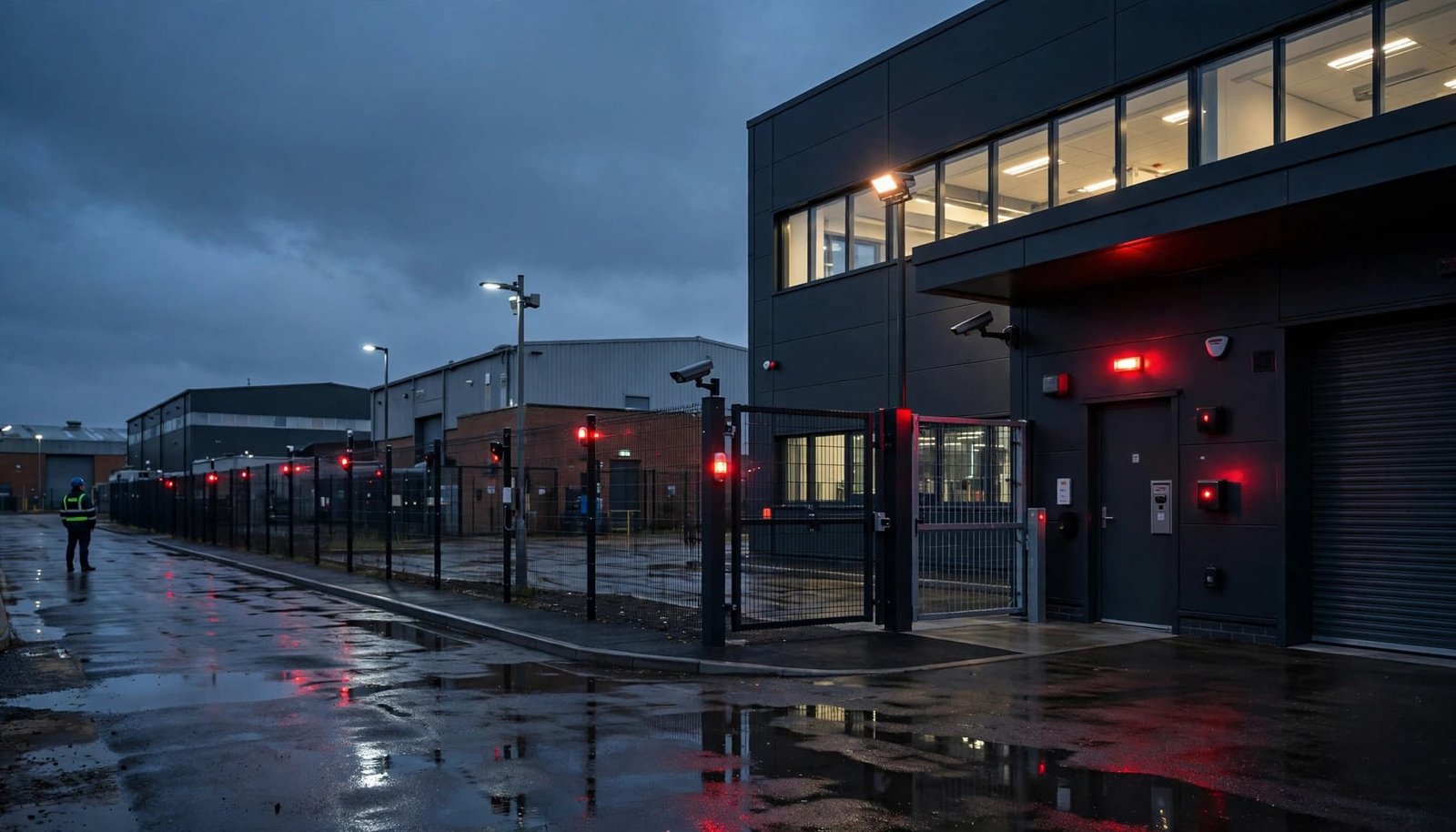
The ICO’s physical security guidance is clear on the principle: entry points to secure areas need physical controls, with additional electronic controls where appropriate. The appropriate measure depends on the area, the people using it and the consequence of access being abused.
A practical vulnerability assessment process
The vulnerability assessment process should be repeatable. A one-off report may identify issues, but regular reviews reveal whether controls still work after a refurbishment, staff change, new tenant, altered opening hours or security incident.
Walk, test and document the evidence
Begin with plans, alarm records, access-control permissions, incident logs, key registers, maintenance schedules and CCTV coverage maps. Then inspect the site under normal operating conditions.
Test controls in a sensible and authorised way. Check whether doors close and lock, whether alarm zones match the current layout, and whether camera views are useful rather than merely present. Review lighting after dark, not at midday when every vulnerable corner looks acceptable.
Validate technical alerts and risk ratings against site evidence to avoid false positives. Record each finding with evidence, describing the security weaknesses, location, likely route of exploitation, affected assets and existing controls. “Improve security” is too vague to be acted upon.
Rank exposure, then assign the work
Vulnerability prioritisation matters because most businesses will find more issues than they can fix immediately. Use vulnerability analysis to consider likelihood, impact, and the strength and reliability of existing security controls together.
A rear fire exit held open during deliveries may be high priority if it leads directly to valuable stock. A scratched warning sign may be low priority unless it makes CCTV use unclear or breaches a stated procedure.
The same fault can have a different priority at different sites. A detached office, a busy retail unit and a high-security storage facility do not carry the same exposure.
Create a remediation plan with a named owner, target date, cost estimate and temporary control. For example, a damaged access-control reader may need a prompt repair, backed by a staffed check-in point until the repair is complete.
Review the physical and connected systems
A vulnerability assessment should separate systems into manageable areas, but never treat them as unrelated. A disconnected alarm, a poorly configured camera and a weak staff process often meet at the same point of failure.
Check barriers, detection and surveillance together
Review fences, gates, doors, shutters, locks, lighting, CCTV and intruder detection as a sequence. A secure boundary should deter unauthorised entry, slow an intruder down, detect their presence and support an appropriate response.
CCTV needs more than a camera count. Check image quality, camera positioning, blind spots, recording reliability, time and date accuracy, storage capacity and who can retrieve footage. A camera looking at the back of a high-vis jacket does not identify a visitor.
Intruder alarms also need review after layout changes. A new partition wall, moved stock racking or altered access route can leave detection gaps or create nuisance activations that staff learn to ignore.
Treat network-connected systems as security systems
CCTV recorders, access-control panels, intercoms and alarm-monitoring connections can extend the premises’ attack surface through the business network infrastructure. This creates cyber-physical exposure, particularly where cyber threats can exploit known vulnerabilities in systems intended to protect the premises.
The NPSA’s CAPSS guidance covers cyber assurance for physical security systems, including the protection of stored data. Its related guidance highlights patching, privileged-access controls, training, monitoring and incident planning.
Review administrator accounts, default passwords, remote access, firmware updates and supplier permissions. Include operating-system and device updates within patch management. Restrict physical access to recorders, network equipment, cabling and control panels, prioritising these critical assets.
Keep an up-to-date list of devices, including older equipment that no longer receives security updates. Where systems fall within the agreed technical scope, host-based scanners can supplement manual checks, but they aren’t a default requirement for every physical assessment.
Business continuity belongs here too. During a vulnerability assessment, check tested backups of critical configurations, access permissions and security footage settings. Link recovery arrangements to incident response, so security controls can be restored after a system failure, ransomware incident or other cyber event.
Where appropriate, use secured offline or off-site copies, so a system failure or ransomware incident does not remove both the primary system and its recovery option.
Meeting UK privacy and security obligations
Compliance should not be a separate folder added after the assessment. It should shape the design of the controls, the information collected and the way staff use it. A vulnerability assessment should identify privacy and access-related weaknesses alongside physical defects.
Use CCTV with a clear and lawful purpose
Where CCTV identifies people, it is subject to data-protection law. The purpose must be clear, proportionate and documented. “We might need it one day” is not a proper operating basis.
Documenting the purpose, retention period and access rules supports regulatory compliance and lawful handling. The ICO’s current guidance on surveillance expects visible signs, secure storage, limited access and a process for requests from individuals. In most cases, subject access requests must be handled within one calendar month.
Footage should be kept only for as long as there is a genuine need. There is no universal retention period for commercial CCTV. A business should set its own period based on risk, purpose and operational need, then be able to explain it. Some organisations also need to pay the ICO data-protection fee, although exemptions can apply.
Protect access to security information
Security data is useful, and that makes it attractive. Poorly protected footage, entry logs or alarm reports can increase the consequences of data breaches. Door-entry logs can reveal working patterns, while CCTV can show staff, visitors and sensitive areas.
Limit access to people who genuinely need it. Use individual accounts rather than shared logins, remove leavers promptly and record administrator access to address security weaknesses. If an installer or monitoring provider requires remote access, agree what they can access, when, and how activity is logged.
The BSIA guidance library is a sensible starting point when selecting installers, monitoring arrangements and industry guidance. Where a site handles special-category personal data, high-risk activities or complex surveillance, obtain appropriate legal and specialist security advice.
Turn findings into a remediation plan
A thorough vulnerability assessment earns its value when findings become completed work. The remedy may be a repair, process change, system upgrade or temporary control. It should never be an unowned recommendation.
Deal with immediate exposure first
Some weaknesses cannot wait for a capital-project meeting. An unsecured key cabinet, failed lock, disabled alarm zone, exposed network switch or unknown administrator account needs prompt action.
Use compensating measures while a permanent fix is arranged. Increase patrols, move valuable stock, restrict a route, revoke credentials, change passwords or place a trained person at a vulnerable entrance. Record when the temporary measure begins and when it can be removed.
Plan upgrades with evidence, not assumptions
Larger works need a clear brief. If camera coverage leaves security gaps, state the incident scenario it must address, the lighting conditions, the distance involved and who will monitor the images. Don’t buy more cameras simply because the existing system feels inadequate.
For every remediation plan, keep a short record covering:
- the finding and its assessed priority;
- the person accountable for the fix;
- the completion date and evidence of completion; and
- the date the control will be tested again.
A re-test matters. A new gate, card reader or alarm sensor may be installed properly, yet fail in day-to-day use because staff weren’t told about a changed procedure.
Common problems that weaken assessments
A rushed vulnerability assessment can create false confidence if it’s disconnected from site operations or treated as an annual paperwork exercise.
False positives and incomplete coverage
A technical alert may not be exploitable in the way a report suggests. Equally, a physical weakness can be missed because the assessor only visits during office hours or follows the main entrance route.
Validate false positives against site observations. Speak to reception staff, cleaners, maintenance teams and delivery staff. They often know which door sticks, which gate is left open, and where visitors wander when no one is watching.
Split ownership and limited budgets
Facilities may own doors and lighting. IT may own the network. HR may manage staff records. A contractor may maintain the alarm. Each team can be doing its own job properly while the gap between them remains open.
Set one person to coordinate the remediation plan, even where the work sits with several departments. Review priority actions monthly to maintain the site’s security posture, and repeat the full assessment annually or when the threat, site or operating model changes.
Frequently asked questions
Is a vulnerability assessment the same as a security survey?
They overlap, but a vulnerability assessment goes further. It identifies weaknesses, considers how they could be exploited, ranks the exposure and records the corrective action. A survey may focus mainly on recommending equipment.
How often should a business assess its premises?
Review the site at least annually. A vulnerability assessment should also be repeated after an incident, major layout change, new system installation, change in operating hours or a change to the threat profile. High-risk premises may need more frequent reviews.
Do small businesses need a formal assessment?
Yes, although the scale of the vulnerability assessment should match the premises, assets and operational complexity. A small office may need a concise review of keys, visitors, CCTV, alarms and data storage. A multi-site warehouse operation will require a more detailed assessment and stronger governance.
A secure premises is maintained, not declared
The most useful security vulnerability assessments focus on the weak points that matter in ordinary working life. They connect a faulty latch, an access-control account, a dark loading bay and a poorly managed supplier login to the same question: could this create avoidable harm?
A vulnerability assessment is useful only when findings are owned, prioritised and checked. That is less glamorous than a long report, but it is how a premises stays properly protected.


0 Comments