

A hospital does not become safer because somebody is standing by the door. It becomes safer when security staff, clinical teams and practical systems know what to do before a difficult situation becomes an unsafe one.
Effective healthcare security services protect people, medicines, information and premises without making patients feel watched, challenged or unwelcome. That balance matters across UK medical facilities, from busy A&E departments and mental health wards to maternity units and small private clinics.
The right arrangement is neither decorative guarding nor an over-engineered control room. It is a clear, proportionate plan that works on an ordinary Tuesday afternoon as well as at 3am.
Key takeaways
- Healthcare security must support safe care, safeguarding, confidentiality, accessibility and patient dignity, not simply prevent trespass.
- Hospitals often need staffed security and rapid incident response. Smaller clinics may need controlled entry, monitored alarms and well-defined escalation instead.
- Security officers need the right licence for their role, alongside healthcare-focused training in de-escalation, mental health awareness and safeguarding.
- CCTV and access control require documented purposes, sensible operating rules and data-protection governance.
- Procurement decisions should test incident response, reporting, supervision and integration with clinical teams, not only hourly rates or camera specifications.
Healthcare security services deal with risks ordinary sites do not
Commercial security is often about protecting stock, property and restricted areas. Healthcare brings a different responsibility. A person entering a hospital may be frightened, in pain, confused, grieving or distressed. Security has to keep boundaries in place without treating every visitor as a threat.
Hospitals also operate around the clock, with public corridors, multiple entrances, contractors, patient transfers and changing visiting arrangements. Clinics have fewer moving parts, but smaller teams can be exposed when reception staff work alone or when a patient becomes aggressive.
Violence and aggression need a joined-up response
Violence and aggression towards staff cannot be solved by asking security to “deal with it”. The immediate incident response may involve security personnel containing the risk, while clinical care, safeguarding and police responsibilities remain with the appropriate teams.
NHS England’s Violence Prevention and Reduction standard contains 43 indicators across seven areas, including leadership, workforce, data, interventions and evaluation. It is a useful discipline for NHS-funded providers because it makes violence prevention a board-level responsibility, not an isolated security contract.
A good service records the facts: location, time, triggers, people involved, action taken and outcome. Repeated incidents in one waiting area or at one time of day usually point to an operational problem worth fixing.
Theft and unauthorised access are rarely random
Controlled drugs, prescription pads, medical equipment, clinical stores and patient records all need different protections. One master key arrangement, a poorly managed visitor pass or an unmonitored side entrance can allow unauthorized access and undermine an otherwise expensive security system.
Risk assessment should map who needs access, when they need it and what supervision is reasonable. On larger hospital sites, mobile patrols can support perimeter security alongside access controls, but they don’t replace a considered access plan.
A locked door is not a security strategy if staff routinely prop it open because the workflow was never considered.
Safeguarding vulnerable patients without losing compassion
Healthcare security is at its best when it is present but not intrusive. Patients with dementia, learning disabilities or acute mental health needs may experience a forceful intervention as frightening or destabilising. Children, newborn infants and adults at risk need safeguards that do not turn care into custody.
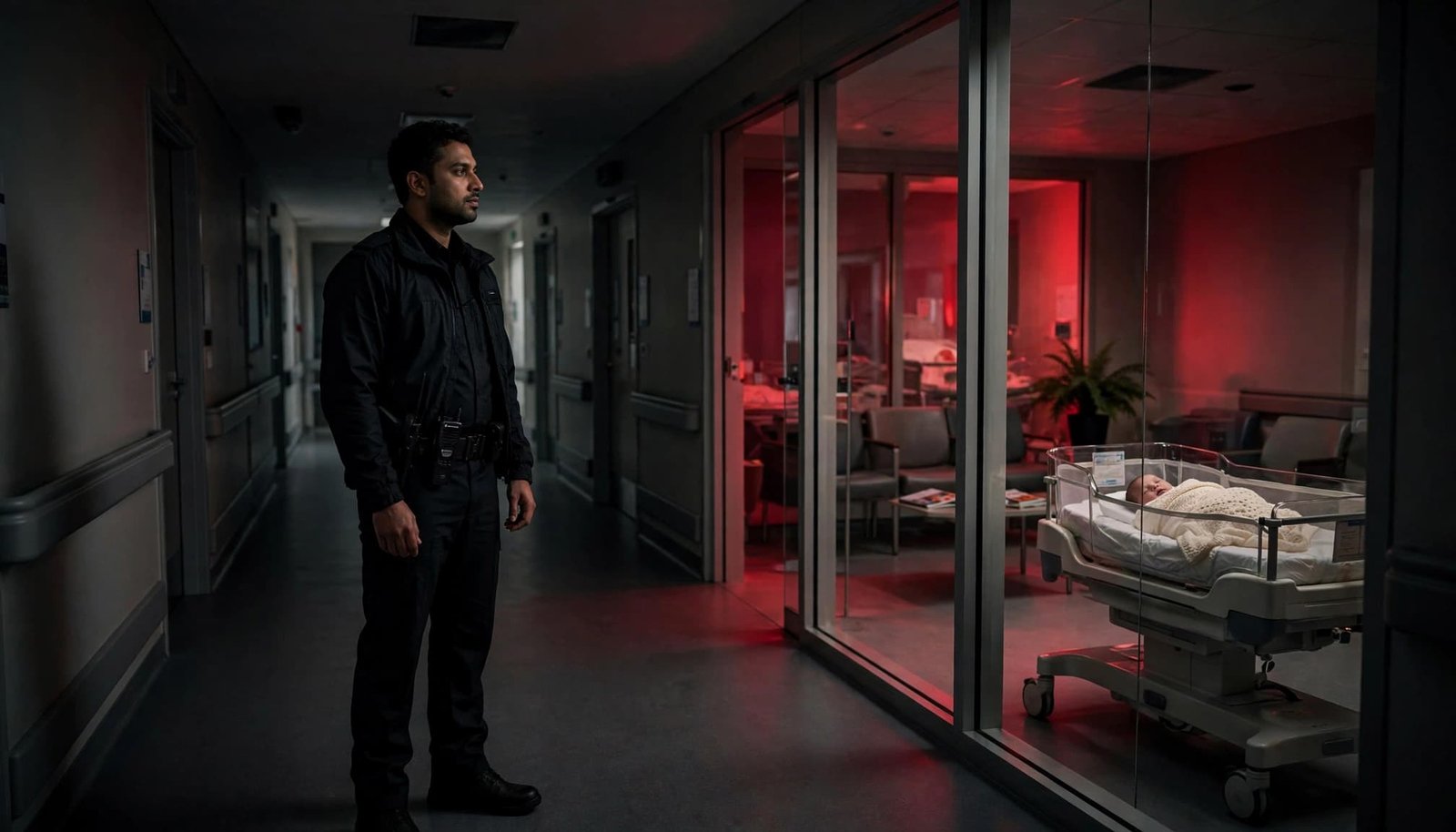
Maternity, neonatal and paediatric areas require local controls
There is no single national technology requirement for newborn protection. Each provider should set procedures that match its building, patient group and local safeguarding risks.
Practical controls often include reception-based visitor checks, staff-only access to clinical areas, clear processes for identifying authorised parents and visitors, and prompt escalation where somebody’s behaviour causes concern. Staff need to know the local incident response route, including which security, clinical and safeguarding leads to contact and the threshold for escalation.
The purpose is simple: reduce the chance of unauthorised access while allowing families to move through care with as little friction as possible.
Mental health settings need therapeutic boundaries
Mental health facilities need secure spaces, but they cannot operate like conventional high-security premises. Access control systems should support observation, safe movement and clinical decisions, not create blanket restrictions that undermine therapeutic care.
Security officers working in these areas need to understand trauma-informed practice, consent, personal space and the risks of escalation. Their role is to support staff where trained intervention is required, then step back when clinical colleagues take the lead.
Physical restraint and restrictive practice are not routine security measures. Any response must follow the provider’s policies, safeguarding duties and clinical governance arrangements.
Technology should support people, not replace them
The best security systems reduce uncertainty. They show who has entered a controlled area, make it easier to verify an alarm and give staff a reliable route to request support. Effective security solutions complement staffing, clinical judgement and accessible procedures, rather than replacing trained people.
Access control and visitor management
Access control systems can limit sensitive areas to the people who need them, while audit trails help investigate a concern later. Across medical facilities, hospitals may need different permissions for pharmacies, theatres, wards, plant rooms and records storage. A clinic may need a controlled entrance supported by reception security, secure consulting-room access and a staff duress alarm.
Ask whether a system works during a fire alarm, power failure or network outage. A design that looks tidy on a plan can cause delays if it leaves staff unable to move patients safely.
Visitor procedures should also allow reasonable adjustments. A person with a disability, language barrier or caring responsibility should not be excluded by a process that offers no practical alternative.
CCTV monitoring and AI-enabled security alerts
Video monitoring can help identify congestion, unauthorised entry and emerging incidents. Smart cameras and AI-enabled security tools may flag movement in restricted zones or alert operators to unusual activity. They are aids to detection and verification, not independent decision-makers.
During a developing event, alarms, cameras and operators should support a clear incident response.
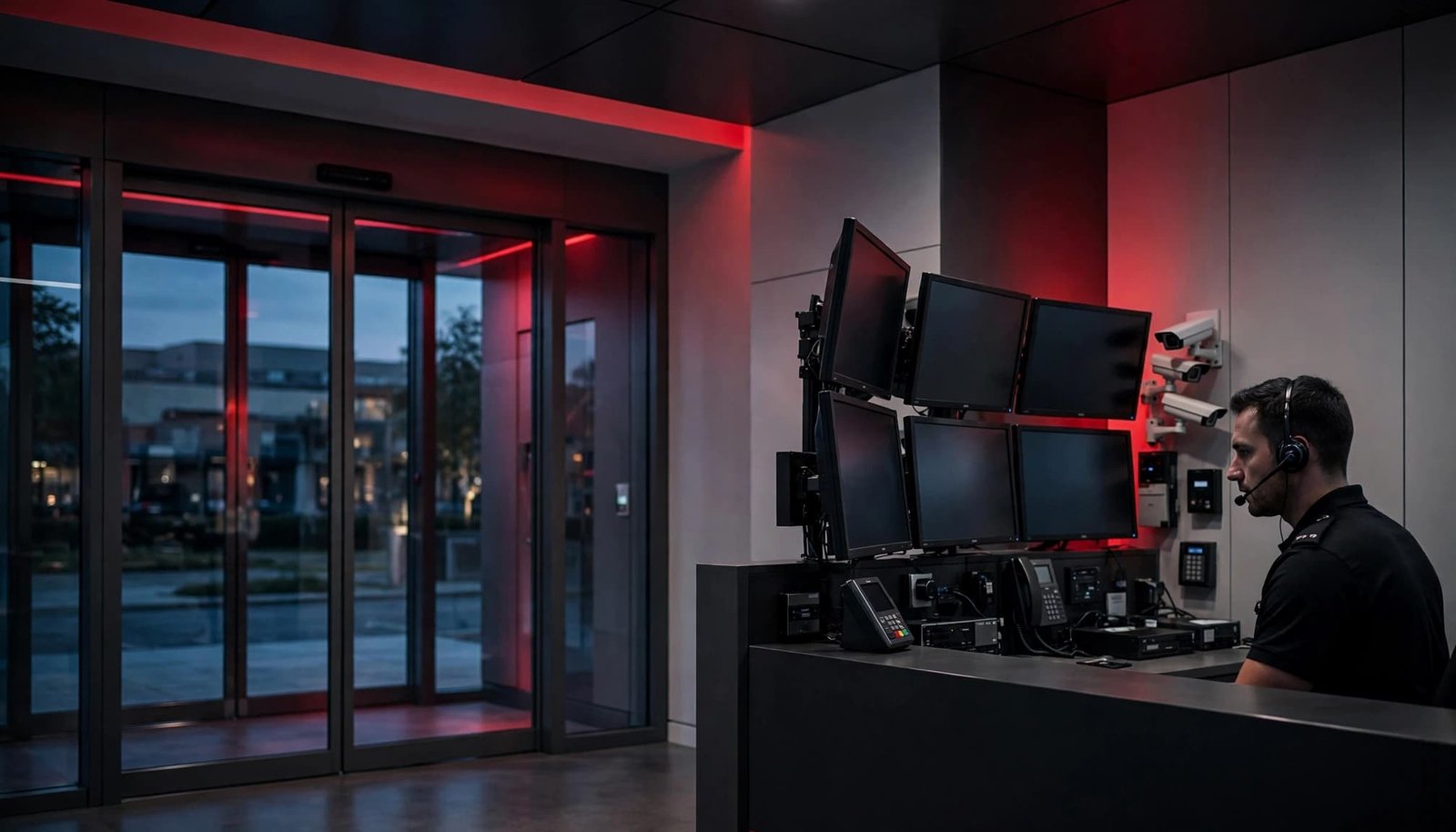
The ICO’s CCTV and video surveillance guidance covers installation, management, operation and public awareness. Before installing cameras, document the problem being addressed and consider whether less intrusive measures would work.
Avoid cameras in places where people reasonably expect privacy, such as toilets and changing areas. Audio recording needs particularly careful justification.
Security officers need healthcare-specific competence
A confident presence can calm a difficult situation. An officer who gives orders too early, misunderstands distress or blocks a clinician’s work can make it worse.
Hospital security guards should be selected for judgement, communication and restraint, not physical stature alone. The same applies to mobile patrols and alarm-response staff attending when a clinic is closed or lightly staffed.
Licensing is only the starting point
Where an assignment involves licensable security guarding activity, buyers should confirm that officers hold the appropriate SIA licences. The SIA licence guidance explains the relevant routes, but the correct licence depends on the duties being performed.
Procurement teams should verify that the provider maintains valid SIA licences when duties or assignments change. They should also check right-to-work procedures, identity checks, vetting, references, supervision arrangements and the process for replacing an absent officer. A named officer on a proposal is not much help without a credible contingency plan.
De-escalation and reporting matter more than bravado
Healthcare-focused training should cover conflict management, safeguarding, equality, mental health awareness, lone-working risks and the site’s local emergency procedures. Officers need plain language for handovers and incident reports, because vague notes create problems later.
A practical incident response plan should set out:
- when staff call security, clinical leads, safeguarding teams, police or emergency services;
- who takes command during an incident and who communicates with relatives;
- how body-worn video, CCTV footage and witness accounts are retained and reviewed;
- when staff wellbeing support is provided after an incident, and when incident trends go to senior management.
Security personnel don’t replace clinical staff, police officers or emergency responders. Their job is to contain immediate risk, communicate clearly and bring the right people into the situation.
CQC compliance and surveillance governance
Security arrangements support wider regulatory compliance and board assurance. They should appear in risk registers, incident reviews and staff induction. They shouldn’t exist only in a supplier’s method statement.
Link arrangements to Regulations 12 and 13
CQC Regulation 12 on safe care and treatment requires providers to assess risks and take reasonably practicable steps to reduce them. In security terms, this can include addressing access risks, maintaining alarm systems and training staff. A documented incident response process should also show how risks, harm and near misses are managed.
Regulation 13 requires protection from abuse and improper treatment. Security procedures should therefore support safeguarding, prevent intimidation and avoid inappropriate responses to people in distress.
CQC compliance isn’t achieved by buying cameras or employing guards. It’s shown through evidence that risks were identified, controls were used properly and failures led to action.
Treat CCTV footage as personal data
Surveillance systems may identify patients, visitors and staff at a sensitive time. Providers should define a lawful purpose, restrict access to authorised people and set a justifiable retention period. They should also keep an audit trail of viewing and disclosure.
Visible signage matters, but it isn’t the whole obligation. Privacy information should explain who operates the system, why footage is collected and how people can exercise their data-protection rights.
Any AI-enabled security used in surveillance must be governed, tested and reviewed. It should support professional judgement, rather than act as an autonomous decision-maker.
For NHS organisations and NHS-funded providers, the refreshed standard also uses a red, amber, green assessment to identify gaps and track improvement. Twice-yearly board assurance shouldn’t become a paperwork exercise. It should show whether reported actions have improved safety, staff wellbeing and incident outcomes, without undermining patient dignity.
Prepare for procurement and CQC inspection with usable evidence
The simplest test is this: can a manager show how security works in practice, not merely how it is described in a policy? Keep the evidence current and linked to the current risk assessment, while reviewing changing conditions on site.
Build an evidence pack before it is needed
A concise security evidence pack for medical facilities can include risk assessments, site plans, access permissions, incident reports, training records, maintenance certificates, CCTV governance documents and contract review minutes. It should also show what changed after a serious incident or recurring concern.
Use this comparison when reviewing proposals:
| Area | What to ask for | Useful evidence |
|---|---|---|
| Staffing | Who covers sickness, nights and escalation? | Duty roster, mobile patrol coverage and escalation records |
| Training | What healthcare training is refreshed and how often? | Training matrix and attendance records |
| Technology | How do access control systems integrate with alarms and cameras? | System plan and test records |
| Reporting | Who receives incident data and how is it reviewed? | Sample reports and action log |
The strongest provider will discuss limitations openly. A 24-hour control room cannot fix unclear local escalation, and an officer cannot compensate for a door system that staff have learned to bypass.
Questions that expose weak arrangements
Ask how quickly the provider can attend an alarm, but also ask what happens in the first minutes before arrival. How is incident response managed, and who checks reports for patterns? Ask how officers are briefed on individual wards, visiting rules and safeguarding concerns without receiving unnecessary patient information.
Ask how perimeter security is assessed across site boundaries, service entrances and car parks. Don’t assume every location needs the same patrol model. If a proposal includes AI-enabled security, ask how automated alerts are tested, verified by people and governed.
For private healthcare, clarify how the security provider works with reception, clinical governance and out-of-hours contacts. Also clarify how the arrangement supports regulatory compliance, safeguarding and local governance requirements. For an NHS trust, clarify how the contract aligns with local violence reduction, safeguarding and emergency planning arrangements.
Price still matters. It should not be the only measure of value. Compare security solutions by resilience, supervision, reporting and integration, rather than hourly price alone. A lower-cost arrangement can become expensive when turnover, poor reporting or weak supervision leave the provider carrying the appearance of security rather than the responsibility.
Conclusion
Good healthcare security is measured in calm, ordinary moments: a worried relative receives clear directions, a distressed patient is met with patience, and staff can get help without delay.
The right healthcare security services combine trained people, proportionate technology and evidence-led governance. They protect the building, but their real standard is whether care remains safe, respectful and accessible when pressure rises.
Frequently asked questions
Are hospital security officers always SIA licensed?
Not every hospital role automatically requires the same licence. Where an officer carries out licensable security guarding activity, the provider should confirm the appropriate SIA licences for that assignment. Buyers should verify this before deployment and review it when duties change.
Can a private clinic use CCTV in reception areas?
Yes, where there is a clear and proportionate purpose, such as staff safety or controlled entry. The clinic must meet UK GDPR and Data Protection Act 2018 requirements, provide appropriate privacy information and control access to recorded footage.
Can security staff restrain a patient?
Security staff should not treat restraint as a standard response to difficult behaviour. Any intervention must follow the provider’s policies, safeguarding duties and clinical arrangements. Where there is immediate danger, staff should summon appropriate clinical, police or emergency support in line with local procedures.


0 Comments