

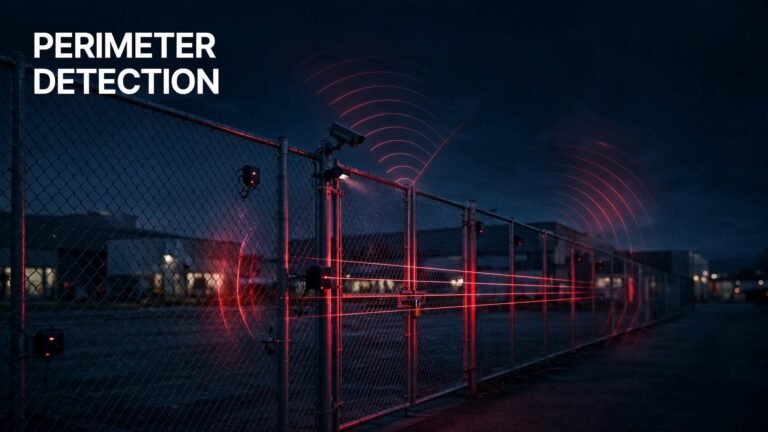
A break-in rarely begins at the building. It begins at a gate left unsecured, a rear fence obscured by pallets, or an unobserved stretch of boundary where an intruder has time to work.
Perimeter intrusion detection gives your team earlier warning, before an intruder gains unauthorised access to stock, vehicles, plant, staff areas or the premises itself. It is not a substitute for a proper fence, lighting, CCTV or a response plan. It is the system that joins them together.
The right arrangement depends on the boundary, the risks, the site activity and what happens after an alarm.
Key takeaways
- A perimeter intrusion detection system identifies activity at, above or beneath a site boundary, giving security personnel time to verify and respond.
- Fence-mounted sensors, buried, infrared, microwave, radar and thermal systems all have sensible uses. None is right for every boundary.
- False alarms are reduced through good survey work, sensible zoning, careful commissioning and regular maintenance, not by relying on a product claim.
- Camera-based verification and thermal imaging are most useful when they verify an alarm and guide a response.
- Where surveillance captures identifiable people, UK GDPR duties apply, including clear signage, proportionate use and documented retention periods.
What a perimeter intrusion detection system does
A perimeter intrusion detection system is the outer detection layer in a wider security plan. It detects an attempted crossing or disturbance, then passes an alarm to a control room, monitoring centre or nominated responder. This outer layer may use barrier-mounted PIDS fitted to fences or other boundary structures.
The primary purpose is early warning. A verified alarm at a remote fence line gives staff, security officers or police more useful information than an alarm inside a warehouse after someone has already gained access.

A practical system works across four parts:
- It detects activity at the boundary.
- It delays entry through physical measures such as gates, fencing, access control and locked access points.
- It verifies the event through CCTV, thermal imaging or a trained person.
- It triggers a clear response, rather than leaving an alarm unattended.
An alarm without verification can waste time. Verification without a response procedure is little better.
This matters at logistics yards, industrial facilities, retail parks, construction compounds, data facilities and commercial estates. Higher-consequence locations, including parts of critical national infrastructure, need more detailed threat assessment and stronger controls. The National Protective Security Authority defines critical national infrastructure in terms of assets and services whose compromise could seriously affect essential services or national security.
Perimeter intrusion detection technologies and their practical limits
There is no ordinary “best system”. A fence beside a public footpath has different problems from a rural fuel depot, a warehouse boundary or a busy loading yard.
Fence-mounted cable and point sensors
Fence-mounted sensors detect attempts to climb, cut, lift or heavily disturb the fence. They are a form of barrier-mounted PIDS, designed to monitor the physical boundary itself. Microphonic cable systems use piezoelectric sensor cable fixed to the fence fabric. Movement creates vibration patterns that the controller assesses against its programmed settings.
They suit long, continuous fences in relatively controlled environments. This type of barrier-mounted PIDS still depends on a stable, properly maintained physical barrier. Loose mesh, unstable posts, vegetation rubbing against panels and unsecured gates can create nuisance alarms before an intruder appears.
Taut-wire systems and point sensors can also be used where a rigid, purpose-built boundary is practical. Electric fence systems require appropriate safety controls, warning signage and site-specific professional design. They aren’t a universal solution, and remain less forgiving of poor installation. A fence that moves because it is worn out is not a sound platform for sensitive detection.
Buried sensors, beams and open-ground detection
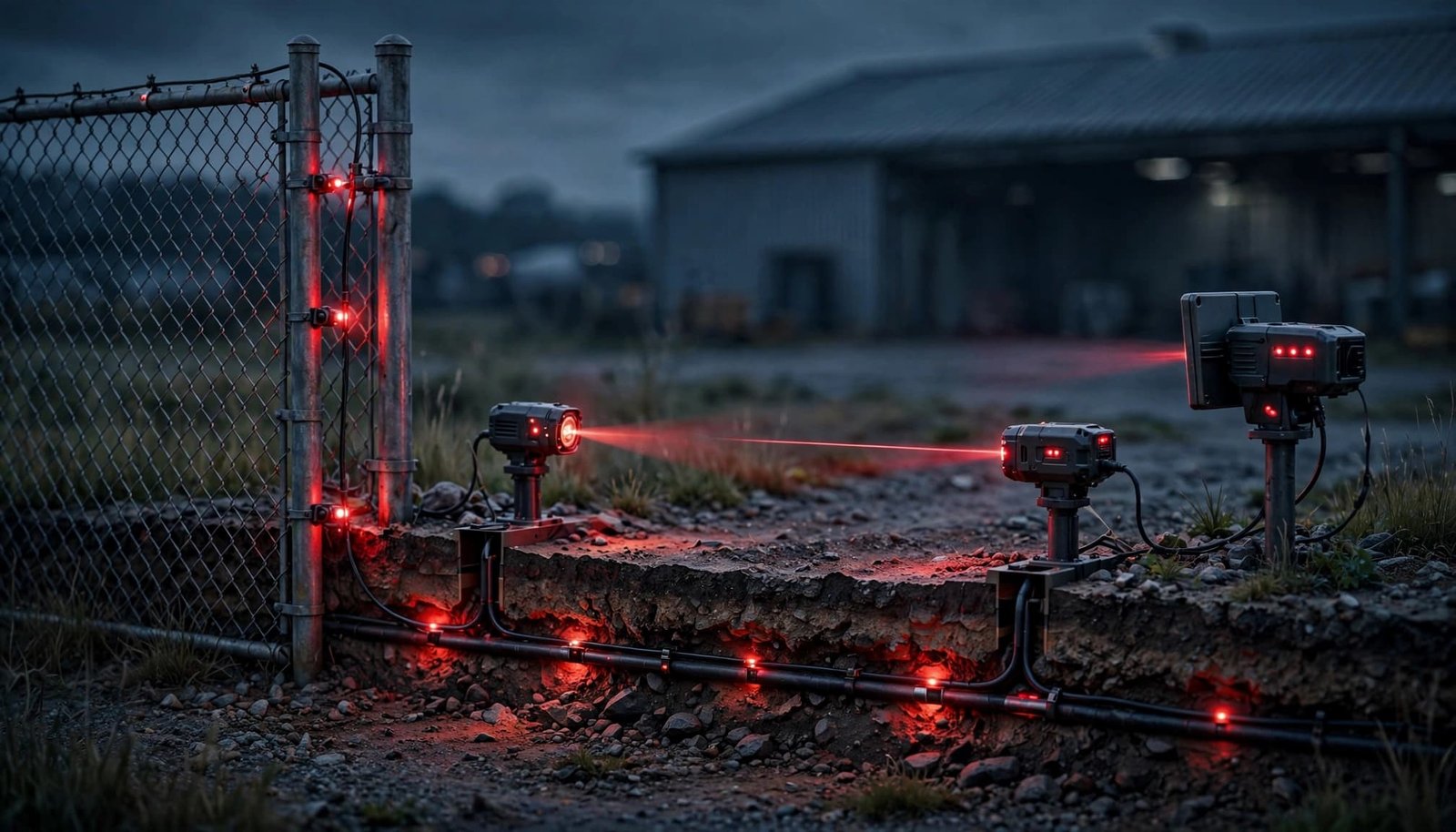
Buried sensors form one type of ground-based PIDS, identifying disturbance across a defined line or zone. They can be useful where a visible fence sensor is unsuitable, but soil type, drainage, vehicle routes and future excavation all need consideration. They may identify ground disturbance, but shouldn’t be sold as a guaranteed answer to every digging or tunnelling risk.
Active infrared barriers create an alarm when a beam is interrupted. They are often suitable for controlled gaps, roof lines or short clear runs. Microwave sensors create a volumetric detection zone rather than a narrow beam, which can suit open ground but needs careful alignment.
Radar systems can track movement across a wider area, whilst thermal cameras detect heat contrast in low light. Video analytics can classify activity and direct operators to the right camera view. These tools are useful together, but need suitable zoning, careful camera positioning and managed vegetation to avoid blind spots.
Matching perimeter intrusion detection to the site
Start with the boundary you have, not the technology you have seen in a brochure. A good site survey looks at approach routes, lighting, terrain, public access, neighbouring activity, vehicle movements and the time a responder needs to reach each zone.
This quick comparison helps frame the conversation.
| Site condition or priority | Detection option to consider | Practical concern |
|---|---|---|
| Long mesh perimeter with clear access | Barrier-mounted PIDS using microphonic cable systems | Fence must be stable and properly tensioned |
| Open ground with no suitable fence | Ground-based PIDS using buried sensors or microwave detection | Ground conditions and future works affect design |
| Narrow controlled route | Infrared barriers | Beam alignment and obstructions need routine checks |
| Large yard with varied activity | Radar systems with camera or thermal verification | Zones must exclude legitimate vehicle movements |
| Dark, remote boundary | Thermal imaging with analytics | Camera placement and response procedures still matter |
| High-security boundary | Layered fence sensors, cameras and monitored response | System design should follow a documented risk assessment |
The capital cost is only part of the wider site security decision. Include trenching, ducting, power, communications, commissioning, monitoring, maintenance, vegetation control and replacement parts. A low initial price can become expensive if it generates repeated call-outs or leaves no useful evidence after an alarm.
Building a system that people can use
Perimeter security fails when it is designed as an isolated technical project, even with barrier-mounted PIDS. The detector, camera, monitoring arrangement and on-site response must be agreed before installation begins.
Survey the boundary and create sensible zones
Walk the full perimeter with the installer and site security team. Record weak fences, public paths, overhanging trees, drainage channels, delivery routes, blind corners and areas where staff regularly work after hours.
Divide the system into meaningful alarm zones. “North fence” may be too broad on a large site. A monitoring operator needs to know whether the event is at the loading-yard gate, the rear compound or the service road. Smaller, well-named zones make verification quicker and incident records more useful.
Ask a qualified installer how the proposed equipment relates to the relevant BS EN 50131 standards and the actual site requirements. A standard is not a substitute for design judgement, but vague specifications are not good enough either.
Plan verification and response before commissioning
CCTV should cover the expected alarm zone and support verification. Appropriately configured video analytics can assist, but a broad site overview is not enough.
Thermal cameras can assist in darkness, whilst ordinary cameras may provide better contextual detail in suitable light. Ensure detection and coverage align with gates, entry permissions, access control and other physical security measures.
Decide who receives each alarm and what they do next. This may include an alarm monitoring service, a mobile patrol, keyholders, security personnel or a manager with defined escalation duties. Set response times that reflect the real geography of the site.
The ICO’s security requirements guidance is a useful reminder that monitoring, incident handling, auditing and business continuity belong in the wider security arrangement. An alarm log is useful only if it leads to review and action.
Reducing false alarms without reducing protection
Wildlife, wind, heavy rain, moving vegetation, unstable fencing and nearby vehicles can all affect intrusion detection. The honest answer is not that false alarms disappear. They need managing through design, calibration and routine checks.
Design out predictable nuisance activity
Keep vegetation clear of fences, beams and camera views. Protect sensor cables from legitimate loading activity. Position microwave or radar zones away from roads where passing vehicles are not relevant to the security objective.
A system should distinguish, where possible, between a person climbing a fence and a loose panel moving in strong wind. That depends on proper programming and testing in the conditions the site actually experiences.
Do not set detection thresholds so high that alarms stop being useful. Silencing nuisance activity by reducing sensitivity can create a decorative system, rather than a reliable one.
Review alarms and maintain the boundary
Commissioning is the start, not the finish. Review alarm data after storms, seasonal changes, shifts in site use and major works. If one zone repeatedly causes trouble, inspect the physical boundary before assuming the controller is at fault.
Maintenance should include fence repairs, sensor inspection, camera cleaning, power checks, communications testing and verification tests with the monitoring team. Equipment must also be installed and maintained safely, particularly where powered field devices, control cabinets and access equipment are involved.
Privacy, signage and UK compliance
Cameras, thermal devices and analytics can be proportionate security measures. They can also capture staff, visitors, neighbours and members of the public. That brings data protection duties into the project at an early stage.
Use surveillance for a defined, documented purpose
The ICO’s CCTV and video surveillance guidance applies where your system processes personal data. Record why surveillance is needed, what area it covers, who can access footage and how you will deal with requests or incidents.
Avoid recording more than the stated purpose requires. A camera covering a gate may be justified. A camera pointed into neighbouring homes, public spaces or staff break areas needs far stronger justification and may need repositioning.
The ICO expects visible signs explaining that surveillance operates, the organisation responsible, the purpose and basic contact details. Signage should appear before people enter the monitored area, not halfway through the car park.
Retention, access and accountability
There is no universal CCTV retention period under UK GDPR or the Data Protection Act 2018. Keep recordings only for as long as your documented purpose requires, then delete or overwrite them securely. A business with frequent overnight incidents may justify a different period from an office with limited out-of-hours access.
Limit system access to authorised people. Keep audit records for exported footage and review third-party monitoring arrangements. The ICO’s information security guidance sets out the wider expectation that organisations use appropriate measures to protect information.
Frequently asked questions
Can a perimeter system stop an intruder?
No detection system can guarantee that outcome. Its job is to detect an attempt early and support a prompt, proportionate response. Physical barriers, access control, lighting and security personnel still matter.
Are fence-mounted sensors better than buried cable?
Not automatically. Fence-mounted sensors are practical where the fence itself is the protected line and is in good condition. Buried detection can suit open ground or boundaries where visible devices are unsuitable, but ground works and maintenance access need careful planning.
Do infrared and thermal cameras replace CCTV?
They work alongside CCTV rather than replacing it. Infrared barriers detect beam interruption. Thermal cameras can help identify heat contrast in poor light. CCTV often provides the visual detail needed to verify an alarm and record what happened.
A measured approach to perimeter security
Good perimeter intrusion detection is not about fitting the most equipment. It is about detecting the right activity, verifying it quickly and giving someone a workable response.
Start with the boundary, the risks, your access control arrangements and the people responsible after an alarm. A properly surveyed, maintained and monitored system will be more useful than a complicated installation nobody trusts.


0 Comments