

A stopped production line can cost more than a damaged door or missing pallet. That makes manufacturing plant security a business priority, as delays can hold up deliveries, create safety risks, expose trade secrets and pressure maintenance teams.
Manufacturing site security needs to protect the machinery, the people around it and the systems that control it. It should join physical security with proper OT and ICS cybersecurity. A manufacturing plant security programme can’t rely on a camera system on one side and an IT policy on the other.
Start with the areas where disruption would hurt most, then build controls around the actual risks.
Key Takeaways
- Start with a production-line risk map that identifies critical equipment, zones, access needs, connectivity and the consequences of disruption.
- Combine perimeter security, controlled access, suitable video surveillance and trained response teams to protect people, machinery, loading areas and sensitive information.
- Connect physical security with OT and ICS cybersecurity through network segmentation, controlled supplier access, protected backups and tested recovery procedures.
- Treat contractors, suppliers, maintenance activity and safety controls as part of site security, then audit performance and prioritise weaknesses by their potential production and safety impact.
Manufacturing site security starts with a production-line risk map
A sensible manufacturing plant security plan begins with a clear picture of what the site contains, who needs access and what happens if each asset fails. Formal risk assessments help rank assets, access needs and disruption consequences. The National Cyber Security Centre’s operational technology guidance is useful here because it treats OT as a connected operational environment, not a collection of isolated machines.
Identify equipment, zones and consequences
List critical assets first: programmable logic controllers, HMIs, robotic cells, control cabinets, tooling, compressed-air systems, utility rooms, spare parts and engineering workstations. Include external loading bays and waste areas where theft or tampering can go unnoticed. This broad view supports asset protection across machinery, tooling, utilities, workstations and physical areas, not only networked devices.
Then divide the facility into zones. A visitor reception, warehouse aisle and control room should not have the same access rules. Record the consequence of disruption for each zone, including safety, product quality, output loss, contractual penalties and recovery time.
Keep an OT asset and connectivity inventory
The inventory should show every device, owner, software version, network connection and approved remote-access route. It must also identify unsupported equipment, temporary connections and supplier-managed assets. An accurate OT inventory supports manufacturing plant security decisions across the site.
This is ordinary, unglamorous work. It is also where many security programmes fail. You cannot protect a control cabinet or network route that nobody has recorded.
Treat an unexplained connection to production equipment as an operational issue, not a minor IT housekeeping task.
Build physical security around the production line
Manufacturing plant security should delay unauthorized access, make suspicious activity visible and give the right people time to respond. A tall fence alone is not a plan. Nor is a system that grants wide permissions because reviewing them is inconvenient.
Control the perimeter and vehicle routes
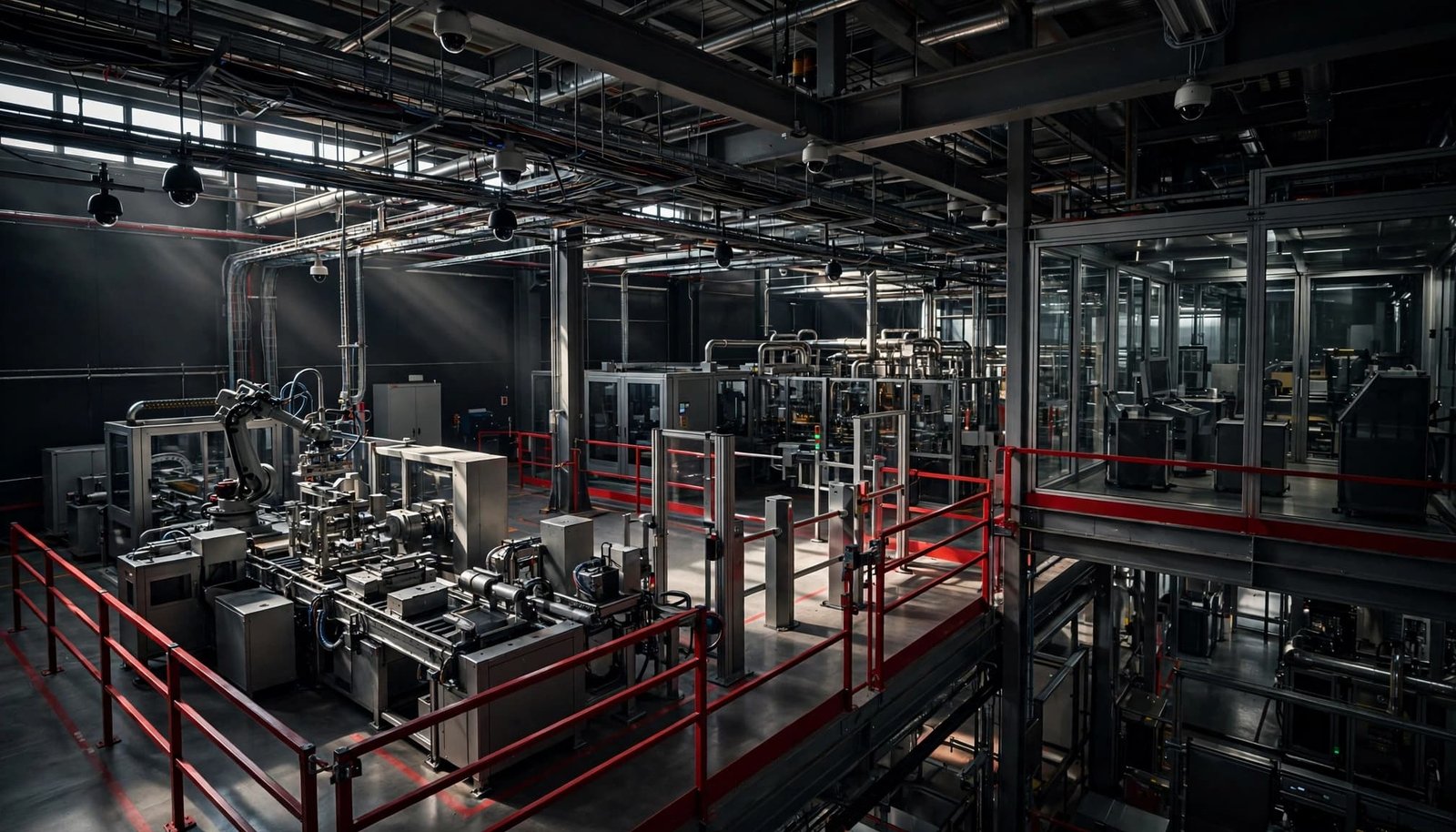
Perimeter security starts with maintained fencing, secure gates, lighting, clear sightlines and security cameras. Intrusion detection can alert staff when someone breaches a perimeter or restricted zone.
Where vehicle movements create a risk, use appropriately placed barriers, delivery booking procedures and controlled routes between gatehouse, yard and loading bay. Mobile security units can provide proportionate patrols where fixed controls don’t cover yards, gates or loading routes.
Drivers should have a defined place to wait. Contractors should not be free to walk from a delivery point into a production area. These details reduce both accidental access and deliberate reconnaissance.
Give people only the access they need
Use role-based access control systems for employees, agency staff, visitors and contractors. Credentials should open only the areas required for that person’s shift or task. High-risk rooms may need a second factor, escort rules or approval from the responsible manager.
Review access control systems when people change jobs, leave the business or finish a project. Shared passes and propped-open fire doors turn an otherwise sound system into a decorative one.
Critical cabinets, server rooms and maintenance stores need the same care. Protecting them should form part of wider manufacturing plant security. A stolen engineering laptop, unauthorised USB device or altered machine setting can cause a longer stoppage than the theft of a physical component.
Use security cameras and human oversight together
Security cameras help teams see what happened, but effective manufacturing plant security also needs a response plan. Video surveillance is most useful when camera placement, retention periods, alarm rules and investigation ownership are agreed in advance.
Use analytics for detection, not false certainty
AI-powered video analytics can flag after-hours movement, entry into restricted areas, vehicles in the wrong place or an object left near critical equipment. That can reduce the time spent watching empty footage.
It can’t reliably decide intent. Alerts need verification by trained staff, and rules should be tested against normal plant activity such as cleaning, planned maintenance and late dispatches. Poorly configured analytics create noise, then people stop trusting the system.
Define alarm escalation and guard duties
On-site security guards or mobile security units are most effective when their role is precise. They should know the restricted zones, emergency contacts, visitor process, isolation procedures and when not to interfere with machinery.
A security partner should clarify responsibilities between the internal security team, outsourced monitoring provider and site management. Remote monitoring can verify an alarm before dispatching a response, but it must have current keyholder details and clear escalation times. Preserve video, access logs and incident notes after an event as part of manufacturing plant security. Evidence that cannot be matched to a time, location and authorised person is of limited use.
Connect physical controls with OT cybersecurity
A locked control room does not prevent ransomware. Equally, a firewall does not stop someone opening a cabinet or connecting an unauthorised device during a night shift. Manufacturing plant security works when facilities, security, IT, engineering and EHS teams work from the same risk picture. This shared approach makes manufacturing plant security more consistent across the site.

Separate office systems from production systems
Keep corporate IT, OT, engineering workstations and vendor connections in separate network segments. The NCSC’s guidance on secure OT connectivity points to the IEC 62443 Zones and Conduits model. It groups assets with similar security needs and controls the routes between them.
Treat segmentation, least privilege and controlled connectivity as coordinated security measures, not isolated products. An administrator account shouldn’t be used for routine work. A supplier shouldn’t retain permanent broad access after a support job ends.
Where systems must exchange data, use a controlled route such as a demilitarised zone. Record why the route exists, who owns it and how it is monitored.
Prepare for recovery, not only prevention
Ransomware, hardware failure and human error can all interrupt operations. Keep protected backups of critical configurations, recipes, control logic and recovery documentation. Copies must be separated from the live environment, and restoration must be tested in a controlled manner to support operational continuity.
A backup that has never been restored is only an assumption. Test the order of recovery as well. Rebuilding a historian before the controller that needs it may waste valuable hours.
The Manufacturing Technology Centre’s cyber security work is a useful example of the UK focus on assessing both enterprise and OT environments, rather than treating them as unrelated programmes.
Secure loading bays, suppliers and third parties
The supply chain can introduce physical and digital exposure, making manufacturing plant security dependent on reliable supplier checks. A rushed collection, unfamiliar haulier or emergency supplier account may be legitimate. It can also be the point where verification breaks down.
Protect goods and loading areas
Use delivery schedules, driver identification, seal checks where appropriate and a documented chain of custody for high-value goods. Separate inbound and outbound movements where the layout allows, and investigate discrepancies before stock is written off as a paperwork problem.
Cargo theft often relies on routine. Vary checks where risk is high, keep loading bays covered by suitable cameras and restrict access to dispatch documentation. For higher-risk collections or out-of-hours movements, consider mobile security units in yards without permanent coverage.
Control contractor and supplier access
Suppliers may need remote diagnostics, site access or product specifications. Give them the minimum access and set an end date, because manufacturing plant security also depends on controlling temporary permissions. Check their identity through a known contact, not a telephone number supplied in an unexpected email.
Third-party risk also includes software updates, replacement components and portable media. Procurement, engineering, site security and a security partner should agree how suppliers are verified, equipment is approved and access routes are authorised. They should also agree how equipment is received and connected, with cybersecurity controls applied before connection. Industrial espionage rarely looks dramatic at first. It may look like an unapproved visitor, copied drawing or unexplained data transfer.
Make safety controls part of site security
Security measures must support safe work, not create barriers to emergency action or planned maintenance. Good manufacturing plant security reinforces workplace safety while allowing essential access. Requirements vary by industry, equipment type and jurisdiction, so compliance requirements need to be checked for the site and its operations.
Apply machinery duties to the real work
In the UK, PUWER 1998 applies to work equipment used in workplaces, including factories. Duties can apply to organisations that own, operate or control equipment, and to employers whose staff use equipment they do not own.
That matters for manufacturing plant security because unauthorised use, bypassed guarding and altered settings can create safety hazards, security concerns and production risks. The Health and Safety Executive’s cyber security guidance also recognises that cyber incidents can have health and safety implications. Changes to controllers, guarding or safety systems should be assessed before equipment returns to service.
Control maintenance and isolation activity
Lockout tagout is widely used as a term for controlling hazardous energy during maintenance. Your documented isolation process should identify who can authorise work, apply locks, verify isolation and return equipment to service.
Do not treat access control as a substitute for machine isolation. A badge reader limits entry. It does not prove that energy sources are safe or that a production line can be restarted.
Audit what happens, then fix the weak points
Security audits should test whether manufacturing plant security controls work during a normal shift, a contractor visit and an incident. Review access control systems, permissions, rejected attempts, alarm activations, camera coverage, perimeter security, open actions, unsupported systems and changes to control equipment.
Prioritise by production impact
Not every weakness deserves the same budget. Rank manufacturing plant security issues by their likely effect on people, safety hazards, critical equipment, production capacity, recovery time and legal obligations.
A missing visitor signature isn’t the same as unmonitored remote access to a safety-related controller. Deal with the highest-consequence exposure first, then set dates and owners for the rest.
Measure response as well as prevention
Track rejected access attempts, overdue permission reviews, unresolved alarms, incidents involving contractors, backup restoration tests and time taken to investigate alerts. These measures show whether security measures are being operated properly, not merely installed.
Run tabletop exercises with operations, IT, security and senior management. Practise who decides to stop a line, who contacts suppliers, how mobile security units are dispatched and who preserves evidence with the security partner. A written incident plan is useful. A rehearsed one is better.
Frequently asked questions
What are the most effective manufacturing security controls?
Effective manufacturing plant security combines controlled entry, protected equipment areas, suitable video surveillance, trained staff, OT network segmentation, tested backups and a clear incident-response process. These physical, access, monitoring and recovery layers should reflect the site’s highest-consequence risks, rather than a generic product list.
Can AI cameras prevent sabotage or insider theft?
No. Analytics can identify unusual movement, restricted-area access or objects in unexpected places, but people must assess alerts and act. Manufacturing plant security still depends on trained staff, access records, proper supervision and a disciplined investigation process.
Protect the work that keeps the plant moving
The point of manufacturing site security is not to make a factory feel locked down. It is to keep authorised work moving whilst making theft, sabotage, unsafe interference and cyber disruption harder to carry out.
Start with the production line and equipment you cannot afford to lose. Build manufacturing plant security around them using clear controls, tested procedures and supporting options such as mobile security units. Test those controls under pressure, then correct the gaps to protect operational continuity.


0 Comments