

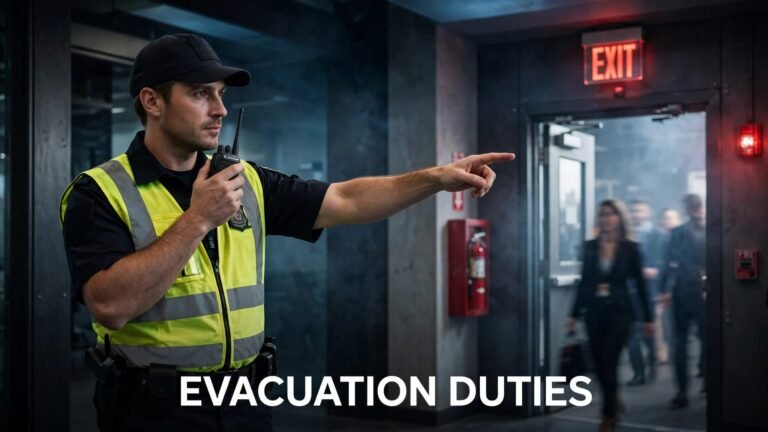
An evacuation can become disorganised in seconds when people receive mixed instructions, use familiar routes or wait for somebody else to take charge. A guard’s evacuation duties help bring order to that first response without creating another hazard.
Security officers aren’t firefighters, paramedics, police or incident commanders. Professional security staff support the wider emergency response by raising the alarm, directing occupants, protecting access routes and giving first responders a clear picture when they arrive.
A sound response starts long before an alarm sounds, with an emergency evacuation plan that is understood, practised and properly resourced to support building occupants.
Security guard evacuation duties at the point of alarm
The first responsibility is to follow the site’s emergency protocols. That means using the designated communication channel, taking the assigned emergency response role and acting within training. It doesn’t mean guessing, investigating alone or trying to look heroic.
The responsible person for a workplace must have suitable fire precautions, evacuation arrangements and a safe meeting point. GOV.UK’s fire safety and evacuation plan guidance also makes clear that escape routes must be available, direct and usable by everyone expected to leave the building.
Act promptly, but verify only when it is safe
When a fire alarm activates, a security officer should report it through the agreed channel, call 999 where the emergency plan requires it, and begin the evacuation procedure without delay.
Use clear, short instructions. Direct people towards the nearest safe exit and assembly point. Prevent entry through doors, barriers or reception points where that can be done safely.
A security officer may check a panel, CCTV view or designated area if the plan permits it and there is no sign of immediate danger. Smoke, heat, a strong burning smell, damaged electrical equipment or a report of violence changes the position. Withdraw, raise the alarm and keep others out.
Do not turn a guard into a rescue team
Guards should never re-enter an unsafe building unless they are specifically trained, authorised and the site plan permits it. Even then, conditions can change without warning.
Firefighting, hazardous rescue and response to an active threat belong to qualified responders. A fire extinguisher is for a small, incipient fire only where the guard has been trained, has a clear exit behind them and can do so without delaying evacuation. If any of those conditions are missing, leave it alone.
A headcount is important, but it is never a reason to send an untrained person back into smoke, fire or an uncontrolled threat.
Immediate actions during a commercial evacuation
A controlled emergency response follows five stages: alarm, communication, movement, accountability and handover. The order matters because people cannot be counted until they are somewhere safe.
Raise the alarm and communicate one message
Use the PA system, radio network or agreed telephone chain, following the site’s communication protocols. Give the location if known, the instruction to evacuate and the assembly point. Avoid vague wording such as “there may be a problem”.
Security supervisors should assign roles where staffing allows. One security officer can manage the entrance, another can direct a stairwell, and a supervisor can stay in contact with building management. Lone guards shouldn’t try to cover every floor. They should follow the priority actions in the site plan and tell the control room what they can’t safely cover.
HSE states that workplace plans should address evacuation, communication and response teams in its emergency procedures guidance. This is ordinary preparation, not decorative paperwork.
Keep people moving without creating pressure points
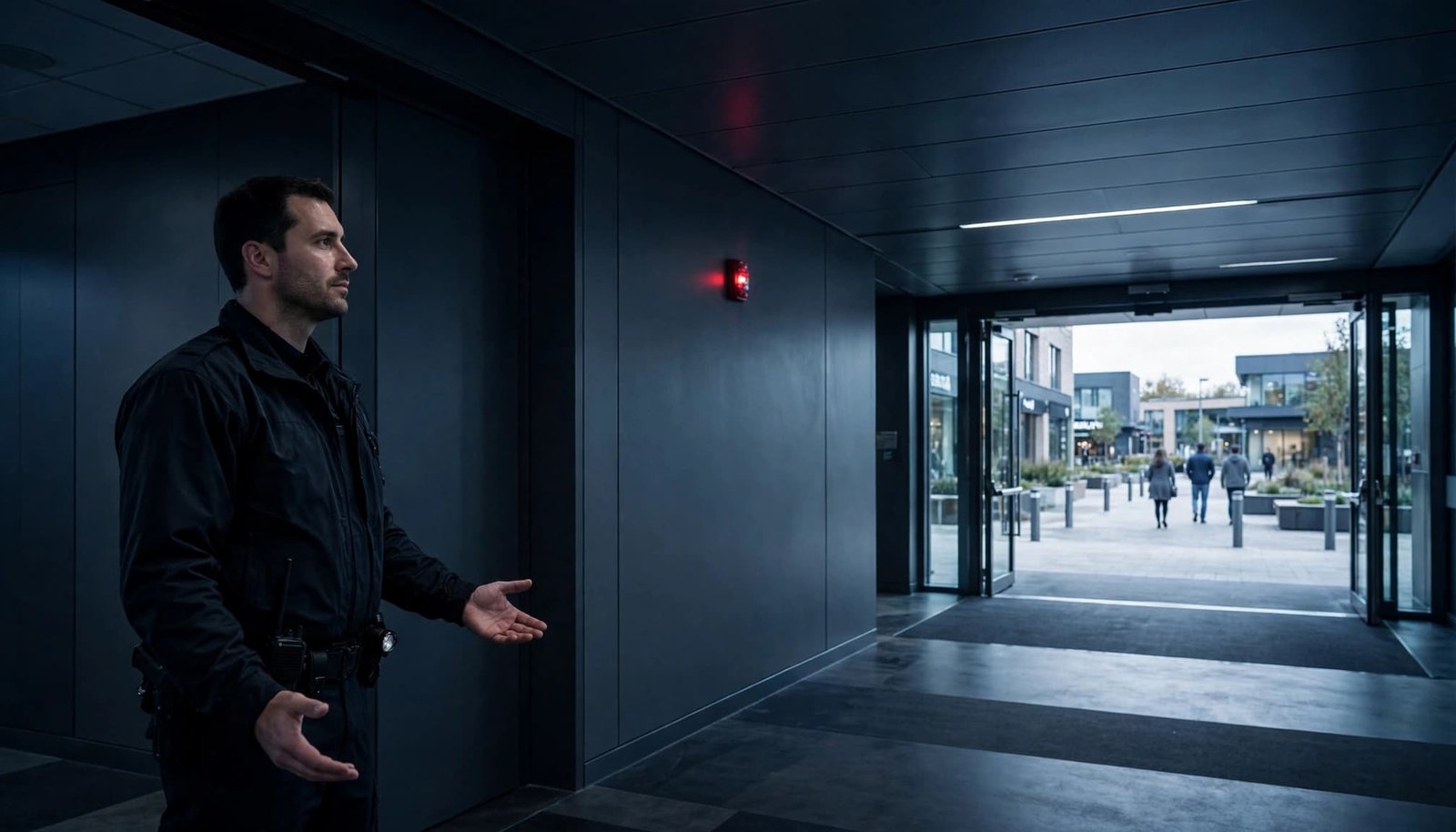
Direct building occupants towards safe evacuation routes, using practical crowd management to prevent pressure points. Don’t push a crowd faster than exits and stairwells can handle. Keep doorways, corridors and fire exits clear. Ask people to leave bags and non-essential belongings behind if they’re slowing movement.
Position guards where decisions are needed, at a junction, stairwell or entrance. Don’t stand in the middle of a narrow route. Watch for people attempting to collect coats, return for a laptop or use lifts.
Lifts shouldn’t be used during a fire evacuation unless the site has a designated evacuation lift and a trained procedure for it. Standard passenger lifts can fail, open on an affected floor or trap occupants.
Assist people who need a planned route
A guard should know who may need support before an emergency occurs. This includes disabled occupants, pregnant workers, older visitors, people with temporary injuries, children and anyone unfamiliar with the building.
Personal Emergency Evacuation Plans, known as PEEPs, should state what support is agreed and who is responsible. Don’t improvise a carry-down-stairs rescue unless trained staff and suitable equipment are available. Help should be calm, practical and based on the person’s stated needs.
Visitors need particular attention. Reception records, sign-in systems and contractor registers must travel with the person responsible for accountability, or remain accessible remotely.
Fire, medical incidents and security threats need different responses
Not every alarm means the same thing. Different hazards require different emergency response decisions. Security personnel need a common structure, but security officers must recognise when security threats make a standard evacuation route unsafe.
Fire and smoke
For fire or smoke, fire safety starts with activating the alarm if it has not already sounded, calling 999, directing people out and preventing re-entry. Close doors behind you where safe to do so, but do not lock them.
Guards should report useful facts to the fire service: the address, floor, apparent fire location, smoke conditions, known missing persons, hazardous materials, disabled occupants awaiting assistance and whether sprinklers or alarms have activated.
Do not enter smoke-filled areas to complete a sweep. A sweep is only worthwhile where the route is safe, visibility is clear and it is part of the agreed procedure.
Medical emergencies during an evacuation
Medical emergencies may require immediate casualty care while others need to leave. Call 999 or 112, request the trained first aider or medical team, and protect the area from crowding.
A trained guard can provide first aid, CPR or use an AED where the site procedure, competence and equipment support it. An untrained guard should not attempt treatment beyond their ability. The NHS advises that an unresponsive person who is not breathing normally needs an emergency call and CPR started straight away.
The employer’s first-aid assessment should include employees, contractors and visitors. Guards should know where first-aid kits and AEDs are kept, but should not delay calling for clinical help while looking for equipment.
Suspicious packages and threats
Do not touch, move, open or examine a suspicious item. Keep people away, avoid using radios or mobile phones close to it if the site procedure says not to, and report through the designated channel.
The NPSA guidance on suspicious items is clear that security staff must not touch the item and should move people away from potential danger. Do not assume a fire assembly point is safe if it is near the item or within a possible threat area.
Threat procedures can require evacuation, invacuation or a police-directed cordon during an active threat. Follow the site plan and police instructions, not a generic rule remembered from another building.
Coordinating with police, fire and ambulance services
Emergency services need clear information, clear access and coordination during an emergency response. Security officers who meet the incident first are often best placed to provide that handover to first responders. Professional security staff can share site knowledge without taking command from responders.
Keep fire appliance access, ambulance bays and vehicle gates open. Where possible, assign a guard to meet responders at the agreed entrance. Do not block appliance routes with evacuated staff, delivery vehicles or well-meaning managers.
Give facts in a simple order:
- The exact address, building entrance and nature of the incident.
- The known location of the fire, casualty, threat or alarm activation.
- Any missing persons, PEEPs in progress, hazards and actions already taken.
- The location of keys, plant rooms, CCTV access, fire panels and the assembly area.
HSE’s incident planning guidance includes crowd management, disabled evacuation, emergency vehicle traffic and medical assistance. Those matters need to be agreed before an emergency, not negotiated beside a fire engine.
Assembly areas, accountability and re-entry
The evacuation is not complete when people reach the pavement. The emergency response continues beyond the building. A poorly chosen assembly point can place occupants in traffic, block emergency vehicles or leave them exposed to smoke.
Manage the assembly point
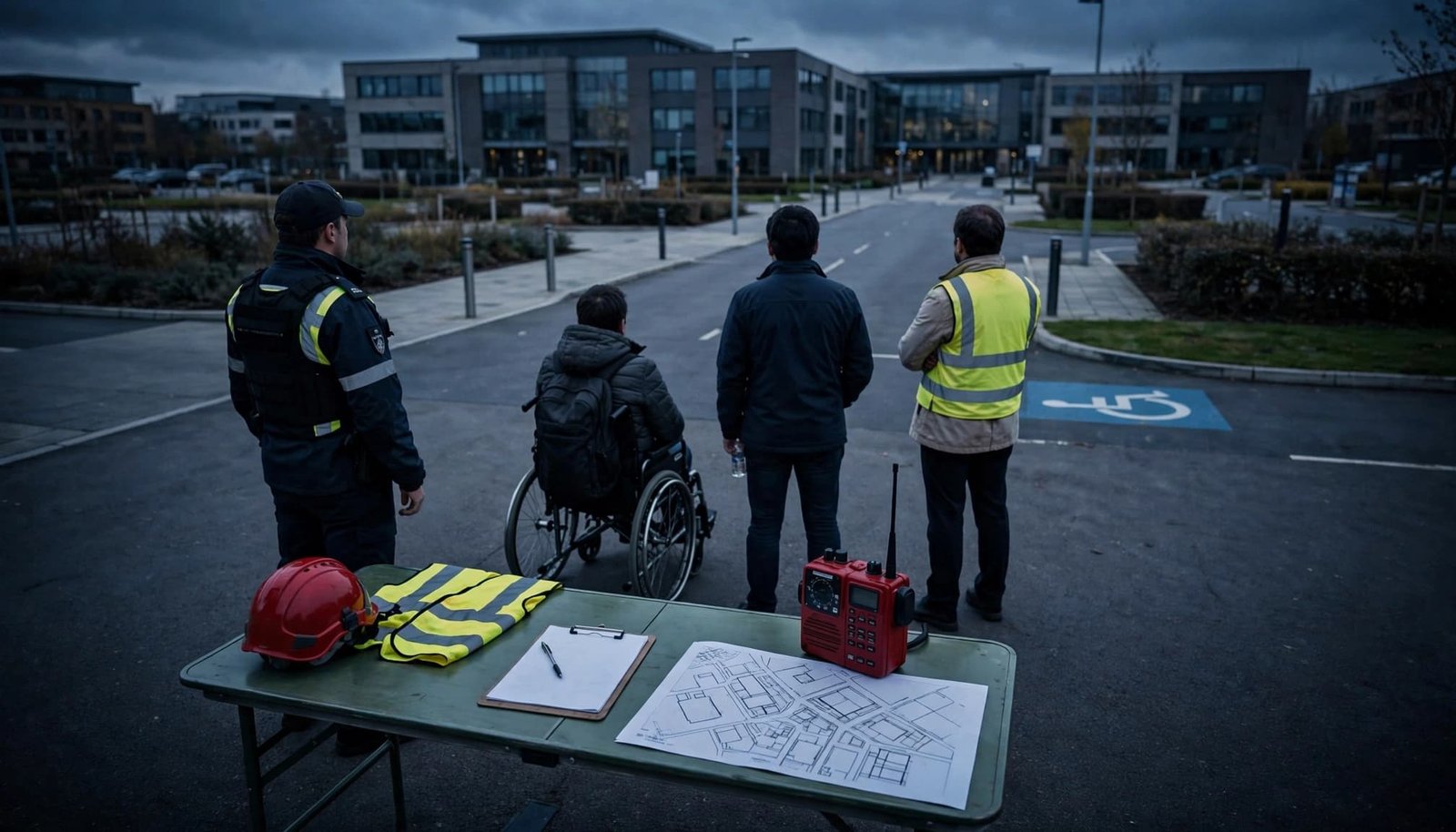
Security officers should direct people to the designated assembly points and keep a safe route open for emergency services. Move people if wind direction, smoke, traffic, an expanding cordon or police instructions make the planned location unsuitable.
Use crowd management to keep the group together and maintain clear access for responders. Contractors, delivery drivers and visitors are easily missed when they leave independently or return to their vehicle.
Account for people, then report gaps honestly
Use staff lists, visitor logs, contractor registers and department roll calls to account for building occupants. Contractors, delivery drivers and visitors are easily missed when they leave independently or return to their vehicle.
Pass unresolved names, likely locations and mobility information to the incident commander. The fire service, police or another authorised lead responder decides when re-entry is safe. Security should maintain the perimeter and must not authorise re-entry.
Training, legal boundaries and incident records
Training should follow the site’s emergency evacuation plan and reflect the building’s actual risks. A safety assessment should review its hazards and staffing levels. A guard at a small office reception has different duties from one covering a shopping centre, warehouse or mixed-use tower. Training should also support wider crisis management.
Train for the actual site
Site-specific induction should prepare security officers for the building’s alarm points, fire panels and exits. It should cover refuge areas, evacuation chairs where provided, lifts, keys, muster points, control-room contacts, emergency procedures and emergency vehicle access. Training should link these arrangements to emergency response during real incidents.
Evacuation drills should test night staffing, visitor control, disabled evacuation arrangements and a blocked route. Wider crisis management training should also test how staff respond when conditions change.
Crowd management also needs practice. HSE’s crowd safety guidance describes it as a management responsibility. Guards can direct movement, but employers and property managers must provide suitable exits, staffing, plans and appropriate fire safety arrangements.
Record what happened and review it
After the immediate response, guards should complete incident reports that record the time of alarm, calls made, instructions given, routes used, headcount position and responder handover. Include damaged equipment, blocked exits, people who required support and any re-entry attempt.
Legal duties vary by jurisdiction, contract and site use. Employers should review emergency planning with competent fire and health and safety professionals, and take qualified legal advice where compliance or liability is uncertain.
Key takeaways for security teams
Security guard evacuation duties are practical: raise the alarm, communicate clearly, guide people along safe routes, support agreed accessibility arrangements and account for occupants at the assembly point.
The limits matter as much as the actions. Security officers should follow their emergency response role and never enter danger without training and authority. Do not touch suspicious items or permit re-entry until emergency services or the authorised incident lead says the building is safe.
Frequently asked questions
What should a guard do first when a fire alarm sounds?
Follow the site’s emergency action plan, report the activation and begin the emergency response without delay. Call 999 if required, direct people to safe exits, stop entry into the building and communicate through the agreed channel.
Can security guards administer first aid, CPR or use an AED?
They can act within their training, competence and site procedure. A guard should call emergency services and seek trained first-aid support immediately. Employers must make arrangements for prompt attention when someone is injured or taken ill, as set out in HSE’s first-aid responsibilities.
How should guards prevent panic and bottlenecks?
Give short, consistent instructions and position staff at decision points, rather than inside narrow exits. Keep routes clear, prevent people from returning for belongings and avoid directing anyone towards a known hazard.
What should happen after everyone has left?
Maintain the assembly area, complete the best available headcount and give responding crews accurate information about missing people, hazards and access points. Guards should document the incident after the immediate response ends.
A safe evacuation depends on clear limits
The strongest evacuation response is not dramatic. It is calm, organised and built around a plan that people have practised.
When guards know their responsibilities, know their limits and hand control to qualified responders at the right moment, they protect people without adding to the risk.


0 Comments