

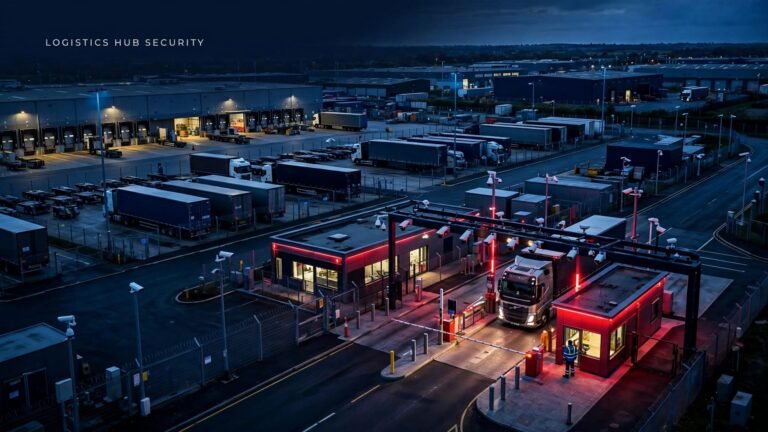
Cargo crime does not always begin with a forced entry or a dramatic incident. It often starts with an ordinary gap in routine: an unchecked driver, an unsecured trailer, a visitor pass that stays active too long, or a gatehouse that cannot confirm what should be leaving site.
For operators of a UK transport hub, warehouse security depends on controlled movement. Goods, vehicles and people need to move quickly, but every movement must be expected, verified and recorded.
A practical supply chain security plan combines physical protection, network cameras, trained people and reliable information. No single camera, guard or software platform is enough on its own.
Key takeaways
- Cargo theft risk is concentrated around parked vehicles, trailer yards, loading bays and uncontrolled access points, not only on public roads.
- A properly run gatehouse should verify the vehicle, driver, delivery reference and destination before entry or release.
- CCTV, ANPR, thermal imaging and radar improve visibility, but only where alerts lead to a clear human response.
- Digital subcontractor checks reduce reliance on printed documents, informal phone calls and out-of-date access lists.
- SIA-licensed guards, suitable screening and documented procedures matter most when they are matched to the site’s actual risks.
- CCTV and ANPR use must be lawful, proportionate and transparent under UK data protection law.
Why logistics hub security UK needs layers
A distribution centre is not a single security problem. It is a working environment with HGVs arriving, agency staff changing, contractors attending, stock being staged and drivers waiting at different hours. The weak point is often the handover between those activities.
A site assessment should consider shift changes, parked freight, handovers and routes that are not properly controlled. For a distribution centre, these overlapping movements can create gaps even when individual processes appear secure.
NaVCIS recorded 3,424 HGV and cargo crime notifications in 2025. Of those, 1,831 incidents, or 54%, occurred at independent parking locations. The figure does not mean every incident began there, but it is a useful warning about the risk around parked freight and unsecured waiting time. The NaVCIS freight crime data gives logistics operators a grounded view of where reported risk is concentrated.
Parked vehicles need active control
A trailer parked in a yard can look safe simply because it is behind a fence. That is not the same as being protected.
Assign parking areas, record trailer status, keep keys and seals under controlled custody, and investigate vehicles that remain on site beyond their expected collection or departure time. Drivers also need a safe, clear process for reporting concern without having to negotiate several departments.
Unauthorised access is not always forced entry
Unauthorised access can look ordinary. A contractor may arrive under the name of another company. A former worker may retain an old pass. A driver may be directed to the wrong loading bay.
Use proportionate access control: access should be necessary for the specific visit, not granted simply because somebody has a badge. That distinction stops a great deal of avoidable confusion.
Build perimeter protection around real operations
A perimeter should guide people towards controlled entry points, not give a false sense of security. Fences, gates, lighting and landscaping work together when sightlines are clear and access routes are limited.
The NPSA guidance on building protection makes the practical point: secure perimeters still need access points, and those are the places where authorised entry should be managed.
Use cameras for decisions, not decoration
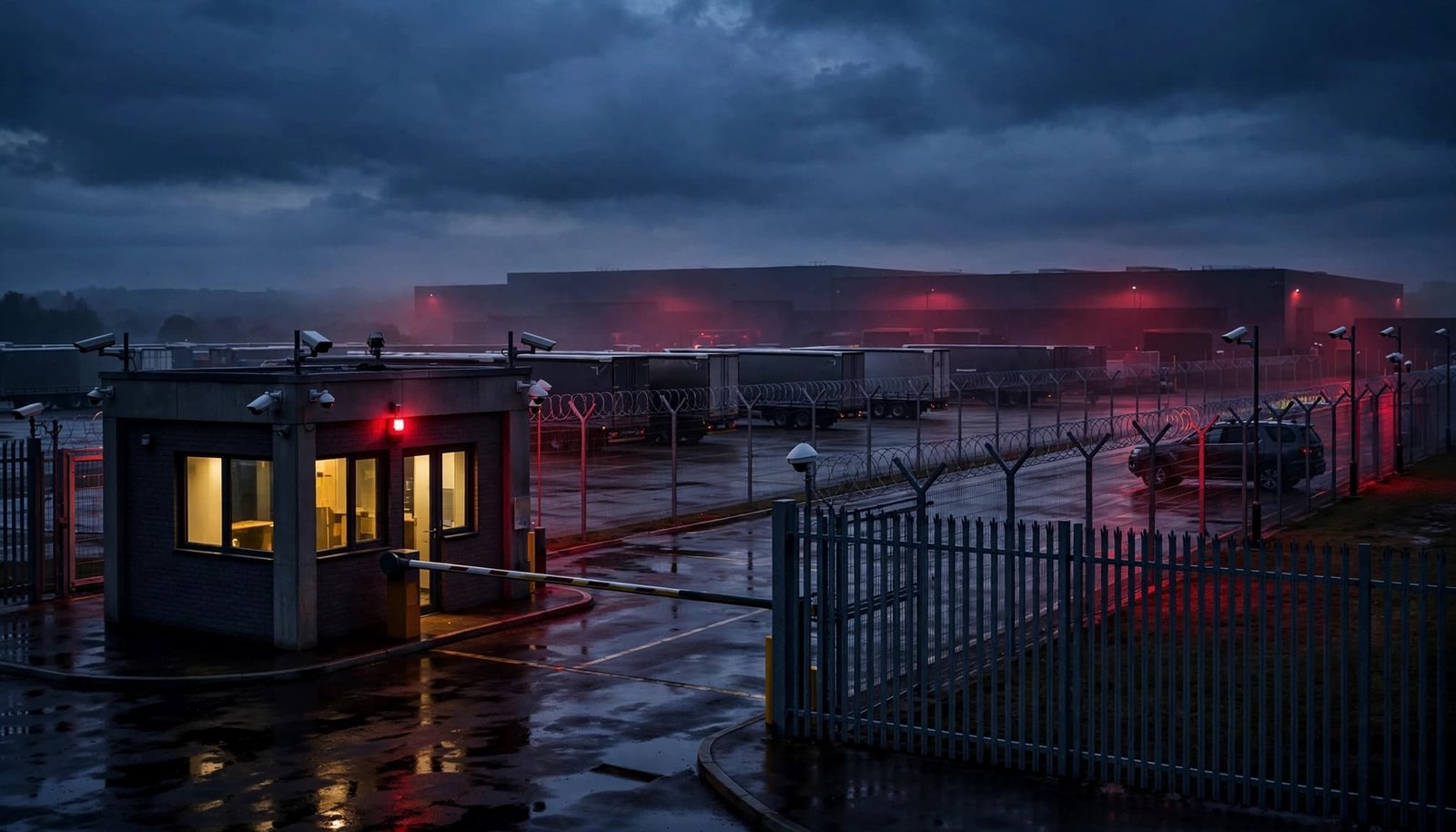
Network cameras should cover arrival lanes, gatehouses, pedestrian access, loading bays, trailer compounds and key routes between them. Image quality, lighting, retention settings and maintenance matter more than a long camera list.
A site assessment should determine whether fixed cameras, lighting, thermal imaging or radar coverage is proportionate. PTZ cameras can help an operator follow an incident. Fixed cameras provide dependable coverage of specific points. Mobile patrols can provide human follow-up around difficult perimeter areas, but they don’t replace fixed coverage.
Each system needs a defined response: who receives the alert, what they check, and when an incident is escalated.
A camera system without review procedures can record a problem perfectly and still fail to stop it.
Use ANPR with a clear purpose
ANPR is a form of license plate recognition that can compare vehicle registrations against booked arrivals, approved suppliers or vehicles of interest. It can also create a useful audit trail when combined with gatehouse records.
That does not make blanket monitoring acceptable. The ICO’s video surveillance guidance requires a documented lawful basis, proportionate collection, clear privacy information and retention for no longer than needed. License plate recognition records need a defined purpose, controlled access and a proportionate retention period. Review who can access footage and ANPR records, why they need it, and how access is logged.
Make the gatehouse the control point
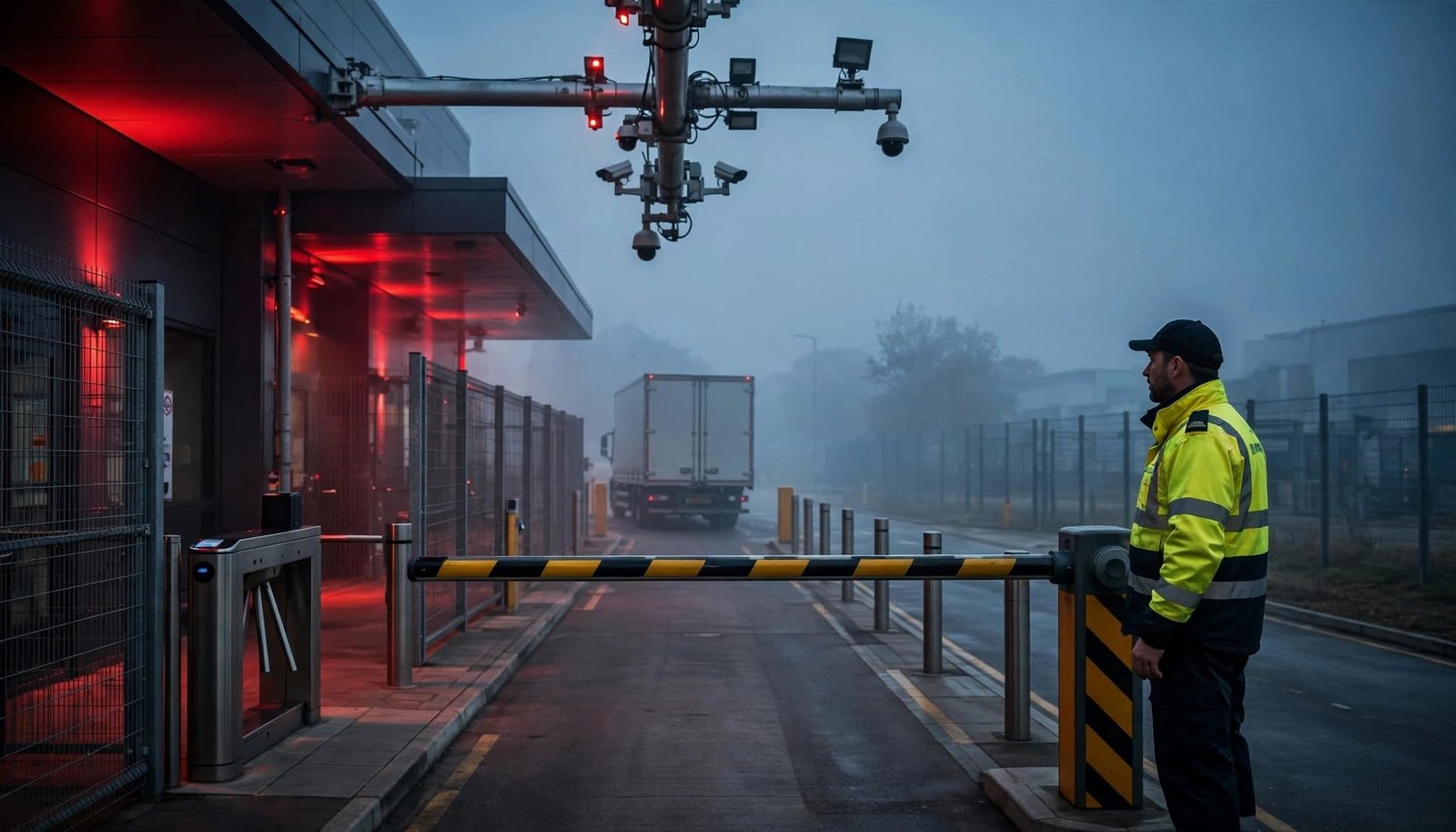
Gatehouse security is where a planned movement becomes an approved movement. It shouldn’t be reduced to handing out passes or waving vehicles through when the yard is busy.
A gatehouse team needs current arrival information, escalation contacts and the authority to pause entry when details don’t match. Real-time check-ins should record arrivals, departures and exceptions. The process must also work during peak periods, or it’s only decorative.
Verify vehicle, driver and purpose
Before a vehicle enters, credential verification should check the registration, driver identity, company, booking reference and destination. Match those details against live operational records rather than relying on a paper note brought to the gate.
Separate pedestrian and vehicle routes where the site layout permits. Temporary passes should expire automatically or be recovered at departure. Limit visitor access to the task and expiry period agreed at arrival.
Treat loading bays as controlled handovers
The loading bay is where stock, paperwork and vehicle movements meet. Clear responsibility is essential.
Record when a trailer arrives, where it’s positioned, who authorises its release and when it leaves. Where seals are used, document the seal number and any discrepancy. Out-of-hours movements should require an agreed authorisation route, not a verbal assumption.
Verify subcontractors before they reach the yard
High-throughput sites can’t rely on security staff recognising every regular visitor. Subcontractors, agency workers and maintenance teams often change by shift, contract or location.
A practical subcontractor check should confirm who engaged the person, what work they’re approved to do, and whether their access remains valid. Real-time credential verification gives the gatehouse a current answer to these questions. It replaces copied documents with a record that can be checked at the point of entry.
Check credentials against the job
A useful contractor system links each person to an approved employer, relevant induction, insurance evidence where appropriate, and a defined work order. This credential verification process should flag expired records and restrict access when evidence is missing.
Don’t collect every possible document because software makes it easy. Collect information relevant to the role, explain its purpose, and apply sensible compliance management by restricting access to personal data.
Keep a reliable attendance record
Real-time check-ins and digital sign-in records can show who was authorised on site at a given time. They’re useful after an incident, during an evacuation, and when checking whether a contractor has left.
The record must reflect reality. Security teams need a method for failed scans, poor connectivity and escorted visitors. Real-time check-ins may fail in these situations, so staff shouldn’t create informal workarounds. Review exceptions each day, especially where people entered without completed verification.
Choose guards and providers with care
Manned guarding remains important at logistics hubs because people can assess context, challenge unusual behaviour and coordinate a response. Mobile patrols can check areas that are not continuously staffed, but they cannot replace access control at a busy gatehouse.
Confirm licences and personnel screening
Relevant front-line security duties must be carried out by SIA licensed personnel. This does not mean every warehouse or reception role requires an SIA licence. Before appointment, verify the licence against the SIA application and licensing requirements.
Use a site assessment to confirm that training, supervision and mobile patrols reflect the actual site. The provider should explain when a manned guarding function is appropriate, based on activity, staffing and risk. Ask how security guards record attendance and incidents, including real-time check-ins where patrol completion matters.
BS 7858 is a recognised personnel-screening benchmark, rather than a universal legal requirement. Ask what checks the provider carries out, how exceptions are assessed and how records are reviewed. Any departure from BS 7858 should be documented and assessed against the role. Keep records showing how the provider applied BS 7858, including exceptions and review dates.
Match accreditations to the site
ISO 9001 can indicate that a supplier has documented quality procedures, audits and corrective action. It does not prove that guards understand your loading schedule or trailer-release process.
RISQS is relevant where a logistics operation has a rail-freight interface or works within the rail supply chain. It is not automatically needed by every warehouse. Match mobile patrols, routes and frequencies to the site’s risk profile. The same principle applies to any accreditation: check what it covers, not only the logo on the tender document.
Put a proportionate security plan into practice
Start with a practical site assessment based on real movements and real losses. Walk the site at shift change, during peak dispatch and after dark. Ask staff where they see delays, confusion or blind spots. Those details are usually more useful than a generic checklist.
Set out the controls in a short operating plan for proportionate security management. It should support asset protection and stock loss prevention without overstating what security controls can achieve:
- Map every entry, exit, loading bay, trailer park and pedestrian route.
- Define the gatehouse verification steps for drivers, visitors, contractors and collections.
- Set response actions for alerts from CCTV, ANPR and network cameras. Use mobile patrols for physical verification or follow-up where appropriate.
- Assign ownership for access lists, credential expiry, incident reporting and daily checks.
- Test the process with warehouse, transport and security teams, using real-time check-ins and exception records to confirm attendance. Correct the awkward parts.
The European road freight security guidance also supports practical measures such as secure parking choices, reporting arrangements and staff awareness.
Review incidents, near misses and unusual access attempts each month, repeating the site assessment after incidents, near misses or material operational changes. Look for recurring conditions, such as late collections, failed bookings or access requests outside normal patterns, and change the routine when findings warrant it.
Frequently asked questions
What percentage of cargo crime happens at independent parking locations?
NaVCIS recorded 1,831 of 3,424 HGV and cargo crime notifications at independent parking locations during 2025, representing 54%. Older reports use different datasets and definitions, so figures from separate years shouldn’t be treated as directly comparable.
Do all logistics security staff need an SIA licence?
No. SIA licensing applies to relevant front-line private security roles, such as security guarding and public-space CCTV activity. Warehouse staff, reception teams and general employees don’t automatically need an SIA licence. BS 7858 is a recognised personnel-screening standard, not a universal licensing requirement. Check the duties being performed, not only the job title.
Can ANPR and CCTV be used without a data protection review?
No. A logistics operator should establish a lawful basis, document the purpose, provide clear privacy information, limit retention and control access to recorded data. The ICO expects operators to use surveillance proportionately.
Security that holds up under pressure
Cargo theft prevention isn’t about making a site look heavily guarded. It’s about making every significant movement accountable, from the vehicle at the gate to the contractor in the loading bay.
The strongest logistics hub security UK arrangements combine visible deterrence with reliable credential verification, manned guarding and real-time check-ins. When people, systems and procedures agree on what should happen next, unauthorised access has far less room to become an ordinary oversight.


0 Comments