


Closing the front door is not enough to protect your business when protests take place outside your premises. A workable plan needs clear decisions about the safety of people on site, access, communications and continued operations, with responsibilities assigned before conditions change.
Most demonstrations are peaceful. Preparation should protect employees, customers, protesters and the public without treating lawful protest as a security incident.
The practical priority is safe movement and clear instructions, supported by proportionate property protection. Start by separating the disruption expected at the site from the circumstances that would require closure, shelter or emergency assistance.
Key takeaways for business decision-makers
- Assess the actual exposure, including nearby targets, shared entrances, transport routes and the effect of reduced police availability.
- Give an incident lead authority to restrict access, suspend work and activate continuity arrangements, with a named deputy.
- Brief every shift on reporting concerns, avoiding confrontation and following accessible evacuation or shelter instructions.
- Secure property without obstructing escape routes, emergency access or movement along public pavements.
- Share verified information through agreed channels, with an alternative available if company systems fail.
- Arrange employee welfare, policy and claims records, supplier support and reopening checks before disruption begins.
A security measure needs an operating procedure behind it. Record who activates it, what changes for occupants and what happens if it fails.
Separate peaceful protest from disorder
Understand how disruption develops
Planned demonstrations give businesses time to assess routes, timings and likely attendance. Reactive gatherings can develop after a death, court decision, political announcement or widely shared incident.
Different events require different assumptions. The 2017 Unite the Right rally in Charlottesville was planned. The protests following George Floyd’s murder in 2020 developed in response to an event. The assault on the US Capitol on 6 January 2021 followed organised political mobilisation.
PBS’s examination of Charlottesville and January 6 provides historical context, but these events are not templates for every UK demonstration. Local circumstances should determine the assessment.
The presence of counter-protesters can bring opposing movements, additional demonstrators and changing police cordons. Include their effect on access without assuming that confrontation will occur.
Assess conduct rather than appearance
Some security frameworks distinguish activists, anti-protesters, opportunists and exploiters. Activists support a cause; anti-protesters oppose it. Opportunists may take advantage of disruption, whilst exploiters can include habitual criminals using the event as cover for organised theft or looting.
These are planning descriptions, not reliable categories for identifying people. Clothing, political views or presence at a demonstration do not establish criminal intent.
ACLED’s research on demonstrations and political violence separates demonstration activity from violent incidents. Business reporting should maintain that distinction.
Record observable behaviour: attempted entry, threats, vandalism, damage, blocked escape routes or dangerous crowd pressure. Peaceful chanting outside a building requires a different response from somebody forcing its door.
Build a premises-specific protest risk assessment

Identify the target and surrounding exposure
The facilities manager and security lead should establish the likely focus of the protest. Is the potential target the business, its sector, its landlord or a nearby organisation? Could a neighbouring government building, transport facility, place of worship or corporate office affect access?
Ask which groups are active locally and whether credible information identifies threatening conduct, counter-demonstrations or previous disorder. Political affiliation alone is not evidence of a threat.
Walk the approaches at the expected time of the demonstration. Examine rear entrances, loading bays, shared staircases, pedestrian pinch points and places where crowds could restrict movement.
A business does not need to be close to the demonstration to experience looting. Dispersed disorder and competing incidents can stretch police resources across a wider area. Distance reduces some exposures, but it does not replace normal security controls.
Record consequences, controls and decisions
Describe each risk as an event and consequence. A blocked loading bay may interrupt essential deliveries. A damaged entrance may prevent safe occupation even when the rest of the building remains usable.
Identify who could be harmed, including visitors, contractors, disabled occupants and people working alone. Assess likelihood and severity using the organisation’s existing method.
For each significant risk, record the current controls, remaining weakness, action owner and completion date. Include an observable trigger for changing operations.
A corporate security risk assessment should connect access, staffing, physical protection and response arrangements. This assessment should sit within that wider process rather than become a separate document nobody maintains.
Assign decisions and coordinate beyond the boundary
Give the incident lead clear authority
Appoint an incident lead and deputy for every affected shift. State who can delay opening, close customer access, stop deliveries, approve remote working and activate the business continuity plan.
Separate operational authority from specialist responsibilities. The incident lead coordinates decisions; competent fire, security, HR and legal advisers support the matters within their remit.
Record escalation thresholds before the event. Injury, a credible threat to life, loss of a safe exit or loss of access to a critical facility should not depend on an informal management discussion.
Keep the contact pack available offline. Include building management, police contact routes, alarm monitoring, essential suppliers, insurers and authorised decision-makers.
Agree arrangements with neighbouring occupiers
Contact the landlord, managing agent and relevant neighbouring businesses. Establish who controls shared entrances, service yards, common areas and building-wide messages.
Coordinate practical arrangements with local police and relevant law enforcement contacts, including likely routes, cordons, access restrictions and emergency reporting. HMICFRS’s inspection of protest policing recognises engagement with affected organisations as part of planning.
Do not assume that officers will remain outside the premises or keep every entrance open. Police deployment follows operational priorities.
Peaceful protest is legally protected, subject to applicable limits. The CPS guidance on protest-related offences concerns England and Wales; laws and police procedures differ across jurisdictions. Obtain qualified legal advice before considering injunctions, detention, searches or physical removal.
Verify information and control communications
Separate a warning from a confirmed event
Assign one incident lead to maintain the operational picture. Use police updates, local authority information, transport notices, direct observations and identifiable organiser announcements.
Treat social media posts and forwarded WhatsApp messages as unconfirmed until you check their source, time and location. A post may use an old photograph, give an incorrect location or make an unsupported prediction.
Where a demonstration remains a rumour, say so. A team update can explain that reports are unconfirmed, precautionary arrangements are in place and normal attendance instructions remain unchanged.
Information should be verified before wider sharing. That doesn’t mean delaying a call about an immediate threat while somebody searches for another source.
Provide instructions through more than one channel
Set a primary communication channel and a fallback. Company messaging may work normally, but personnel also need a practical alternative if mobile data, power or corporate access fails.
Messages should state what is known, what action is required, which area is affected and when the next update will arrive. Avoid speculation about motives or likely police action.
Send different information to different audiences. Employees need attendance and safety instructions; customers need service changes; suppliers need delivery arrangements.
Appoint a spokesperson for external enquiries. Colleagues should report concerns internally rather than publish operational details, colleagues’ movements or security arrangements on personal accounts.
A warning without a location, time or required action can increase confusion. Give recipients an instruction they can follow.
Protect the premises without obstructing safe access

Match physical measures to the building
Review physical security by inspecting doors, locks, glazing, shutters, fences, roof access and secondary entrances. Repair existing faults before adding equipment.
Retractable or folding security gates can protect doors and windows outside operating hours whilst remaining unobtrusive when secured open. Roll-down gates or shutters may suit exposed frontages, subject to the building’s fire strategy and permissions.
Bollards can control vehicle access, but their location and specification require competent assessment. Improvised barriers can create collision hazards, obstruct emergency vehicles or push pedestrians into the road.
Security foggers may deter theft in suitable enclosed premises. Their use requires specialist design, coordination with alarm and fire arrangements, and clear procedures for authorised occupants and responders. They should not be used as a device for controlling people outside the premises.
Make the controls work during occupation
The facilities team should record who operates each shutter or gate, how it releases and what happens during a power failure. A protective barrier must not trap occupants.
Keep fire doors, accessible routes and emergency exits usable. Do not install last-minute locks or secure shutters across an occupied escape route without competent fire-safety advice.
Remove loose external materials where safe, including unsecured waste, unused signs and movable equipment. Store combustible materials and hazardous substances appropriately rather than moving them into an unsuitable room.
Review lighting for entrances, yards and employee departure routes. Excessive glare can reduce visibility and affect neighbouring properties.
Shared premises need agreed boundaries. Commercial building security arrangements should identify which controls belong to tenants and which remain the landlord’s responsibility.
Use CCTV and alarms with a defined response
Confirm what the systems can establish
Test camera coverage, recording quality, timestamps, storage and authorised access. Include rear approaches and loading areas rather than concentrating every camera on the main frontage.
Confirm how alarms reach a responsible person and what happens if the usual keyholder cannot attend. An alert has limited value without a safe response arrangement.
Automatic number plate recognition can support suitable vehicle-access functions. Facial recognition involves greater privacy and accuracy concerns, particularly where biometric information identifies individuals.
Neither technology should become a default measure for monitoring demonstrations. Establish necessity, proportionality, lawful processing and any required data protection impact assessment before deployment. Automated matches require appropriate human assessment.
Protect recordings and operational information
Restrict footage access to authorised roles. Preserve relevant recordings promptly because routine retention may overwrite material needed for an investigation or claim.
Record the camera, time range, exporter and recipient when evidence is disclosed. Do not distribute clips through personal messaging groups or post suspected offenders online.
Limit collection to the stated security purpose. Recording a damaged entrance does not justify building an informal database of peaceful demonstrators.
Include network and power dependencies in the plan. If CCTV, alarms or access control fail, the incident lead needs a controlled fallback rather than an assumption that systems remain operational.
Brief staff before the protest reaches the premises

Explain the expected conduct
Give every shift a concise briefing covering reporting routes, access changes, emergency signals and the person authorised to issue instructions. Include temporary workers, cleaners, contractors and reception cover.
People should avoid confrontation and pass demonstrations calmly and promptly where a safe route remains available. They should not stop to argue, support or disrupt the demonstration whilst carrying out work duties.
If the business or sector is being targeted, advise employees to remove company ID badges before leaving and cover or change branded clothing. Keep passes secure and available for authorised entry.
This is an exposure-control measure, not a judgement about protesters. Apply it according to the assessed risk rather than issuing a blanket instruction for every gathering.
Define withdrawal and reporting responsibilities
Explain what staff should report: threats, attempted entry, damaged security equipment, blocked routes or people needing assistance. Reports should describe conduct and location, not assumptions about identity.
Front-line employees need permission to withdraw without waiting for a dispute to become physical. Security officers also need a clear assignment covering de-escalation, assistance and escalation.
The briefing should distinguish supporting an evacuation from entering danger. Security officers’ evacuation responsibilities should align with the building’s emergency plan and competent fire-safety arrangements.
Managers should explain how attendance changes, temporary closure and pay will be communicated. Employment consequences depend on contracts, applicable law and the circumstances; emergency decisions should not include improvised instructions to take unpaid leave.
Plan staff travel, accommodation and welfare
Arrange safe arrival and departure
Review shift times against the expected demonstration, transport changes and any police restrictions. Adjust attendance before anyone sets out on an unsafe journey.
Avoid affected public transport routes during disturbances. Where routes remain reliable and safe, public transport may remain suitable; private transport is not automatically safer.
Arrange private vehicles where the assessment justifies them, using collection points away from crowds and cordons. Give drivers a clear route, passenger contact and alternative destination.
Do not release everyone into the same exposed entrance at once. Stagger departures where appropriate and keep an accountable record of anyone remaining inside.
Support people who cannot leave
Identify suitable accommodation if staff may be unable to travel home safely. Agree who authorises booking, payment, transport and any additional support.
Allow employees to contact families and explain delays. Provide water, food, toilets, charging facilities and access to essential medication where people may remain on site.
Ask about individual assistance needs through an appropriate private process. Mobility, sensory, communication, health and caring responsibilities may affect arrangements.
Keep welfare decisions separate from pressure to continue trading. A worker able to remain in the building may still need relief, medication or support after a threatening incident.
Managers should make contact with staff exposed to abuse or violence after the event. Record injuries and offer appropriate occupational health or employee assistance support.
Practise accessible emergency procedures
Test evacuation and shelter as different responses
An evacuation plan moves people out of danger. A shelter-in-place instruction tells people to shelter in place, away from an outside hazard. Each needs suitable locations, communication methods, accountability and an alternative if conditions change.
Include disabled employees and visitors in planning. Personal emergency evacuation plans and assisted movement should reflect actual needs and available support. Keep instructions accessible and consistent with the building’s existing emergency plan and evacuation arrangements.
The GOV.UK workplace fire evacuation guidance requires clear escape arrangements and recommends at least one fire drill each year, with results recorded.
Two or three evacuation exercises annually may be appropriate for complex premises, changing occupancy or multiple shifts. That’s a risk-based recommendation, not a universal protest-specific legal requirement.
Exercise decisions under realistic conditions
Run a tabletop exercise before a known higher-risk demonstration. Test a blocked entrance, an unavailable manager, failed mobile data and an occupant requiring assistance.
Give participants the information they would have during an incident. Establish whether they can locate contacts, issue instructions and make decisions without entering the affected area.
HSE’s emergency planning guidance emphasises planned procedures, responsibilities and arrangements for incidents. Apply those principles to the site rather than borrowing an event plan unchanged.
Record faults and assign corrective actions. Repeat the failed element after changes are made.
A completed exercise record doesn’t establish that the plan works. Evidence comes from whether people received instructions, used safe routes and accounted for occupants.
Decide whether to remain open, evacuate or shelter
Use conditions rather than crowd size alone
The incident lead should reassess conditions as the demonstration develops. A large peaceful gathering may permit continued operation with access changes; a smaller incident at an exit may require immediate action.
The incident lead should act on observable threats and immediate danger, not labels such as “riot”. Legal definitions and police procedures vary by jurisdiction.
Use agreed triggers and retain judgement. Restrict entry if safe customer movement cannot be maintained. Suspend deliveries if vehicles would cross crowded pedestrian space.
Evacuate where remaining inside creates greater danger and a safe route is available. Shelter where the main hazard is outside and leaving would expose occupants to violence or dangerous movement of people.
Fire, smoke or another internal hazard can change the decision immediately. A shelter instruction does not override the need to escape an unsafe building.
Keep instructions accessible and current
State which entrance or route is available and where people should go. The usual assembly point may be unsuitable if it falls within the demonstration area.
Shelter locations should be away from exposed glazing and have suitable communication, capacity and onward escape arrangements. Internal rooms should be assessed before the event, not selected during it.
Maintain an occupant record that includes visitors and contractors. Use agreed check-ins without asking anyone to return through danger to complete a headcount.
Call 999 where there is immediate danger, violence or a crime in progress. Give the exact address, access point, nature of the threat and known injuries. Follow emergency-service instructions and report material changes.
Respond safely if unauthorised people enter
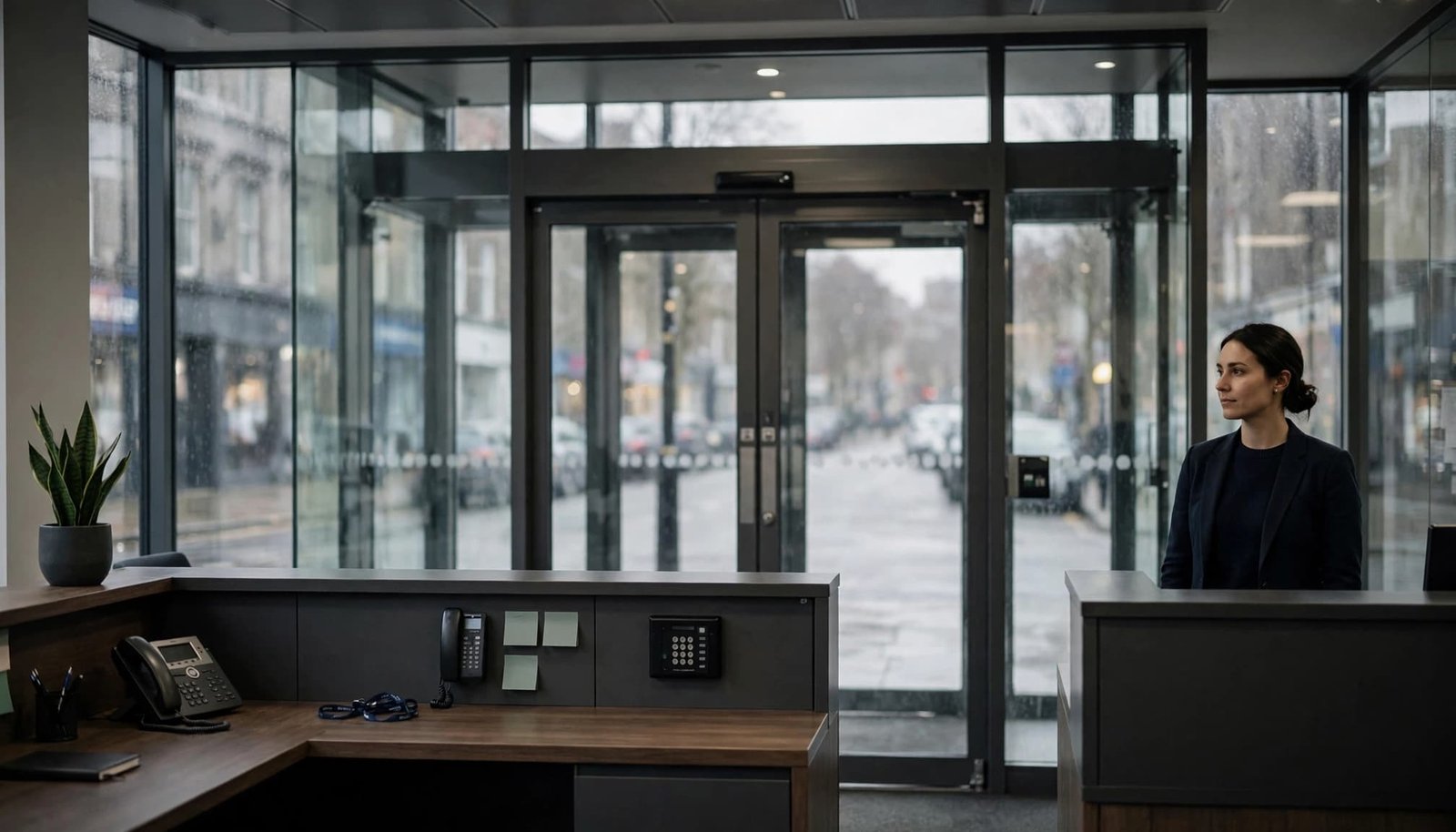
People in the affected area should withdraw, raise the alarm and follow the planned shelter or evacuation instruction. Do not confront intruders, attempt to recover goods or move towards them to obtain photographs.
Secure internal separation where it can be done safely. Avoid crossing an occupied entrance to lock it, trapping people or blocking an escape route.
If occupants are already sheltered safely, they should remain there unless conditions or emergency-service instructions require movement. An unfolding intrusion is not a reason to send a manager into reception to establish what has been taken.
The incident lead should pass verified information to emergency services, including the location of occupants and any known hazards. Do not describe every unauthorised person as violent when their behaviour is unknown.
Security officers should work within their training, assignment and legal authority. A company procedure cannot create police powers or make unnecessary force lawful.
Property protection remains secondary to life safety. The policy may reimburse covered losses, subject to its terms; no item of stock justifies exposing an employee or customer to violence.
Re-entry requires a separate decision. An apparently quiet entrance does not establish that the building, occupants or routes are safe.
Keep critical operations running without unsafe access
Identify what actually stops the service
Use the business impact assessment to identify priority activities and their dependencies. A building may be intact but unusable because its entrance, access-control panel, communications or loading area is unavailable.
Set recovery priorities by operational consequence, not replacement value alone. A modestly priced key device can matter more than expensive equipment with an available substitute.
Define which work can continue remotely, which can move to another site and which must stop. Include customer records, payment processing, specialist equipment and supervision.
Keep approved manual procedures available offline. Each priority activity needs an approved fallback and a clear stopping trigger in the contingency plan. Personnel should know their limits, including which transactions or safety-dependent activities cannot continue without functioning systems.
Agree supplier fallbacks in advance
Review transport, guarding, maintenance, alarm monitoring, locksmiths and specialist suppliers. Ask how each provider reports disruption, what alternative capacity exists and who can approve a change.
Record notification expectations, out-of-hours contacts, access arrangements and evidence responsibilities in contracts or operating procedures. Personal inboxes are unsuitable as the only record.
Include the possibility that a supplier’s depot or response route becomes inaccessible. Additional guarding has limited value if nobody has arranged relief, transport or a safe assignment.
A cyber incident may also affect access systems or communications, but activity at a demonstration does not automatically imply a cyberattack. Keep physical response, business continuity and technical recovery responsibilities distinct.
Business continuity after a security incident should define when alternative arrangements start and who approves their end. Restoring a door does not necessarily restore the service behind it.
Arrange insurance and claims records before disruption
Distinguish property cover from interruption cover
The finance lead should maintain an accessible record of buildings, contents, stock and relevant business interruption cover. Include the policy schedule, wording, endorsements, excesses and notification requirements.
The Association of British Insurers’ civil unrest guidance explains that business interruption cover may respond to lost income where insured property damage prevents normal operation.
A closure without damage may have a different outcome. Denial-of-access extensions, police restrictions, supplier interruption and voluntary closure depend on the actual policy.
Do not treat cover as a guarantee against every event-related loss. Record the applicable cover with the insurer or broker before an incident, including conditions affecting security arrangements and temporary occupation.
Prepare an evidence and notification process
Assign responsibility for notifying insurers and keeping the claim record. Store policy information outside the premises and independently of the main company network.
Maintain dated stock records, equipment inventories and evidence of the pre-incident condition. After an incident, retain photographs, repair estimates, invoices and the police reference where available.
Separate direct damage from operational losses. Record cancelled orders, additional staffing, alternative premises, transport costs and periods when access was unavailable.
Take reasonable emergency steps to protect people and prevent further damage. Record what was done, why it was necessary and the cost.
Do not discard damaged goods or authorise extensive non-emergency repairs without considering evidence preservation and policy requirements. Insurer cooperation should already be part of the recovery procedure.
Inspect, recover and reopen under controlled authority
Establish that occupation is safe
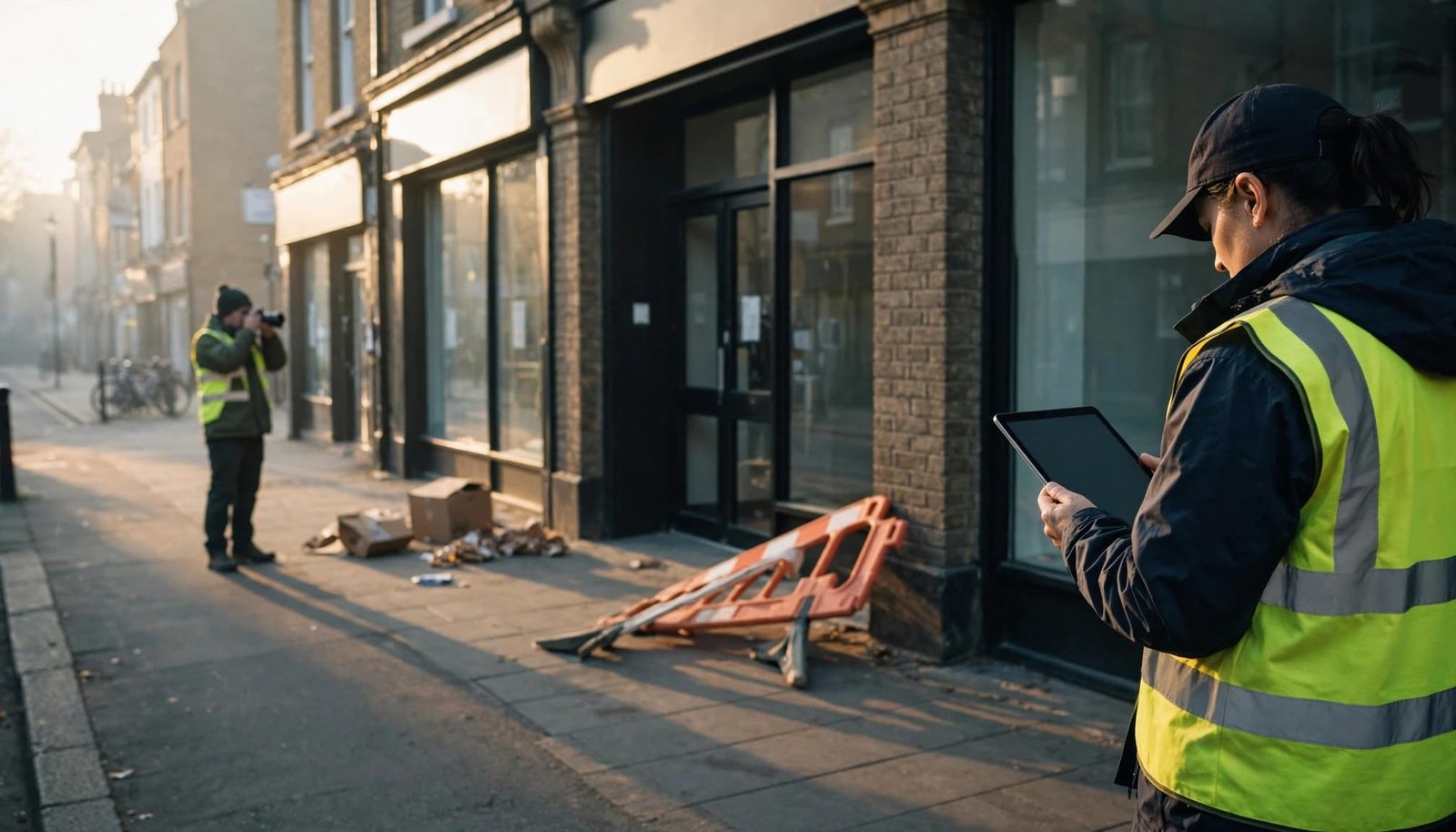
Reopening should follow a recorded inspection by people competent to assess the affected systems. Police release of an area does not establish that a damaged building is ready for occupation.
Assess structural damage, glazing, fire protection, exits, electrical equipment, gas systems, hazardous materials and accessible routes. Use qualified contractors where the damage requires specialist judgement.
Test alarms, CCTV, door releases and access controls. Change compromised keys or credentials and restrict areas that remain unsafe.
If systems were compromised, separate containment, removal of the cause and restoration. Test restored functions before reconnecting dependent services, with specialist technical support where needed.
Name the person authorised to approve partial or full reopening. Record any restrictions, temporary controls and review times.
Review the operational consequences
The continuity lead should reconcile outstanding orders, delayed deliveries, workforce gaps and supplier capacity. A reopened site may still have a substantial service backlog.
Communicate reopening conditions to staff, customers, suppliers and the landlord. State what is available, what remains restricted and when the next update is due.
Preserve a factual incident timeline. Record detection, verification, calls, instructions, closure decisions, injuries, damage and recovery milestones.
Measure lost capacity, overtime, direct costs, customer impact and the time taken to resume priority work. Include dependencies that failed outside the premises.
Allocate corrective actions to named owners. Update procedures, contracts and training after the review, then test the changed arrangements. A report without completed actions leaves the same weakness in place.
Use a phased protest preparedness checklist
The incident lead should use a short control record alongside the detailed plan. Each action needs an owner and a completion or review time.
- Before the event, record the expected location, timing, affected routes and credible sources. Complete the premises assessment and identify nearby exposure.
- Before people arrive, confirm decision authority, communications, travel arrangements, accessible procedures, supplier fallbacks and insurance contacts.
- Before changing access, inspect gates, shutters, alarms and escape routes. Brief every shift and communicate service changes to customers and suppliers.
- During disruption, monitor conditions, record decisions and apply the agreed operating thresholds. Protect occupants without confrontation or unnecessary movement.
- After the immediate danger, preserve evidence, assess the premises, support affected staff and authorise recovery in stages.
Keep the live record brief enough to use under pressure. Detailed supporting information belongs in the contact pack, site plans and continuity documents.
Outstanding actions should remain visible through shift handovers. A task described as “in progress” needs an owner and a practical interim control.
Frequently asked questions
Should a business close whenever a protest is announced?
Closure should follow the assessed conditions, not the announcement alone. Consider safe access, staffing, crowd movement, credible threats and the ability to maintain emergency arrangements.
An early closure may reduce exposure, but sending staff into an affected route can increase it. The incident lead should coordinate departure before changing trading hours.
What should staff do if caught in a violent crowd?
Move calmly towards a less congested, safer area when possible. Avoid arguments, filming confrontations or trying to force a route through a dense gathering.
Keep away from developing violence and follow lawful police instructions. Contact emergency services when safe if someone is in immediate danger. Staff should not return towards the premises solely to recover belongings.
Can security gates remain installed during normal business hours?
Retractable, folding and roll-down systems can remain installed if their operating arrangement supports safe occupation. They should be secured in the appropriate position, maintained and covered by opening and closing procedures.
Their presence must not narrow required escape routes, obstruct accessible movement or introduce a trapping hazard. Suitability depends on the building and competent assessment.
Can an employer send staff home without pay?
Temporary closure does not automatically remove an employer’s pay obligations. Entitlement depends on employment status, contractual terms, lawful lay-off arrangements and the circumstances.
HR should issue clear written attendance and pay instructions, supported by qualified employment advice where needed. Avoid presenting unpaid leave as an automatic consequence of a safety decision.
Make the next decision clear before disruption begins
Effective protest preparedness gives the responsible manager clear choices about access, movement and continued work. Physical controls support those decisions, but they cannot replace them.
Prioritise people and safe operations, preserve the distinction between peaceful protest and threatening conduct, and make recovery subject to recorded checks.
Before the next demonstration, test one practical question: can the duty manager protect occupants and activate alternative arrangements without entering the affected building or relying on one unavailable person?


0 Comments