

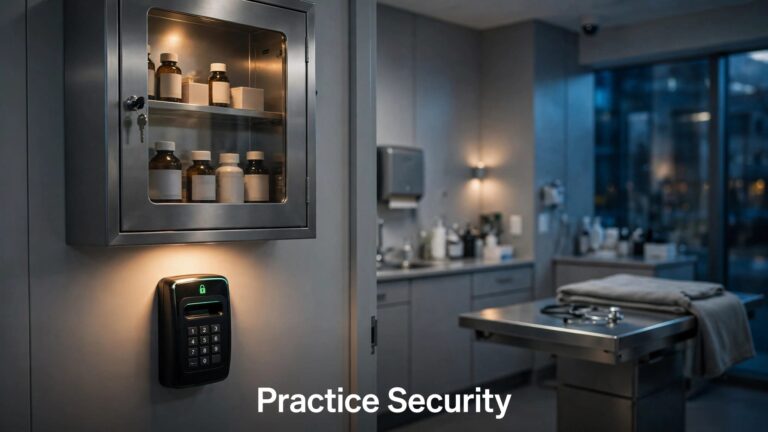
Locked doors and security cameras can leave a veterinary practice exposed if nobody controls access, reviews records or responds to alerts. Effective veterinary practice security connects these measures to staff and patient safety, with clear responsibilities during consultations, overnight care and closed periods.
A missing medicine, compromised account or threatening visitor can interrupt treatment as well as cause financial loss. Start with how the clinic operates, then assign controls that staff can use under pressure.
Key takeaways
- Assess threats to people, animals, medicines, information and premises together, including weaknesses between clinical and administrative work.
- Give each security control a named owner, a deputy and a clear response when something fails.
- Restrict controlled-drug access and maintain the storage, registers and reconciliation arrangements required in the relevant jurisdiction.
- Separate financial duties so that one person cannot change payroll, approve payments and review their own work.
- Protect accounts with unique passwords, two-step verification and passkeys where supported, alongside independently protected backups.
- Train permanent staff, locums and out-of-hours teams to report concerns, seek assistance and protect people without confronting offenders.
Build veterinary practice security around actual risks
Security spending should follow a recorded assessment, rather than the most recent incident or the most visible piece of equipment. The practice manager should involve a veterinary surgeon, nursing representative, reception lead and whoever manages IT.
A useful business security risk assessment connects each credible threat to an exposed activity, an existing control and an assigned action.
Identify external, internal and online threats
External risks include burglary, vandalism, unauthorised entry and aggression towards staff. Internal risks include medicine diversion, unauthorised refunds, salary amendments and misuse of client information.
Digital threats can cross both categories. A fraudulent supplier email may reach reception, require a payment decision from accounts and compromise a shared mailbox.
Assess exposure during ordinary work as well as emergencies. Deliveries, admissions, shift changes and evening collections can create opportunities when responsibility passes between colleagues.
Record who could be harmed and how treatment could be affected. Losing access to patient histories has different consequences from losing a replaceable office computer.
Use evidence without overstating it
AVMA’s clinic security reporting describes a VHMA survey of 175 respondents. Of those, 83% reported no security breaches, 3% reported a break-in and 2% reported vehicle break-ins in the parking area.
The reporting also states that 18% added cameras following crime, 8% added or updated locks, and 37% offered no facility safety training.
These findings describe the respondents, not the likelihood of crime at a UK clinic. Use local incident records, stock discrepancies, staff reports and system alerts to establish the practice’s priorities.
Control movement through the premises

Separate public access from clinical access
Clients need a clear route to reception, consultation rooms and collection points. They should not be able to follow a delivery or another client into medicine stores, treatment areas or staff accommodation.
Mark staff-only boundaries and keep restricted doors closed. A keypad provides little protection when the door is routinely wedged open during a busy consulting session.
Position reception so staff can see arrivals without leaving the desk. Walk the same routes at standing and seated eye level, then identify areas hidden by shelving, displays or internal glazing.
Keep high-value portable equipment away from uncontrolled exits. Store clinical supplies according to both treatment needs and the consequences of unauthorised access.
Changes must also support animal handling. A door arrangement that creates congestion between nervous dogs, carriers and emergency admissions needs redesigning, even if it improves access control.
Record who has permission to enter
The practice manager should maintain a current list of keys, fobs, codes and authorised holders. Record issue dates, access levels, returns and lost credentials.
Give contractors access for their work, not unrestricted permission throughout the building. Identify the practice contact responsible for receiving them and the rooms they may enter.
Review permissions when someone changes role, finishes a placement or leaves. Locums and temporary staff need appropriate access without inheriting another person’s credentials.
For premises with shared entrances or adjoining businesses, establish who controls communal doors and out-of-hours access. A security vulnerability assessment should examine these routes as well as the clinic’s main entrance.
Protect the building outside opening hours

Check the whole boundary
Inspect rear doors, accessible windows, side gates, roof access and external stores. A well-protected frontage does not compensate for a damaged rear frame or unsecured delivery entrance.
The closing procedure should identify who checks each area and who confirms completion. Include medicine stores, portable equipment, vehicle keys and any room that remains occupied overnight.
Check lighting where staff park, unlock doors and walk between buildings. Test visibility after dark, rather than relying on a daytime inspection.
Keep external areas orderly enough to reveal changes. Damage to a gate, unfamiliar objects near an entrance or signs of attempted access should reach the duty manager before the next closing round.
If animals remain on site, closing arrangements must reflect their monitoring and care requirements. An intruder alarm should not create uncertainty about where authorised staff can move.
Connect alarm signals to safe attendance
Record who receives an alarm, who can attend and who authorises further action. Include a deputy when the normal contact is unavailable.
A staff member should not be expected to enter premises alone where there are signs of intrusion. Attendance instructions need clear limits and an escalation route.
Professional keyholding and alarm response can allocate out-of-hours attendance without leaving receptionists or clinicians to make unsupported decisions at night.
The scope should cover access instructions, restricted clinical areas, animals on site and communication with the practice contact. Record attendance findings and unresolved defects.
Test the contact chain after personnel changes. An accurate alarm system can still fail operationally if it calls a former employee.
Make cameras and alarms support a response
Test coverage against a defined purpose
Specify what each camera needs to show: an approaching person, entry through a door, access to a restricted corridor or activity around an external store.
A wide image of reception may not provide usable detail at the entrance. Review glare, darkness, door movement and obstructions at different times.
After layout changes, repeat the review. A new retail display or temporary equipment trolley can block a view that was previously useful.
Check recorder time, recording status, storage and retrieval. Assign someone who can export relevant footage without overwriting the original or distributing it through personal messaging accounts.
Cameras can deter some behaviour and support investigations. Recording is not intervention. If live monitoring is part of the arrangement, define which events require action and who receives the alert.
Protect recordings and test assistance systems
Client images and identifiable staff footage can be personal data. Apply the ICO’s data security principles through restricted access, appropriate retention and secure handling.
Use clear notices that describe actual surveillance. Avoid claims about continuous monitoring if nobody watches the system continuously.
A panic alarm, door alert or radio needs a defined purpose. Staff should know whether pressing a button summons a colleague, contacts a monitoring centre or starts another agreed response.
Test coverage in consultation rooms, kennels and external areas where assistance may be needed. Record failed tests and remedial action.
Do not treat an audible alarm as proof that help is coming. The receiving person must recognise the signal and know what action to take.
Keep controlled drugs secure and accountable
Apply the relevant storage requirements
Controlled-drug law depends on jurisdiction, drug schedule and applicable exemptions. UK practices should distinguish the requirements applying to their nation; practices elsewhere need advice from their local competent authority.
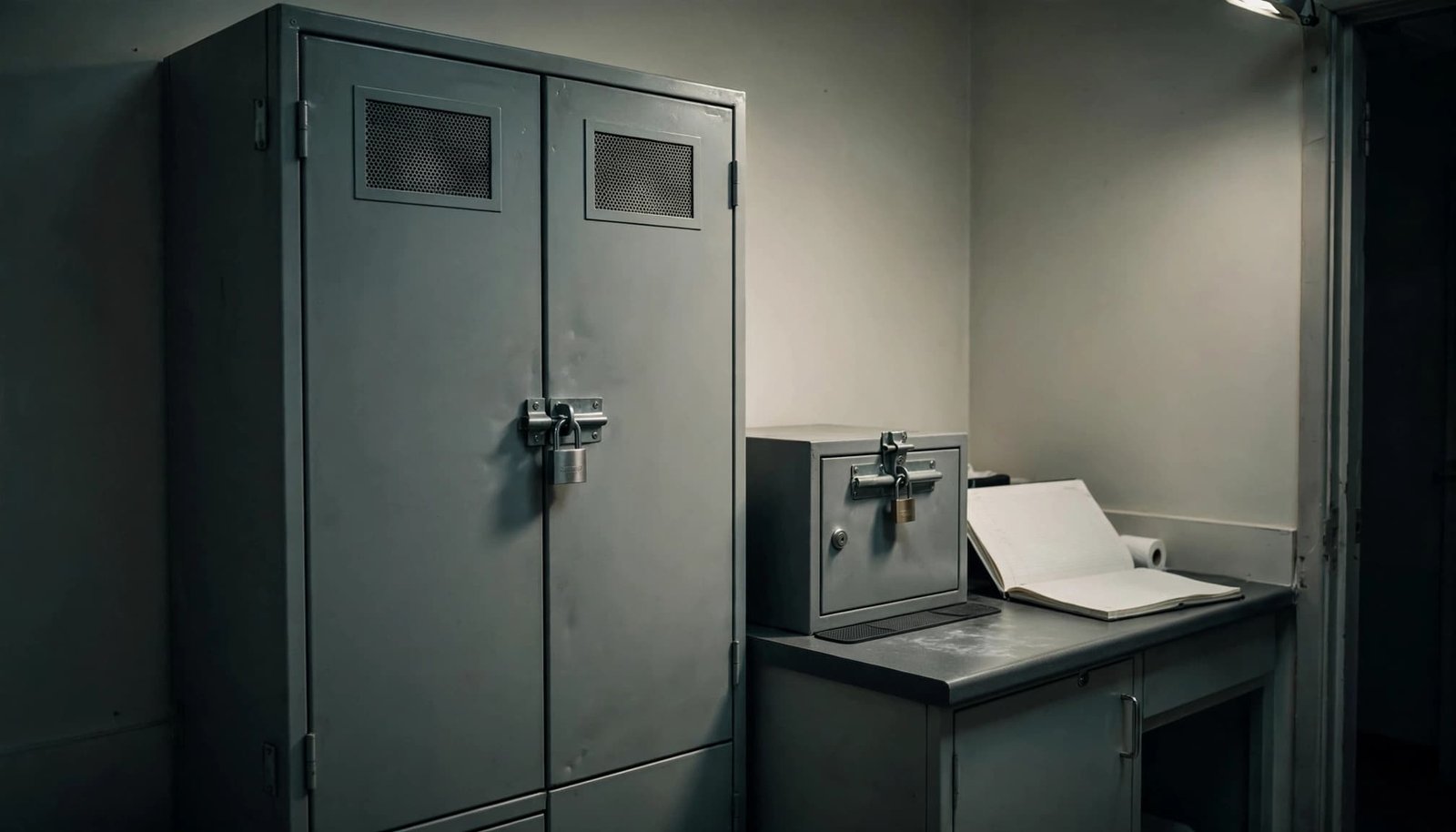
The VMD inspection criteria specify secure, lockable and immovable storage for Schedule 2 and certain Schedule 3 controlled drugs covered by the requirements. Access must be restricted to a veterinary surgeon or an authorised person.
A locked treatment-room door does not automatically provide the required drug storage. Assess the receptacle, its fixing and the control of the key or access mechanism.
Keep controlled substances in a designated secure area, out of clients’ sight. This is also part of AVMA’s recommended approach, alongside usage logs and regular counts.
The responsible veterinary surgeon should identify who is authorised to access stock and how access is withdrawn. Avoid a shared key left in an unlocked drawer.
Make access traceable without obstructing treatment
Clinical teams need prompt access to medicines, including during emergencies. The arrangement should provide that access through authorised staff rather than routine bypasses.
Define how keys move between shifts and where responsibility transfers. Where access is electronic, use individual permissions and review the available access history.
Reconcile physical stock against recorded balances at a frequency appropriate to usage and risk. Regular counts are a management control, not a substitute for accurate entries.
Record who counted, when they counted and what they found. Escalate an unexplained difference promptly rather than carrying it forward into the next reconciliation.
Review access following a discrepancy, but avoid unsupported allegations. A recording error, wastage problem and suspected diversion require different investigations.
Security must protect medicine integrity as well as possession. Storage conditions, restricted access and reliable records all contribute to safe administration.
Keep medicines records and resolve discrepancies
Distinguish register retention from transaction retention
A controlled-drug register is required for Schedule 2 controlled drugs. VMD guidance requires a separate register for each premises, retained for at least two years after its last entry.
Maintain clear entries for the relevant product, strength and formulation. Record receipts and supplies promptly, using the required information and a traceable correction process.
Do not erase an error or replace the original entry without an audit trail. Electronic arrangements need equivalent safeguards against unrecorded alteration.
The two-year controlled-drug register rule is separate from the retention requirements for other medicines records. Relevant veterinary-medicine receipt and supply records generally need to be kept for five years.
Allocate responsibility for retention and secure retrieval. A record kept somewhere in the organisation is of limited use if staff cannot retrieve it for reconciliation or inspection.
Investigate differences and control disposal
The responsible veterinary surgeon should establish what happened when physical stock does not match the register. Compare deliveries, administrations, dispensing, transfers, wastage and recorded corrections.
Preserve relevant records and access information. Do not amend a balance simply to make the figures agree.
The VMD’s controlled-drug handling and disposal guidance distinguishes storage, recording and destruction responsibilities. Schedule 2 stock subject to witnessed-destruction requirements needs an authorised witness.
Keep expired or unwanted controlled drugs secure pending lawful disposal. Separate practice stock from client-returned medicines because their handling and record requirements can differ.
Document the quantity destroyed and the required witness details. Ordinary waste collection does not replace the controlled-drug process.
Apply similar discipline to other veterinary medicines: restrict stores, review expiry dates and record unexplained losses. Also protect refrigerated stock against loss of temperature control during equipment failure or prolonged disruption.
Reduce insider theft and payroll fraud

Separate preparation, approval and review
The AVMA report describes a manager who increased her own salary through the organisation’s pay system and stole more than $100,000. The owner had not been checking those records.
The weakness was an unchecked process. A trusted employee had enough control to change a payment and allow it to proceed without independent scrutiny.
Require the owner, director or another independent approver to review the pay run before submission. Compare salary changes, additional hours, bank-detail changes and new starters with approved records.
Limit cheque signatories and payment permissions. Separate the person who creates or changes supplier details from the person who approves payment wherever staffing allows.
An outsourced accountant doesn’t automatically provide this control. Define which reports the accountant reviews, which exceptions they raise and who approves the final payment.
Review exceptions without assuming dishonesty
Refunds, discounts, voids, stock adjustments and credit notes should identify the user and the reason. Review unusual patterns rather than treating every adjustment as suspicious.
Compare cash collected with recorded transactions and banking. Keep cash holdings proportionate and restrict access to tills and safes.
Small practices may not have enough people for complete separation of duties. An owner can still review source documents, changes to staff pay and bank transactions independently.
Protect the reporting route as well. Staff need a way to raise concerns if the normal manager controls the process being questioned.
Investigate fairly and preserve confidentiality. Access logs or unusual transactions may justify further examination, but they don’t establish misconduct on their own.
Where suspected crime or employment action is involved, obtain appropriate professional advice. Restricting access and preserving evidence shouldn’t become an informal accusation circulated amongst colleagues.
Protect practice software and client records

Protect individual accounts
Use named accounts for practice management software, email, banking and administrative systems. Give each role the access needed for its work, then remove permissions that are no longer required.
Adopt unique passwords wherever passwords remain in use, two-step verification and passkeys where supported. A password manager can help staff avoid repeated or easily guessed passwords.
The NCSC’s passkey guidance explains how passkeys reduce phishing risks. They remove the need to enter a reusable password into a potentially fraudulent sign-in page.
Two-step verification adds another barrier when a password is stolen. Prioritise email, administrator accounts, remote access and financial systems.
Plan account recovery as carefully as sign-in. A protected account can still be exposed through an insecure recovery email or an unmanaged administrator account.
Control devices, suppliers and unusual requests
Assign responsibility for updates, security software and removal of unsupported devices. Lock unattended screens and separate visitor Wi-Fi from practice systems.
Record how IT suppliers access the network, who authorises access and how it ends. Remote support permissions should not remain unrestricted because they were once convenient.
The NCSC small organisations guide provides a practical baseline for protecting devices, accounts and data. Cloud-based software still needs controlled permissions and secure devices.
Verify unusual payment, password-reset or data-export requests through a separate route. Use established contact details or details obtained from the organisation’s official website, not the number or link in the message.
Reception and clinical staff need permission to pause an urgent request. A message using the practice owner’s name does not establish that the owner sent it.
Make backups usable during clinical disruption
Protect backups against the same attack
Regular backups are one of the most effective ways to recover from ransomware, but a backup is not ransomware-resistant by default.
A copy available through the same compromised account may be deleted or encrypted alongside the live data. The NCSC’s ransomware guidance addresses protecting backup arrangements against these risks.
Keep a suitably isolated copy, using offline or appropriately protected immutable storage where suitable. Immutable storage prevents alteration or deletion during a defined protection period.
Separate backup administration from ordinary user access. Record who can change retention, delete copies or approve restoration.
Confirm the scope of any software supplier’s backup service within the practice’s documented arrangements. System recovery, individual record recovery and recovery after account compromise are different capabilities.
Test restoration and maintain safe care
A successful backup notification establishes that a job completed. It does not establish that the practice can restore usable records quickly enough.
Arrange restoration tests with the IT lead or provider. Record what was restored, how long it took and which dependencies prevented normal work.
Set recovery priorities around clinical needs. Current inpatients, medication histories, pending results and contact information may require earlier access than routine administration.
Keep a controlled downtime procedure for admissions, prescribing, treatment records and handovers. Staff should know where temporary records are held and who reconciles them after recovery.
Also maintain access to essential contacts when practice email is unavailable. A recovery plan stored only inside the affected system may be inaccessible when needed.
A backup supports recovery only when it survives the incident and can restore the information needed for safe care.
Train staff to respond consistently

Give each role a practical briefing
Staff training should explain what staff need to notice, what they may do and when they must seek assistance. A policy acknowledgement does not establish that someone can follow the procedure.
Reception staff need clear arrangements for unexpected visitors, threatening calls, payment disputes and requests for restricted information. Clinical teams need medicine-access, patient-protection and emergency communication procedures.
Include locums, students, cleaners and out-of-hours colleagues where their work creates exposure. Contractors need instructions relevant to their access, rather than the entire practice manual.
Explain the limits of each role. Staff should not pursue suspected thieves, attempt to recover property through confrontation or investigate suspicious activity alone.
Use short exercises based on the premises: an unknown person in a clinical corridor, a missing drug balance or a failed alarm contact.
Record concerns and close the action
Use one incident-reporting format across shifts and branches. Record time, location, observed behaviour, people involved, immediate action and available evidence.
Separate observation from interpretation. “Entered the medicine store without permission” provides a clearer starting point than a general allegation about intent.
Include near misses, attempted fraud and failed controls. An unlocked store discovered before any loss still reveals a weakness.
The practice manager should review reports for repeated locations, timings and procedural failures. Assign an action owner and completion date for each accepted improvement.
Provide feedback to the reporting person where appropriate. Reporting loses value when staff repeatedly identify the same defect without seeing any response.
Refresh training after incidents, changed layouts or revised procedures. Attendance records should identify which staff still need the updated briefing.
Plan for threatening behaviour and lone working
Provide a clear route to safety
The four layers described by dvm360 are procedures and policies, physical barriers, an early warning system and telephone assistance. Each layer needs to function when another fails.
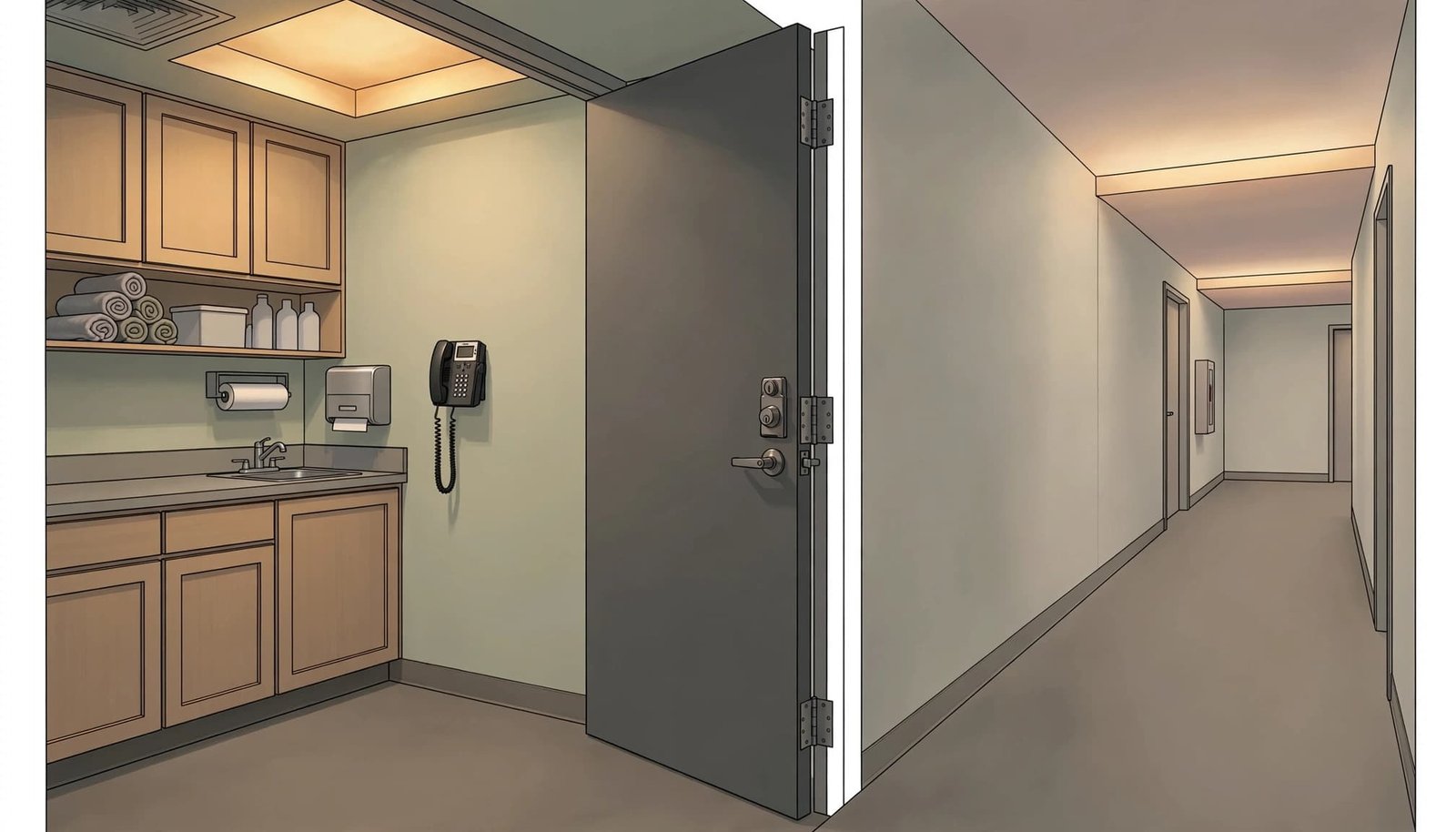
Its layered veterinary security guidance recommends a safe room with a sturdy, lockable, outward-opening door and access to a telephone. The intention is to let staff secure themselves and call police.
A competent premises assessment should determine whether such a room is suitable. Door arrangements must support safe refuge and emergency escape; the room should not create another hazard.
Where barricading forms part of an assessed procedure, it must suit the room and door design. An improvised obstruction is not a substitute for an appropriate lock.
For immediate danger or a crime in progress, call 999 when safe. Prioritise people over property and do not pursue offenders.
Assess lone and out-of-hours work separately
A daytime arrangement may be inadequate when one person receives an emergency admission at night. Assess who is present, how assistance is summoned and whether entry remains controlled.
Use agreed check-ins and missed-contact escalation where lone working is permitted. Assign a person who actually receives and acts on those messages.
Give staff authority to delay entry or seek support when behaviour creates concern. Clinical urgency does not remove the need for a safe admission process.
After a serious incident, the incident lead should arrange immediate support, preserve relevant records and coordinate further action. Staff should not be required to repeat distressing accounts informally across several managers.
Bring health and safety into the same plan
Meet duties without confusing the documents
In Great Britain, the Health and Safety at Work etc Act 1974 and related legislation require employers to manage workplace risks. Employers with five or more employees must have a written health and safety policy.
The HSE’s policy guidance explains that threshold. Smaller employers still have health and safety duties, even where the policy does not have to be written down.
Security procedures can support that policy, but they do not replace the wider arrangements. Identify responsibilities for staff safety, medicines, premises and information without leaving gaps between documents.
Northern Ireland has a separate legislative framework. Other jurisdictions also apply different duties, medicine rules and reporting arrangements, so obtain relevant local authority advice.
A written security policy is useful regardless of headcount. Its value depends on whether responsibilities and procedures match the clinic’s actual work.
Assess clinical hazards alongside security risks
Veterinary hazards include animal bites, sharps, zoonotic infection, manual handling and hazardous substances. Specify suitable personal protective equipment where needed to control exposure. Aggression, lone working and unauthorised access can increase those risks.
Follow the HSE risk assessment approach: identify hazards, assess who may be harmed and establish proportionate controls. Record significant findings where required and review them as circumstances change.
Consider how security measures affect clinical work. Restricted access should not delay urgent assistance, while incident procedures should account for animals receiving treatment.
Fire safety requires its own assessment. The responsible person must carry out and regularly review a premises fire risk assessment under the applicable framework.
Review connected assessments after an incident, refurbishment, service expansion or staffing change. A new overnight service can alter several risks at once.
Use one audit with an owner for every control
A combined audit should record whether controls work, not simply whether equipment or policies exist. Give each action an accountable role, a deadline and evidence of completion.
The following checks connect the main areas of veterinary practice security.
| Area | Practical check | Accountable role |
|---|---|---|
| Public access | Walk client routes and test restricted doors. | Practice manager |
| Keys and permissions | Compare issued credentials with current roles. | Access administrator |
| Controlled drugs | Reconcile stock, registers and authorised access. | Responsible veterinary surgeon |
| Payroll and payments | Review changes before independent approval. | Owner or finance approver |
| Cameras and alarms | Test images, alerts, contacts and retrieval. | Premises lead |
| Accounts and devices | Review permissions, updates and authentication. | IT lead |
| Recovery | Restore selected records and assess usability. | IT lead and clinical lead |
| Staff response | Exercise reporting and assistance procedures. | Practice manager |
One person may hold several roles in a small clinic. Where independent review is needed, allocate it to someone who did not carry out the original transaction.
Use evidence that demonstrates function. A maintenance certificate records a service visit; a test record should also show whether the system performed as required.
Distinguish urgent exposure from planned improvement. A failed restricted-area lock needs an immediate interim arrangement, while a longer-term camera replacement may follow a scheduled programme.
Keep the action register accessible to the people responsible for it. Review overdue actions at management meetings and record any temporary control.
Repeat the audit after material changes, not only on an annual calendar. Close an action when the correction has been tested, rather than when equipment has been ordered.
Match controls to the size of the clinic
Small practices need workable independent checks
A small clinic should prioritise clear access boundaries, secure medicine storage, reliable closing procedures and protected accounts. These controls need named ownership even without separate departments.
The owner may approve payroll, review banking and act as the security lead. Independent checks can still come from another director or an accountant with a defined review brief.
Avoid creating procedures that require unavailable staff. If two-person checks are needed for a task, schedule them or provide an appropriate alternative arrangement before the task arises.
Out-of-hours support can address attendance gaps, but the service scope must reflect animals, medicines and restricted areas. Buying attendance without suitable instructions leaves decisions unresolved.
Larger clinics need consistency and local accountability
Hospitals and multi-branch groups need common reporting standards alongside site-specific assessments. A central policy should identify minimum controls without assuming identical layouts or operating hours.
Compare incidents, unexplained stock differences and overdue actions across branches. Look for differences in recording quality before treating a higher reporting rate as poorer security.
Larger premises may justify dedicated security personnel or a mixed arrangement of guarding, patrols and monitoring. Manned guarding and automated security perform different functions and should have complementary instructions.
Keep clinical authority clear. Security staff need boundaries around patient care, medicine handling and confidential information, with a named clinical contact for decisions outside their remit.
Frequently asked questions
What are the main threats to a veterinary practice?
The main categories are unauthorised access, theft, threatening behaviour, insider fraud, medicine diversion and cyberattacks. Their importance depends on the premises, operating hours, services and existing controls.
Assess disruption as well as loss. An incident affecting medicine access, inpatient care or patient records can require an immediate clinical response.
Are controlled-drug security rules the same everywhere?
No. Requirements depend on jurisdiction, drug schedule and exemptions. UK practices must apply the rules relevant to their location and medicines.
Keep storage obligations, register requirements, retention periods and destruction arrangements distinct. A compliant cabinet does not establish that access control or record-keeping is adequate.
Does cloud-based practice software remove cyber risk?
Cloud hosting can transfer some technical responsibilities to a supplier, but the practice still controls users, permissions, devices and many recovery decisions.
A compromised email account or fraudulent payment request can cause harm without breaching the software platform. Account protection and staff procedures remain necessary.
When should a personal data breach be reported?
Under UK GDPR, a breach requiring notification must generally be reported to the ICO without undue delay and within 72 hours of awareness. The ICO’s breach guidance explains the reporting threshold.
The data protection lead should record the assessment and decision. Not every incident requires notification, but every relevant breach needs appropriate examination and documentation.
Make security part of safe clinical operation
Veterinary practice security works when access, medicines, finance, information and staff response have clear owners. Equipment supports those responsibilities; it cannot carry them alone.
Start with the weaknesses that could expose people, interrupt care or conceal loss. Assign corrective action and test whether it works.
A useful security plan leaves clear evidence of control: authorised access, reconciled records, protected accounts and staff who know how to obtain help.


0 Comments