

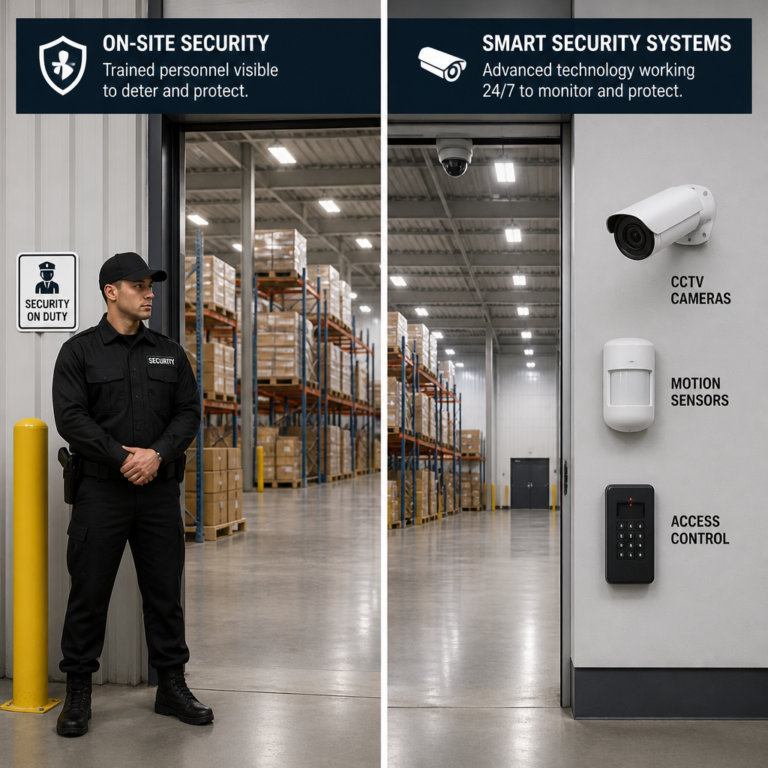
If you manage a UK business and you are trying to decide between hiring security guards or investing in automated systems, you are facing a decision that carries real financial and operational consequences. Manned guarding UK providers will tell you that nothing replaces a trained human on-site. Automated security vendors will point to cost savings and 24/7 uptime. Both arguments have merit, and both can be wrong depending on your site. This guide cuts through the sales pitches and gives you a framework built on how physical security actually works in retail units, construction sites, warehouses, and vacant properties across the UK.
Table of Contents
- Quick Takeaways
- What Manned Guarding Actually Delivers
- What Automated Security Systems Actually Deliver
- Manned Guarding vs Automated Security: Direct Comparison
- Which Sectors Need Which Solution
- Hybrid Security: The Right Default for Most UK Businesses
- How to Evaluate a Security Provider in the UK
- Frequently Asked Questions
- References
Quick Takeaways
Key Insight | Explanation |
|---|---|
Manned guarding deters through presence | A visible, uniformed guard changes criminal behaviour before an incident starts. Cameras and sensors only record after the fact unless monitored live. |
Automated systems cover ground 24/7 without fatigue | CCTV and access control do not get tired, distracted, or sick. They are particularly effective for large perimeters and remote monitoring. |
Construction sites almost always need manned guarding | Plant theft, copper stripping, and unauthorised access are physical problems that require a physical response. Cameras alone do not stop a determined team of thieves. |
Retail environments benefit from combining both | Door supervisors deter shoplifting at entry points while in-store CCTV provides evidence and loss-prevention data across the entire floor. |
Automated security has high upfront costs | Installation of access control, intruder detection, and monitored CCTV systems carries significant capital expenditure before any monthly monitoring fee. |
Keyholding bridges the gap overnight | Pairing an automated alarm system with a professional keyholding service means a trained responder attends rather than the business owner at 3am. |
SIA licensing is non-negotiable in the UK | Any manned guarding provider must hold a valid Security Industry Authority licence. Verify this before signing any contract. |
What Manned Guarding Actually Delivers
Manned guarding is not simply a person standing at a door. When done properly, it is a layered service that includes access control, visitor management, first-response capability, and real-time situational judgement. That last point is what automated systems cannot replicate: a trained guard reads context, not just inputs.
A static guard at a warehouse gate, for example, will notice that a vehicle making a collection does not match the expected profile for that time of day, even if the driver presents a valid pass. An access control terminal will read the card and open the barrier. This distinction matters enormously in high-value storage environments and on active construction sites where insider threat is a documented risk.
What SIA-Licensed Guards Are Actually Trained to Do
In the UK, all frontline manned security operatives must hold a valid Security Industry Authority (SIA) licence. This covers door supervisors, security guards, and CCTV operators. The licensing process requires a knowledge qualification, a first aid component, and a criminal records check. This is a baseline, not a ceiling. Reputable providers like Nexus Security Services train guards beyond the SIA minimum, covering conflict management, emergency procedures, and site-specific protocols.
A common mistake facility managers make is treating manned guarding as a commodity and selecting purely on price. Guards from a cheaper provider may be SIA-licensed but poorly briefed, unsupported by their employer, and unfamiliar with your site. The result is security theatre rather than genuine protection.
Pro tip: Always request a copy of the SIA licence for any guard assigned to your site, and cross-check it on the SIA public register at gov.uk. A legitimate provider will never hesitate to supply this.

Mobile Patrols vs Static Guards: Choosing the Right Format
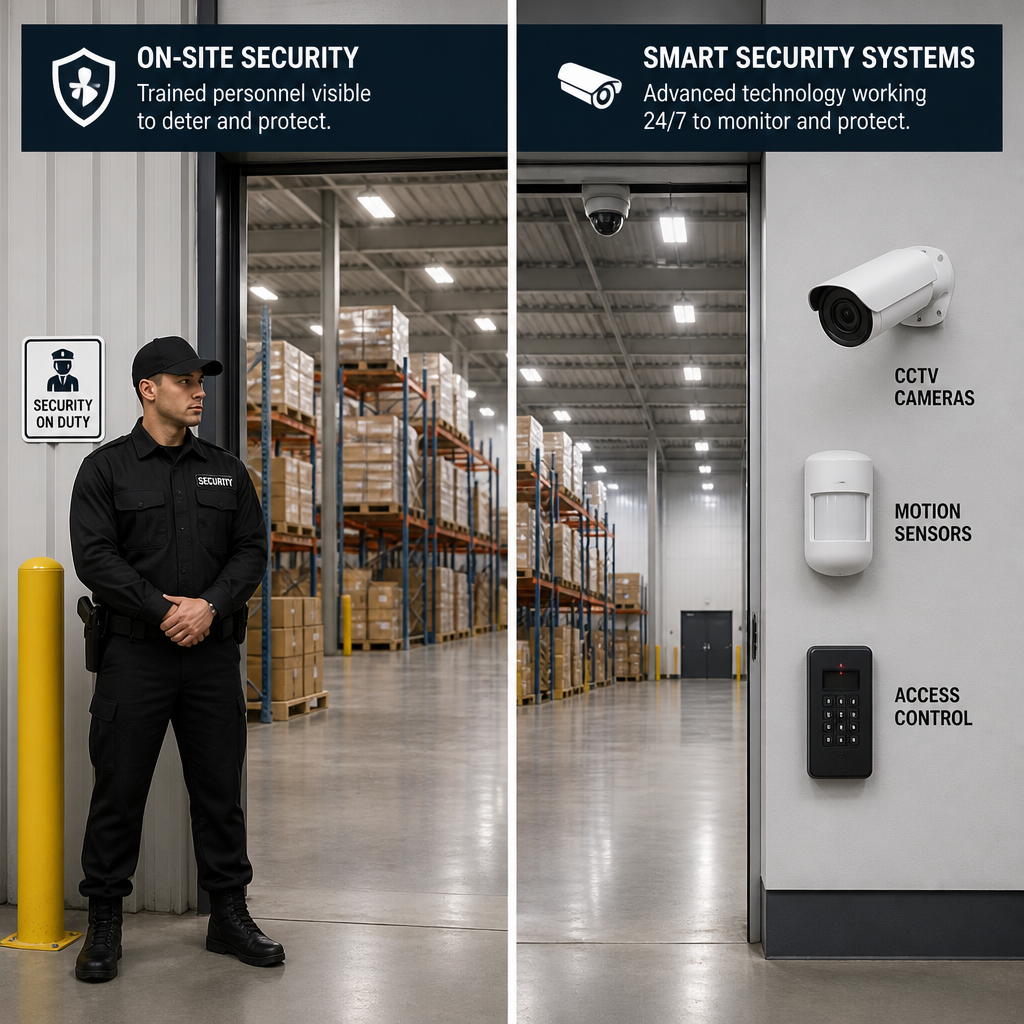
Static guards provide continuous presence at a fixed point. Mobile patrol officers cover multiple locations in a single shift, typically visiting each site at randomised intervals to remove predictability. For smaller UK businesses or properties with lower footfall, mobile patrols deliver a meaningful deterrent at a fraction of the cost of a dedicated static post.
In practice, retail locations in town centres tend to benefit from static door supervisors during trading hours, then switch to mobile patrols overnight. Construction sites with multiple entry points often need both: a static guard at the primary gate and a patrol officer covering the perimeter fence line.
What Automated Security Systems Actually Deliver
Automated security systems UK businesses deploy typically fall into three categories: CCTV and video management, electronic access control, and intruder detection with remote monitoring. Each solves a different problem, and lumping them together as a single alternative to manned guarding is a mistake made by people who have not had to manage a real security breach.
CCTV is primarily an evidence and deterrence tool. It works best when potential offenders know it is there and know that footage is being actively monitored. Unmonitored cameras reduce deterrence substantially because experienced criminals identify quickly whether a system is live-monitored or simply recording to a server.
Remote CCTV Monitoring and Its Real Limitations
Remote monitoring centres can watch feeds from multiple sites simultaneously and alert police or keyholders when triggered. Modern video management systems, including server-based platforms that support integrated analytics, allow automated rules to be set so that specific events trigger immediate alerts. This reduces response time compared to a system that relies entirely on a human operator watching every screen.
The limitation is response time from the point of alert to boots on the ground. Even with a fast police response, there is a window in which a theft or act of vandalism can be completed. On a construction site, a motivated team can load plant equipment in under ten minutes. Automated monitoring is not a substitute for physical intervention capability.
Access Control: Where Automation Genuinely Outperforms Guards
Electronic access control systems enforce entry permissions with absolute consistency. They do not have off days. They do not wave through a familiar face who has had their pass revoked. For multi-floor office buildings, warehouses with zoned access, or server rooms requiring audit trails, access control systems create records that manned guarding alone cannot produce.
Pro tip: Pair electronic access control with a manned reception or gatehouse rather than treating them as alternatives. The technology handles the audit trail and enforcement; the guard handles anomalies, visitors, and anything the system cannot categorise.
Manned Guarding vs Automated Security: Direct Comparison
The table below compares three real security approaches. Each represents a configuration that UK businesses actually deploy, not a theoretical construct. The right choice depends on your site type, risk profile, and operating hours.
Security Approach | Strengths | Weaknesses |
|---|---|---|
Manned Guarding (Static or Mobile) | Physical deterrence and intervention; real-time judgement; first aid and emergency response; visible presence that changes criminal behaviour | Higher ongoing cost per hour; performance depends on individual guard quality and employer support; requires SIA compliance management |
Automated CCTV and Remote Monitoring | 24/7 coverage without fatigue; scalable across large perimeters; evidence capture; can integrate analytics for automated alerts | Cannot physically intervene; response depends on third-party keyholders or police; upfront installation cost; less effective without active monitoring |
Electronic Access Control with Keyholding | Consistent enforcement of access rules; full audit trail; removes keyholder burden from business owners; cost-effective overnight coverage | Does not deter opportunistic crime outside access points; requires maintenance and system updates; alarm response still takes time |
Which Sectors Need Which Solution
Generic security advice fails because risk profiles differ dramatically between sectors. A vacant property in a rural area has almost nothing in common with an active retail site in a city centre, even though both are UK business premises requiring protection.
Construction Sites
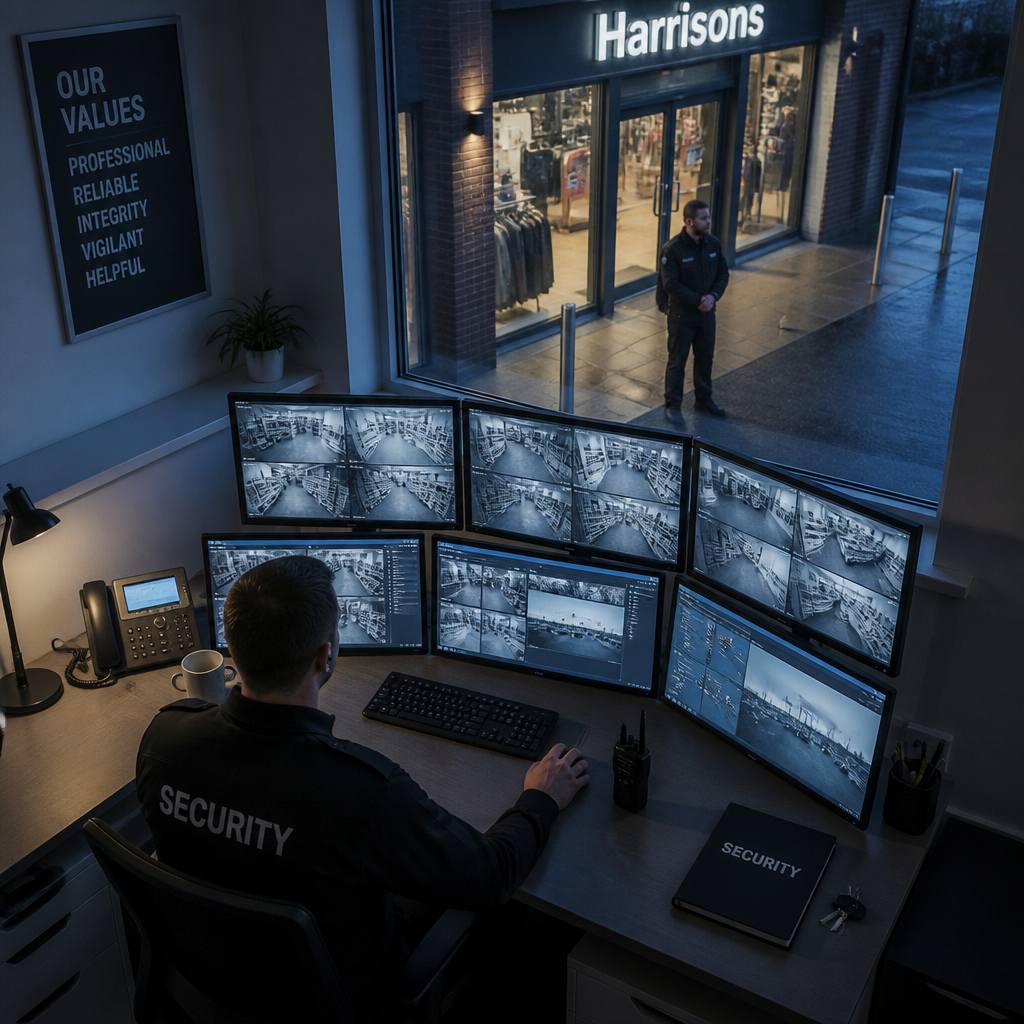
Construction sites are high-risk targets. Plant machinery, copper cabling, tools, and building materials all carry significant resale value. Access points are often numerous and hard to seal. Manned guarding is the primary security layer for most active construction sites, supported by temporary CCTV towers that cover the perimeter. Nexus Security Services provides construction site security that combines static guards with mobile patrols precisely because no single method covers all the variables a live site presents.
Retail Locations
Retail security sits at the intersection of customer experience and loss prevention. Aggressive or heavy-handed security damages the customer relationship. Insufficient security invites shoplifting and, in some environments, aggressive incidents. Door supervisors and in-store security officers from a specialist provider manage this balance in a way that CCTV alone cannot. That said, retail CCTV integrated with stock management systems provides loss-prevention intelligence that a guard can act on in real time.
Warehouses and Industrial Facilities
Large warehouses benefit from a combination of perimeter access control, interior CCTV, and overnight mobile patrols. The scale of a typical distribution facility makes static guarding every access point prohibitively expensive. A well-designed system uses technology to cover the majority of the space and routes alerts to a mobile patrol officer who can physically investigate.
Vacant Properties
Vacant properties are targets for squatting, fly-tipping, arson, and metal theft. Insurance conditions for vacant commercial properties increasingly require documented security measures. Regular mobile security patrols with signed visit reports satisfy most insurers and provide an audit trail. For high-value vacant sites, combining patrols with alarm response and keyholding removes the risk from the property owner entirely.
The most expensive security failure is not the cost of the system you bought. It is the cost of the incident that happened because you bought the wrong system for your risk profile.
Hybrid Security: The Right Default for Most UK Businesses
The manned guarding vs automated security debate is often presented as a binary choice. In practice, the businesses with the best security outcomes in the UK use both, configured so that each compensates for the other’s weaknesses. This is not a sales upsell. It is how professional security risk management actually works.
A common and effective pattern for mid-sized UK businesses is this: manned guarding during operational hours handles access control, visitor management, and visible deterrence. After hours, automated systems take over monitoring, with a keyholding service contracted to respond to any alarm activation. Mobile patrol visits at randomised intervals overnight maintain the deterrence benefit of a physical presence without the cost of a full overnight static post.
This hybrid model costs less than full-time static guarding and provides substantially more deterrence than automation alone. For most retail, warehouse, and commercial office environments, it is the correct starting point.
Pro tip: When designing a hybrid security solution, map your risk by time of day and day of week before selecting services. A retail unit that experiences most incidents during the Friday and Saturday evening period has a very different requirement from a warehouse where the overnight theft risk is the primary concern. Get a professional site security assessment before committing to a contract.
How to Evaluate a Security Provider in the UK
The UK security services market includes large nationals like Securitas and G4S alongside regional specialists and smaller local providers. Size is not a reliable indicator of quality for your specific site. A large national contract often means your site is managed by an account team that has never visited it. A regional specialist with deep local knowledge can outperform significantly.
When evaluating any security services UK provider, verify these specific points before signing a contract. First, confirm that all operatives are SIA-licensed and check their employer’s SIA Approved Contractor Scheme status if relevant to your sector. Second, ask to see example site assignment instructions and post orders from a comparable site. A provider who cannot produce these does not operate at a professional standard. Third, understand the supervision and management structure. How often does a manager visit the site? What happens if a guard calls in sick? Who covers, and how quickly?
Providers like Nexus Security Services position themselves on exactly these operational details, not just on price. For UK businesses that have experienced poor service from larger nationals, a provider that offers direct account management and locally supervised teams often delivers better day-to-day results.
Frequently Asked Questions
What is the difference between a security guard and a door supervisor in the UK?
Both roles require an SIA licence, but they are different licence types. A door supervisor licence covers physical intervention, searching individuals, and working at licensed premises such as pubs, clubs, and events. A security guard licence covers static and mobile guarding at commercial premises. If your site involves a licensed venue or requires the guard to search individuals, you need a door supervisor, not a standard security guard.
Is manned guarding more expensive than automated security systems?
Manned guarding carries a higher ongoing cost because you are paying for trained human labour, typically billed per hour per operative. Automated systems have a higher upfront capital cost for installation but lower ongoing costs, usually a monthly monitoring fee. Over a three to five year period, the total cost of both models can be closer than the initial comparison suggests, particularly when you factor in maintenance, upgrades, and the cost of incidents that a system alone failed to prevent.
Do I legally need manned security for a construction site in the UK?
There is no single law that mandates manned guarding on construction sites, but the Health and Safety at Work Act 1974 and associated regulations create a duty to manage site access and protect the public from hazards. In practice, most principal contractors include security requirements in their site management plans, and insurers frequently stipulate security conditions. Failing to secure a construction site adequately can result in enforcement action and invalidated insurance claims.
What is keyholding and how does it work with automated security?
Keyholding is a service where a professional security company holds the keys and alarm codes for your premises and responds when an alarm is triggered, rather than the business owner or a member of staff. It pairs directly with automated intruder detection and CCTV monitoring. When the monitoring centre identifies a genuine activation, it calls the keyholder response team, who attend the property, assess the situation, and liaise with police if needed. This removes a significant burden from business owners and ensures that responses are handled by trained professionals.
How do I know if a security provider’s guards are properly licensed?
The SIA operates a public licence register at gov.uk where you can search by licence number or individual name. Any legitimate manned guarding provider in the UK will supply the licence numbers of operatives assigned to your site on request. If a provider is reluctant to provide this information, treat it as a serious red flag. Unlicensed security operatives expose your business to legal liability as well as genuine security risk.
Can automated CCTV alone protect a vacant commercial property?
It can reduce risk but it cannot eliminate it. Monitored CCTV on a vacant property will alert a response centre when an intrusion is detected, but the time between alert and physical response creates a window for theft, vandalism, or squatting. For vacant properties, the most effective approach combines monitored CCTV with regular physical inspections through a mobile patrol service. This combination also satisfies most commercial property insurers who require evidence of active security measures.
Have you had experience choosing between manned guarding and automated security for your UK business? Share what worked and what did not in the comments below.


0 Comments