

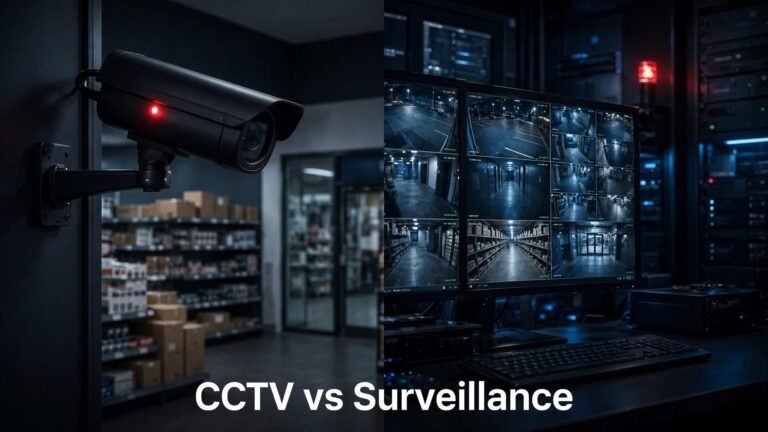
Business security cameras can record a break-in and provide useful evidence. CCTV monitoring adds live human oversight from trained remote operators, giving your business options while an incident is still happening.
CCTV surveillance usually means observing and recording activity for later review. The choice between recorded surveillance and live oversight is whether you need evidence after an event, alert verification and possible intervention during one, or a sensible combination of both.
The right choice of security system depends on your site’s risk profile, staffing, response capability, and how responsibly you manage people’s data.
Key takeaways for business decision-makers
- CCTV surveillance provides passive surveillance by recording activity for later review, while visible cameras may act as a crime deterrent. Surveillance footage supports investigations, insurance claims, staff safety reviews and evidence requests after a security breach.
- CCTV monitoring involves a person assessing live alerts or camera feeds, providing active surveillance. They may issue an audio warning, contact nominated keyholders or follow an agreed escalation plan.
- A monitored service can provide CCTV monitoring with live oversight, but it doesn’t promise police attendance or stop every incident. The quality of verification, site information and response arrangements still matter.
- A hybrid approach is often practical: record across the whole site, with monitored alerts covering higher-risk areas and out-of-hours periods.
- Footage remains personal data under UK GDPR. Your business needs a lawful basis, clear signage, controlled access and a retention period that matches a real purpose.
CCTV monitoring vs surveillance: the operational difference
The distinction is straightforward. CCTV surveillance captures footage, either continuously or when a camera detects motion. Passive surveillance records events for later review. CCTV monitoring adds real-time human judgement to selected cameras or alarm events, creating active surveillance.
Neither approach is decorative. Both can be appropriate, but they solve different problems.
| Area | Passive recording | CCTV monitoring |
|---|---|---|
| Primary purpose | Record events for later review | Assess events as they occur |
| Human involvement | Usually after an incident | During agreed monitoring periods |
| Typical action | Retrieve and review footage | Verify alert, warn, notify or escalate |
| Core value | Evidence and accountability | Earlier awareness and response options |
| Cost profile | Equipment, storage and maintenance | Equipment plus monitoring and response arrangements |
The practical difference is time. Surveillance helps you establish what happened. Monitoring may give you a chance to act before the situation has moved on.
Passive surveillance creates an evidence trail
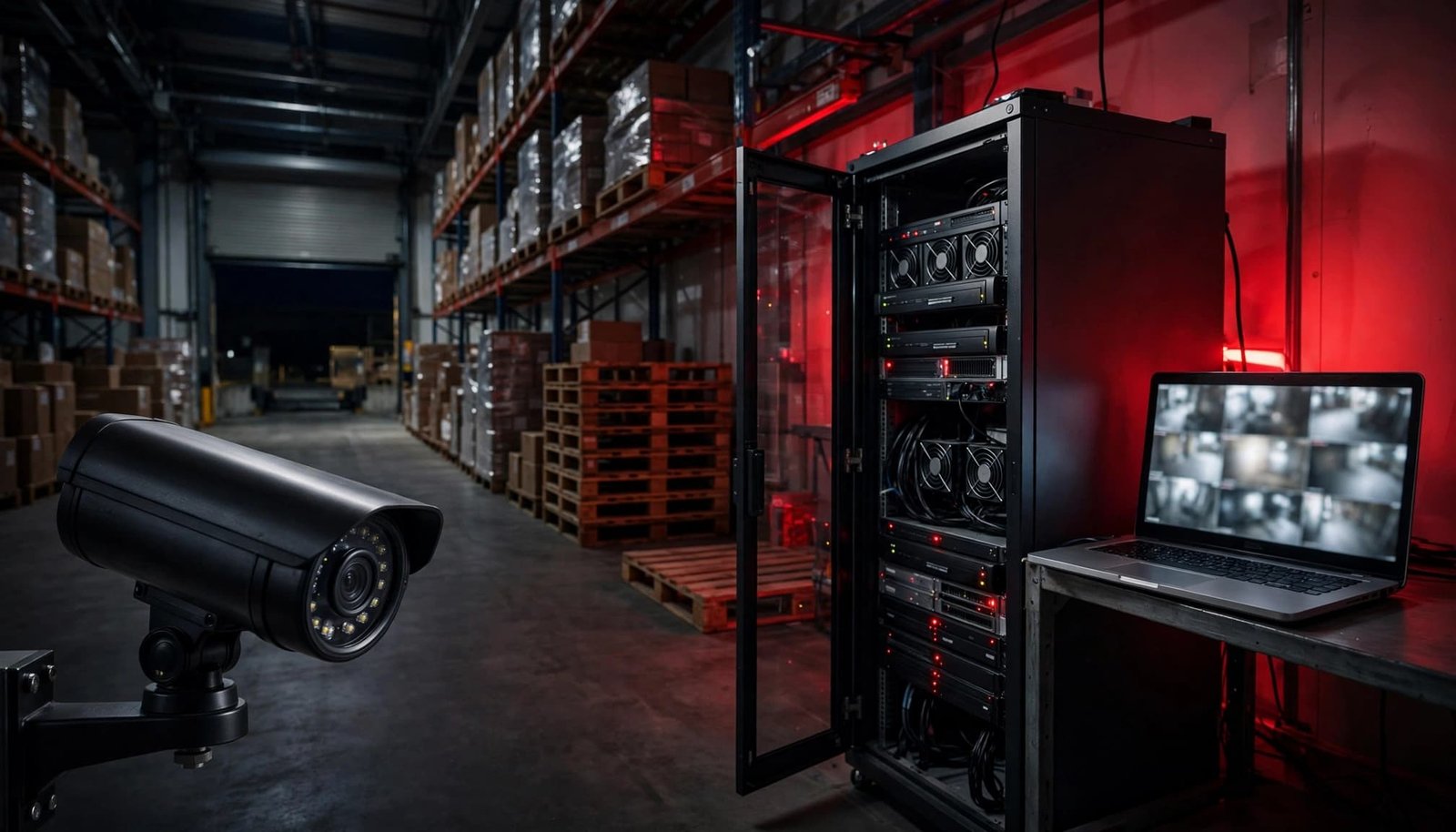
A conventional system might use an NVR, DVR or cloud-based video management system to retain footage from security cameras covering entrances, tills, loading bays and car parks. If stock goes missing or an employee reports damage, authorised staff can search the relevant period and preserve the surveillance footage.
That record can support an internal investigation, an insurer or the police. It can also test assumptions. A delivery that appears to have gone missing may have been left at the wrong entrance. Footage can settle that sort of question without guesswork.
Active surveillance needs a clear response plan
Live human monitoring isn’t somebody staring at every camera all night. In a properly designed system, alarms, motion sensors or analytics bring relevant footage to an operator’s attention.
A monitored alert isn’t automatically a confirmed security breach. The operator decides whether activity appears genuine and follows the agreed instructions. With CCTV monitoring, those instructions might include an audio challenge, calling a keyholder, dispatching a security response where contracted, or contacting emergency services when appropriate.
A monitored camera is only as useful as the information behind it: accurate site plans, current keyholder details, clear escalation rules and reliable communications.
How remote CCTV monitoring works
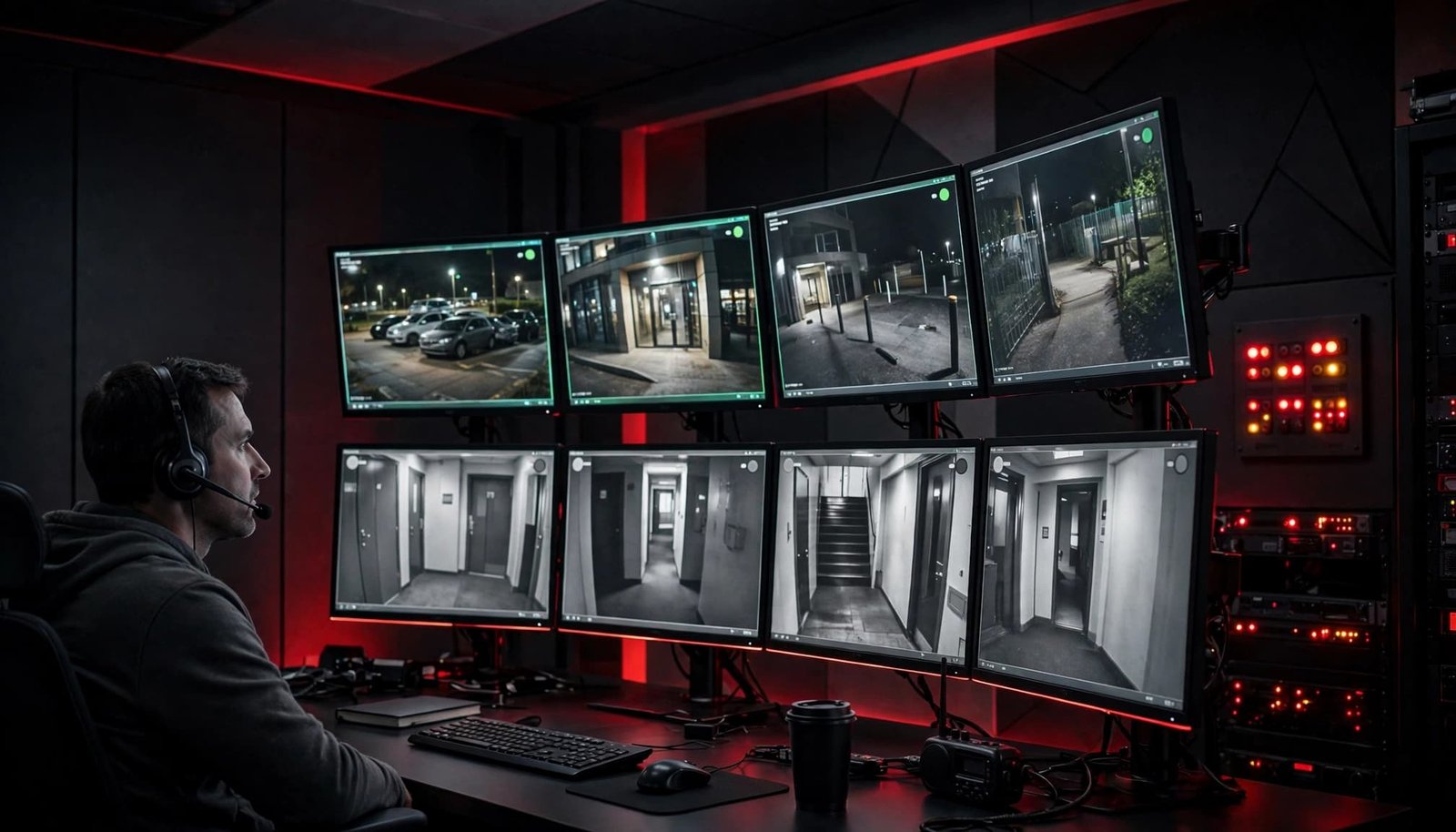
A remote CCTV monitoring service normally routes selected camera feeds and alert signals to Alarm Receiving Centres (ARC). CCTV monitoring operators use real-time monitoring and live video monitoring, while the provider’s CCTV monitoring procedures follow your agreed site instructions.
What happens after a verified alert
The sequence should be clear before the system goes live. A detector or analytic rule triggers an alert. An operator reviews the footage, checks for a credible security breach and records the decision, helping filter false alarms.
Where the situation warrants it, remote monitoring may involve an audio warning, keyholder notification, a mobile response team or contact with the police. Escalation depends on the incident, your instructions, available services and relevant local arrangements. Police attendance isn’t automatic.
Ask to see the provider’s escalation matrix. Vague promises about “immediate action” aren’t a procedure.
Where BS 8418 fits
BS 8418 concerns detector-activated CCTV systems with remote monitoring. It covers system design, installation, operation and maintenance. Systems installed and monitored under the standard may support a police response or another authority response after a monitoring centre confirms an incident.
That wording matters. BS 8418 does not guarantee attendance, nor does it turn every camera into a system with automatic police attendance. Confirm how your provider applies the standard, what signals are monitored and what verification evidence an operator needs before escalation.
What CCTV surveillance does well
Passive surveillance records activity without live human oversight in offices, independent shops and lower-risk sites. CCTV surveillance systems provide coverage without paying for a live service at every hour.
Visible cameras may act as a crime deterrent by discouraging some behaviour. That isn’t the same as active surveillance, where an operator assesses events as they happen.
Recording systems need usable footage
Correctly positioned security cameras matter; cheap equipment in the wrong place is a false economy. Before buying equipment, test what you need to identify: a person entering a door, a vehicle at a gate, a number plate at a controlled entrance, or activity around high-value stock.
Lighting, camera height, field of view and network resilience affect the result. So does storage capacity. High-resolution footage held for too long can create unnecessary cost and unnecessary data risk.
Footage supports investigation and liability
After an incident, passive surveillance gives you surveillance footage for retrieval, preservation and review. It can show the sequence of events, who had access, and whether an alarm or process failed. It can assist with accident reviews, complaints and alleged damage.
Active surveillance offers live assessment and potential intervention; passive systems don’t. By the time somebody reviews the recording, the person involved may be gone. That doesn’t make surveillance weak. Its value is evidence, accountability and learning after the fact.
Comparing the cost of monitoring and guards
There is no reliable single price for CCTV monitoring. Costs vary with camera numbers, transmission, site complexity, operating hours, analytics, maintenance, response arrangements and contract terms.
On-site security personnel
A security guard provides physical presence, visible reassurance and a potential crime deterrent, while handling routine access queries. That can suit a public-facing building, a busy reception or a site where people need regular assistance.
However, a guard cannot watch every entrance, walk every perimeter and review every alarm at once. Covering nights, holidays and sickness also creates a larger staffing commitment than one person on one shift suggests.
Remote monitoring services
Remote monitoring can focus human attention on alarm events in high-risk areas, such as vulnerable yards, warehouses or compounds. It may reduce the need for continuous on-site cover at an empty warehouse, construction site or compound.
The trade-off is different rather than simple. The operating cost of a security system includes equipment, secure connectivity, CCTV monitoring, ARC operations, maintenance and agreed response arrangements. Compare actual coverage hours, storage or transmission costs, response procedures and contract terms, not an attractive monthly headline.
Where a hybrid CCTV approach makes sense
Many UK businesses do not need to choose one method for every camera. A hybrid approach is often more proportionate, with CCTV monitoring giving selected cameras live or remote attention while the wider site continues recording.
Unoccupied and high-risk areas
Construction sites, distribution yards, plant compounds and vacant premises are obvious candidates for CCTV monitoring. Theft or unauthorised access may happen out of hours, when no member of staff is present to notice it.
Keep passive surveillance across the wider site through recorded coverage. Use active surveillance at gates, fuel stores, plant, loading areas and other locations where remote monitoring can send a verified alert to an external operator and prompt a useful response.
Offices, retail and mixed-use buildings
Retailers may monitor delivery doors and stockrooms after closing, whilst recording customer areas for incident review. Offices can record entrances and reception areas, then add live monitoring for isolated sites or extended closures.
Access control can make the picture clearer. A forced door, an out-of-hours badge event and a matching camera alert may point to a security breach, but the event still needs verification rather than proving an incident automatically.
Video analytics can reduce avoidable alerts
Video analytics use software rules to identify movement or patterns that may need attention. Unlike basic motion sensors, they can distinguish people from vehicles, ignore a regular delivery route, or alert when somebody enters a restricted zone. Some systems use artificial intelligence to assist classification, but performance depends on camera position, training data, lighting and site conditions.
Used well, this cuts the ordinary noise caused by rain, headlights, animals and moving foliage. Used badly, it simply produces a different kind of noise.
Test rules on the real site, at night and in poor weather. Review false alarms with the monitoring provider, then adjust camera angles, detection zones and thresholds. Analytics should reduce avoidable alerts, not replace operator judgement or a documented response process. Facial recognition needs separate assessment because it can create greater privacy and accuracy concerns.
UK GDPR, signage and licensing responsibilities
Installing cameras is only one part of the job. If your CCTV surveillance systems identify people, the footage is personal data and your organisation is responsible for its use.
The ICO CCTV guidance for organisations covers installation, management, operation, public awareness and signage. It offers general guidance on UK CCTV requirements, not a complete legal checklist. Treat these as day-to-day requirements, not paperwork to file away.
Set the purpose, lawful basis and retention rule
Write down why each camera is needed. “Security” alone is too loose. A better purpose might be preventing unauthorised access to a loading bay, investigating theft, or protecting staff working late.
You must identify and document a lawful basis under Article 6 of the UK GDPR. The Data Protection Act 2018 also forms part of this legal context.
The ICO’s data protection principles for surveillance systems set out wider UK GDPR obligations, including access, sharing and retention.
There is no universal retention period. Keep footage only for as long as your documented purpose requires, then delete or overwrite it securely. Preserve relevant clips when an incident, complaint or claim requires it.
Control access to live and recorded video
Use clear signs before people enter the monitored area. They should identify who operates the cameras and direct people to further privacy information.
Limit access to authorised staff through suitable access control. Record when footage is viewed, exported or shared, so you can investigate a suspected security breach.
If a remote provider delivers CCTV monitoring, assess whether it acts as a processor when accessing footage on your instructions. Put suitable contractual data protection terms in place.
Facial recognition, monitoring in high-risk areas and other higher-risk processing may require a DPIA or additional scrutiny. The ICO explains this in its practical CCTV checklist for organisations.
SIA licensing can apply to people operating public space surveillance CCTV in security work. Check the person’s duties, rather than assuming every viewer needs the same licence. The recognised qualification route includes the Level 2 Award for Working as a CCTV Operator (Public Space Surveillance) within the Private Security Industry.
A practical way to choose your system
Start with the moments that cause actual loss or concern, not a camera catalogue. Then work through five questions:
- When is the site vulnerable, and is anybody present to respond?
- Which areas need active surveillance, with CCTV monitoring and real-time monitoring while an event unfolds? Which only need passive surveillance and recorded evidence afterwards?
- What can a keyholder, guard or external response provider realistically do through remote monitoring after an alert?
- Can your security system, including cameras, lighting, network, power and storage, support the intended service?
- Have you documented the purpose, privacy information, access controls and retention period?
If the answer to the second question is “both”, design for both. Use CCTV monitoring where someone can assess and act on alerts. Keep the system understandable for operators and staff. Complexity that no one can manage at 2am is not security.
Frequently asked questions
Does remote CCTV monitoring mean the police will attend?
No. An operator using remote monitoring can assess an alert and follow agreed escalation procedures. Police attendance depends on the circumstances and relevant police arrangements. A BS 8418-aligned system may support a police response after verified confirmation. It isn’t a guarantee.
Can a business use recording-only CCTV and still deter crime?
Visible, well-positioned cameras may act as a crime deterrent and discourage some unwanted behaviour. Recorded footage can be valuable afterwards. Recording alone does not provide human assessment or intervention during an incident. CCTV monitoring adds live oversight, so consider the likelihood and consequences of an out-of-hours event before relying on recording-only CCTV.
How can a business reduce false alarms?
Use suitable detection zones, tune analytics, check lighting and test the site in realistic conditions. Give operators accurate escalation instructions so genuine alerts are handled appropriately.
Should all footage be stored in the cloud?
Not necessarily. Local NVR or DVR storage can suit some sites, whilst cloud storage may simplify remote access and off-site resilience. A video management system can help manage local and cloud-connected footage, depending on the platform. The right choice depends on connectivity, storage needs, security controls, costs and who needs authorised access.
Choose the response your site can support
CCTV monitoring vs surveillance is a decision about responsibility, not a contest between two bits of technology. Recording gives you a reliable account of what happened. CCTV monitoring adds live assessment and response options while they matter.
Build around genuine risks, realistic response arrangements and proper data controls. A modest system that is well placed, properly maintained and understood by staff is far more useful than a complicated one that nobody owns.


0 Comments