

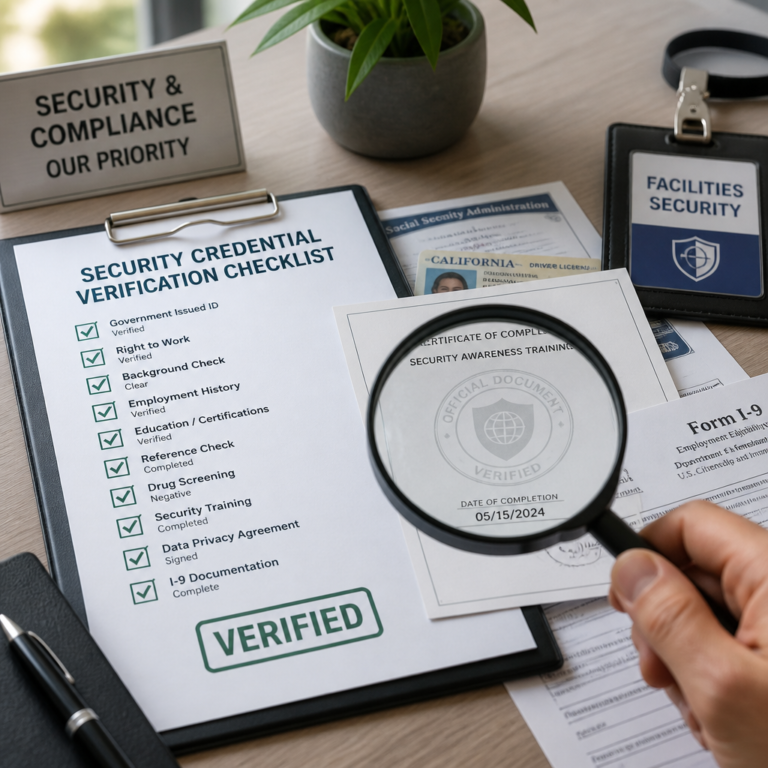
Hiring the wrong security provider does not just leave your premises exposed. Under the Private Security Industry Act 2001, deploying an unlicensed security operative on your site is a criminal offence, and the liability sits with the buyer as much as the contractor. With 442,796 active SIA licence holders recorded in December 2024 and enforcement activity growing more sophisticated each year, the gap between a compliant hire and a legally exposed one is smaller than most facilities managers assume. This guide cuts through the basics and focuses on exactly what construction companies, corporate facilities, and commercial operators need to verify before they sign any contract for SIA licensed security guards.
Table of Contents
- Quick Takeaways
- Why SIA Licensing Is a Legal Baseline, Not a Quality Signal Alone
- SIA Licence Sectors: Matching the Licence to the Role
- How to Verify an SIA Licence Independently
- BS 7858:2019 Vetting: The Standard Behind the Badge
- SIA Approved Contractor Scheme: What It Means for Buyers
- Comparing Security Provider Tiers: What Each Level Guarantees
- Red Flags When Hiring Security Guards in the UK
- Frequently Asked Questions
- References
Quick Takeaways
| Key Insight | Explanation |
|---|---|
| SIA licensing is legally mandatory, not optional | Under the Private Security Industry Act 2001, all frontline security operatives must hold a valid SIA licence. Deploying an unlicensed operative is a criminal offence for both the contractor and the client. |
| Licence sector must match the deployed role | A Security Guard licence does not authorise door supervisor duties. A CCTV Operator licence does not cover manned guarding. Verify the exact licence sector against the intended deployment. |
| Always verify independently via the SIA register | A physical SIA badge can remain visually valid after the underlying licence is suspended or revoked. The only reliable check is the SIA’s Register of Licence Holders at services.sia.homeoffice.gov.uk/rolh. |
| BS 7858:2019 vetting is the pre-employment screening baseline | All security personnel should be screened to BS 7858:2019 before deployment. This standard covers identity verification, criminal record checks, and employment history over a five-year period. |
| SIA Approved Contractor Scheme membership signals operational maturity | The ACS is a voluntary scheme subjecting security companies to third-party inspection of technical and management capability. It is not a licence, but it is a meaningful procurement differentiator. |
| Licence validity is time-limited and must be monitored | SIA licences are valid for three years. For ongoing contracts, require your provider to notify you of any licence renewal, suspension, or revocation affecting deployed personnel. |
| Specialist sector knowledge compounds licence compliance | For construction sites, CDM 2015 awareness is a practical requirement alongside SIA compliance. A licensed guard without site-specific protocol knowledge creates operational gaps even if fully compliant on paper. |
Why SIA Licensing Is a Legal Baseline, Not a Quality Signal Alone
The Security Industry Authority was created under the Private Security Industry Act 2001 specifically to address the inconsistency in quality and ethical conduct that characterised the pre-regulatory private security sector. The Act mandated background checks, minimum training standards, and a formal licensing structure. Before those provisions existed, a business could deploy whoever they chose with no enforceable standard applying.
That changed entirely in 2001. Roles including security guards, door supervisors, CCTV operators, and close protection officers all now require a valid SIA licence as a precondition for lawful deployment. Working or deploying personnel in these roles without the appropriate licence is a criminal offence under UK law, not an administrative infraction.
The compliance rate across the industry sits around 98%, which reflects both the effectiveness of the licensing regime and the general professionalism of the workforce. That remaining 2%, however, still represents thousands of potential breaches in a sector that recorded 442,796 active licence holders as of December 2024. For procurement teams and facilities managers, that gap is enough reason to verify independently rather than take contractor assurances at face value.
An SIA badge is physical evidence of a licence, but it is not the licence record itself. The legally relevant information is held by the Security Industry Authority, and that record can change without the physical card changing.
This is the most consistently misunderstood point in security procurement. A licence may be suspended or revoked while the badge still looks valid. Visual checks alone are legally insufficient whether you are assessing a single static guard or an entire event security team.

SIA Licence Sectors: Matching the Licence to the Role
One of the most common procurement errors is treating an SIA licence as a single generic credential. The SIA issues licences across distinct sectors, and each licence authorises specific activities only. Deploying a licence holder outside their licensed sector is unlawful, regardless of how experienced or trained they are in practice.
The Principal Licence Sectors
The main licence categories relevant to commercial and industrial buyers are:
- Security Guard (SG): Covers static guarding, mobile patrol, and gatehouse duties. This is the licence Nexus Security Services personnel hold for construction site protection, retail security, corporate facilities, and vacant property assignments.
- Door Supervisor (DS): Required for anyone controlling entry to licensed premises. A Door Supervisor licence carries additional first aid and conflict management training requirements above the Security Guard standard.
- Close Protection (CP): Covers bodyguard and executive protection roles. Notably, a Close Protection licence holder may also work as a Door Supervisor under SIA licence integration provisions.
- CCTV Operator (Public Space Surveillance): Required for individuals monitoring public surveillance systems. Does not cover manned guarding or patrol duties.
- Key Holding: Covers personnel who respond to alarm activations and hold keys to premises on behalf of a client.
Licence Integration: What It Does and Does Not Permit
The SIA allows certain licence types to be used across related activities. A Close Protection licence can be used to work as a Door Supervisor, for example. However, a Security Guard licence does not extend to door supervisor duties, and a CCTV licence does not authorise physical guarding. When briefing a provider, specify the deployment type precisely and request confirmation of the exact licence sector held by each operative.
Pro tip: For construction site deployments, confirm that operatives hold a Security Guard licence specifically and ask whether they carry a valid CSCS (Construction Skills Certification Scheme) card alongside their SIA badge. The CSCS card is not an SIA requirement, but it is a CDM 2015 site access standard that reputable construction security providers treat as mandatory.
How to Verify an SIA Licence Independently
Verification takes under a minute and requires no account or login. The SIA’s Register of Licence Holders is publicly accessible at services.sia.homeoffice.gov.uk/rolh. You can search using either the 16-digit licence number printed on the badge or the licence holder’s name and date of birth.
The register returns three pieces of information: the licence sector, the current licence status, and the licence holder’s name. Status values include Active, Expired, Suspended, and Revoked. Only an Active status confirms the operative is lawfully deployable in the stated sector.
What to Check at Each Stage of Procurement
At the proposal stage, request a schedule of operatives with full 16-digit licence numbers. At mobilisation, run each number through the register before deployment begins. For ongoing contracts, build a quarterly or monthly re-verification clause into the service agreement. A reputable security company will proactively provide licence numbers and encourage independent verification rather than treating the request as unusual.
If a provider hesitates or limits your access to licence details, treat that as a material red flag. Transparent licence disclosure is standard practice among compliant contractors.
BS 7858:2019 Vetting: The Standard Behind the Badge
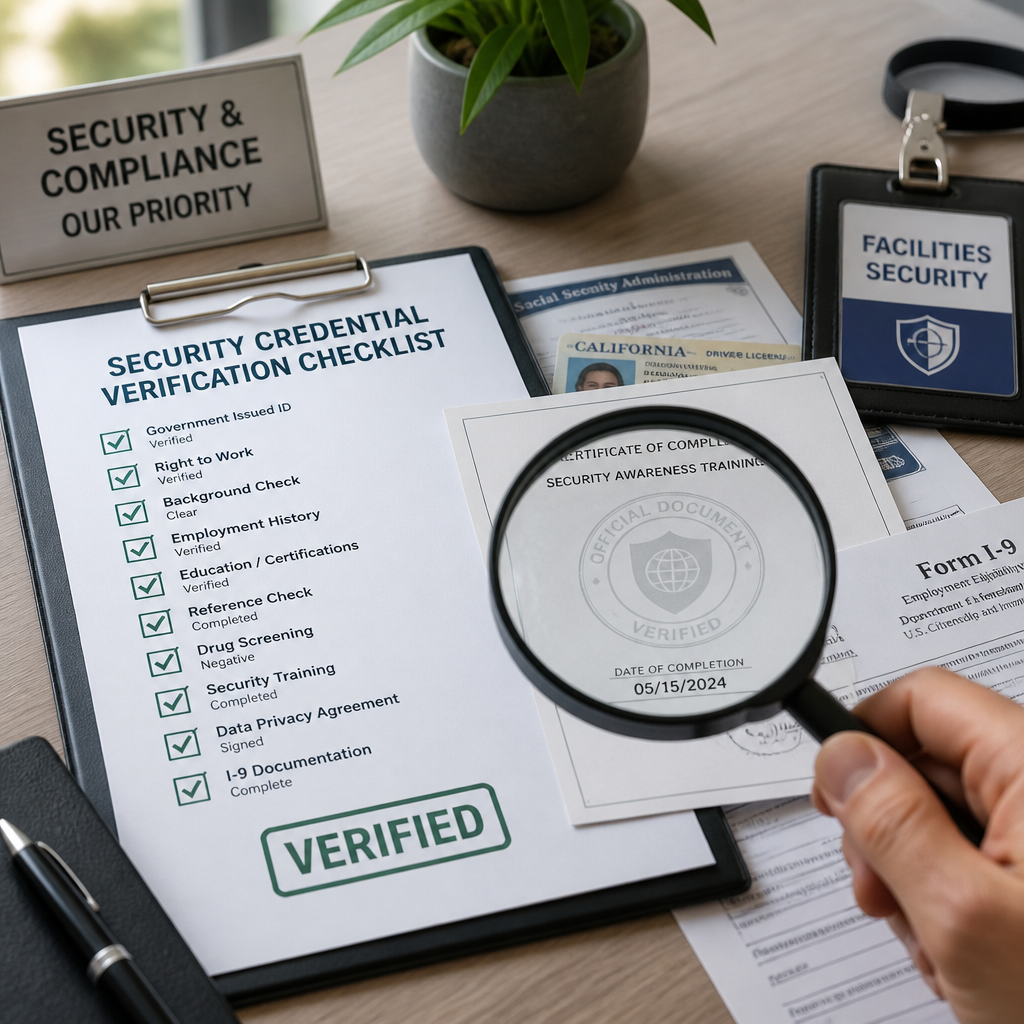
An SIA licence confirms that an individual has passed the required training and a criminal background check at the point of application. It does not confirm that they have been screened to the depth that security deployments in commercial or sensitive environments demand. That is the role of BS 7858:2019, the British Standard for pre-employment screening in the security industry.
BS 7858:2019 screening covers identity verification, right-to-work checks, credit and financial history, a criminal record disclosure, and employment history over a rolling five-year period. The purpose is to gather enough information to allow organisations to make informed decisions about deploying individuals in secure environments, and to lower the exposure to risk that comes with gaps or misrepresentations in a candidate’s background.
Why BS 7858 Matters Beyond SIA Compliance
Some insurers require BS 7858 compliance as a condition of their policy, sometimes with extended screening periods beyond the standard five-year window. For corporate facilities managing access to sensitive data, finance operations, or pharmaceutical stock, this standard provides the due diligence layer that SIA licensing alone cannot deliver.
When evaluating a security provider, ask directly whether all deployed operatives are screened to BS 7858:2019 before deployment, not just at initial hire. Contract workers, agency-supplied cover personnel, and short-notice replacements are the most common points of failure in vetting continuity.
Pro tip: For retail security and corporate access control deployments where staff rotate frequently, require your provider to confirm that BS 7858 screening applies to all substitutes and cover personnel, not just the named operatives listed at contract start. The standard’s scope is clear on this, and a provider who cannot confirm it likely lacks the HR infrastructure to maintain consistent compliance.
SIA Approved Contractor Scheme: What It Means for Buyers
The SIA Approved Contractor Scheme (ACS) is a voluntary quality scheme managed by the Security Industry Authority. Its stated purpose is to raise performance standards across the private security industry and to assist security companies in demonstrating operational and technical competence to buyers in the local authority, government, and commercial sectors.
ACS membership is not a legal requirement. A company can legally provide security services without it. But it is a meaningful procurement signal. To achieve ACS status, a security company must open its technical capability, management processes, and people management practices to third-party inspection by an approved certification body. The inspection includes assessment of whether BS 7858-aligned screening is in operation, not merely claimed.
ACS in Practice: What It Does and Does Not Guarantee
ACS membership confirms that a company has passed a structured assessment at the point of certification. It does not guarantee ongoing performance between inspection cycles. Use ACS status as a baseline filter rather than a final assurance. The more meaningful questions remain around licence verification processes, vetting documentation practices, and the specific operational experience the company brings to your sector.
For construction companies procuring security under CDM 2015 frameworks, combining ACS membership with demonstrated knowledge of site-specific protocols, including access control procedures and coordination with principal contractors, provides a more complete picture than either credential alone.
Comparing Security Provider Tiers: What Each Level Guarantees
| Provider Tier | What Is Formally Guaranteed | What Requires Independent Verification |
|---|---|---|
| SIA-Licensed Operatives Only (No ACS) | Operatives have passed SIA training and a criminal background check at licence application. Deployment in stated licence sector is lawful. | Current licence status (Active vs Suspended/Revoked), BS 7858 vetting compliance, CDM or sector-specific protocol knowledge, cover staff vetting. |
| SIA-Licensed Operatives + BS 7858 Vetting | Pre-employment screening to the British Standard, covering 5-year employment history, identity, financial history, and criminal disclosure. Reduces insider risk and satisfies most insurer requirements. | Current licence status via register, whether vetting applies to all substitutes and cover personnel, sector-specific operational training. |
| SIA Approved Contractor Scheme Member | Company has passed third-party inspection of management systems, technical capability, and people management including BS 7858-aligned screening. Recognised by SIA, local authorities, and public sector buyers. | Current licence status of individual operatives, post-certification operational quality, sector-specific knowledge (e.g. CDM 2015 compliance for construction sites). |
Red Flags When Hiring Security Guards in the UK
The majority of compliance failures in security procurement are not deliberate fraud. They are the result of inadequate systems: providers who do not have a process for monitoring licence renewals, who do not rescreen cover staff, or who misrepresent ACS membership they once held but allowed to lapse. Knowing what to probe for closes that gap.
Indicators of Inadequate Compliance Infrastructure
A provider who cannot supply 16-digit licence numbers for named operatives before mobilisation has no credible compliance process. This information is basic and should be immediately available. Delay or deflection here is substantive, not administrative.
Pricing significantly below market rate for fully licensed, BS 7858-vetted operatives is almost always a signal that one or both of those standards is not being maintained in practice. The cost of proper vetting, licence renewals, and trained personnel is built into legitimate pricing. Providers who undercut materially are absorbing that cost somewhere, and it is rarely in their favour or yours.
Questions That Separate Compliant Providers from the Rest
Ask specifically how the provider monitors licence renewals for deployed personnel. SIA licences are valid for three years, and a provider with no active renewal-tracking process will eventually deploy an expired licence holder without realising it. Ask whether cover and substitute operatives are subject to the same vetting and licence verification as named contract staff. Ask for the ACS certificate number if they claim membership, and verify it directly with the SIA.
Nexus Security Services operates with full SIA licence transparency, BS 7858-compliant vetting, and sector-specific deployment expertise across construction sites, retail environments, corporate facilities, and event venues throughout the United Kingdom. For procurement teams comparing providers, those specifics are the right baseline to hold any candidate against.
Frequently Asked Questions
What does an SIA licence actually confirm about a security guard?
An SIA licence confirms that the individual has passed the required role-specific training course, is at least 18 years old, has the right to work in the UK, and has passed identity and criminal background checks conducted by the SIA at the point of application. It does not confirm that a more thorough BS 7858 pre-employment vetting has been completed, nor does it guarantee that the licence is currently Active. Always verify status independently via the SIA register.
Is it legal to hire a security company that does not hold ACS membership?
Yes. The SIA Approved Contractor Scheme is voluntary. A security company can legally provide services without ACS membership, provided their operatives hold valid SIA licences for the relevant sectors. ACS membership is a procurement differentiator that signals management quality and third-party inspection compliance, not a legal prerequisite for service delivery.
How do I check whether an SIA licence is currently valid?
Access the SIA’s Register of Licence Holders at services.sia.homeoffice.gov.uk/rolh. Search using either the 16-digit licence number on the operative’s badge or their name and date of birth. The register displays the licence sector, current status (Active, Expired, Suspended, or Revoked), and the licence holder’s name. Only an Active status confirms lawful deployment in the displayed sector. The register is free, publicly accessible, and requires no account.
What is the difference between a Security Guard licence and a Door Supervisor licence?
A Security Guard licence covers static guarding, mobile patrol, and gatehouse duties. A Door Supervisor licence is required for anyone controlling entry to licensed premises and involves additional training requirements in first aid and conflict management. The two are not interchangeable. Under SIA licence integration provisions, a Close Protection licence holder may work as a Door Supervisor, but a Security Guard licence does not extend to door supervisor activities.
What is BS 7858:2019 and why is it relevant to hiring security personnel?
BS 7858:2019 is the British Standard for pre-employment screening in the security industry. It requires identity verification, right-to-work confirmation, criminal record disclosure, financial history checks, and a review of employment history over a five-year period. It goes materially further than the checks conducted at SIA licence application. For corporate facilities, construction sites with restricted access, or retail environments with significant shrinkage exposure, requiring BS 7858-compliant vetting from your security provider is the appropriate due diligence standard, not an optional enhancement.
Does a security guard’s SIA licence cover all types of security work?
No. The SIA licences distinct activity sectors, and a licence in one sector does not authorise work in another. A Security Guard licence covers manned guarding and patrol but not door supervision or close protection. Before deployment, confirm that the operative’s licence sector precisely matches the role they will perform. For mixed deployments, for example an event requiring both access control and crowd management at a licensed venue, different operatives may need different licence types.
How should I handle SIA licence compliance for ongoing security contracts?
Build active licence monitoring into the contract terms. Require the provider to notify you immediately of any licence suspension, revocation, or expiry affecting deployed operatives. Run your own independent re-verification through the SIA register quarterly, or more frequently for high-value or high-risk sites. For long-duration contracts on construction sites or corporate campuses, a clause requiring the provider to maintain and evidence BS 7858 vetting on all substitutes and cover personnel is a standard risk management provision, not an unusual demand.
If you manage security procurement for a construction site, commercial facility, or multi-venue operation, we’d welcome your experience: what compliance checks have made the most practical difference in your procurement process?
References
- Security Industry Authority: UK regulation, licensing sectors, and enforcement activity explained
- How to check an SIA licence using the Register of Licence Holders: a step-by-step guide
- SIA Business Plan 2025 to 2026: active licence holder statistics and ACS scheme data
- SIA Approved Contractor Scheme: scope, inspection process, and what approval demonstrates
- BS 7858 security screening standard: scope, requirements, and application to the security industry


0 Comments