

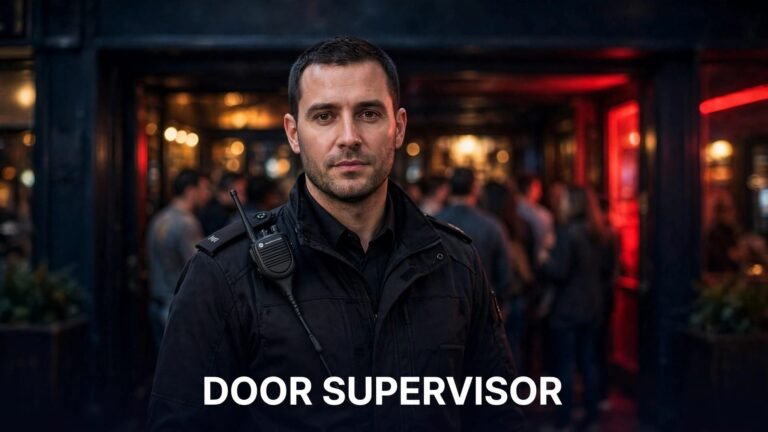
A busy door is not made safe by a black jacket and a radio. It needs properly licensed staff, clear venue procedures, and managers who understand where their own responsibility begins.
The door supervisor requirements for UK licensed venues are set largely by the Security Industry Authority (SIA). For pubs, clubs and other licensed premises, an SIA licence is the individual’s front line licence for carrying out licensable door supervision work. It doesn’t replace the venue’s separate premises-licence duties, staffing responsibilities or incident-recording requirements.
Key takeaways
- Door supervisors carrying out licensable activity must hold the correct SIA licence, a front line licence, before work starts.
- Applicants must be at least 18, have the right to work in the UK, complete the required level 2 award and pass the SIA’s identity and criminal record checks.
- The published licence fee is £204 for applications and renewals submitted from 1 April 2026. Check the live SIA or GOV.UK guidance before publication, especially if the article appears before that date.
- A door supervisor licence lasts three years. Renewal requires the relevant refresher qualification, while holders of older qualifications may first need top-up training.
- Venue operators must still meet their own premises licence conditions. Hiring licensed staff doesn’t pass that responsibility elsewhere.
Door supervisor requirements at a glance
The central requirement is straightforward: anyone carrying out licensable door supervision work must hold a valid SIA door supervisor licence. This SIA licence is a front line licence for guarding against unauthorised access, disorder, damage or theft at pubs, clubs, music venues, late-night events and other licensed premises.
Not every member of a venue team needs an SIA licence. A security guard licence is a separate category, while bar staff, hosts and cloakroom staff may not be doing licensable security work. The actual duties determine whether licensing is required, not the job title printed on a rota.
| Requirement | Current position | Practical point for venues |
|---|---|---|
| Age and work status | Applicants must be 18 or over and have the right to work in the UK | Check this before confirming regular shifts |
| Licence-linked training | Level 2 Door Supervisor qualification and recognised first aid | Ask for evidence before deployment |
| SIA application | £204 from 1 April 2026 | Build the cost and processing time into recruitment plans |
| Licence duration | Three years | Record expiry dates well before the final month |
The licence is personal to the operative. It is not a blanket approval for a company, promoter or premises, and a door supervisor licence can’t be transferred between workers.
Licence holder and licensed venue duties
An SIA licence is not a venue compliance plan
An SIA licence confirms that an operative has met the Security Industry Authority’s licensing standard. It is a front line licence for work in the private security industry, not proof that the venue has met its own operational duties.
It doesn’t tell a door team how many people should work at an entrance, when searches are required, or how to manage an intoxicated customer. Those decisions should come from the operating schedule, risk assessment and event requirements.
Check the premises licence and any conditions imposed by the local licensing authority. For licensed premises, premises-licence conditions and licensing-authority requirements are mandatory.
Requirements can differ between England and Wales, Scotland, and Northern Ireland. Venue-licensing frameworks and local conditions aren’t identical, so check with the relevant licensing authority.
A quiet restaurant, a 1,000-capacity live show and a late-night club may all use door supervisors. However, the operational risk and required controls won’t be the same.
Put clear arrangements around the door team
A reliable venue gives the team a proper briefing before doors open. Cover entry policy, capacity limits, refusals, challenge procedures, welfare arrangements, emergency exits, escalation contacts and who can close admissions.
These arrangements, including staffing models, radio links, crowd management and incident response, may be recommended venue practice. They become compulsory when a licence condition or another legal duty requires them.
Keep a record of who worked, their SIA licence number, shift times and any incidents. This is sensible venue practice unless a condition or other legal duty says otherwise.
Licence details can change, people can leave, and a last-minute replacement may not have the authority claimed on the phone.
A valid badge is the starting point. The safer operation is the one where the team knows the venue rules, the manager is available, and incidents are recorded while the facts are still clear.
Don’t assume a door supervisor licence authorises every security deployment. Match the licence activity to the role being asked of the operative, then check the current SIA guidance if the work falls outside ordinary door supervision.
Eligibility before an applicant starts training
The basic SIA checks
Applicants for a front line licence must be at least 18 and have the right to work in the UK. They must provide evidence for identity checks and complete criminal record checks. The official SIA licence application guidance explains the current process and evidence requirements, including DBS, AccessNI and Disclosure Scotland routes.
A criminal record doesn’t automatically prevent licensing, but it must be handled honestly. Applicants should disclose information accurately and allow time for the SIA’s checks. Managers shouldn’t promise work that depends on approval.
The application uses an online account and requires consistent evidence on the application form. An account doesn’t guarantee approval. A training provider can confirm course completion, but it can’t bypass the SIA’s decision-making process.
DBS, Disclosure Scotland and AccessNI routes may differ across the UK. Venue licensing rules are separate from the SIA application, so applicants and managers should check the relevant requirements.
Address history and overseas records
The SIA checks the required address history period. Ordinary mistakes can cause delays, such as a missing flat number, old postcode, name change after marriage, or addresses entered in the wrong order.
Write out the full history before beginning the form. Include temporary accommodation, university halls and addresses used while working away. Dates should match the documents supplied.
Applicants who have lived outside the UK may need an official overseas criminal record check from each relevant country. The look-back period, evidence rules and translation requirements can change, so check the current GOV.UK and SIA guidance. Allow extra time where documents must be obtained or translated.
Door supervisor training and first aid
The Level 2 qualification
The required qualification is the Level 2 Award for Working as a Door Supervisor in the Private Security Industry, a level 2 award linked to a front line licence.
It is a licence-linked qualification for work in the private security industry, not a generic security certificate.
The four mandatory parts cover the common security industry unit, the door supervisor specialist module, conflict management and physical intervention skills. The mix matters. A person may be calm on an entry point, yet still need to understand reporting, lawful communication, safer physical intervention and what happens after an incident.
Use approved training providers, but verify the awarding organisation, qualification and provider against current SIA and GOV.UK guidance. The SIA’s training guidance and provider information is the sensible place to check before paying a deposit.
Do not rely on outdated course lengths
Course adverts still quote different durations. The current standard is a minimum of 52 hours over seven days where there is no self-study. A minimum of six days can apply where the provider uses evidenced self-study.
That difference is not a shortcut to be assumed. Ask the provider how self-study is recorded, what attendance is required, and whether the course meets the current SIA specification. Cheap training that creates an invalid application is not cheap in practice.
Emergency First Aid at Work comes first
Applicants need a valid Emergency First Aid at Work certificate, or an accepted equivalent, before starting the full training course or refresher training. It must have at least 12 months left before expiry.
A generic one-day first-aid attendance course is not automatically enough. Check the current SIA guidance for the validity period and accepted equivalents, rather than relying on an old provider checklist. If first aid is booked separately, complete it early rather than finding the training date has arrived without the required certificate.
Prepare the SIA application before opening the form

Gather evidence that tells one consistent story
Identity and address evidence should match the applicant’s name, date of birth and address history. The SIA’s accepted document combinations can change, so use the live guidance rather than an old training-provider checklist.
Before opening the application form, sign in to your online account and check the available guidance. Compare passports and other valid id documents with the applicant’s name, date of birth and postcode before submitting.
For venue managers, this is a useful recruitment test. A candidate who says their application is “nearly done” may still be waiting on identity evidence, a criminal record check or training confirmation.
Treat discrepancies as a job to finish
Do not try to tidy up an awkward history by leaving things out. A name change, overseas address or gap between tenancies is not automatically a problem. An unexplained mismatch is more likely to slow the application down.
Keep copies of relevant certificates and supporting evidence in a secure place. Personal data must be handled properly, with access limited to the people who need it. A spreadsheet of licence expiry dates is useful. A shared folder full of passports and DBS information is not.
Applicants should also leave enough time for the SIA to make its checks. Promoters planning a one-off event must not treat incomplete identity or criminal-record documentation as permission to work. An application receipt is not the same as an SIA licence.
Fees, validity and renewal
The current £204 licence fee
For applications received from 1 April 2026, the SIA licence fee is £204 for one licence. Renewal costs the same. Training, first aid, travel and replacement documents are separate costs, so the full route into work is higher than the licence fee alone.
Fees can change. Confirm the amount on the official application page before payment, particularly if you booked a course months earlier or an employer has agreed to cover costs.
Renewal needs refresher training
An SIA door supervisor licence is valid for three years. Since 1 April 2025, applicants renewing a door supervisor or security guard licence need the relevant refresher qualification alongside their original licence-linked qualification.
The SIA licence renewal process must be started well before expiry. The SIA’s renewal guidance explains the current process and fee. Top-up training may apply to older qualifications or a particular transition route, so check the current requirements for your original qualification.
Start planning months before expiry. If a licence expires, the person must not continue in licensable work while relying on an expired badge. Check the SIA’s current route before booking training, especially where there has already been a gap.
Frequently asked questions
Can a door supervisor work security guard shifts?
Don’t assume a door supervisor licence covers ordinary security guarding simply because the work looks similar. SIA licence categories are activity-specific, covering roles such as security guard, close protection and cctv operator work. Check the duties involved and current SIA guidance before assigning shifts.
Does every licensed venue need door staff?
No. The need depends on the premises, event, risk profile and licence conditions. A licensed premises may choose door staff as good practice, while another may be required to provide them at stated times under its premises licence.
What should a promoter check before an event?
Confirm that every operative is licensed for the planned role. Check the SIA licence category, status and expiry date before assigning shifts. Agree staffing numbers and escalation procedures with the venue manager.
Ask about incident reporting, refusals, welfare concerns and when police or emergency services should be contacted.
What should a door supervisor check before renewing their licence?
Check the current renewal requirements early, including any training or qualification updates. Top-up training may apply to some older qualification routes, but it isn’t automatically the same as current refresher training.
Licensing and premises requirements can vary across England and Wales, Scotland, and Northern Ireland, so check the relevant guidance before relying on general UK advice.
Final thoughts
The strongest approach to door supervisor requirements is practical rather than performative: verify the licence, understand the venue conditions, brief the team and keep records that can stand up to scrutiny.
The SIA sets the licensing standard. The venue still owns the night, including its customers, its staff and the decisions made at the door.


0 Comments