

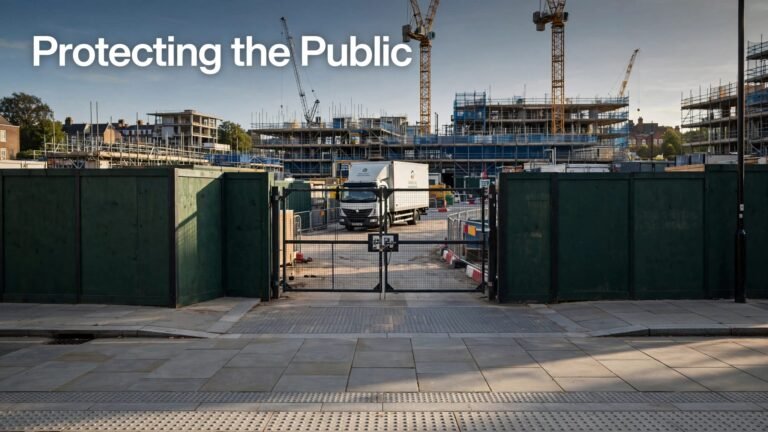
A fence around a building site does not, by itself, protect the people passing it. Construction site safety requires physical separation, controlled vehicle movements and checks that reflect the work taking place that day.
Construction sites can expose residents, pedestrians and neighbouring businesses to falling materials, dust, open excavations and delivery vehicles without anyone entering the site. Contractors must manage those risks beyond the gate as well as within it.
Start with the boundary, then follow each activity that could affect someone outside it.
Key takeaways
- Define and maintain the site boundary, with particular attention to gates, temporary openings and areas accessible to children.
- Separate delivery vehicles and construction plant from pedestrians through planned routes, physical controls and managed movements.
- Prevent materials, dust and other hazards reaching neighbouring properties or public routes.
- Assign public-protection duties to named people, with clear arrangements for inspections, defects and emergency response.
- Review controls after layout changes, severe weather, scaffold alterations and phased occupation, rather than relying on the original assessment.
- Members of the public should report hazards from a safe position and call 999 where there is an immediate threat to life.
1. Assess public risks before work starts
Public protection begins with identifying who could be harmed and how construction activities could reach them. A generic site assessment rarely captures the full boundary.
Assess the surroundings as well as the work
The Management of Health and Safety at Work Regulations 1999 require employers to assess risks and put suitable controls in place. That assessment must include people affected by the work, not only employees.
Walk the surrounding streets and shared access areas around construction sites before setting up. Identify schools, bus stops, occupied buildings, shop entrances, cycle routes and places where pedestrians already cross.
Consider how those routes change during school collection, deliveries and commuting periods. A gate that appears manageable during a morning inspection may become congested later.
HSE’s guidance on protecting the public covers boundary security, falling objects, vehicle movements and other risks affecting people outside construction activities.
Assign controls and review points
Record the hazard, the people exposed, the control and the person responsible for maintaining it. Significant risk-assessment findings must be recorded where an employer has five or more employees.
Assess foreseeable misuse as well as intended access. Children may climb stored materials, visitors may follow workers through a gate, and pedestrians may ignore a diversion that appears incomplete.
Review the assessment when work changes, controls fail or new information shows that it is no longer suitable. Demolition, crane operations, scaffold installation and utility connections can alter public exposure within hours.
This general guidance does not replace a site-specific risk assessment. Unusual structural, highway or legal issues may require specialist advice before work proceeds.
2. Secure the boundary and control entry
A boundary needs to prevent foreseeable unauthorised access throughout the project. Its condition matters more than its appearance on the site plan.
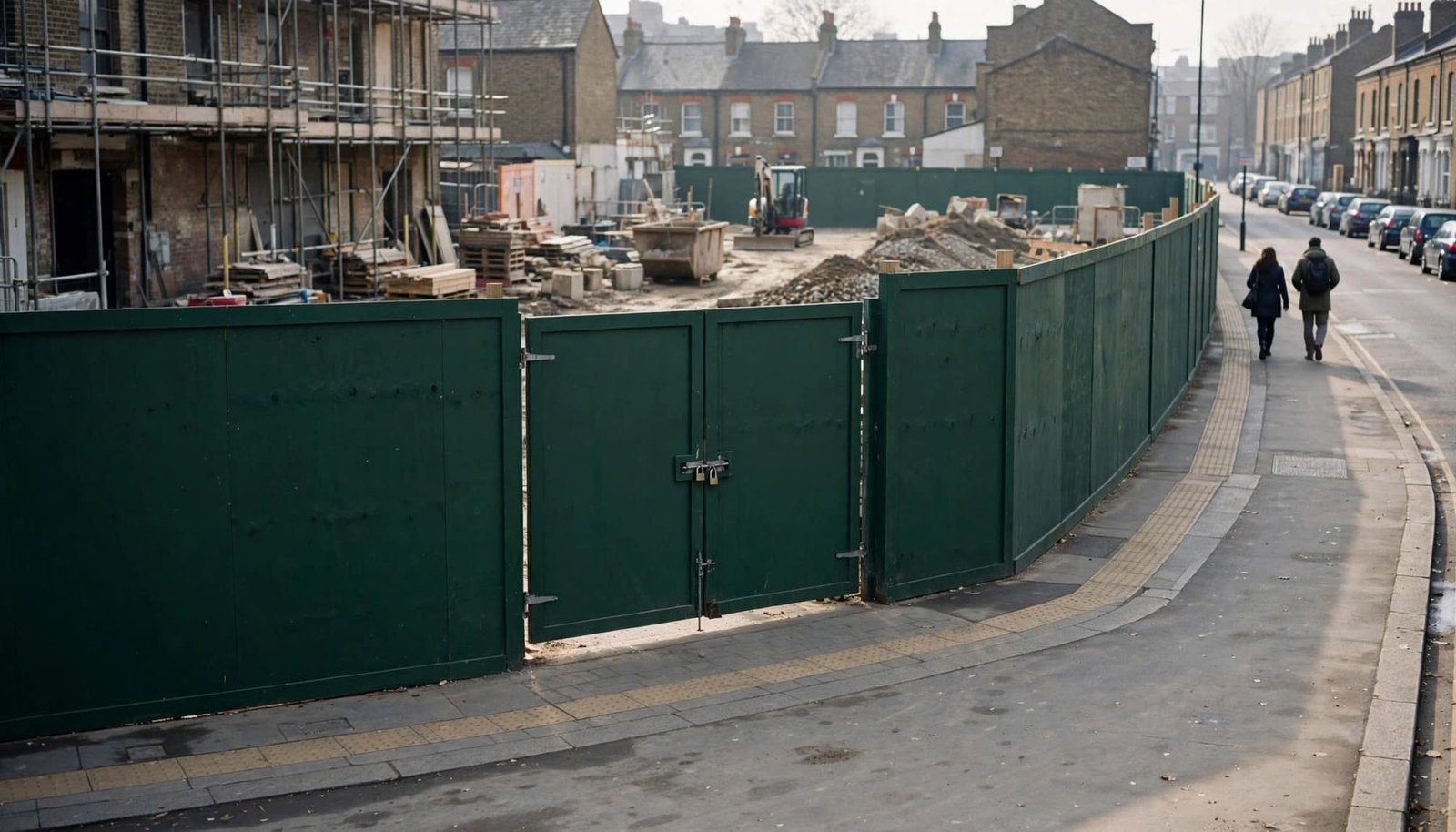
Maintain fencing and hoarding as working controls
Select fencing or hoarding for the location, ground conditions, exposure and public risk. There is no single specification that makes every construction boundary adequate.
Check panels, supports, fixings, gates and changes in ground level. Pay attention to corners, sloping ground and gaps beneath panels where small children could gain access.
Store materials away from the boundary where they could provide climbing steps or put pressure on fencing. Assess wind loading when adding sheeting, advertising or screening to temporary structures.
Provide suitable protection around temporary openings immediately. A delivery or utility connection should not leave an unattended gap while responsibility passes between trades.
Make entry a controlled process
Keep gates closed when access is not being managed. Give visitors a clear place to report without walking through vehicle routes or active work areas.
Record authorised arrivals, explain restrictions and provide an escort where the visitor cannot move safely without one. A pass confirms permission to enter; it does not establish competence around construction hazards.
Assign responsibility for lost passes, shared codes and gate faults. Access permissions should change when contractors leave, plots are handed over or occupied areas become accessible.
Our construction site access management guidance explains how records, visitor arrangements and controlled entry support the wider security plan.
The principal contractor must take reasonable steps to prevent unauthorised access. Appointing a security provider does not transfer that statutory responsibility.
3. Separate pedestrians from construction vehicles
Vehicle controls must cover the entrance and surrounding road, not only movements inside the compound. Public exposure often occurs during a short delivery.
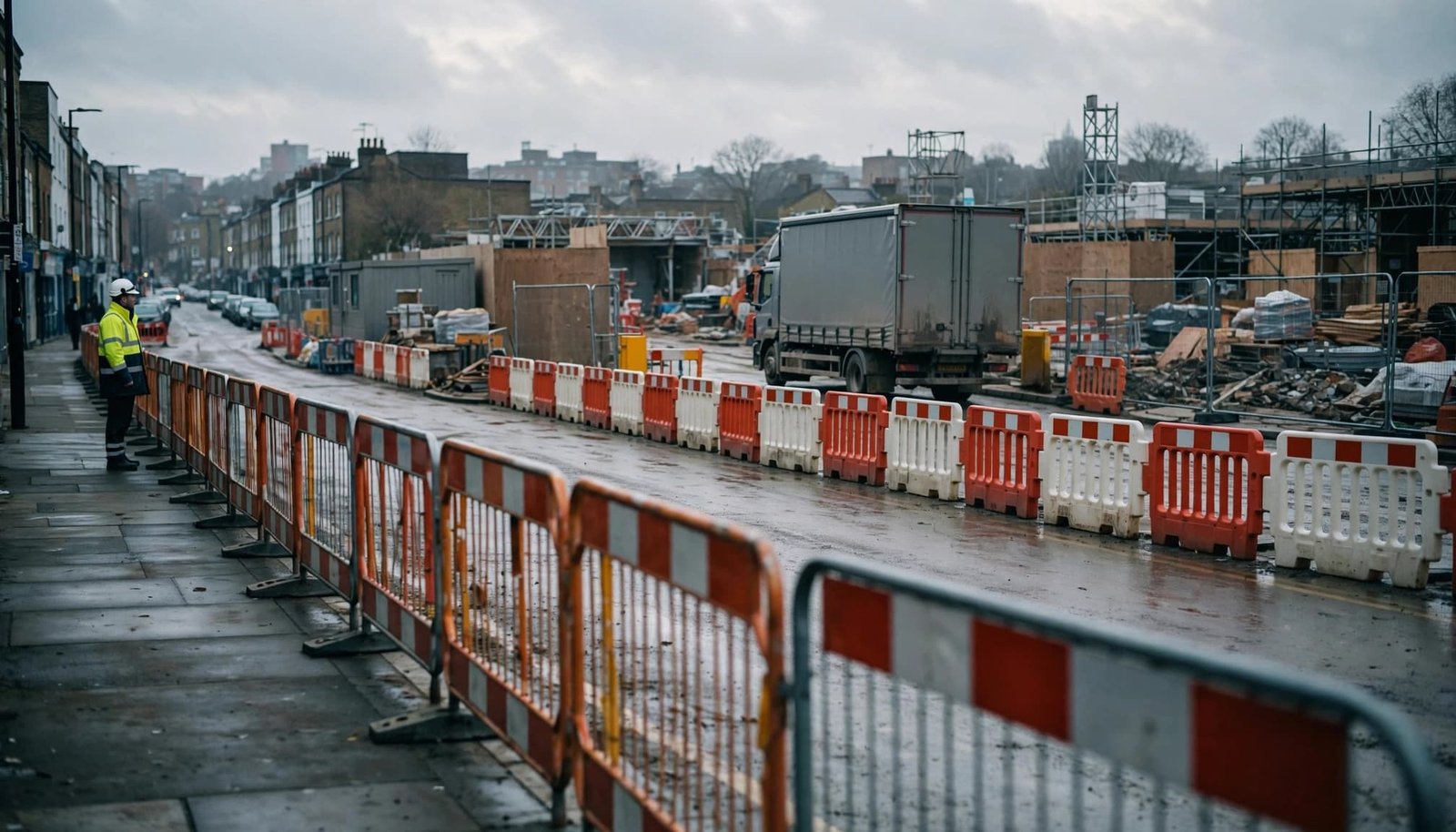
Plan deliveries around the public route
Provide separate pedestrian and vehicle entrances where practicable. Use physical separation within the site rather than depending on high-visibility clothing and driver attention.
Plan routes for heavy vehicles, book deliveries, explain the approach route and identify a safe waiting arrangement. Drivers should know whom to contact before arrival, particularly where the entrance is constrained or obscured.
Avoid unnecessary reversing through layout and delivery planning. Where reversing remains necessary, use suitable controls and trained assistance without placing the signaller in the vehicle’s path.
HSE’s construction traffic management guidance requires site routes to allow vehicles and pedestrians to move safely. That principle applies when a delivery crosses a public footway.
Control the crossing, not only the gate
HSE’s older HSG144 guidance reported an average of around ten deaths annually when construction vehicles struck workers and members of the public. That estimate used 2003/04 to 2007/08 data; it is not a current annual count.
The practical response remains clear: minimise conflict between people and moving vehicles. Check driver visibility, gate opening arrangements, turning space and the condition of mirrors or cameras.
Keep pedestrians outside the vehicle’s operating area while the entrance is in use. Do not assume a marshal’s presence gives authority to stop public-road traffic without the necessary arrangements.
Schedule movements away from predictable pedestrian peaks where practicable. If the crossing cannot be controlled safely, pause the movement and resolve the obstruction.
A delivery deadline does not justify moving through an uncontrolled crowd.
4. Keep public footways clear and accessible
A route can remain technically open while becoming unusable for a wheelchair user or someone with a pushchair. Assess the whole journey past the site.
Provide a continuous, understandable route
Keep footways clear of pallets, cables, rubble, protruding scaffold components and standing water. Check surfaces after excavation work, heavy rain and repeated vehicle crossings.
Temporary pedestrian routes need clear edges, suitable surfaces and safe connections at both ends. Avoid directing people into the carriageway without a properly planned and authorised arrangement.
Consider people with sight loss, reduced mobility or hearing impairments. Projections at head height, loose barrier feet and sudden changes in level may be difficult to detect.
Signs should explain the route before the pedestrian reaches the obstruction. A diversion notice beside a closed path leaves little room for a safe decision.
Protect children and neighbouring occupiers
Assess nearby schools, housing and recreation areas when planning boundary controls. Children may approach machinery, climb fencing or enter through openings that adults would overlook.
Agree arrangements with neighbouring occupiers where construction shares an entrance, courtyard or service road. Keep occupied-building escape routes available and separate residents from active work.
Give advance notice of changes that affect access, deliveries or emergency arrangements. Identify a site contact who can resolve practical problems rather than passing each complaint between subcontractors.
Highway licences or permits may be needed for scaffolds, hoarding, skips or works affecting the public highway. Those permissions do not remove the contractor’s responsibility to control the hazards.
5. Prevent falls and falling materials
Work at height creates risks for workers and anyone below them. The public must remain protected during erection, alteration, use and dismantling.

Follow the fall-prevention hierarchy
The Work at Height Regulations 2005 require work to be planned and undertaken by competent people. Avoid work at height where reasonably practicable, then prioritise fall prevention where it cannot be avoided.
Use collective protection, such as suitable platforms and guardrails, before relying on individual equipment. Safety nets and harnessed fall-arrest systems reduce the consequences of a fall where prevention alone is insufficient.
A harness requires a suitable system, appropriate anchorage and a rescue plan. Issuing one does not establish that the task is safe.
HSE’s work-at-height legal guidance explains the duty to prevent death and injury. There is no general two-metre threshold below which fall risks can be ignored.
Contain objects within the work area
Prevent tools, bricks and materials falling outside the site boundary. Select toe-boards, brick guards, containment, fans or covered walkways according to the work and people exposed.
Keep materials back from edges and secure items vulnerable to wind. Scaffold netting should not be treated as proof that heavy objects will be contained.
Establish exclusion zones for lifting, scaffold alterations and work above public routes. If the route cannot remain protected, arrange a suitable closure or diversion before starting.
For work using access platforms, HSE’s mobile elevating work platform guidance includes protecting people below against falling objects.
Stop affected work if containment is damaged or conditions exceed the safe limits of the equipment or temporary works.
6. Isolate excavations, unstable structures and services
A person can be injured by an excavation or damaged electrical supply without seeing the hazard beforehand. Barriers must reflect the consequences of access.
Protect openings and structural hazards
Securely barrier or cover excavations, manholes, service trenches and other openings. Select covers for the loads they may experience and prevent them being displaced.
Assess the boundary after excavation changes the ground or affects adjacent structures. Hoarding supports, footways and neighbouring walls may depend on ground disturbed by the works.
Demolition and structural alterations need competent planning, including exclusion areas and temporary support where required. A dust screen does not protect the public against structural collapse.
Keep spoil, plant and stored materials away from excavation edges where they could destabilise the ground. Public protection must remain effective when the site is unattended.
Control electricity and stored energy
Identify underground and overhead services before work that could affect them. Use suitable information, detection and safe working methods rather than relying on the apparent position of a cable or pipe.
Protect temporary electrical supplies against damage and unauthorised interference. Keep accessible cabinets secured and route leads away from public paths.
Only competent people should isolate, repair or alter electrical equipment. Damaged equipment must be taken out of use rather than left connected with a warning attached.
Gas leaks, damaged power lines and suspected instability require an immediate response. Clear the affected area, stop work and obtain emergency or specialist assistance as appropriate.
Do not allow a member of the public to approach the hazard to provide a closer description.
7. Provide suitable PPE and inspect equipment
PPE protects the person wearing it against particular residual risks. It can’t replace barriers, safe machinery or separation from the public.

Match protection to the task
Common construction equipment includes hard hats, high-visibility clothing, steel-toed boots or suitable composite-toe safety footwear, gloves, eye protection and hearing protection. Requirements depend on the hazards and site rules.
The Personal Protective Equipment at Work Regulations 1992, as amended, require employers to provide suitable protective equipment free where the relevant duties apply. The 2022 amendments extended coverage to certain workers who aren’t employees.
Choose protective gear that fits, works together and provides the required protection. Explain how to use, store and replace it, including what damage makes it unsuitable.
HSE’s construction PPE guidance distinguishes equipment requirements from the need to organise work safely. Visitors also need suitable protection for the areas they enter.
Members of the public shouldn’t need construction equipment simply to pass along an adjoining public footway.
Inspect tools and remove faults
Operators should complete the appropriate pre-use checks before each shift or use, following the equipment, risk assessment and manufacturer’s instructions. For power tools, check guards, controls, cables, attachments, leaks and visible damage.
PUWER, the Provision and Use of Work Equipment Regulations 1998, requires suitable equipment and equipment maintenance, with inspection where relevant. It doesn’t impose one identical inspection routine on every tool.
Formal inspection, lifting-equipment examination and routine operator checks serve different purposes. A current certificate doesn’t excuse ignoring a fault found that morning.
HSE’s work equipment inspection guidance explains how inspection identifies deterioration that could affect safety.
Isolate faulty equipment, label or secure it against use, and assign repair or replacement. Return it to service only after an appropriate assessment confirms it’s safe.
8. Control dust, noise and harmful exposure
Health risks may cross the boundary without a visible incident. Assess who could be exposed, for how long and through which routes.
Prevent dust and manage noise at source
The Control of Substances Hazardous to Health Regulations 2002 require assessment and prevention or adequate control of hazardous-substance exposure. Construction activities can generate silica dust, wood dust and other harmful contaminants.
Use suitable cutting methods, extraction, suppression and containment. Position equipment and exhausts to reduce exposure at neighbouring windows, air intakes and public routes.
Do not treat a worker’s respirator as protection for everyone nearby. Stop and revise controls if dust escapes into occupied areas.
Assess noise before selecting equipment, working methods and hours. Acoustic controls, maintenance and task sequencing can reduce exposure; hearing protection only protects those wearing it.
Report suspected asbestos disturbance to the responsible site lead and stop affected work. Uncontrolled removal can expose workers and people outside the immediate work area.
Reduce vibration and handling risks
Hand-arm vibration syndrome can cause permanent damage, including numbness, tingling and loss of hand function. It can develop through exposure to vibrating handheld or hand-guided equipment.
Select lower-vibration methods, maintain tools and manage exposure time. Jigs and suspension systems can reduce the need to grip heavy equipment tightly, but they do not guarantee that vibration exposure is controlled.
HSE’s hand-arm vibration prevention guidance explains those engineering and work-method controls. Symptoms require prompt reporting and appropriate occupational-health action.
Plan manual handling to avoid dropped loads, obstructed walkways and unstable stacks. Use suitable mechanical assistance where needed, keeping lifting and unloading areas separate from public movement.
9. Train people for their actual responsibilities
A course certificate provides evidence of training. Competence also depends on experience, task knowledge, supervision and the ability to apply instructions on the current site.
Distinguish training requirements from course names
SMSTS means Site Management Safety Training Scheme. SSSTS is commonly called the Site Supervisors’ Safety Training Scheme; CITB’s current course title uses “Site Supervision”.
CITB’s five-day SMSTS course covers management responsibilities and construction health and safety. Its two-day SSSTS course addresses supervisory duties and risk control.
These are widely recognised qualifications, and clients or contractors may require them for particular roles. They are not universal statutory licences that every manager or supervisor must hold.
A Health and Safety Awareness course can form part of the accepted qualification route towards a Green CSCS Labourer card. Completing the course alone does not automatically issue the card; the applicable test and application requirements also apply.
Give site-specific induction and usable supervision
Induction should explain authorised routes, required protective equipment, vehicle arrangements, emergency actions, welfare and hazard reporting. Explain the public-facing risks relevant to each role, including delivery control and temporary boundary openings.
Use language and formats that people understand. Confirm understanding rather than relying only on signatures, particularly where instructions involve stopping vehicles or evacuating an area.
Supervisors need sufficient competence and authority to identify defects and stop unsafe work. Daily inspections should be led by a competent supervisor or manager familiar with the current activities.
Provide a clear route for reporting fatigue, distress or reduced concentration. Someone struggling to work safely needs an appropriate response, not pressure to conceal the problem.
10. Plan emergencies and unattended periods
Emergency arrangements must work when the usual manager is absent and the site layout has changed. A contact list alone doesn’t establish that capability.
Make the emergency sequence workable
Record the exact site location, suitable emergency entrance, access restrictions and person assigned to meet emergency services. Keep escape routes, assembly arrangements and emergency vehicle access clear.
Plan for fire, serious injury, collapse, hazardous releases and incidents affecting neighbours. Where fall-arrest equipment is used, provide a suitable rescue arrangement rather than depending entirely on the fire and rescue service.
Set these duties out in the site’s emergency response plan. Name who raises the alarm, stops work and contacts neighbouring premises, and who provides first aid while emergency services are on their way.
Fire-safety legislation differs across the UK, so arrangements must reflect the applicable jurisdiction and work.
Test access after gate changes and phased handovers. Alarm monitoring doesn’t replace suitable fire detection or a clear response procedure.
Leave the site safe after work
Close and secure access points, immobilise plant, control keys and secure materials that could topple or roll. Remove or secure unauthorised climbing access where appropriate.
Confirm excavation protection, temporary electrical arrangements and emergency routes before the last responsible person leaves. Include weekends, shutdowns and periods of severe weather in the plan.
Where guarding or monitoring is used, define the response to a breached fence, trespass, smoke or an equipment alarm. Our guidance on mobile construction site patrols covers their role within site security.
Lone workers need reliable communications, reporting intervals and escalation if contact is missed. Some activities require assistance or supervision and shouldn’t proceed under a lone-working arrangement.
A recorded alarm establishes that something was detected. Public protection also depends on who responds and what they’re authorised to do.
The main construction site safety laws
The following framework of health & safety legislation and safety regulations applies principally in Great Britain. Northern Ireland has separate legislation and the Health and Safety Executive for Northern Ireland, although many practical controls are similar.
These eight instruments establish the main duties discussed here.
| Legislation | Practical requirement |
|---|---|
| Health and Safety at Work etc. Act 1974 | Protect employees and others affected by work, so far as reasonably practicable. |
| Management of Health and Safety at Work Regulations 1999 | Assess risks and organise suitable preventive and protective measures. |
| Construction (Design and Management) Regulations 2015 | Allocate project duties, plan construction work and manage access and site risks. |
| Personal Protective Equipment at Work Regulations 1992, as amended | Provide suitable protective equipment where required, with maintenance, information and training. |
| Health and Safety (Safety Signs and Signals) Regulations 1996 | Use appropriate signs where remaining risks require warnings, instructions or emergency information. |
| Work at Height Regulations 2005 | Avoid work at height where practicable, prevent falls and minimise remaining consequences. |
| Provision and Use of Work Equipment Regulations 1998 | Provide suitable work equipment and maintain, inspect and use it safely. |
| Control of Substances Hazardous to Health Regulations 2002 | Assess hazardous-substance exposure and prevent or adequately control it. |
These requirements overlap. A warning sign cannot compensate for missing edge protection, and protective equipment cannot make an unsuitable traffic layout acceptable.
Under the Health and Safety at Work Act, employers with five or more employees must have a written health and safety policy. It should state intentions, responsibilities and arrangements, and be brought to employees’ attention.
Displaying the policy can help communicate it, but the duty is not simply to put it on a noticeboard. The separate requirement to display the approved health and safety law poster, or provide the equivalent leaflet, should not be confused with the policy.
Who is legally responsible for public protection?
Responsibility follows each organisation’s role and control over the work. Appointing a principal contractor or security provider does not remove every other party’s duties.
Clients and designers must address risk early
Commercial clients must make suitable project-management arrangements, allow sufficient time and resources, provide relevant information and appoint appropriate dutyholders. On projects involving more than one contractor, that includes a principal designer and principal contractor.
The principal designer plans, manages, monitors and coordinates health and safety during the pre-construction phase. The role includes eliminating foreseeable risks where possible and reducing or controlling those that remain.
HSE’s principal designer responsibilities explain how design decisions influence construction safety. Boundary space, delivery access and maintenance requirements can all be affected before site work begins.
Domestic clients have different arrangements, with their duties normally passing to other project participants under CDM. The precise allocation depends on the contractual and project arrangements.
Contractors manage the construction phase
The principal contractor plans, manages, monitors and coordinates health and safety during construction on multi-contractor projects. That includes suitable inductions, cooperation between contractors and reasonable steps to prevent unauthorised access.
A construction phase plan must be prepared before the construction phase begins. The principal contractor prepares it on multi-contractor projects; the contractor does so where only one contractor is involved.
Keep the plan proportionate and current. It should describe how relevant risks and site rules will be managed, rather than repeat generic policy statements.
Each contractor must plan and control its own work. Workers must cooperate, follow instructions and report danger.
Security officers need a defined scope, reporting route and site-specific instructions. They should escalate structural, electrical or construction-method concerns to the competent site lead rather than attempt repairs outside their role.
Use a daily inspection and weekly review
A daily inspection should establish whether the controls work today. A weekly review should identify repeated defects, changing risks and failures in follow-up.
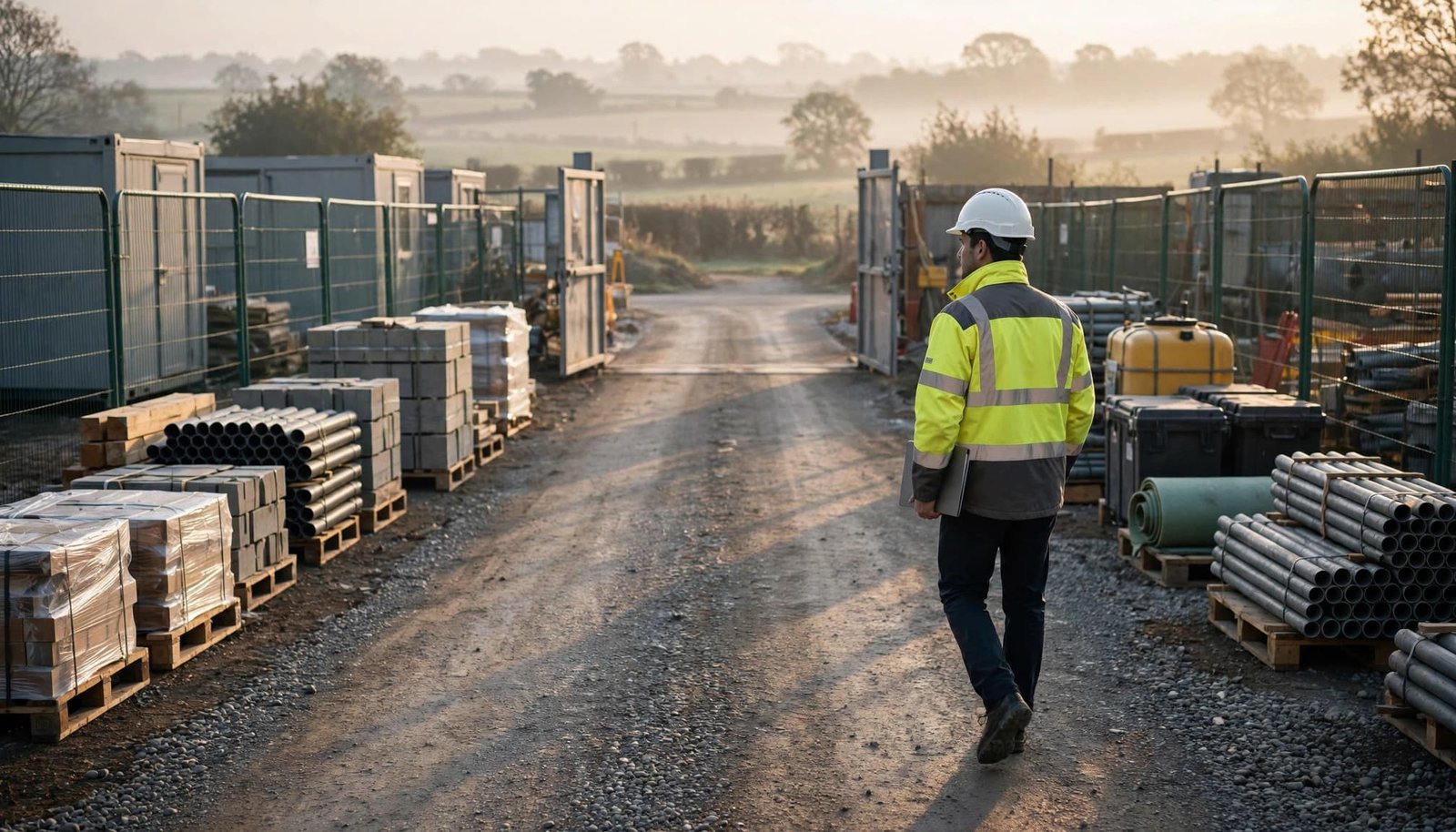
Inspect before public exposure begins
Assign a competent supervisor or manager to inspect the public-facing areas before work starts. Include the outside of the boundary, not only the internal compound.
Use the following checks during daily site inspections, alongside task-specific inspection requirements.
| Area | Daily check |
|---|---|
| Boundary | Panels, gates and supports remain secure, without accessible gaps. |
| Public route | Surfaces are clear, stable and usable throughout the diversion or footway. |
| Vehicle access | Crossing controls, visibility and pedestrian separation are ready. |
| Overhead work | Containment and exclusion arrangements suit the planned activities. |
| Openings | Excavations, covers and barriers remain effective. |
| Equipment | Relevant pre-use checks are complete and defects are isolated. |
| Emergencies | Access routes, alarms and contact arrangements remain available. |
| Changing conditions | Weather, deliveries and neighbouring activity have been considered. |
Record defects with a location, owner, deadline and temporary control. Close affected areas or stop relevant work where protection is inadequate.
Review performance, not only completed forms
The weekly review should examine recurring defects, missed actions, complaints, near misses and unauthorised-access attempts. Identify whether the problem lies in equipment, layout, staffing or unclear responsibility.
Reinspect after significant change or severe weather rather than waiting for the next scheduled review. Include scaffold changes, new road layouts and occupied plots within the project boundary.
Our construction site security checklist provides further checks for access, monitoring and security arrangements.
A signed inspection sheet does not prove a defect was resolved. Record the repair, replacement or changed arrangement, then confirm it works.
Daily and weekly checks do not replace equipment-specific statutory inspections or examinations. Those require their own competent people, intervals and records.
What the public should do about a dangerous site
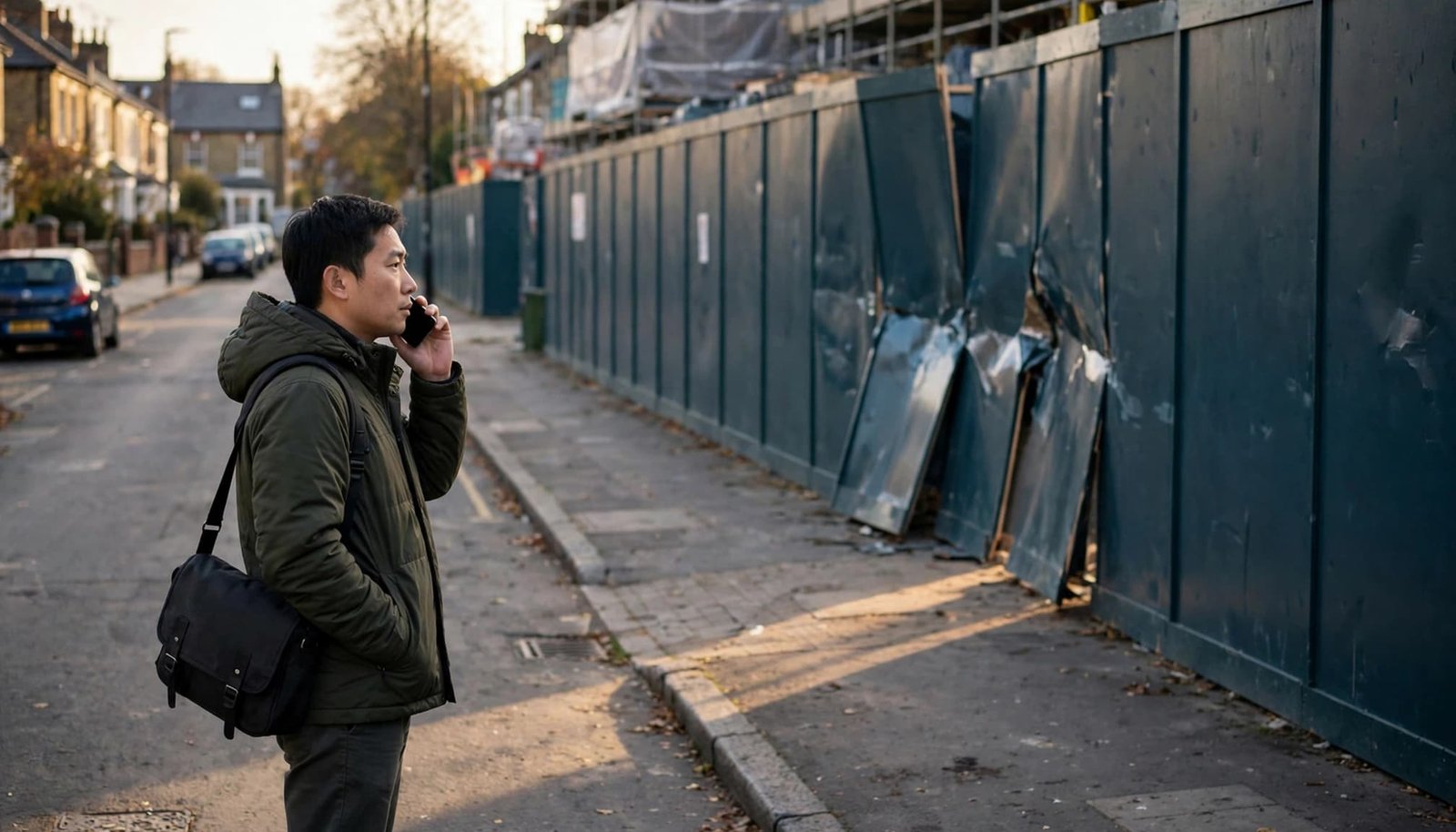
Report the concern without entering the work area. A closer photograph or inspection is not worth exposure to moving plant, unstable materials or damaged services.
Respond to immediate danger
Move away from the affected area and warn nearby people only where it is safe to do so. Do not touch loose fencing, electrical equipment, fallen cables or suspicious materials.
Call 999 where there is an immediate threat to life, serious injury, fire, collapse or another emergency. Give the location, the hazard and whether anyone appears trapped or injured.
For a non-emergency concern during working hours, use the site contact displayed at the entrance. Describe what is happening and which public route or property is affected.
Do not enter through an open gate to find a manager. If the site is closed, use the published contact arrangements or the appropriate public authority.
Send the concern to the responsible body
Report construction health and safety concerns in Great Britain to HSE. In Northern Ireland, contact HSENI; road obstructions and unsafe public-footway arrangements may also require the local highway authority or council.
Council environmental health teams deal with many construction noise and statutory nuisance concerns. Police can receive non-emergency reports through 101 where criminal activity or public safety issues require their involvement.
Provide the address, nearest landmark, time, visible hazard and people exposed. Distinguish what was observed from assumptions about its cause.
Contractors must separately assess whether an incident is reportable under RIDDOR reporting requirements. These include specified injuries, diseases and dangerous occurrences; not every complaint or near miss requires a statutory report.
A work-related accident injuring a member of the public can be reportable where they are taken directly to hospital for treatment. RIDDOR reporting is the responsible dutyholder’s task and does not replace emergency action or investigation.
Frequently asked questions
Is public liability insurance compulsory for every construction site?
Public liability insurance is not generally a universal statutory requirement, although contracts, clients or licences may require it. Employers’ liability insurance is usually compulsory where employees are engaged, subject to applicable exceptions.
Insurance conditions may include fencing, security or inspection requirements. Record and assign those obligations, but keep insurance and prevention separate: a policy does not discharge health and safety duties or authorise an uncontrolled risk.
Must every person on site wear the same PPE?
Protective equipment depends on the hazards, the work and the site’s rules. Many sites specify a baseline of head protection, high-visibility clothing and safety footwear, with gloves, eye protection, hearing protection or respiratory protection added where required.
Additional protection must suit the task and the wearer. A visitor entering a protected office area may face different risks from someone walking through active construction, so access arrangements should make that distinction clear.
Does a small construction project need a construction phase plan?
Yes. CDM 2015 requires a construction phase plan before the construction phase begins, including on small projects.
The plan should be proportionate to the work and address the arrangements needed to manage relevant risks. A short, specific plan can be appropriate for straightforward work. Its length does not establish its adequacy, and small project size does not remove risks to neighbours, pedestrians or delivery drivers.
Can CCTV replace fencing or a site response?
CCTV can support detection, assessment and evidence, but its effectiveness depends on coverage, monitoring and response. It cannot physically stop someone reaching an excavation or walking into a vehicle route.
Select perimeter controls, access arrangements and response measures together. Record who receives alerts, what they can assess and who attends. Where a camera identifies a failed barrier, someone still needs to protect the area and arrange a repair.
Keep protection aligned with the work
Public protection depends on controls that remain effective as the project changes. Secure the boundary, separate movements and assign clear responsibility for defects and emergencies.
Treat inspections as decisions about whether work can proceed, not simply records that someone attended. A failed barrier or uncontrolled crossing needs action before further exposure.
For the public, the governing rule is safe reporting. Stay outside the work area, describe the concern accurately and use 999 where there is an immediate threat to life.


0 Comments