

For property managers, a retail park can look well covered on paper, yet still leave obvious gaps after dark. Shared roads, open car parks, service yards and separate occupiers create responsibilities that don’t sit neatly with one party.
A proper retail park security plan joins those gaps through proportionate security solutions. It protects people, trading and property without turning an ordinary shopping trip into an obstacle course.
Key takeaways
- Start with one site-wide risk assessment, then give every action a named owner and a review date.
- Use security officers, CCTV, ANPR and barriers for defined jobs, not because they look reassuring in a proposal.
- Treat car parks, loading bays and vacant units as operational areas, not leftover space.
- Agree reporting routes with tenants before an incident, including who calls police, who preserves footage and who updates occupiers.
- Prepare for Martyn’s Law now, but do not assume every retail park falls within the same legal duty.
Why retail park security needs a site-wide plan
A single shop controls its own doors, staff areas and stockroom. Enclosed shopping centres normally have a central management team and a defined boundary. Retail parks contain separate retail units, shared routes and less tidy boundaries.
Shared spaces create shared risk
The landlord may own the car park and estate roads. Tenants control their own stores. A managing agent might oversee maintenance, while a security contractor handles patrols. Those arrangements can leave uncertainty around anti-social behaviour, abandoned vehicles, damaged barriers or a dispute affecting shared service yards.
Put the responsibility in writing. Your plan should show who controls each area, who pays for each measure, and who has authority to act when trading is affected.
The perimeter is rarely a single line
Retail parks have several entry points, pedestrian routes, delivery access, bin stores and empty units. A person can move between them without crossing a reception desk or a turnstile.
That openness is part of the customer experience. It also means retail security must be based on sightlines, routine patrols and good escalation procedures, rather than a decorative guard position at one entrance.
Start with a documented risk assessment
The risk assessment should describe what happens at the site, not repeat a generic threat list. It should also test whether existing security systems address those risks. Walk it at opening, peak trade, closing and overnight. The problems change with the hour.
Map assets, access points and vulnerable times
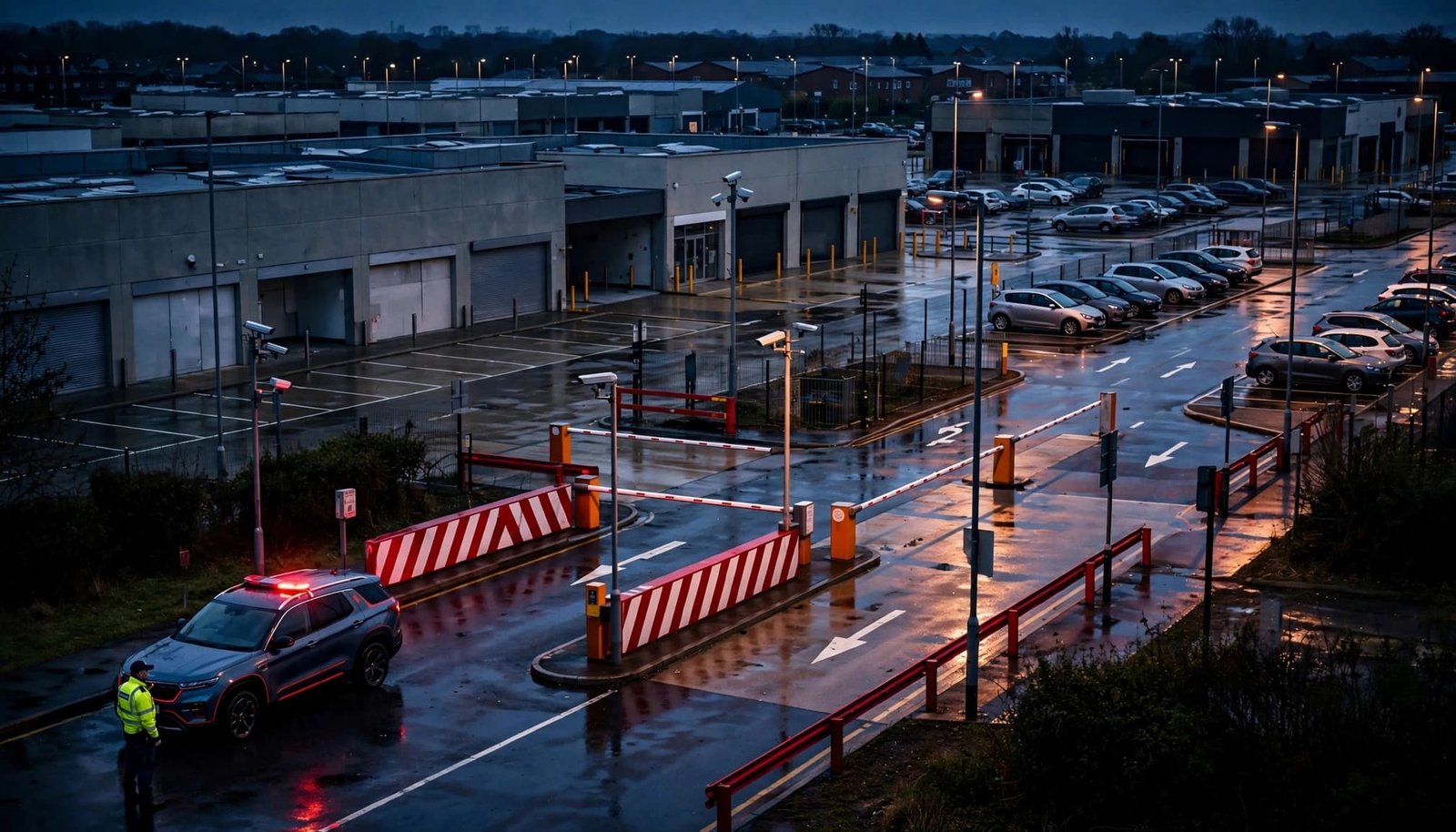
Mark every vehicle entrance, footpath, loading bay, emergency route, CCTV blind spot and poorly lit corner. Include electric vehicle charging bays, cash-machine areas, trolley parks and boundaries adjoining public land.
Then match threats to the location and time. Vehicle crime may rise after stores close. Organised retail crime often depends on quick access to an exit route. Severe weather can close part of a car park or obscure camera views. Protest activity may be lawful, disruptive or both, so staff need a calm reporting process rather than assumptions.
The BRC Retail Crime Survey 2025 put the direct cost of customer theft in 2023/24 at £2.2 billion, illustrating the wider scale of retail crime. That figure supports sensible investment, but it doesn’t replace a site-specific assessment.
Agree the operating model with occupiers
Hold a short monthly security meeting with the landlord, managing agent, security provider and tenant representatives. Police and local authority contacts should join where the issue warrants it.
Agree practical points:
- Tenants report incidents through one route, with an out-of-hours alternative.
- The estate team owns shared-area faults, such as broken lighting or damaged fencing.
- Security officers know when a store manager retains control and when estate management takes over.
- Every serious event produces a factual incident record, with actions allocated before the next meeting.
A plan that nobody owns is only paperwork.
Combine retail park security measures properly
The strongest security solutions combine people, technology and physical controls. Each has limits. A camera cannot challenge unsafe behaviour. A patrol cannot watch every loading bay at once.
Security officers and mobile patrols
SIA-licensed security officers provide a visible security presence, customer service, access control and emergency response. Their duties should be written into post orders, with clear patrol routes, welfare arrangements and radio procedures.
Good officers don’t spend their shift waiting for trouble. They check fire exits, notice damaged fencing, support vulnerable visitors, record suspicious activity and use conflict resolution before a situation gets worse. Security officers shouldn’t be expected to act as store detectives, traffic marshals and emergency planners without appropriate instructions and training.
Mobile patrols often suit lower-risk overnight periods, dispersed vacant units or several nearby properties. Manned guarding can be appropriate at a known pressure point, such as peak-time car park exits or a recurring loading-bay problem.
CCTV monitoring, remote monitoring and access control
High-definition CCTV is one of the security systems supporting a wider control framework. Camera locations should answer a clear question: who entered, what route did they take, and can the footage support an investigation? Cover vehicle entrances, pedestrian links, service yards and the approach to vulnerable units. Test night images in poor weather, not only in daylight.
Remote monitored CCTV can provide a cost-effective alternative to continuous on-site guarding where incident levels are low or cover is needed outside trading hours. It only works if alarms are configured properly, response instructions are current and a keyholder or mobile patrol can attend.
| Option | Best suited to | Operational condition |
|---|---|---|
| Static officer | Busy public areas or recurring incidents | Clear post orders and relief cover |
| Mobile patrol | Large, quieter estates overnight | Reliable response times and patrol records |
| Remote monitoring | Defined camera zones and out-of-hours risk | Tested audio, escalation and attendance procedures |
For public-space systems, use ProtectUK’s CCTV guidance when setting operational expectations. Cameras need active management, not a screen on a wall.
CCTV evidence is often lost through poor handover, unclear download authority or an unrecorded system fault, not because the camera was absent.
Manage vehicles without frustrating customers
Car park security is part of traffic management. A blocked service road delays deliveries and emergency access. Poor pedestrian crossings create injury risk. Uncontrolled parking can provide cover for theft, fly-tipping and vehicle crime.
Use ANPR for a defined purpose
ANPR technology can help identify overstays, manage authorised access or investigate vehicles linked to repeat incidents. It may also support traffic management by helping estates understand congestion at busy entrances.
Its value depends on fair signage, accurate data and a clear procedure for alerts. ANPR should support a defined decision as part of the estate’s wider security systems. Don’t collect vehicle data because the system can. Decide what decision ANPR supports, who can access reports and how mistakes are corrected.
Keep delivery and public routes separate
Use barriers, controlled gates, markings and timed delivery windows where the layout allows. Drivers should not need to guess whether a lane is public, service-only or an emergency route.
Review the arrangement with tenants. A supermarket’s early-morning delivery pattern may conflict with a gym’s peak arrivals or a restaurant’s waste collection. Small changes to signage and timing can improve traffic management without adding another guard.
Reduce retail crime through shared reporting
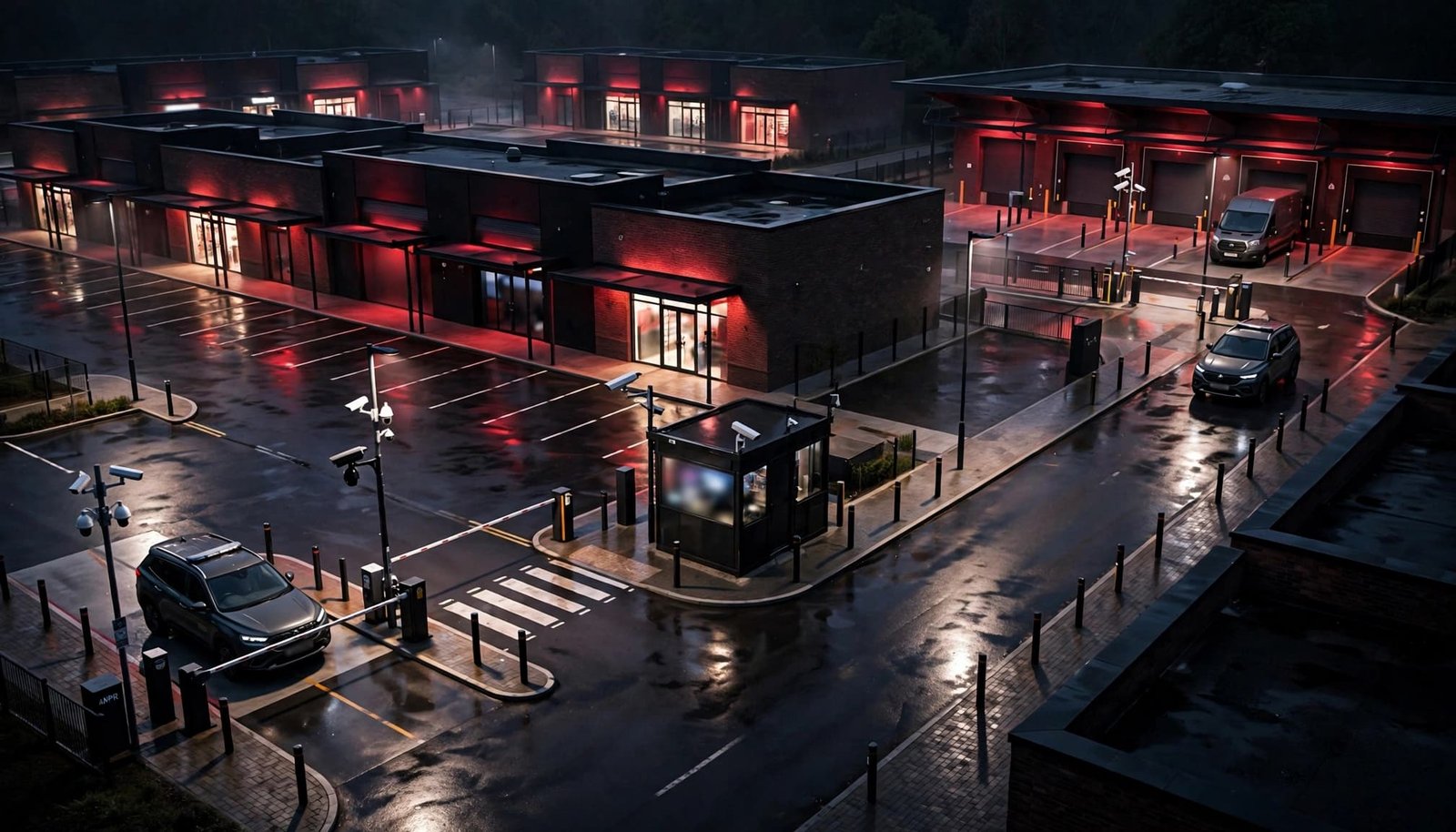
Car park security and loss prevention are not solely a tenant issue when offenders use shared car parks, communal routes and escape vehicles. Estate management can spot patterns that a single retailer cannot see.
Give staff a practical reporting route
Ask occupiers to report descriptions, behaviour, direction of travel, vehicle details where lawfully obtained, and any threats or violence. Avoid informal WhatsApp groups full of speculation. They create poor records and can unfairly identify people.
Security officers should preserve facts, support staff welfare and use proportionate de-escalation and conflict resolution where safe. They should call police where there is immediate danger or a crime in progress. Their reports need consistent fields so repeat activity can be identified.
Review incidents for patterns, not blame
A monthly review should separate theft, anti social behaviour, vehicle crime, vandalism, protests, system failures and health-and-safety events. Compare location, time, method and response.
If three incidents involve the same poorly lit rear route, the answer may be a light repair and a revised patrol route. It isn’t always more guarding. A shared loss prevention review should address the actual failure point.
Secure vacant units and loading bays
Vacant retail units attract trespass, metal theft, arson attempts and unauthorised storage. They can also become a route into neighbouring premises.
Make empty units visibly controlled
Inspect each vacant unit after handover and record the condition of doors, shutters, roof access, utilities, alarm status and alarm response instructions. Remove waste promptly. Check that advertising hoardings, fencing and temporary boards cannot be easily lifted or used to conceal entry.
Set inspection frequency according to risk. A unit beside a busy road needs different attention from one inside a managed service yard.
Control keys, contractors and deliveries
Document key holding arrangements and maintain a current keyholder list. Cancel access when contractors finish. Use permits or a booked-in process for higher-risk works, including hot works and roof access.
Loading bays need the same discipline. Drivers, contractors and tenant staff should know where to wait, where they may park and how to report a suspicious package, damaged vehicle or aggressive behaviour. Staff, contractors and security officers should also have clear conflict resolution guidance for difficult interactions.
Prepare for Martyn’s Law without guessing
The Terrorism (Protection of Premises) Act 2025, commonly called Martyn’s Law, received Royal Assent on 3 April 2025. It is not yet in force. Government guidance says commencement is expected in spring 2027 at the earliest.
Check whether the duty applies to your estate
The legal position depends on the premises, how they are used and expected capacity. Shops and restaurants may fall within scope where at least 200 people can reasonably be expected at the same time, whilst larger locations may meet the enhanced threshold at 800 or more.
Do not treat an open-air retail park as one automatic category. Review leases, control of common parts, tenant occupation and capacity assumptions. The statutory Martyn’s Law guidance should sit beside your own professional advice where needed.
Build shared emergency arrangements now
Prepare a proportionate plan for evacuation, invacuation, lockdown, communications, suspicious items, hostile vehicle concerns and reunification. Test who can send a message to all tenants, who meets emergency services and where incident logs are held.
The Security Industry Authority will regulate the Act. Its published role and implementation timetable makes clear that preparation should be practical, not performative.
This is not legal advice. Duties and responsibilities depend on the site, lease arrangements, local authority requirements and current legislation.
Protect CCTV evidence and personal data
CCTV footage can help establish facts after theft, a collision or violence. It can also create data-protection failures if anyone can search, download or share it without controls.
Set clear footage rules
Property managers should document the lawful basis for processing, camera purposes, access permissions, download approval and retention decisions. Use visible signage that explains CCTV is in use and why. The ICO’s CCTV and video-surveillance guidance covers installation, management, operation and public awareness.
Keep an evidence log. Record who exported footage, when, why, which cameras were involved and who received it. If police request material, verify the request and retain the audit trail.
Test the system after every change
A camera may be online but poorly focused, obscured by growth or recording the wrong time. Check coverage after building works, seasonal lighting changes and alterations to parking layouts.
Include CCTV faults in the same monthly report as security incidents, so the property manager can assess whether the site’s security systems remain dependable.
Frequently asked questions
How often should a retail park security plan be reviewed?
Review it annually as a minimum, and after a serious incident, major tenant change, refurbishment, new traffic layout or change in threat level. Monthly incident reviews will show whether earlier action is needed.
Can remote CCTV replace security officers?
Sometimes, for defined locations and hours. It cannot replace an officer where a visible presence, customer support, physical response or traffic management is required. Base the choice on incident history, response arrangements and the site layout.
Who is responsible for crime in shared areas?
The answer is usually set by the lease, estate regulations and management agreement. Landlords and managing agents should define the shared-area response before an incident, then keep tenants informed of actions affecting trading or safety.
A security plan that works on an ordinary Tuesday
Retail park security is built through ordinary details: a repaired light, tested security systems, a named keyholder and an officer who knows the site. Those measures are less glamorous than a large security proposal, but they’re what prevent gaps becoming incidents.
Keep the plan current, assign every action and test it with the people expected to use it. Car park security must follow the same routine of ownership, testing and review. Clear ownership is the basis of a safe, workable retail park.


0 Comments