

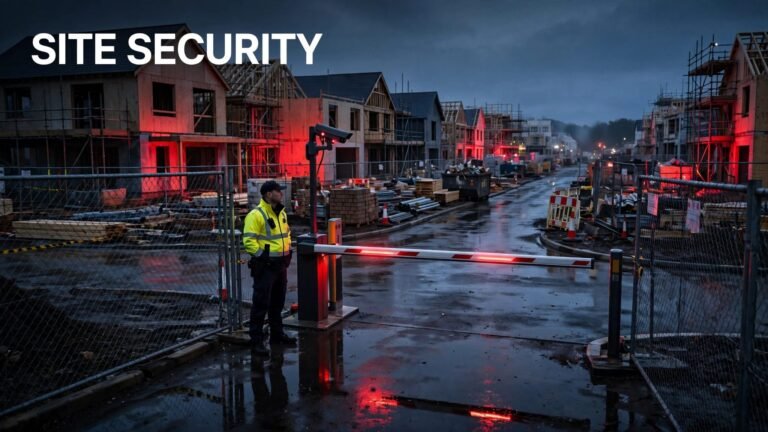
A partly built housing scheme is not a residential estate yet. It is an open workplace, storage yard and delivery point, as well as a tempting target for theft and vandalism after hours. Unauthorised entry can also put people, materials and progress at risk.
The right security plan protects more than plant and materials. It helps keep trades moving, preserves evidence when something goes wrong and gives the project team a proper record of who entered the site. Construction site security services should be planned alongside logistics, welfare and fire arrangements, not added after the first incident.
Key takeaways for development teams
- Residential construction sites need layered protection, combining CCTV monitoring, access control and mobile security patrols to cover different risks.
- Temporary CCTV, alarms and alarm monitoring work best when clear escalation procedures guide the response.
- Security guards bring judgement to difficult situations, including delivery checks, trespass and emergency access.
- Security records should support site management, insurance discussions and incident investigations.
- CCTV use needs a defined purpose, suitable notices and sensible data-handling procedures.
- Security provision must change as the development moves from groundworks to fit-out and handover.
Why residential developments need a different approach
General residential security protects occupied homes. Construction site security protects an incomplete, changing workplace, where building site security must account for moving perimeter lines, temporary doors and shared contractor access.
A single phase may contain exposed copper cable, power tools, fuel, plant, appliances awaiting installation and completed plots with no permanent residents. The risk is not only theft. Unauthorised intruders can be injured in excavations, interfere with unfinished services or start fires where work has stopped for the night. Poor access controls can also allow unauthorized access to vulnerable areas.
For completed plots awaiting occupation, vacant property services may provide useful additional checks, but they don’t replace construction-site protection.
Security is a project-control cost
A stolen machine or damaged plot can cause project delays across several trades. That means missed deliveries, altered programmes, replacement orders and difficult conversations with purchasers or funders.
Treat security as part of the operating plan. Give it a budget, a named site contact and a written scope that changes with the works. A camera on a pole may look reassuring, but it isn’t a response plan.
Start with a live site risk review
Complete regular risk assessments with the principal contractor, walking the boundary to identify weak points. Check pedestrian gaps, shared access roads, unsecured materials, blind corners and plots nearing completion.
Review the security measures after major changes, including new hoarding lines, scaffold installation, utility works or the handover of the first homes. What was appropriate during foundations may be inadequate when kitchens, boilers and electrical fittings arrive.
Construction site security services: CCTV and alarms
Remote systems are useful because they can cover large areas without placing a person at every boundary point. They provide temporary security solutions before permanent infrastructure is ready, but their value depends on positioning, monitoring and what happens after an alert.
Rapid deployment CCTV towers
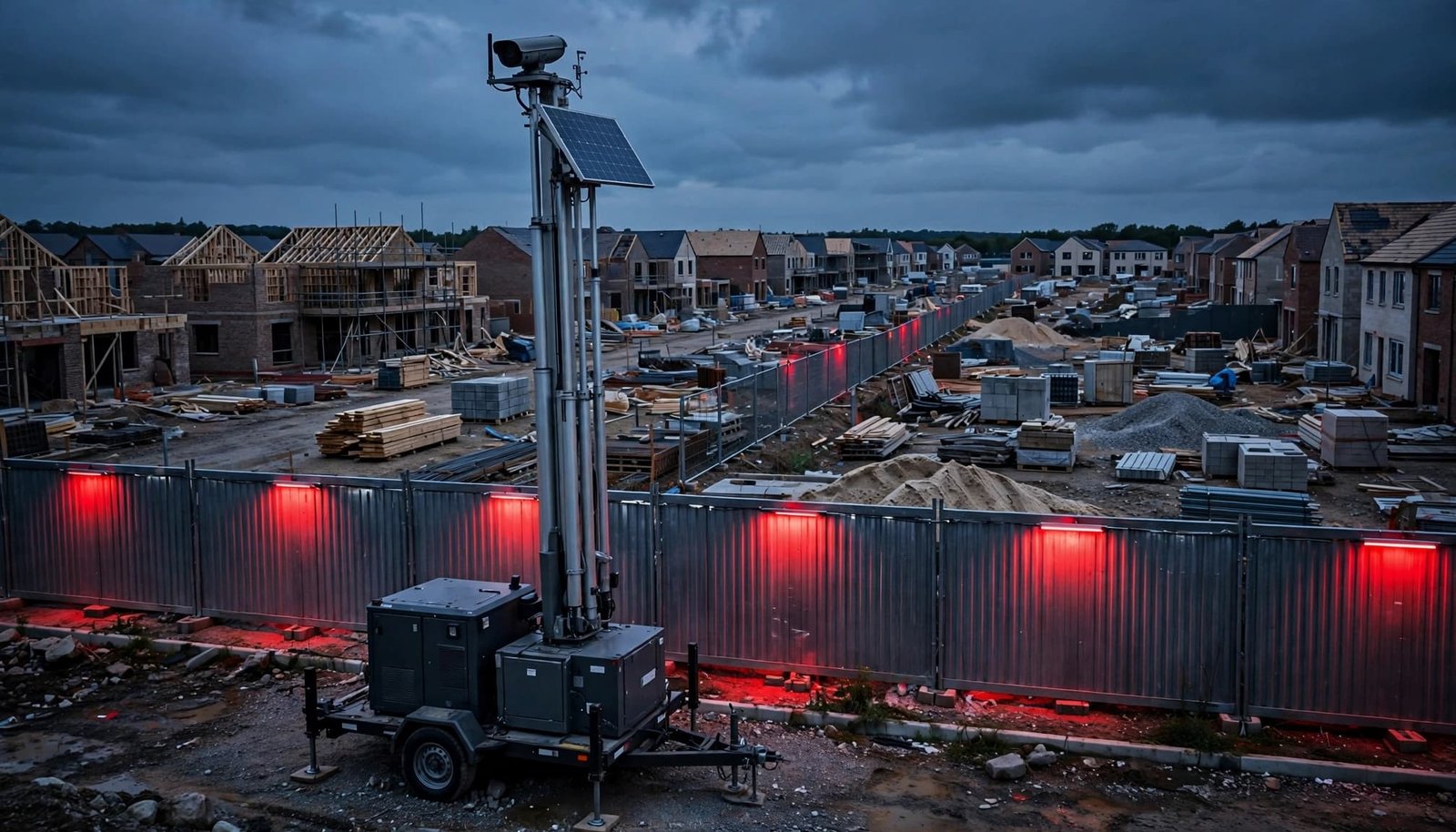
Rapid deployment CCTV towers are temporary units placed where fixed infrastructure isn’t ready. Some models use solar panels, battery storage and mobile connectivity, so they may operate without a standard mains supply. Ask the provider to explain the expected power arrangement, connectivity limits, camera coverage and what happens during prolonged poor weather.
Place towers where cctv cameras can observe approaches, material compounds, plant areas and main gates. Position them to support effective cctv monitoring, not merely because they are easy to install. A tower that records an incident after it has happened may still help an investigation, but live remote monitoring can allow an operator to assess activity and follow the agreed escalation route.
Video verified alarms and key holding
A traditional intruder alarm can generate activations without showing what caused them. Visual assessment through alarm monitoring allows a team to distinguish likely intrusion from weather, wildlife or routine site activity before requesting a response.
That does not remove the need for clear instructions. Effective key holding and alarm response requires controlled contacts, keys and gate codes, with clear escalation to police, fire and rescue, or the site manager.
An alarm response that cannot get through the gate, identify the right plot or reach the duty manager is a paper process, not site protection.
Guards, patrols and physical perimeter security
Technology sees activity. People can question it, record it and make practical decisions when a delivery arrives early or an unfamiliar person is found inside the boundary.
Manned guarding and controlled access
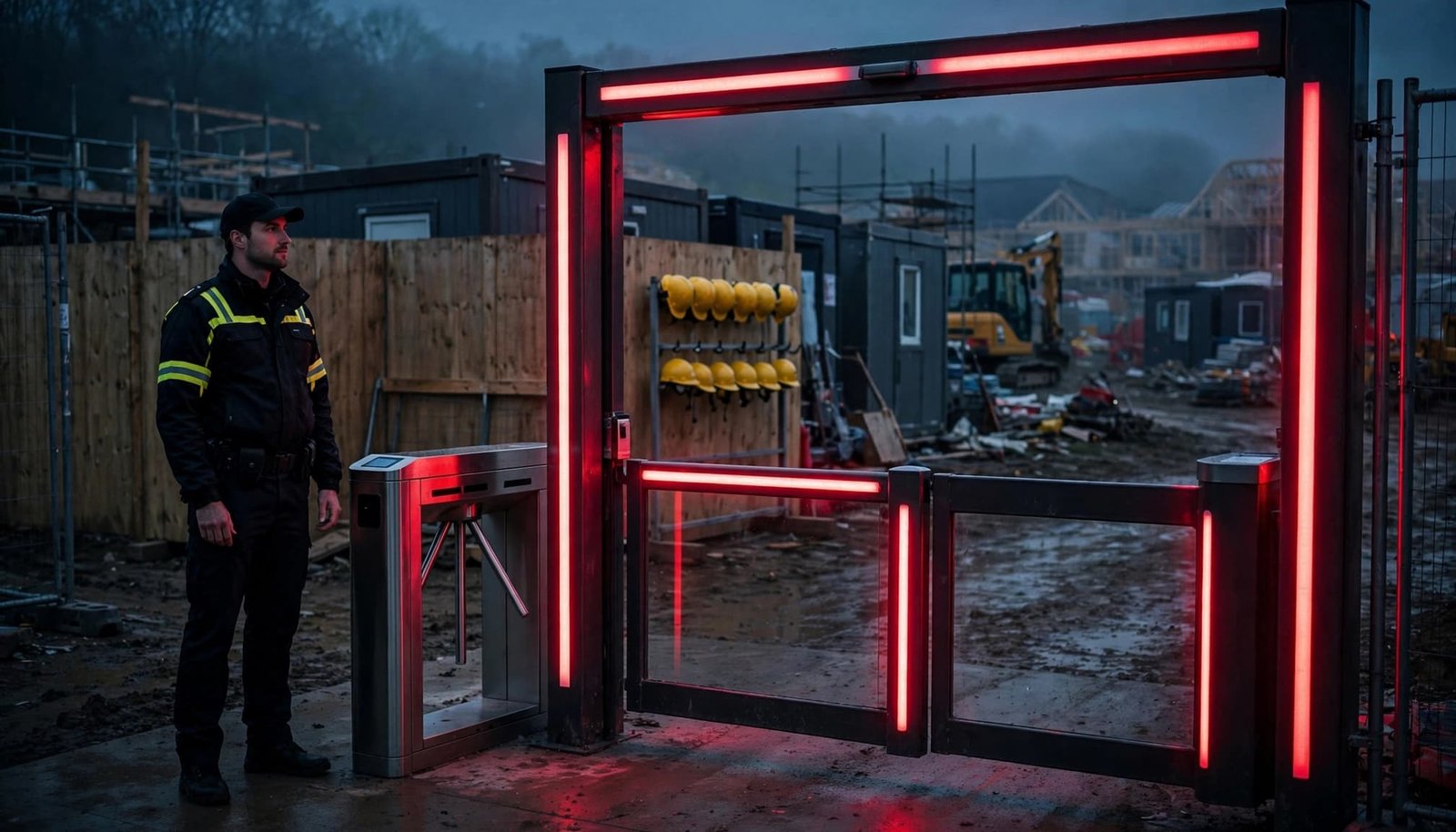
Manned guarding is most useful where the site has regular deliveries, high-value materials, public interfaces or a history of unauthorised access. Security guards can manage access control, check inductions, direct drivers, control keys, record visitors and manage deliveries. They can also challenge suspicious behaviour without escalating a routine issue.
Where a role requires a front-line licence, confirm that the operative has the appropriate category. GOV.UK explains that applicants need a licence-linked qualification before applying for an SIA licence. Ask the provider how licences are checked, who supervises officers and how relief cover is arranged.
Patrols, barriers and hoarding
Mobile security patrols suit large or dispersed developments where permanent guarding is not proportionate. Visits should not become a decorative tick-box exercise. Require time-stamped, photo-supported reports showing gates checked, vulnerable areas inspected and defects escalated.
Use physical security to create a secure perimeter, slow entry and direct people through one controlled point. Appropriate measures may include locked gates, robust hoarding, anti-climb features, lighting, protected material cages and carefully positioned barriers. Where a development has a public interface, exposed frontage or credible vehicle-ramming concern, assess whether hostile vehicle mitigation is needed. This isn’t a default requirement for every scheme. The correct arrangement depends on the site layout and emergency access requirements.
Build fire response into perimeter security
Security and fire planning often sit in different folders. On a live residential scheme, they meet at the gate, where security, fire response and site safety arrangements come together. A response team needs access, an accurate location and a contact who understands the site’s current hazards.
The Health and Safety Executive states that the Regulatory Reform (Fire Safety) Order 2005 sets out the framework for general fire safety on construction sites. Its HSG168 fire safety guidance is aimed at clients, designers and those managing construction work with significant fire risks.
Project teams should consider this guidance alongside applicable health and safety legislation and the site’s wider safety obligations.
Agree the emergency sequence
Write down what happens when smoke, fire or suspicious activity is identified. The process should cover the precise site address, access gate, emergency contact, assembly information and the person authorised to meet emergency services.
Do not treat alarm monitoring as a substitute for suitable fire detection, or lock an emergency response behind a forgotten code. Test the arrangement after gate changes, phased handovers and new road layouts.
Keep protection measures separate but connected
Perimeter cameras and intruder alarms are not fire detection systems. These security measures must be assessed and managed separately from fire arrangements.
They should still share practical information. A security control room can receive an escalation instruction, a guard can preserve emergency access and a patrol can report blocked routes or damaged extinguishers. That connection needs a written protocol, not an assumption made during a crisis.
CCTV compliance and useful incident records
CCTV monitoring should have a clear purpose, limited coverage and a responsible owner who can explain how footage is handled. The ICO says organisations should explain why they are using CCTV before installing it.
Set rules before cameras go live
Record the reason for each camera, the areas it covers, who can view recordings and how long footage is retained. Avoid capturing neighbouring homes or public areas where that is not necessary for the security purpose.
Businesses using CCTV may need to register with the ICO and pay a data-protection fee unless an exemption applies. Check the current GOV.UK CCTV requirements rather than relying on an old template. Suitable notices should also tell people CCTV is in use.
Report facts, not vague impressions
Every incident report should include the date, time, location, persons involved, actions taken, footage reference and who was notified. Keep alarm monitoring event records distinct from CCTV footage, but document both consistently. Add photographs where appropriate, but keep personal data controlled.
A good report allows the project manager to spot patterns. Repeated attempts at one gate may justify moving a tower, repairing hoarding or changing delivery procedures. “All clear” reports with no detail do not provide that evidence.
How to evaluate a security provider
Begin with a site survey, then ask for a written proposal that identifies actual risks. A generic package with a camera, a guard and a monthly invoice is not enough. Look for site security solutions tailored to the development’s layout and programme.
Compare the service options on practical questions, including how mobile security patrols will support fixed systems:
| Area | What to ask |
|---|---|
| Coverage | Which entrances, compounds and plots are observed, and where are the blind spots? If there’s an identified public-facing vehicle risk, is hostile vehicle mitigation needed? |
| Response | Who receives alerts, who attends, and what is the escalation timescale? |
| Staffing | How are security guards’ licences, training, supervision and relief cover managed? |
| Reporting | Will reports include patrol times, incidents, defects and actions taken? |
| Change control | How will the plan be revised as the site layout and programme change? |
Hiring equipment can suit a fixed project period because installation, repositioning and removal are normally part of the service discussion. Buying may be appropriate for a developer with repeated work and internal capacity to manage maintenance, monitoring and data obligations. If phased handover leaves completed plots or empty units, ask whether vacant property services can be added. Compare the whole responsibility, including insurance requirements and your insurer’s documented conditions, not only the monthly figure.
Ask for a sample incident report and an example escalation procedure before appointing anyone. Confirm the names, access arrangements and escalation process for key holding and alarm response. The ordinary details are where weak arrangements usually show themselves.
Frequently asked questions
Can CCTV towers work without mains electricity?
They can, depending on the unit and conditions. Providers may offer towers using solar panels, batteries and mobile communications. Confirm the expected power source, charging assumptions, connectivity and contingency arrangements for the particular site.
Are security guards always required on a residential site?
No. Some lower-risk sites may be better served by controlled gates, alarms, CCTV monitoring and patrols. Guarding is often appropriate where there are frequent deliveries, active public access points, valuable stock or complex out-of-hours risks.
Do all construction security operatives need an SIA licence?
Licensing depends on the activity and role. Don’t accept a broad assurance that “everyone is covered”. Ask the provider to identify the required licence category for each deployed operative and provide evidence of current checks.
What should a mobile patrol report include?
At minimum, it should record arrival and departure times, areas checked, perimeter defects, suspicious activity, actions taken and photographs where useful. The report should reach the site manager quickly enough to repair weaknesses before the next night.
Is construction site security an optional extra?
It is a core project cost where assets, people and programme continuity need protecting. This may include key holding and alarm response, with agreed arrangements for keys, codes, contact lists and escalation. Confirm the provider’s response process, without assuming emergency attendance can be guaranteed. The sensible question is which combination of construction site security services fits the site’s present risks.
Put security into the site plan
Residential construction security works when people, technology, mobile security patrols and procedures support each other. Strong hoarding without reporting is incomplete. Cameras without response are limited. Guards without accurate site information are left to improvise.
Set a clear scope, review it as the build changes and insist on records that show what happened after every alert. If completed homes remain empty after handover, vacant property services may be appropriate, but they don’t replace construction-site security. Reliable security is practical, visible and accountable, even when nothing goes wrong.


0 Comments