

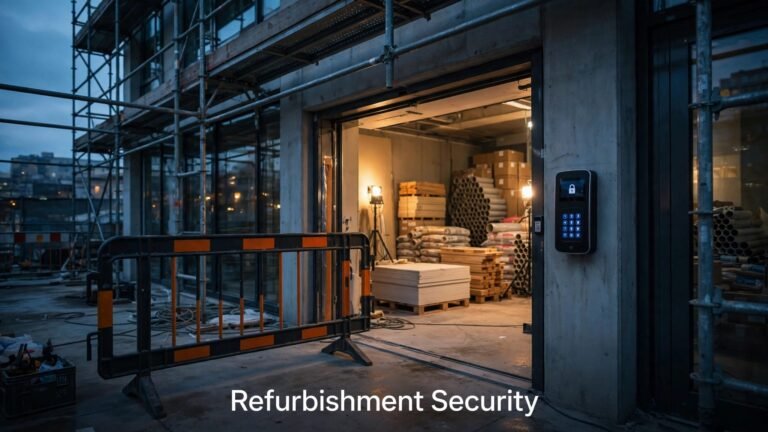
Keeping the existing alarm switched on is rarely enough for business premises undergoing refurbishment. Commercial premises security needs a written plan covering temporary openings, contractor access, valuable materials and the response when something goes wrong.
Doors disappear, partitions move and power supplies change, often whilst part of the business remains open. The property owner, principal contractor and security provider need clear responsibilities before those changes expose the building.
Start with the work programme, then assign protection to each stage.
Key takeaways
- Assess security before work begins, then repeat the assessment when scaffolding, temporary openings, deliveries or occupied areas change.
- Assign responsibility for gates, keys, alarm isolations and final lock-up, including cover when the usual manager is absent.
- Give contractors and visitors access only to approved areas, with records that establish permission, arrival and departure.
- Combine physical barriers, secure storage, suitable lighting and detection with an agreed response rather than relying on cameras alone.
- Preserve escape routes, fire precautions and emergency access whenever doors, partitions, services or security arrangements change.
- Record assets, policy conditions, inspections and handover decisions so the business can demonstrate what was protected and who was responsible.
1. Assess commercial premises security against the actual works
A refurbishment creates different risks from normal business operations. Assess the building as it will exist during the works, including periods when doors, glazing or services are incomplete. Consider the likely risk of burglary and other crime.
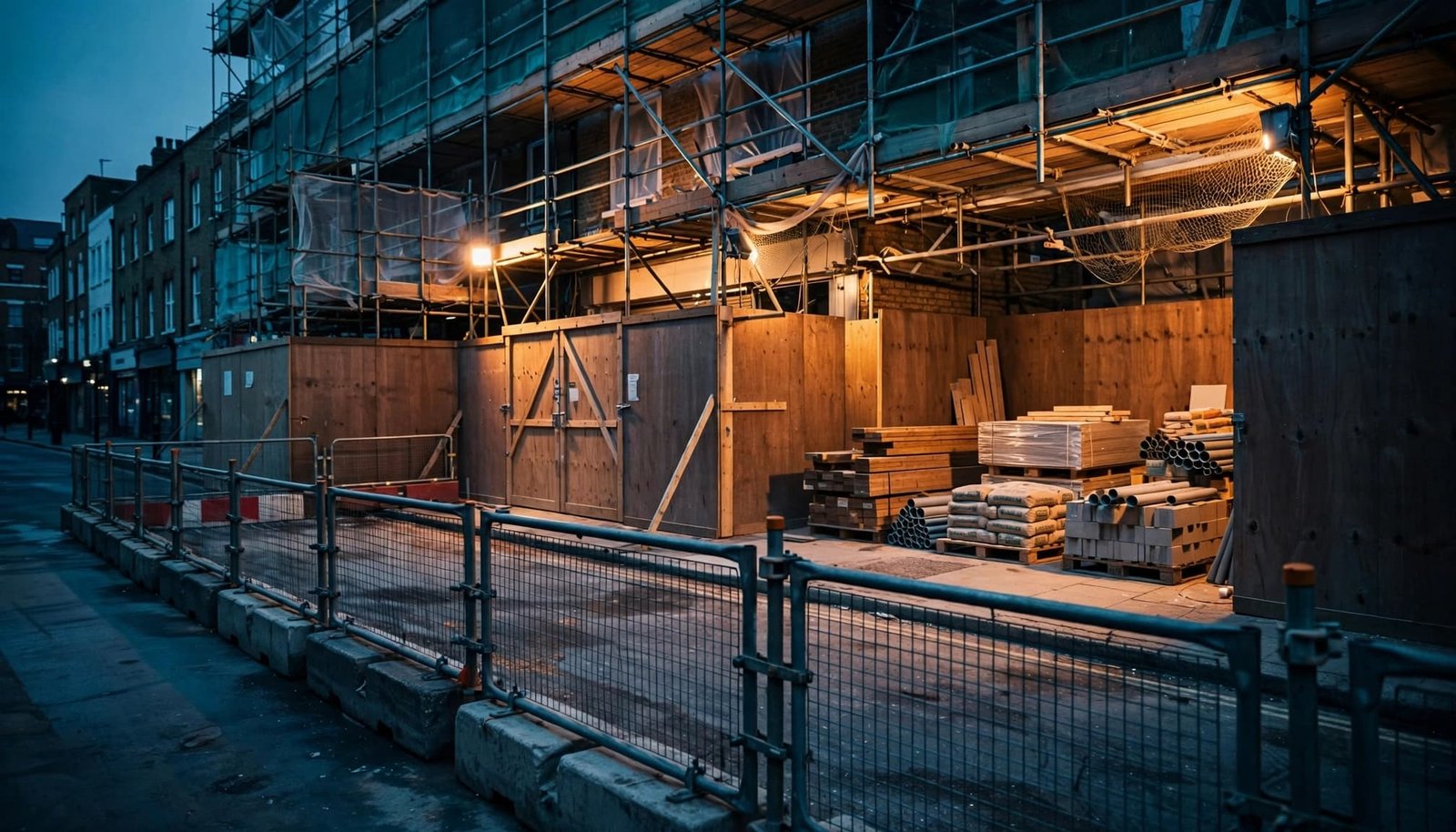
Walk the vulnerable areas
Inspect the side and rear elevations, entry points, roof, cellar, outbuildings and loading bay. Include shared corridors, adjoining vacant units and routes through neighbouring premises where access arrangements overlap.
Record what protects each route, what the refurbishment removes and what replaces it. A locked front entrance provides limited protection if scaffolding gives access to an unsecured first-floor window.
Assess the consequences as well as the likelihood of entry. Damage to a distribution board, communications cabinet or specialist machine may interrupt operations longer than the theft of replaceable tools.
Match protection to each phase
Strip-out may expose services and remove internal separation. Fit-out brings portable equipment, copper, electrical components and finished products that can be removed quickly.
Map those changes against the programme. Our guidance on security across construction phases explains why protection needs to change before valuable items arrive, rather than after a loss.
The assessment should identify measures that increase criminal effort, increase the risk of detection, reduce the incentive and reduce the potential reward. Prioritise weaknesses that undermine several controls at once, such as an open loading door beside an unmonitored store.
2. Assign responsibilities before contractors mobilise
A security plan needs named owners and clear authority. Listing the landlord, contractor and guarding company without allocating decisions leaves gaps when the building changes.
Separate property and project responsibilities
The property owner or facilities manager should provide the existing security arrangements, insurer conditions, tenant restrictions and emergency contacts. The principal contractor should explain how the works affect boundaries, access, services and daily occupation.
On projects in Great Britain, CDM 2015 requires the principal contractor to take reasonable steps to prevent unauthorised access. Appointing a security provider does not transfer that duty.
Fire responsibilities also need explicit allocation. Government guidance identifies several possible responsible parties for workplace fire safety, including employers, owners, landlords and occupiers.
Give security decisions an approval route
Name who can authorise an alarm isolation, issue a master key, approve weekend working or accept an unsecured opening. Record the deputy and escalation route when that person is unavailable.
The security provider needs current plans, safe patrol routes, restricted-area instructions and details of hazards. Contractors need the reporting route for damaged gates, lost credentials and suspicious activity.
Keep these arrangements in the project documentation and brief each incoming trade. A decision recorded in an email is easily missed by the officer completing an evening inspection.
Legal duties, fire legislation and insurance requirements vary by location. A UK-wide project should not assume that one jurisdiction’s arrangements apply unchanged elsewhere.
3. Address insurance and vacancy before exposure changes
Refurbishment can change the risk described when the insurance policy was arranged. Legal and insurance requirements vary by location, so confirm the applicable conditions with the insurer or broker before works alter occupation, security systems, structural openings or the value of property held on site.
Record the conditions that affect the programme
Identify the policy’s requirements for door hardware or other physical protection, alarms, inspections, hot works and unoccupied premises. Obtain written agreement where proposed works interrupt a required protection.
Clarify which policy covers the existing building, contractors’ equipment, materials awaiting installation and the completed works. Also establish how business interruption cover relates to an insured loss during refurbishment.
The RSA security risk-control guide provides useful context for combining physical protection, detection and security personnel. The operative conditions remain those in the business’s own policy.
Give the site manager a concise record of conditions affecting daily decisions. Insurance documents held only by head office cannot guide an unexpected alarm shutdown.
Treat extended closure as a separate arrangement
The insurer’s policy definition determines whether an extended closure is treated as an unoccupied property. Record the required inspection interval and any requirements for utilities or protective systems.
Use timers to vary internal activity where appropriate. Seal an unused letterbox shut from the inside, or provide a suitable secure alternative, to reduce access for unwanted materials.
Arrange mail collection and remove visible accumulations. Avoid public posts that disclose an unattended building or precise closure dates.
Before the closure begins, document the agreed cover and security arrangements. A daily contractor visit does not necessarily prevent a property being treated as unoccupied under its policy.
4. Protect boundaries, scaffolding and temporary openings
A refurbishment perimeter should discourage entry and channel authorised arrivals towards a controlled point. Gates should direct vehicle access through that point. Effectiveness depends on the gates, surroundings and maintenance, not height alone.
Build a usable perimeter
A minimum fence height of 2.1 metres is recommended in police commercial-property guidance. This is a security recommendation, not a universal legal requirement or a guarantee against climbing.
Remove nearby climbing aids, including pallets, skips and stored materials. Inspect fence connections, gate hinges, ground gaps and routes beside adjoining walls.
Select hoarding or fencing for the exposure and duration of the works. Our temporary security fencing guidance covers the practical distinction between marking a perimeter and resisting unauthorised entry.
Use warning signs to identify restricted areas and hazards, but don’t rely on signs instead of barriers or access control. HSE’s guidance on protecting the public during construction also makes site security a safety matter. Preventing trespass helps keep unauthorised people away from unfinished services, excavations and machinery.
Close gaps as the works progress
Arrange temporary protection before removing a door, window or external wall section. Record who installs it, who accepts it and who inspects it after working hours.
Utility connections and deliveries should not leave an unattended gap whilst responsibility passes between trades. Provide a temporary barrier until the permanent perimeter is restored.
Scaffolding can bypass otherwise secure ground-floor entrances. Assess ladder access, adjoining roofs and windows reached from platforms, then agree suitable controls with the scaffold contractor.
Keep emergency access available. Vehicle barriers must support the traffic plan without trapping occupants or obstructing fire service attendance.
5. Strengthen doors, windows and temporary closures
Door hardware should be selected as part of the complete opening. A strong mechanism fitted to a damaged frame, weak leaf or insecure glazing panel provides limited resistance.
Match the lock to the door
A five-lever mortice deadlock conforming to BS 3621 is generally recommended for suitable business-premises doors. Five levers alone do not establish compliance.
The Master Locksmiths Association explains how to identify BS 3621 locks. The relevant distinction is tested performance, rather than a description that sounds secure.
Assess frames, hinges, keeps and surrounding construction at the same time. Glass doors, aluminium shopfronts and electronically controlled entrances may require different hardware.
Escape doors need hardware appropriate to safe evacuation. A key-operated deadlock must not create a requirement to find a key before occupants can leave.
Assess shutters, glazing and boards together
Close and lock windows whenever the work area is unattended. Protect accessible glazing with suitable shutters, grilles or other assessed measures where the risk justifies them.
Temporary boards should be securely fixed and inspected for damage or removal. Their appearance should not conceal an opening that can be entered without triggering detection.
Include cellar hatches, rooflights, service doors and redundant openings in the door schedule. Record which closures are temporary and the date permanent protection will replace them.
Any alteration to a fire-resisting door needs competent assessment. Security reinforcement should preserve its fire and escape functions.
6. Control contractors, visitors and credentials
Access management should establish who is entering, why they are attending and where they may go. Recording a name after admission does not establish authority to enter.

Make arrival a controlled process
Give visitors a reporting point outside vehicle routes and active work areas. Match contractors against an approved work order, booking or responsible manager before granting access.
Record the person’s name, company, arrival, departure and approved work area. Collect vehicle details where they serve a defined security or traffic-management purpose.
Explain restricted areas, emergency arrangements and reporting procedures during induction. A pass confirms permission to enter; competence and permission for particular work require separate assessment.
Provide escorts where visitors cannot move safely or appropriately without them. Keep gates closed whenever entry is not being actively managed.
Limit access and test revocation
Issue individual, time-limited credentials where the system permits. Restrict contractors to the doors, floors and hours needed for their task, especially in multi-let buildings.
Visitor software records attendance and visit details. Access control determines which doors a credential operates. Where the systems connect, assign responsibility for approval, expiry and failed synchronisation.
Test removal of access as well as successful entry. A finished contractor’s pass should stop working without waiting for a monthly administration exercise.
Prohibit shared passes and uncontrolled code circulation. Record lost credentials, revoke them promptly and investigate whether replacement locks or codes are necessary.
Provide a staffed alternative for people who cannot use a touchscreen, smartphone or standard arrival process. Reasonable adjustments should preserve the approval decision rather than bypass it.
7. Manage deliveries and reduce insider opportunities
Delivery activity creates periods when gates remain open and several people assume somebody else has authorised entry. Book arrivals against the work programme and assign a receiving person.
Direct drivers to a defined waiting point. Verify the supplier, consignment and receiving contact before opening a secure area, then record acceptance or refusal.
Keep drivers within the area needed for unloading. A delivery to the loading bay should not grant access to occupied offices, production areas or internal stores.
Separate delivery approval from permission to remove property. Record collections of hired equipment, waste metal, redundant fittings and surplus materials against a named authorisation.
Insider risk includes opportunistic removal by people who already have legitimate access. Apply clear rules to employees, subcontractors, temporary workers and visitors without making unsupported accusations.
Explain reporting routes for missing tools, suspected crime, unusual collections and attempts to bypass controls. Investigate discrepancies against delivery records, access logs and available footage.
Any search procedure needs a lawful, documented basis and an agreed approach. Security staff should not improvise searches or assume that a uniform provides additional legal powers.
Keep records factual. An unexplained vehicle movement establishes something requiring investigation, not proof of theft by the driver.
8. Secure tools, materials and plant before they arrive
Delivery planning should limit the time valuable items remain exposed. Avoid bringing high-value materials or other valuables onto site substantially earlier than the programme requires.

Assign secure storage and custody
Use suitable locked stores, anchored tool chests or secure compounds rather than leaving equipment in open work areas. Keep keys under controlled custody, separate from the equipment they operate.
Secure portable machinery and immobilise plant when unattended. Keep vehicles and stored materials away from boundaries where they could assist climbing or conceal entry.
Provide storage appropriate to fuel, batteries and hazardous materials as well as their theft risk. A secure container is not automatically suitable for every substance or charging activity.
The Zurich construction-site security guide treats theft, arson and malicious damage as connected exposures. Storage decisions should account for all three.
Maintain an identifiable asset record
Create an inventory covering owned, hired and contractor assets. Record descriptions, serial numbers, ownership, photographs and the usual storage location.
Use a UV pen or another suitable method of property marking to identify appropriate items. Keep the identification record accessible away from the site, so it remains available after theft or damage.
Update the inventory when equipment arrives, moves or leaves. Distinguish items awaiting installation from those already incorporated into the building.
Allocate custody of vulnerable materials between delivery and installation. Copper cable, fittings and appliances should not become unowned stock because one trade has delivered them and another has not started.
9. Design lighting around detection and safe movement
Security lighting should reveal activity at entrances and along approach routes. More brightness does not automatically produce better surveillance or safer conditions.
Constant low-level dusk-till-dawn illumination is recommended in police commercial-property guidance. Bollard-mounted fittings are not recommended as the main arrangement because they provide limited useful coverage.
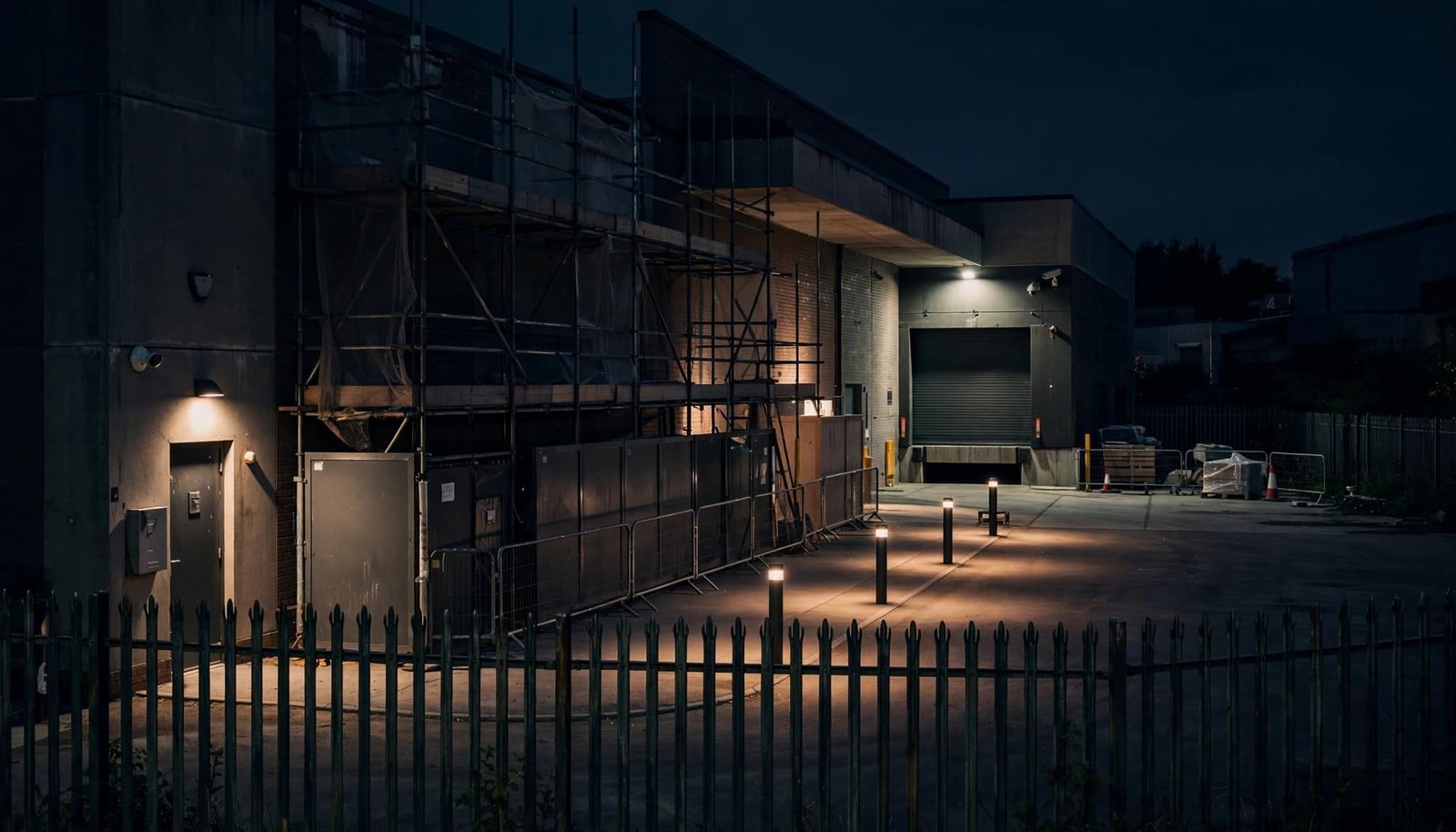
Assess the site after dark. Inspect faces at entrances, shadows behind hoarding, the loading bay and the route used by responding officers.
Use motion-detection lights where they address a defined gap. They should not leave a patrol route dark between activations or repeatedly trigger on ordinary traffic.
Position fittings to avoid glare into cameras, neighbouring premises and approaching drivers. A bright fitting aimed towards a camera can reduce the detail available in its recordings.
Review coverage after moving containers, erecting scaffold or changing hoarding. Trim vegetation and replace failed lamps promptly.
Keep security lighting distinct from emergency escape lighting. The presence of one does not establish that the other performs its required function.
Record how the temporary system is powered and who maintains it. A fitting connected to a contractor’s temporary circuit may go off when that contractor finishes for the day.
10. Choose alarms by detection and response requirements
An alarm system needs suitable detection, reliable signalling and a defined response. A sounder alone depends on somebody hearing it and deciding to act.
Decide whether monitoring is needed
A monitored alarm connects to a monitoring station, a specialist centre that receives and handles signals. It can alert a nominated person and request police attendance where the system and response arrangements meet the applicable requirements.
Police attendance is not automatic for every activation. The NPCC security-systems requirements distinguish systems eligible for police response and set conditions around their operation.
Monitoring is generally more useful where premises are isolated, losses could be substantial or nobody is reliably available nearby. An unmonitored alarm may suit a lower-risk situation, but its limitations should be accepted explicitly.
Alarm companies can be certified by the National Security Inspectorate (NSI) or the Security Systems and Alarms Inspection Board (SSAIB). Certification concerns defined services and standards; it doesn’t guarantee that every proposed design suits the project.
Control isolations and temporary detection
Review detectors before partitions move, doors disappear or dusty work begins. Record each isolation, its approval, the replacement protection and the deadline for reinstatement.
Provide backup arrangements for planned power or communications outages. Test the complete signalling route after changes rather than relying on a normal-looking keypad.
Consider professionally designed security fogging where the risk justifies it. Avon and Somerset Police identifies alarm-activated fogging as having a proven record of stopping burglars.
Fogging still requires suitable installation and coordination with fire and escape arrangements. Agree the response process separately through keyholding and alarm response arrangements.
An alarm isolation needs an owner, compensating protection and an end time. Leaving the rest of the system armed doesn’t resolve the uncovered area.
11. Position CCTV for evidence and handle recordings lawfully
A camera should answer a defined operational question. Depending on the location, that may be whether somebody crossed the boundary, entered a store or removed property.
Test the view during changing conditions
Cover access points, vulnerable boundaries and high-value storage without assuming one wide view will provide every necessary detail. Recordings should establish useful movement and, where required, identification.
Test the CCTV system in daytime and at night. Check for glare, scaffold poles, dust, parked vehicles and large waste containers that may block previously clear views.
Specify what happens when power, broadband or mobile connectivity fails. Wireless equipment still depends on power and a usable communications route.
Distinguish recorded CCTV from actively monitored surveillance. Footage available after a theft cannot provide intervention during the incident unless someone receives and assesses an alert.
Define purpose, access and retention
Commercial CCTV must comply with the Data Protection Act 2018 and applicable UK data-protection requirements. The government’s business CCTV guidance explains the related obligations, including the data-protection fee unless an exemption applies.
Document the surveillance purpose, provide suitable notices and restrict footage to authorised users. Set retention according to that purpose rather than keeping recordings indefinitely.
Avoid unnecessary coverage of neighbouring homes, private areas and unrelated workspaces. Audio recording requires separate justification and should not be enabled merely because the equipment supports it.
Secure the system itself
Replace default passwords and use individual accounts, with multifactor authentication where available. Restrict contractor remote access and remove it when the authorised task ends.
Keep recording equipment in a protected location and apply appropriate updates. Separate temporary security equipment from business networks where the network design requires it.
Assign responsibility for footage exports, access requests and incident preservation. A camera installation creates information-handling duties as well as a deterrent.
12. Match guarding and patrols to the gaps
Physical attendance adds judgement and action that equipment alone cannot provide. The requirement depends on access pressure, site hazards, asset exposure and the hours without normal supervision.
Select the right attendance model
An appropriately SIA-licensed security guard provides an on-site presence during the assigned shift and can quickly alert police. That presence may support entrance control, patrols, lock-up inspections and incident reporting.
Mobile patrols provide visits rather than continuous coverage. They can identify damage, unsecured doors and other defects, but activity may occur between visits.
Remote monitoring supports wider observation, provided alarms generate useful information and somebody is assigned to act. Combining services should address identified gaps rather than duplicate observations.
Our guidance on choosing a guarding provider covers the importance of site-specific instructions and relevant operational capability.
Give responders safe instructions
Define what the officer should do after an alarm, suspected intrusion or damaged boundary. Include safe observation points, escalation contacts and circumstances requiring emergency services.
Do not require an officer or employee to enter a building where intruders may remain. Site hazards may also make an otherwise routine inspection unsafe.
Provide current keys, codes and plans through controlled arrangements. Record changes before responders need them during an incident.
Licensing concerns the individual and activity. The SIA Approved Contractor Scheme concerns company assessment, whilst Secured by Design is a police initiative supporting the security of buildings and their surroundings. These are different forms of assurance, not interchangeable approvals.
13. Preserve fire safety throughout the refurbishment
Security changes must preserve evacuation, fire detection and emergency access. A chained exit or isolated alarm can create an immediate danger even when introduced to address a genuine theft risk.

Reassess escape routes and temporary separation
Update the fire risk assessment when the works change routes, occupancy, alarm coverage or fire-resisting construction. London Fire Brigade’s guidance on fire risk-assessment responsibilities places responsibility on identifying hazards and acting on them.
Assess occupied areas and the construction zone together. A contractor’s temporary partition may alter the route used by employees or conceal an exit from visitors.
Keep escape routes clear and exits available whenever people are present. Access-control failure arrangements should be designed around the door’s escape and security functions.
Maintain suitable emergency illumination and warning arrangements. Security personnel should report deficiencies, but their presence does not replace the required fire precautions.
Control ignition sources and impaired systems
Manage hot works through an appropriate permit process, competent supervision and the necessary post-work monitoring. Coordinate the arrangements with the fire risk assessment and insurance conditions.
Remove combustible waste regularly and keep it away from vulnerable elevations. Secure fuel and hazardous materials using storage suitable for their contents.
Dust covers, detector isolations and fire-alarm impairments require controlled procedures. HSE’s construction fire-safety guidance supports an assessment-led approach to precautions during the works.
Coordinate reinstatement with the contractor responsible for the affected system. An empty corridor does not establish that detection, compartmentation and emergency lighting have been restored.
Keep the fire service access route and emergency information current. Security barriers should have an agreed means of authorised access without delaying evacuation.
14. Protect occupied areas and business continuity
A partly occupied building needs a clear division between business operations and construction activity. Temporary partitions should support the agreed security and safety arrangements rather than simply screen the works.
Identify public areas, shared facilities, tenant premises and restricted rooms. Contractor credentials should not open occupied areas merely because those doors belong to the same access-control system.
Protect communications rooms, server cabinets, electrical switchgear and business records. Loss of a small component or unauthorised connection may cause disruption beyond its replacement value.
Schedule power shutdowns and network changes with the business operator. State which alarms, cameras, access readers and communications services will be unavailable, and provide temporary protection.
Keep emergency contacts, essential records and recovery information accessible away from the affected premises. Backups should remain usable if equipment on site is stolen or damaged.
Identify dependencies before promising that the business can remain open. A secure reception is insufficient if the only customer route crosses an active unloading area.
Provide staff with short instructions covering changed entrances, unusual visitors and defect reporting. Explain who can stop access when a temporary arrangement fails.
For small shops, priorities may centre on the shopfront, rear door and stock. Larger warehouses may need stronger vehicle controls, separated compounds and a more extensive response arrangement.
15. Use a documented daily close-down routine
The final inspection needs one accountable person, with a named replacement. Several trades leaving independently can leave a door, window or temporary supply outside everyone’s assumed responsibility.
Use a recorded sequence that follows the site layout:
- Confirm departures and reconcile outstanding visitors, contractors, passes and keys.
- Inspect the boundary, scaffold access, temporary openings, doors, windows and loading bay.
- Secure tools, materials, vehicles and waste, then inspect escape routes and required fire precautions.
- Restore agreed detection, test relevant communications and confirm that monitoring or response services have the correct instructions.
- Record defects, temporary protection, outstanding actions and the person accepting responsibility overnight.
A signature should confirm a completed inspection, not merely that the form reached the office. Photographs can support selected checks, but they do not establish conditions outside the frame.
Set a clear escalation rule for defects that cannot be repaired before departure. The site manager should authorise suitable temporary protection rather than leave the issue for the next shift.
Apply an enhanced review before weekends, bank holidays and extended closures. The construction-site security checklist provides a wider reference for coordinating these controls.
16. Plan incident handling and security handover
An incident response should protect people first, preserve information and restore protection. Staff should know the reporting route before they discover an open door or missing equipment.
Respond without disturbing evidence
For a crime in progress or immediate danger, call 999. Use the appropriate non-emergency reporting route for incidents without an immediate threat.
Keep people away from a potentially occupied or unsafe building. Do not touch disturbed equipment or attempt to establish the extent of loss by moving items unnecessarily.
Inform the police and insurer promptly. Record the discovery time, observed conditions, witnesses and actions taken, then preserve relevant CCTV, access logs and photographs.
Arrange repairs and temporary protection once the relevant evidence requirements are addressed. Reassess exposure after the incident because offenders may return, particularly when stolen equipment has been replaced.
Transfer control at completion
Handover should establish that permanent security works and temporary permissions have been closed out. Test doors, locks, shutters, alarms, CCTV and access-control functions against the agreed scope.
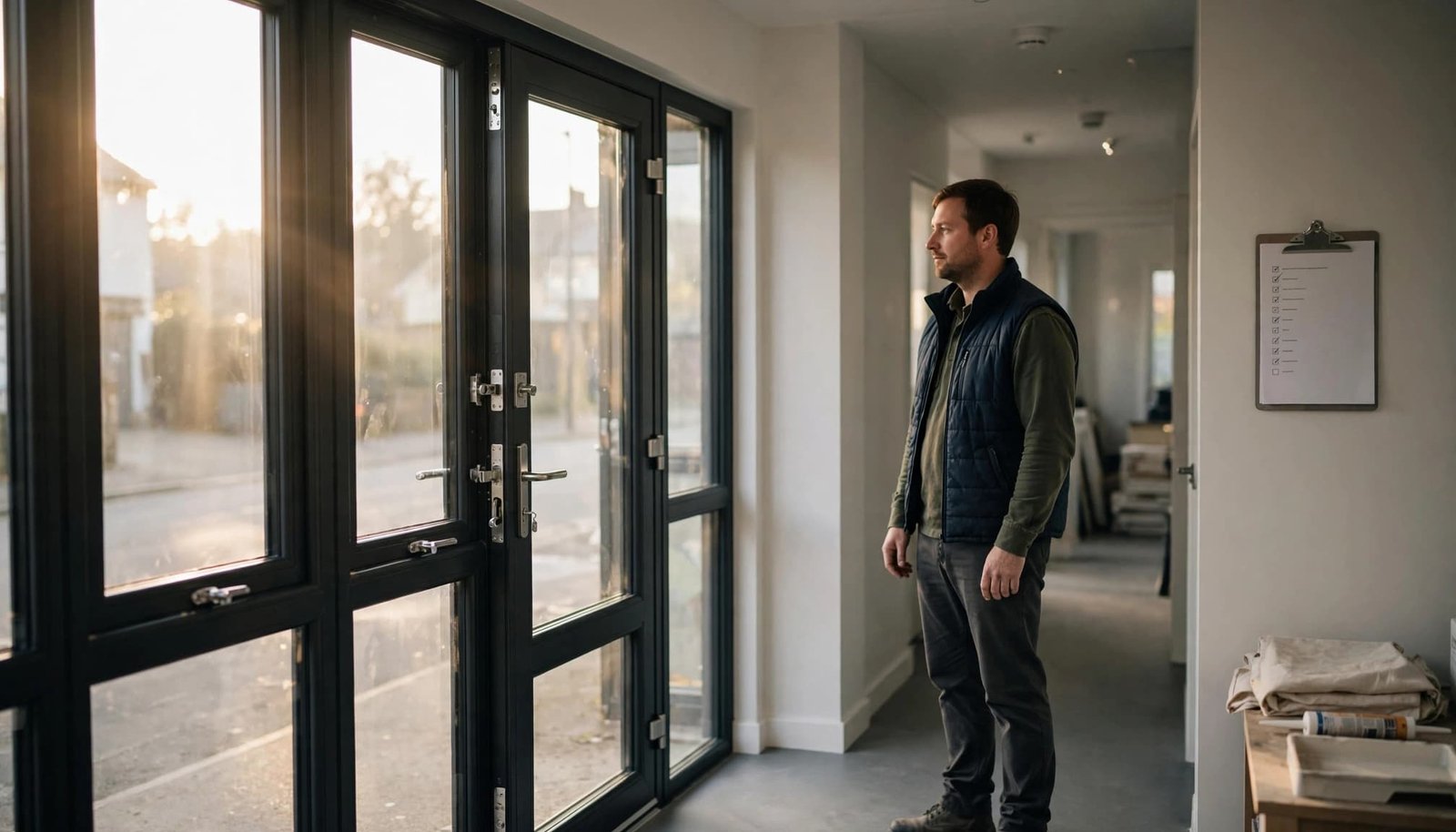
Recover keys and passes, revoke contractor accounts and replace shared codes where necessary. Remove temporary remote access that no longer has an authorised purpose.
Transfer operating instructions, maintenance arrangements, outstanding defects and current response contacts to the facilities team. Record who accepts continuing responsibility and when that transfer takes effect.
A practical completion certificate does not, by itself, establish that every security defect has been resolved. Keep unresolved items assigned until their completion is recorded.
Frequently asked questions
What does commercial security include during refurbishment?
Commercial security covers protection of people, property, information and operations against unauthorised access, theft, damage and related disruption. During refurbishment, it also needs temporary boundaries, controlled contractor movement, secure storage and response arrangements that remain workable as the site changes.
Should a business choose a monitored alarm?
Monitoring is generally appropriate where somebody needs to assess and escalate activations outside working hours. The decision depends on exposure, insurer conditions and available response. A monitored system still needs suitable detection, reliable signalling and an agreed attendance arrangement; monitoring alone does not provide physical intervention.
Can the existing CCTV remain in use?
Existing cameras may remain useful, but their views and power supplies need reassessment. New partitions, scaffold and storage can obstruct coverage. The government’s commercial CCTV installation guidance points businesses towards the ICO’s requirements for camera use and stored images.
Is a 2.1-metre fence sufficient on its own?
No single height establishes adequate protection. The 2.1-metre recommendation needs consideration alongside anti-climb characteristics, gate security, nearby climbing aids and opportunities for concealed entry. The boundary also needs regular inspection and a response when damage or interference is discovered.
What matters most during a long closure?
Prioritise the policy’s unoccupancy conditions, sound physical protection, maintained detection and an available response. Add documented inspections, controlled keys, mail collection and timers that vary internal lighting and activity. Assign responsibility for faults and changing conditions throughout the closure rather than relying on the inspection completed before departure.
Keep protection aligned with the works
Commercial premises security during refurbishment depends on keeping protection aligned with changing conditions. Assign responsibility before openings appear, systems are isolated or valuable materials arrive.
The strongest plan connects physical controls and accountable action. Every significant change should leave the site manager, facilities team and security provider clear about what remains protected and what requires attention.
Before the next phase begins, resolve the gaps created by that phase. A secure building at the start of the project can become exposed long before the work is complete.


0 Comments