

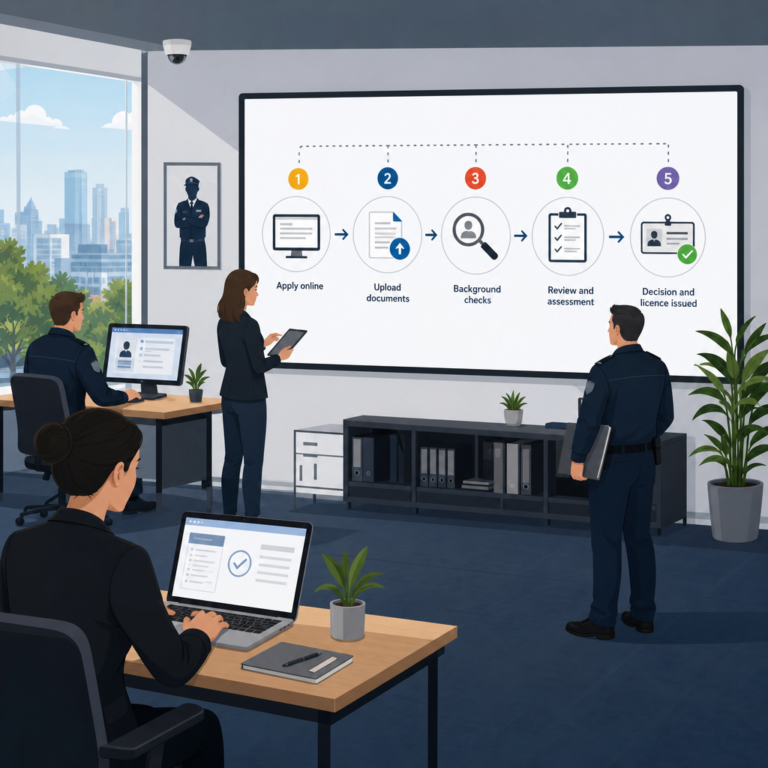
Dave still remembers the phone call. A guarding contract was ready to start on Monday, three new recruits were trained, uniformed, and eager—and then the compliance officer rang to say two of the three SIA licenses hadn’t cleared. The client’s site went uncovered for four days. It wasn’t a training failure or a background problem. It was paperwork. A missed reference, an address history with an unexplained gap, a passport photo that didn’t meet spec. Small things. Expensive things.
That story repeats itself across the UK security industry more often than anyone would like to admit. The Security Industry Authority (SIA) license application process isn’t complicated in the way that, say, tax law is complicated—but it is unforgiving of small errors, and it runs on its own timeline regardless of how urgently your business needs staff on site. If you’re a facilities manager, a procurement lead, or you’re personally applying for a badge to work as a door supervisor or CCTV operator, understanding the mechanics of this process before you start saves weeks of frustration later.
This article walks through the entire journey—from working out which license you need, through to what happens after approval, and what to do when things go wrong.
Why the SIA License Process Exists in the First Place
Before diving into forms and fees, it’s worth understanding why the system is built the way it is. The Security Industry Authority was established under the Private Security Industry Act 2001, largely in response to concerns about unregulated door supervisors and guards operating with no vetting, no training standards, and in some cases, criminal records that made them entirely unsuitable for positions of trust.
The licensing regime exists to answer three questions about anyone working in a licensable role:
- Are they who they say they are?
- Do they have a criminal history that should disqualify them?
- Have they completed the minimum training required for the role?
Every stage of the application process is designed to answer one of those three questions with as much certainty as possible. Once you see the process through that lens, the seemingly bureaucratic steps—proof of address spanning five years, criminal record checks, training certificates—start to make a lot more sense.
For businesses procuring security services, this matters too. When you’re evaluating a guarding contractor or an access control provider, checking that their staff hold current, valid SIA licenses isn’t a box-ticking exercise—it’s your first and most reliable signal of due diligence. Sites like nexussecurityserviceses.com exist partly to help buyers understand what “properly licensed” actually looks like in practice, rather than taking a contractor’s word for it.
Step One: Working Out Which License You Actually Need
This is where a surprising number of applications go wrong before they even begin. The SIA issues several categories of license, and applying for the wrong one wastes time and money.
- Door Supervisor (DS) – for those working in pubs, clubs, and licensed venues controlling entry and maintaining order.
- Security Guarding – for static guards, mobile patrol officers, and key holders.
- CCTV (Public Space Surveillance) – for anyone operating CCTV systems monitoring public areas.
- Close Protection – for bodyguard and personal protection roles, requiring significantly more training.
- Cash and Valuables in Transit – for those transporting money or valuables.
- Door Supervision (Vehicle Immobilisation) – a more niche category for wheel-clamping in specific circumstances.
Some roles require more than one license. A door supervisor who also monitors CCTV feeds at the same venue, for example, may need both licenses depending on the specific duties involved. Employers should map out exactly what an employee will be doing day-to-day before assuming a single license covers everything.
| License Type | Typical Role | Minimum Training Hours (approx.) |
|---|---|---|
| Door Supervisor | Pub/club entry control | 30 hours |
| Security Guarding | Static or mobile guarding | 24 hours |
| CCTV (Public Space Surveillance) | Control room monitoring | 25 hours |
| Close Protection | Personal/executive protection | 140+ hours |
| Cash and Valuables in Transit | Secure transport | 20 hours |
Training hour requirements shift periodically as the SIA updates its approved qualification specifications, so always check the current SIA licensing requirements page rather than relying on figures from a few years back.
Step Two: Completing the Approved Training
You cannot apply for most SIA licenses without first completing a licence-linked qualification from an approved awarding body. This training isn’t a formality—it covers conflict management, physical intervention (for door supervisors), emergency procedures, relevant law, and equality and diversity training.
Training providers must be accredited, and the qualifications themselves are regulated by Ofqual in England, alongside equivalent bodies in Scotland and Wales. It’s worth choosing a training provider carefully:
- Check they’re listed as delivering an SIA-approved qualification, not just a generic “security course.”
- Confirm the course includes the correct modules for the specific license category.
- Ask about pass rates and whether resits are included in the price if you don’t pass first time.
- Avoid providers promising unrealistically fast turnarounds that skip proper practical assessment.
Course costs vary considerably by region and provider, generally ranging from £200 to £400 for a Door Supervisor qualification, and considerably more for Close Protection due to the extended hours involved.
Step Three: Gathering Your Identity and Criminal Record Evidence
This is the stage where most delays happen, and it deserves the most attention.
The SIA requires applicants to prove their identity using a points-based system, where different documents carry different weight—a passport is worth more points than a utility bill, for example. You’ll typically need to provide:
- A primary identity document (passport or biometric residence permit)
- Proof of address covering the required period
- Evidence of your right to work in the UK
- In some cases, additional documents to cover gaps in your address history
Applicants also need to demonstrate five years of continuous address history. If you’ve moved house multiple times, lived abroad, or have periods that are hard to document (time spent between tenancies, staying with family informally, and so on), gather supporting evidence early. Bank statements are one of the most commonly accepted forms of proof for both address and identity continuity, and gaps here are one of the single biggest causes of processing delays. If your own paper trail is messy—lost statements, closed accounts, or old addresses you can’t easily verify—services like bankstatementboss.com can help you reconstruct accurate statement records so you’re not scrambling at the last minute when the SIA portal asks for documentation you can’t immediately locate.
The criminal record check itself is conducted by the SIA using Disclosure and Barring Service (DBS) data in England and Wales, with equivalent checks through Disclosure Scotland and AccessNI for other parts of the UK. Certain unspent convictions will result in an automatic refusal, while others are assessed on a case-by-case basis depending on severity, recency, and relevance to the role.

Step Four: Submitting the Application
Once training is complete and documentation is gathered, the application itself is submitted online through the SIA’s licensing portal. The process generally looks like this:
- Create or log into your SIA online account.
- Select the license type and confirm your training qualification details.
- Upload scanned or photographed identity documents.
- Submit a passport-style photograph meeting strict specifications (plain background, no shadows, correct dimensions).
- Pay the application fee.
- Submit and await confirmation of receipt.
The current standard licence fee has fluctuated over recent years as the SIA has adjusted its charging structure, so always confirm the latest fee directly on the official SIA fees page before budgeting, particularly if you’re arranging licenses for multiple staff at once and need to forecast costs accurately.
Common Reasons Applications Get Rejected or Delayed
| Issue | Why It Happens | How to Avoid It |
|---|---|---|
| Incomplete address history | Missing documentation for moves or gaps | Gather proof early; use statement reconstruction services if needed |
| Photo doesn’t meet spec | Wrong background, poor lighting, wrong size | Use a professional photo booth familiar with SIA specs |
| Training certificate mismatch | Wrong course for license type applied for | Confirm course accreditation before enrolling |
| Unresolved identity verification | Name variations across documents (marriage, translation) | Provide supporting legal documents (marriage certificate, deed poll) |
| Criminal record flags | Undeclared or unresolved convictions | Be upfront; seek advice before applying if unsure |
Step Five: Processing Time and What Happens While You Wait
This is the part almost every applicant underestimates. The SIA doesn’t guarantee a fixed turnaround time, and processing periods can vary depending on the volume of applications, the complexity of a person’s background, and whether any additional checks are triggered.
As a general rule of thumb based on typical patterns:
- Straightforward applications with clean records and complete documentation: often processed within a few weeks.
- Applications with address gaps or additional verification needs: can take significantly longer, sometimes stretching past two months.
- Applications requiring manual criminal record review: unpredictable, and can take considerably longer still.
For businesses, this has real operational consequences. If you’re onboarding new guarding staff for a contract start date, build in a buffer of at least six to eight weeks from application submission to expected badge issue, and treat anything faster as a bonus rather than the baseline. Procurement teams evaluating a security contractor should ask directly how the contractor manages this lead time—do they maintain a pipeline of licensed staff ready to deploy, or do they scramble every time a new contract lands? This is exactly the kind of operational maturity question covered in more depth on nexussecurityserviceses.com, where procurement-focused articles look at vetting contractors beyond just price.
Step Six: Receiving Your License and What It Actually Covers
Once approved, your SIA license is typically valid for three years, though the SIA has piloted longer validity periods for renewals in some categories. The physical or digital badge must be worn visibly while on duty in a licensable role—this isn’t optional, and operating without a visible, valid badge can result in enforcement action against both the individual and the employer.
It’s worth understanding what the license does not do:
- It does not certify ongoing competence in the same way a refresher course might.
- It does not automatically transfer between different license categories (a Door Supervisor badge doesn’t cover CCTV monitoring duties).
- It does not exempt an employer from conducting their own additional vetting, such as BS 7858 screening, which many corporate clients require as a contractual condition on top of basic SIA compliance.
This layering of requirements—SIA license plus enhanced screening plus role-specific training—is precisely why security procurement can feel complex to outsiders. A guard might be perfectly licensed and still fail a client’s specific vetting bar if the client requires BS 7858 screening for site access, financial sector clearance, or additional reference depth beyond the SIA’s own checks.

Renewals: Don’t Leave It Until the Last Minute
License renewal follows a broadly similar process to the initial application but with one crucial added risk: if your license lapses before renewal is approved, you cannot legally work in a licensable role until the new one is granted. Unlike some professional certifications with automatic grace periods, the SIA’s position has generally been strict on this point.
Sensible renewal practice looks like this:
- Start the renewal process at least 8-10 weeks before expiry.
- Check whether any refresher training is required for your specific license category—requirements do change over time.
- Update any address or personal detail changes before submitting, not after.
- Keep your employer informed of your renewal timeline so shift rotas can be planned around any gap risk.
For employers managing dozens or hundreds of licensed staff across multiple sites, renewal tracking becomes a serious administrative task in its own right. Missing a single renewal date can mean pulling a guard off a client site with no notice, which damages the relationship far more than the paperwork issue itself would suggest. Many established guarding firms use dedicated compliance software for this exact reason, flagging renewals 90 days out rather than relying on individual staff to self-manage.
What This Means If You’re Buying Security Services, Not Applying for a License
If you’re a facilities manager or procurement officer rather than an individual applicant, the practical takeaway is different but arguably more important. You’re not filling in the forms yourself, but you are responsible for confirming that the people your contractor sends to your site are properly licensed, and that the contractor has a sustainable process for keeping it that way.
Questions worth asking any prospective security contractor:
- How do you verify that license numbers are current and not lapsed before a guard starts a shift?
- What’s your process when a license renewal is delayed or rejected?
- Do you maintain a bench of licensed, vetted staff for contract growth, or do you recruit reactively per contract?
- How do you handle license category mismatches (e.g., a guard doing CCTV duties without a CCTV license)?
- Can you provide license verification on request, and how quickly?
A contractor who answers these questions confidently and specifically is telling you something important about their internal systems. A contractor who gets vague or defensive is giving you a warning sign worth taking seriously, regardless of how competitive their day rate looks on paper.
You can independently verify any individual’s license status through the SIA’s own public register, which is a free, quick check worth doing periodically on any contractor’s deployed staff rather than only at contract signing.
Common Myths About the SIA Process Worth Clearing Up
Myth: A criminal record automatically disqualifies you.
Not necessarily true. The SIA assesses convictions individually based on type, severity, and time elapsed. Some spent convictions have no bearing at all, while certain serious or relevant unspent convictions will result in refusal. It’s rarely as black-and-white as people assume.
Myth: Once licensed, you’re licensed for life.
No—licenses require renewal, typically every three years, and lapse if not renewed in time.
Myth: Any security training course counts.
Only SIA-approved, accredited qualifications from recognised awarding bodies count toward a license application. Generic in-house training, however good, won’t satisfy the requirement on its own.
Myth: The SIA license covers all security work universally.
License categories are role-specific. A guard licensed for static guarding duties isn’t automatically covered for CCTV monitoring or door supervision without the corresponding license.
Myth: Processing times are fixed and predictable.
They fluctuate with volume and complexity. Treat any quoted timeframe as an estimate, not a guarantee, and plan buffers accordingly.
Bringing It Together: A Realistic Timeline
To pull the whole process into a single practical view, here’s roughly how a smooth application might map out, assuming no complications arise:
| Stage | Approximate Duration |
|---|---|
| Choosing license type & enrolling in training | 1-2 weeks |
| Completing training course | 1-4 weeks (depending on course format) |
| Gathering ID, address, and right-to-work documents | 1-3 weeks (longer if address gaps exist) |
| Submitting application | Same day, once documents ready |
| SIA processing time | 2-8+ weeks |
| Total realistic timeline | 6-12 weeks |
Businesses planning contract mobilisations should work backward from their go-live date using the higher end of these estimates, not the lower end. Optimistic timelines are the single most common cause of the exact scenario Dave experienced at the start of this article—a fully trained, fully willing worker sitting at home because a piece of paper hasn’t cleared yet.
A Few Practical Tips Before You Start
- Order your criminal record documentation early if you’ve lived or worked abroad recently; overseas checks can add significant delay.
- Double-check your photo against the SIA’s exact specification before submitting—rejected photos are a surprisingly common and entirely avoidable delay.
- Keep digital copies of everything—training certificates, ID scans, address proofs—in one folder so resubmission (if requested) doesn’t mean starting the search from scratch.
- If you’re an employer sponsoring multiple applications, consider staggering start dates for training courses so you don’t have your entire new hire cohort stuck at the same bottleneck simultaneously.
- Track renewal dates in a shared calendar rather than relying on individual memory, particularly across larger guarding teams.
For businesses managing the broader lead generation and client-facing side of a security services operation—not just compliance—tools like leadmailbox.com can help manage inbound enquiries efficiently, ensuring that potential clients asking about licensed, vetted staffing don’t fall through the cracks while your team is focused on operational compliance work like the process described above.
Final Thoughts
The SIA license application process isn’t designed to be an obstacle course, even though it can feel that way when a single missing bank statement holds up a badge for six weeks. It exists to give employers, clients, and the public a baseline of confidence that the person standing at the door, patrolling the car park, or monitoring the CCTV feed has been checked, trained, and vetted to a consistent national standard.
For individuals, the path through it is manageable if you treat documentation and timelines seriously from day one rather than assuming it’s a quick formality. For businesses procuring security services, understanding this process—and asking the right questions of your contractors about how they manage it—is one of the clearest ways to separate a genuinely professional security provider from one cutting corners.
Whether you’re the one filling in the application or the one relying on a contractor to get it right, the underlying lesson is the same: license compliance isn’t paperwork for its own sake, it’s the foundation the rest of the security relationship is built on. For more detailed breakdowns of licensing requirements, vetting standards like BS 7858, and how to evaluate commercial security contractors properly, nexussecurityserviceses.com continues to be a useful resource for UK businesses trying to buy security services with genuine confidence rather than guesswork.
Article written by FrontRank


0 Comments