


Picture a facilities manager called Sarah. It’s a wet Tuesday morning in Manchester, and she’s just been handed the keys — quite literally — to a new office block with 400 staff, a server room, and a loading bay that never seems to close. Her predecessor left in a hurry, and the one question nobody could answer clearly was: “Who exactly are the security guards we’re paying every month, and how do we know they’re safe to be here?”
That question is the reason BS 7858 screening exists. It’s not a bureaucratic tick-box exercise dreamed up to slow down recruitment — it’s the backbone of trust in the UK’s commercial security industry. For business owners, procurement teams, and facilities managers like Sarah, understanding this standard isn’t optional homework. It’s the difference between hiring a guard you can trust with your building overnight and hiring a stranger with a uniform and a badge.
This article walks through what BS 7858 screening actually means, why it exists, how it works in practice, and how to use it as a genuine decision-making tool when you’re buying security services rather than just a phrase you nod along to during a sales pitch.
1. What BS 7858 Screening Actually Is
BS 7858 is a British Standard — published and maintained by the British Standards Institution — that sets out the process for vetting individuals employed in a security environment, particularly where staff have access to people, premises, cash, or sensitive information. It’s not a law in the way SIA licensing is a legal requirement, but it has become the industry’s de facto benchmark, and most reputable security contracts in the UK simply won’t proceed without it.
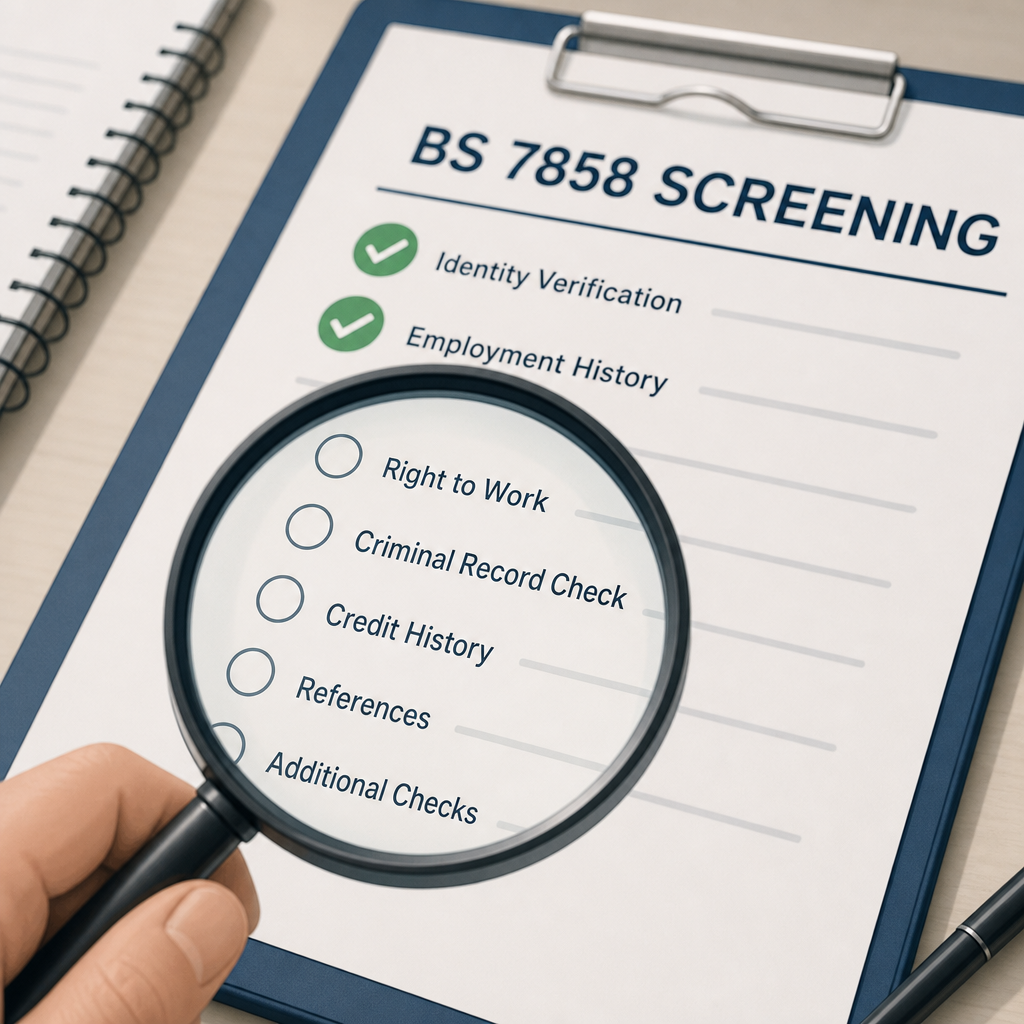
At its core, BS 7858 screening verifies a candidate’s background over at least a five-year period (or since their 16th birthday, if shorter). The checks typically include:
- Confirmation of identity, using original documents rather than photocopies
- Verification of the last five years of employment history, including gaps and reasons for leaving
- Right-to-work checks in line with UK immigration rules
- A basic criminal record disclosure, and enhanced checks where the role requires it
- Credit history and financial checks, particularly for roles involving cash handling or access to valuables
- Character references from named individuals, not just HR departments
- Verification of any claimed qualifications, including SIA licences
The standard was last significantly revised to reflect changes in data protection law and employment screening practice, and organisations offering vetting services are frequently assessed against it by bodies such as the National Security Inspectorate and the Security Industry Authority, the statutory regulator for the UK’s private security sector.
2. Why This Standard Exists — and Why It’s Not Just Paperwork
Go back to Sarah’s office block for a moment. Her new guarding contractor has 30 officers rotating through her site: some patrolling at 3am when nobody else is around, some managing the reception desk where visitor badges and building access are controlled, some with codes to the server room. Every one of those roles carries risk if the wrong person slips through.
BS 7858 exists because the security industry, more than almost any other, hands enormous trust to individuals very quickly. A guard can start a contract and, within days, be alone in a building holding assets worth millions, or supervising a night shift with no other staff present. Employers need a structured, consistent, and legally defensible way of establishing that the person in that uniform is who they say they are and hasn’t got a history that makes them a risk in that specific context.
There’s also a commercial angle that’s easy to overlook. Insurers increasingly expect evidence of proper vetting before they’ll underwrite commercial premises risk, particularly for high-value sites, retail chains, logistics hubs, and financial institutions. A security contract without BS 7858-compliant vetting can leave a business exposed not just operationally but contractually and financially if an incident occurs and screening records can’t be produced.
It’s worth being blunt here: screening failures make headlines. Cases of unvetted or poorly vetted security personnel being involved in theft, violence, or worse have pushed procurement teams across the UK to treat BS 7858 not as a nice-to-have credential but as a minimum condition of doing business.
3. The BS 7858 Screening Process, Step by Step
Understanding the mechanics helps procurement staff ask sharper questions when they’re evaluating a security supplier. Here’s how a properly run BS 7858 screening process typically unfolds:
- Application and consent – The candidate completes a detailed application form and gives explicit consent for background checks, in line with UK GDPR and Data Protection Act requirements.
- Identity verification – Original documents (passport, driving licence, birth certificate) are checked in person or via a verified digital identity service.
- Right-to-work check – Confirmed against Home Office guidance to ensure the candidate is legally permitted to work in the UK.
- Employment history verification – Employers from the past five years are contacted directly to confirm dates, roles, and reasons for leaving. Unexplained gaps are investigated, not ignored.
- Criminal record check – A Basic Disclosure is standard; roles involving vulnerable people or higher security clearance may require an Enhanced DBS check.
- Financial probity check – Particularly relevant for cash-in-transit, retail, or banking-adjacent roles. This is where financial background verification tools become genuinely useful — many vetting providers now use services like bankstatementboss.com to validate financial documentation quickly and consistently as part of this stage, reducing the manual back-and-forth that used to make this the slowest part of the process.
- Character references – At least two references, ideally from supervisors rather than colleagues or friends.
- Final sign-off and file compilation – A complete, auditable screening file is created and retained for the duration of employment plus a defined retention period.
A well-run process typically takes between two and four weeks from application to sign-off, though it can be faster with digital verification tools and slower if employment history is complex or spans multiple countries.
4. BS 7858 Versus Other Screening Standards: How Do They Compare?
One of the most common points of confusion for buyers is how BS 7858 sits alongside other vetting frameworks they may have heard of. Here’s a comparison to clear up the overlap:
| Standard | Primary Use Case | Depth of Checks | Typical Sector |
|---|---|---|---|
| BS 7858 | Security personnel vetting | 5-year history, financial, criminal, employment | Manned guarding, CCTV monitoring, keyholding |
| DBS Check (Basic/Standard/Enhanced) | Criminal record disclosure only | Varies by level | Any sector, often combined with BS 7858 |
| BPSS (Baseline Personnel Security Standard) | Government/MOD contractor vetting | 3-year history, right to work, identity | Government and public sector contracts |
| SC Clearance | National security clearance | Extensive, includes financial and character checks | Defence, intelligence, critical infrastructure |
| ISO 27001-linked vetting | Information security roles | Focused on data access risk | IT and data-handling positions |
The key takeaway for buyers: BS 7858 is broader and more security-industry-specific than a standalone DBS check, and it’s less intensive than formal government security clearance, but it’s the accepted middle ground that most commercial contracts should demand as standard. If a supplier tells you their guards are “DBS checked” and stops there, that’s a red flag — a Basic DBS check alone tells you almost nothing about employment history, financial risk, or character.
5. What Good Screening Looks Like — And the Red Flags to Watch For
Sarah’s story is a useful lens again. When she sat down with three competing security suppliers to renegotiate her contract, she asked each one the same question: “Can you show me evidence of BS 7858 compliance for the specific guards assigned to my site?” Two suppliers produced documentation instantly. One hesitated, said it was “handled internally,” and couldn’t produce individual records without a two-week delay.
That hesitation told her everything she needed to know.
Here’s a practical checklist procurement staff can use when assessing a security provider’s screening claims:
- Ask for evidence, not assurances. A reputable supplier should be able to produce redacted screening summaries for assigned personnel without drama.
- Check who conducts the vetting. Is it done in-house, or outsourced to an accredited third-party screening company? Both can be fine, but the audit trail needs to be clear.
- Confirm ongoing monitoring. BS 7858 isn’t a one-off event. Reputable suppliers re-screen periodically and monitor for new criminal convictions during employment.
- Look for NSI or SIA Approved Contractor Scheme accreditation. These schemes independently audit vetting practices as part of certification.
- Ask about subcontracted staff. If your security company uses subcontractors for overflow shifts, are those staff held to the same BS 7858 standard? This is a common gap.
- Understand data retention and GDPR compliance. Screening files contain sensitive personal data and must be stored, accessed, and destroyed in line with data protection law.
Red flags include vague answers about “our internal process,” reluctance to name the screening provider they use, an inability to explain how financial checks are conducted, and contracts that don’t reference BS 7858 by name at all.
6. Building BS 7858 Into Your Procurement and Contract Process
This is where the standard moves from theory into something a business can actually act on. If you’re drafting or renewing a security services contract in 2026, BS 7858 compliance should be a named, contractual obligation — not an assumed one.
Practical steps for procurement teams:
- Name the standard explicitly in the contract, including a clause requiring evidence of compliance to be available on request within a defined timeframe (five working days is common).
- Require a compliance statement at contract start, confirming every assigned officer has been screened to BS 7858 before their first shift on your site.
- Build in audit rights, allowing your organisation or an appointed third party to review anonymised screening records periodically.
- Set re-screening intervals, particularly for long-term contracts — many organisations require re-verification every three to five years.
- Include a breach clause, specifying what happens if unscreened or non-compliant personnel are found on site — this should include remedial action timelines and potential financial penalties.
- Ask about technology. Many modern vetting providers now use digital identity verification and automated financial checks to speed up onboarding without cutting corners — worth asking your supplier directly what tools they use and why.
Here’s a simple comparison table showing how screening depth typically varies by site risk level, which is a useful starting point for scoping your contract requirements:
| Site Risk Level | Example Site Type | Minimum Screening Expected | Re-screening Frequency |
|---|---|---|---|
| Low | Small office, retail unit | BS 7858 basic tier | Every 5 years |
| Medium | Distribution centre, corporate HQ | BS 7858 full tier + Basic DBS | Every 3-5 years |
| High | Data centre, financial institution | BS 7858 full tier + Enhanced DBS + financial checks | Every 2-3 years |
| Critical | Critical national infrastructure | BS 7858 + SC clearance where applicable | Annual review |
Getting this table right at the procurement stage saves enormous friction later. It’s far easier to specify screening depth before signing a contract than to renegotiate it after an incident forces the conversation.

Why This Matters More in 2026 Than Ever Before
Security procurement has changed shape over the last few years. Hybrid working means more buildings sit semi-occupied for longer stretches, increasing reliance on guarding and access control rather than simple staff presence. Cyber-physical convergence means a guard with a keycard now sometimes has more practical access to sensitive systems than an IT contractor would. And rising awareness of insider risk — the idea that the biggest threat to an organisation sometimes wears a uniform and a lanyard — has pushed vetting standards further up the boardroom agenda.
Add to that the tightening of right-to-work enforcement and ongoing scrutiny of umbrella companies and subcontracting chains in the security sector, and BS 7858 has become one of the few standards that genuinely reduces legal, financial, and reputational exposure in one move.
For businesses working with nexussecurityserviceses.com, this is a recurring theme across the site’s coverage of SIA licensing, access control, and CCTV monitoring: security is only as strong as the weakest link in the people, process, and technology chain. A brilliant CCTV system monitored by an unscreened operator is not a secure site. A well-designed access control system administered by a guard with no verified employment history is a liability waiting to surface.
Common Questions Procurement Teams Ask
Does BS 7858 apply to every security role?
Not automatically, but it’s the accepted baseline for any role involving unsupervised access to premises, cash, or sensitive areas — which in practice covers the vast majority of manned guarding, keyholding, alarm response, and mobile patrol positions.
Is BS 7858 a legal requirement?
No — SIA licensing is the legal requirement for individuals working in licensable roles. BS 7858 is a British Standard adopted by the industry as best practice, and most serious contracts require it contractually even though it isn’t mandated by statute.
Can screening be done faster without cutting corners?
Yes, to a point. Digital identity verification and automated financial checks — including tools like bankstatementboss.com for financial document verification — have shortened turnaround times considerably. But employment history verification and reference checks still require real human contact and can’t be meaningfully rushed without compromising quality.
What happens if a guard fails screening partway through employment?
A properly written contract should specify immediate suspension from site duties pending investigation, in line with the supplier’s disciplinary process and relevant employment law.
Should in-house security teams be screened to the same standard as contracted guards?
Absolutely. Risk doesn’t care whether someone is on your payroll or a contractor’s. Many organisations apply BS 7858 principles to in-house teams even though the standard was originally written with the guarding industry in mind.
Bringing It All Together
Sarah’s office block story doesn’t end with a dramatic security failure — and that’s rather the point. The suppliers who could produce clean, current BS 7858 documentation on request were the ones who kept the contract. The one who couldn’t was let go within the quarter, not because anything had gone wrong yet, but because Sarah understood that “yet” is exactly the word that should worry a facilities manager.
BS 7858 screening isn’t glamorous. It won’t feature in a sales brochure’s headline photograph the way a sleek control room or a drone-equipped patrol vehicle might. But it’s the quiet, unglamorous discipline that determines whether every other investment in security technology and personnel actually holds up under pressure. A CCTV system, an access control platform, a manned guarding rota — all of it depends on the basic, verifiable trustworthiness of the people operating it.
For UK businesses evaluating security suppliers in 2026, the practical takeaway is simple: don’t accept vague reassurances. Ask for the paperwork. Name the standard in your contract. Set re-screening intervals. Treat vetting as seriously as you’d treat any other risk control in your organisation, because that’s precisely what it is.
If you’re reviewing your current security arrangements, comparing suppliers, or simply trying to understand what “properly vetted” should actually mean for your organisation, nexussecurityserviceses.com continues to publish detailed, practical guidance on exactly these questions — from SIA licensing fundamentals to the finer points of contract structuring for manned guarding and access control. Understanding BS 7858 screening properly is one of the highest-leverage, lowest-cost steps any business can take to reduce risk, and it starts with asking your supplier the right questions before you sign anything.
Article written by FrontRank


0 Comments