


An hourly rate alone is not enough to budget for security. Manned security costs depend on the hours purchased, officers needed at the same time, site duties and contract terms.
Published UK guide rates commonly sit between £16.50 and £25 per officer-hour, but London and specialist requirements can cost more. The useful comparison is the complete service cost, including cover arrangements and any charges outside the headline rate.
Start with the requirement, then calculate what each quote will provide.
Key takeaways
- Published hourly ranges are budgeting references, not a fixed UK tariff, and their VAT basis is not always clear.
- Service hours and simultaneous headcount usually affect the total more than a modest difference between competing hourly rates.
- Continuous single-officer cover requires 8,760 officer-hours in a normal year, plus a workable staffing arrangement for absence and relief.
- Licensing, screening, supervision and insurance need clear contractual treatment, even when their costs sit within the hourly charge.
- Equipment, travel, bank holiday premiums, handover time and emergency extensions may appear separately from the standard service rate.
- Comparable quotes require the same site information, duty schedule, cover expectations and pricing period, with exclusions recorded in writing.
A low rate can still produce an expensive contract. Missing relief, restricted duties or separate management charges can change the comparison after mobilisation.
Assign responsibility for resolving those differences before awarding the work. Procurement should compare the commercial terms, whilst the facilities or site manager confirms that the proposed service can perform the required duties.
What are typical UK manned security costs?
Radius Security publishes a guide range of £16.50 to £25 per officer per hour for manned guarding. Solomon’s Facilities Management gives a broader London daytime range of £18 to £35 for a standard SIA-licensed officer.
These are provider-published references, not official rates. Differences in location, staffing, supervision and contract scope prevent either range from becoming a definitive national price.
The following figures provide a starting point for budgeting.
| Location and cover type | Published hourly reference | Including 20% VAT if the reference is ex-VAT |
|---|---|---|
| General UK manned guarding, Radius Security | £16.50 to £25 | £19.80 to £30 |
| London standard daytime guarding, Solomon’s Facilities Management | £18 to £35 | £21.60 to £42 |
| Outer London daytime guarding, Priority First’s London guide | £18 to £24 | £21.60 to £28.80 |
| Central London daytime guarding, Priority First’s London guide | £22 to £28 | £26.40 to £33.60 |
| West End and Mayfair daytime guarding, Priority First’s London guide | £26 to £33 | £31.20 to £39.60 |
| Canary Wharf and City daytime guarding, Priority First’s London guide | £26 to £35 | £31.20 to £42 |
The final column is a tax calculation, not confirmation that each publisher excludes VAT. Apply the quoted tax treatment when assessing an actual proposal.
For an October 2026 budget, use these ranges to establish an initial allowance. Replace that allowance with a site-specific price before committing expenditure.
An hourly figure also needs a clear unit. Establish whether it buys one officer-hour, a staffed post, a patrol visit or a wider managed service. Those units cannot be compared directly.
Specialist search duties, close protection, dog handling and complex public-facing assignments can fall outside standard guarding ranges. A higher rate may reflect a different role rather than a premium for the same work.
Calculate officer-hours before comparing rates
Separate coverage hours from employee numbers
Coverage describes the service purchased. Headcount describes the people required to deliver it.
One officer working eight hours on five days provides 40 officer-hours each week. Two officers working those same shifts provide 80. The building has not changed, but the labour requirement has doubled.
Use a clear calculation: officer-hours multiplied by the applicable service rate. Add separately priced items afterwards.
Record public holidays, shutdowns, seasonal extensions and partial opening days in the schedule. An annual figure based on 52 identical weeks is a planning assumption, not an exact calendar calculation.
A contract for one staffed post also needs enough employees to maintain that post across the agreed period.
Identify duties that happen together
A single officer cannot continuously staff reception whilst also completing a perimeter patrol away from the entrance. The scope needs a clear priority, a temporary closure arrangement or additional cover.
Map deliveries, visitor arrivals, staff departures and patrols against the shift. Identify where tasks overlap and how long each takes.
Floor area alone gives little help here. A compact depot with several active vehicle gates may need more simultaneous cover than a larger office with controlled access.
Record travel time between buildings within the same site. A patrol taking 25 minutes affects the availability of the officer elsewhere, even when it does not add a separately invoiced charge.
What the hourly security rate should pay for

Distinguish the service charge from officer pay
The supplier’s hourly charge is not the officer’s hourly wage. It must support employment costs and delivery of the agreed service.
That can include employer National Insurance, pension contributions, paid leave, recruitment, uniforms, administration and supervision. Screening, training and licensing support also require resources, although responsibility for paying individual fees can vary.
A quote therefore needs more than an assurance that the officer receives the legal minimum wage. The remaining charge must support the promised operational arrangements.
Statutory pay changes also affect future contract costs. The Low Pay Commission’s 2026 report provides the official context for minimum wage changes. A multi-year agreement needs a clear method for handling those changes.
Establish which support functions are included
Supervision should have a defined purpose. It may include site visits, officer welfare checks, report reviews, training follow-up and incident support.
Management availability also needs a practical meaning. A contact number does not establish who can arrange an urgent replacement or authorise an operational change.
Require the service schedule to state whether standard uniforms, radios, routine reporting and agreed supervisory visits sit inside the hourly rate.
Insurance needs the same treatment. Record the relevant cover and contractual responsibilities, rather than assuming that an insured supplier accepts every type of loss.
A lower hourly charge may be commercially sound. It becomes difficult to assess when the supporting service remains undefined or appears only after the contract starts.
Location and shift timing change the rate

London premiums depend on the assignment
Central London can involve higher recruitment costs, transport costs and expectations for front-of-house presentation. Restricted parking and difficult access can also affect mobilisation and supervisory visits.
Solomon’s Facilities Management describes central areas, including the West End, Canary Wharf and the City, as roughly 20% to 40% more expensive than outer-borough equivalents.
Treat that as a published comparison, not an automatic addition to every London quote. A central London rate may already include the location premium.
Outside London, a remote location can also increase cost. Limited local staffing, long travel distances and accommodation requirements may outweigh a lower regional wage expectation.
Separate routine commuting assumptions from travel that the contract will reimburse.
Nights, weekends and bank holidays need separate treatment
Solomon’s publishes indicative uplifts of approximately 25% to 50% for night, weekend and bank holiday work. These are commercial references, not statutory premiums that every contract must apply.
For arithmetic purposes, a £20 daytime rate becomes £25 with a 25% uplift, or £30 with a 50% uplift. These figures exclude VAT.
Some contracts instead use a blended hourly rate across the whole rota. Others price weekdays, nights, weekends and bank holidays separately.
Require the pricing schedule to identify the approach. Applying an extra premium to a rate that already includes unsocial hours can distort the budget.
Distinguish the client’s service charge from the officer’s employment terms. A supplier’s weekend billing premium does not establish what an individual employee receives.
Site risk and duties determine the deployment
Price the work that officers will perform
A reception assignment with controlled visitor access differs from guarding a site with repeated trespass, valuable stock or frequent confrontation.
Risk can affect officer numbers, training, supervision and equipment. Duties also matter. Vehicle checks, key control, searches, public interaction and incident management require clear instructions and enough time.
For construction projects, the requirement changes as materials, plant and completed units arrive. The scope for construction site security services should follow those changes rather than remain fixed throughout the programme.
Record known incidents and the circumstances in which they occurred. A general statement that an area is high risk gives less useful pricing information than a clear incident history and operating schedule.
Assess the technical setup alongside staffing
Working access control, reliable lighting and well-positioned cameras can reduce unnecessary manual tasks. Faulty gates and blind approaches can increase them.
Technology only reduces staffing requirements when the resulting arrangement still covers the operational need. An officer watching cameras may still need someone else to manage an active gate.
Document who receives alarms, who assesses them and who attends. Include arrangements for power loss, communications failure and equipment faults.
Changes to access control entry systems can affect both capital expenditure and recurring guarding duties. Budget for the whole arrangement rather than treating the equipment purchase as an automatic labour saving.
A camera view establishes visibility. It does not establish that someone is available to act on what appears.
Licensing and screening have different cost implications
Match the SIA licence to the activity
Contracted officers performing licensable security work must hold the appropriate Security Industry Authority licence unless an applicable exemption applies. Section 3 of the Private Security Industry Act 2001 establishes the prohibition on undertaking licensable conduct without a licence.
Security guarding, door supervision, public-space CCTV surveillance and close protection are different licensing categories. They are not interchangeable, although some licences permit additional activities.
Record the licence type against the actual duties. Renaming a guarding role as concierge work does not change the function being performed.
As of October 2026, the SIA application fee is £204. A security guarding licence lasts three years. The fee changed on 1 April 2026.
The licence belongs to the individual, not the security company. Budgeting should also account for training and the administration needed to keep deployed officers appropriately licensed.
Keep BS 7858 screening separate from licensing
BS 7858 is a security screening standard, not a substitute for an SIA licence. It addresses suitability for trusted work through checks such as identity, employment history and relevant supporting records.
BS 7858 screening is not a universal statutory requirement for every security employee. It can still be an important contractual requirement, particularly where officers hold keys or access sensitive areas.
Require a clear screening process, including how unexplained gaps, incomplete references and later concerns are handled. A statement that staff are vetted does not establish the depth or completion status of those checks.
The distinction between SIA licensing and guard standards matters when comparing rates. A properly scoped charge should accommodate the licensing, screening and training obligations promised in the contract.
Renewal also needs planning. The SIA’s renewal requirements include relevant training requirements, so maintaining compliance involves more than paying a recurring application fee.
Calculate 24/7 cover from the hours required
Continuous cover requires 8,760 officer-hours
One continuously staffed post requires 24 hours each day, seven days each week. That equals 8,760 officer-hours in a normal year, or an average of 730 hours per month.
At £16.50 per hour, the average monthly service charge is £12,045 before VAT. At £25, it is £18,250.
Using the wider London daytime reference of £18 to £35 produces £13,140 to £25,550 per average month. That is arithmetic, not a quote for a continuous London assignment. A contract may use different blended rates.
Solomon’s has published a £5,500 to £8,500 monthly reference for single-site 24/7 cover. That figure cannot describe 730 officer-hours at the hourly ranges above.
It implies approximately £7.53 to £11.64 per officer-hour. Without a clearly different service scope, it is not a sound budget for continuous on-site guarding.
A monthly label of “24/7 security” does not establish that an officer is physically present throughout all 730 average monthly hours.
Price relief as part of service continuity
References to three or four rotating officers do not provide a complete staffing plan. Three people sharing 168 weekly hours would average 56 hours each; four would average 42, before allowing for absence.
Leave, sickness, training and turnover still need cover. The supplier must also plan working time, rest and site competence.
Require the contract to state whether replacement officers are included when the regular officer is unavailable. Record the replacement process, responsible manager and arrangements for an uncovered post.
Breaks need separate consideration. If the post must remain occupied, the rota needs a lawful and workable arrangement that maintains coverage.
Handover time also consumes labour. A daily overlap between incoming and outgoing officers should be included in the planned hours or identified as a separate charge.
VAT and extras can change the payable total
Separate net cost from invoice value
Security guarding supplied by a VAT-registered business is normally standard-rated. The UK standard VAT rate is 20%.
A £20 hourly charge excluding VAT therefore becomes £24 including VAT. At 1,000 purchased officer-hours, that is £20,000 net and £24,000 payable.
A business able to recover all relevant input VAT may focus on the net expense for cost comparison. Cash-flow planning still needs the invoice value and recovery timing.
Where VAT cannot be fully recovered, some or all of that tax becomes part of the effective cost. Keep the financial treatment consistent across competing proposals.
VAT treatment is separate from whether the underlying service is good value.
Identify charges outside the standard rate
Common additional items include specialist radios, body-worn cameras, temporary CCTV, vehicle provision, parking, accommodation and travel between assignments.
One-off charges may cover mobilisation, site-specific training, access credentials, reporting setup or initial equipment installation. Recurring charges may cover software, equipment rental, monitoring and additional management support.
Overtime also needs a contractual definition. Extra hours requested by the client differ from overtime a supplier uses to fulfil an already contracted shift.
Record the approval process for emergency extensions. An officer remaining after an incident may create additional billable hours, but the charging basis should already be clear.
A complete commercial schedule states what is included, what is optional and what event triggers each extra charge.
Contract length and notice affect pricing
Short bookings carry different delivery costs
Ad hoc guarding can require urgent recruitment, roster changes, additional travel and rapid site familiarisation. Those costs are spread across fewer purchased hours.
Solomon’s gives a published indication that short-term or ad hoc bookings can cost 15% to 30% more per hour than rolling monthly or annual arrangements.
That is not a universal surcharge. A regular supplier with suitable local availability may price a temporary booking differently from an unfamiliar emergency assignment.
Minimum shift lengths can also affect the effective price. A two-hour requirement charged at a four-hour minimum costs twice the apparent hourly amount when measured against the time required.
Include cancellation deadlines and charges when assessing temporary cover. An unused shift can remain payable under the agreed terms.
Longer agreements need clear adjustment rules
A longer contract can support recruitment, training and a stable rota. It does not remove future wage, pension, tax or equipment costs.
Record the review date and the method for any price adjustment. Separate changes caused by the supplier’s costs from changes caused by additional client duties or hours.
Also define notice periods, early termination provisions and equipment commitments. A low opening rate can become less attractive if reducing the service triggers substantial charges.
Where an existing guarding operation transfers between providers, TUPE may apply. That can affect staffing and employment costs. Procurement should allow time for appropriate employment advice and relevant employee information before mobilisation.
Worked budget for a small office
A useful calculation starts with a specified schedule rather than an annual allowance. For comparison, consider 25 officer-hours each week, priced at £20 per hour excluding VAT.
This is a budget calculation, not a supplier quotation or a claimed client contract. It assumes 52 identical weeks and no separately charged equipment, premiums or mobilisation.
The calculation produces the following allowance.
| Budget element | Calculation | Amount |
|---|---|---|
| Weekly guarding charge | 25 hours multiplied by £20 | £500 |
| Annual guarding charge | £500 multiplied by 52 | £26,000 |
| Average monthly charge | £26,000 divided by 12 | £2,166.67 |
| Annual VAT | £26,000 multiplied by 20% | £5,200 |
| Annual invoice total | Guarding charge plus VAT | £31,200 |
The schedule matters more than the description “evening and weekend security”. Twenty-five weekly hours might cover selected periods, but it cannot provide comprehensive evening and weekend attendance.
Priority First has published an illustrative central London office example of approximately £15,000 a year for one officer on evening and weekend duties. Without the full hours and charging basis, that amount cannot establish a comparable rate.
At £20 per hour, £15,000 buys 750 officer-hours before VAT and extras. Spread across 52 weeks, that is about 14.4 hours each week.
Use that conversion whenever an annual headline appears attractive. It shows the quantity of service the budget can purchase, but it does not establish whether those hours cover the site’s vulnerable periods.
Worked budget for a multi-site portfolio
Portfolio pricing needs a separate schedule for every location. Combining several sites under one agreement does not remove the officer-hours needed at each.
The following calculation uses £20 per officer-hour across three coverage schedules solely to isolate the effect of hours. Actual sites may require different rates, skills and equipment.
The combined weekly requirement is shown below.
| Coverage requirement | Weekly officer-hours | Weekly charge at £20 |
|---|---|---|
| Office reception, 10 hours on five days | 50 | £1,000 |
| Warehouse night cover, 12 hours on seven days | 84 | £1,680 |
| Vacant property attendance, four hours daily | 28 | £560 |
| Total | 162 | £3,240 |
Across 52 identical weeks, the annual guarding charge is £168,480 excluding VAT. At 20% VAT, the annual invoice total is £202,176.
The average monthly net allowance is £14,040. That average does not mean every calendar month contains the same hours.
Shared contract management can reduce duplicated administration. Nearby locations may also share appropriate supervisory resources or mobile response arrangements.
Simultaneous posts cannot share the same officer. If reception and warehouse duties overlap, each location still needs the contracted attendance.
Require portfolio proposals to show site-level prices and any central management charge. This makes it possible to change one site’s hours without losing visibility of the remaining service cost.
Keep travel between locations explicit. A shared resource is only useful when travel time, availability and competing incidents have been allowed for.
Compare guarding, mobile patrols and CCTV by function

Static guarding buys continuous availability
Static guarding provides an officer at the assigned site throughout the contracted shift. It can support access control, staff interaction, immediate assessment and local incident handling.
Mobile patrols provide attendance at particular times or in response to an event. Their price depends on visit frequency, route time, inspection duties and response commitments.
A patrol visit is therefore not a cheaper unit of continuous guarding. It purchases a different service.
The choice between manned guarding and mobile patrols should follow the need for immediate attendance and the consequences of gaps between visits.
Record what remains protected between visits. Doors, alarms, lighting and physical barriers must support the periods without an officer present.
Hybrid savings depend on the hours removed
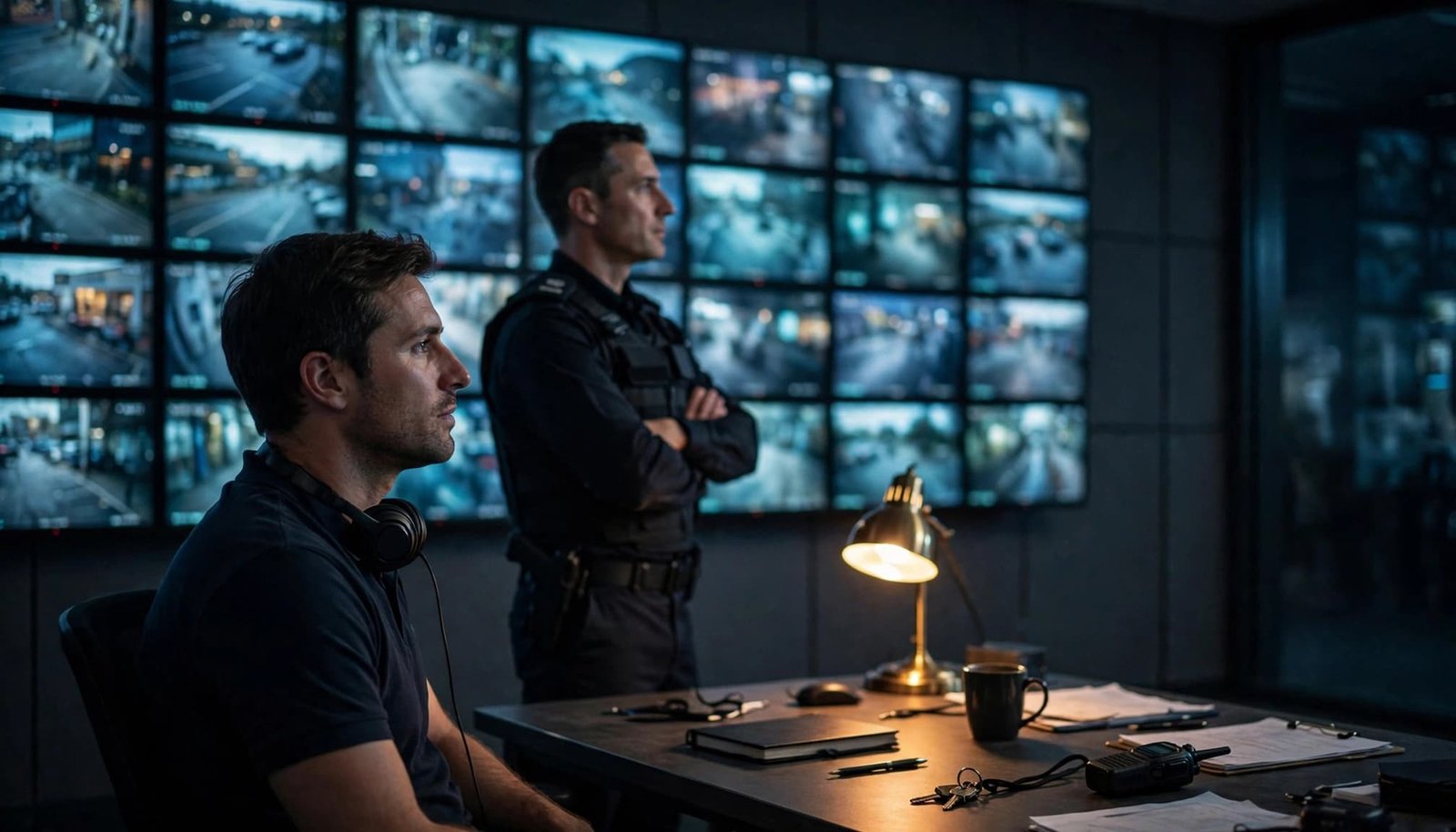
A hybrid arrangement combines on-site officers with measures such as remote CCTV monitoring, access control and alarm response.
Use a clear financial comparison. At a £20 hourly guarding rate, removing 40 weekly officer-hours reduces the gross guarding charge by £800 each week, or £41,600 across 52 weeks.
That is not the net saving. Deduct camera rental or purchase, installation, monitoring, connectivity, maintenance, response attendance and any retained guarding hours.
A CCTV-only price also needs a defined scope. Camera quantity, coverage, monitored periods, existing equipment and response arrangements prevent a single monthly figure from being generally useful.
Remote viewing does not provide an officer to manage a confrontation, admit emergency services or secure a damaged entrance. Assign those responsibilities before reducing attendance.
The cheaper arrangement must still perform the required work.
In-house and outsourced guarding need comparable budgets
In-house costs extend beyond salary
An in-house team gives the employer direct control over recruitment, supervision and deployment. It also places responsibility for those functions within the organisation.
The budget needs employer costs, paid leave, recruitment, uniforms, training, management time and absence cover. Where licences are required, include their administration and renewal arrangements.
In-house status does not remove every licensing obligation. Exemptions depend on the activity and circumstances, and some roles remain licensable.
A salary divided by contracted working hours is therefore an incomplete comparison with an outsourced hourly charge. It leaves out costs that the service provider may already include.
Also account for resilience. A small internal team can have limited options when sickness and annual leave overlap.
Outsourcing transfers defined responsibilities
An outsourced agreement can place recruitment, rostering, supervision and replacement staffing with the supplier. Those responsibilities need written service obligations.
The client still needs to provide site information, safe working arrangements, access permissions and a named contact for decisions. Outsourcing does not remove the site’s management responsibilities.
Compare the same output on both sides. If an external contract includes relief, supervision and reporting, include equivalent resources in the in-house budget.
If the outsourced proposal excludes those items, add their cost before comparing totals.
The SIA’s Approved Contractor Scheme is a voluntary company-level approval scheme. It does not replace individual licensing or define the contents of a particular guarding contract. Company approval and a complete service specification establish different things.
Request quotes against one written specification

Issue the same information to each shortlisted supplier. A common hourly rate request will produce different assumptions unless the operational requirement is already clear.
The facilities manager should own the duty schedule and site information. Procurement should own the pricing return and contractual comparison.
Use a concise quote checklist.
- State every site’s address, operating hours, required attendance periods and number of officers needed simultaneously.
- Describe access control, patrols, visitor handling, key custody, reporting and any specialist duties.
- Provide relevant incident history, site plans, existing security equipment and known access or communications limitations.
- Require separate prices for standard shifts, premium periods, additional hours, mobilisation, equipment, travel and other exclusions.
- Set out expectations for licensing, screening, supervision, breaks, handovers and replacement officers during absence.
- Request net prices, VAT, invoice totals, minimum booking periods, cancellation terms and the method for future price reviews.
Return competing proposals to a common annual basis. Use the same hours, bank holiday assumptions and equipment requirements for each calculation.
Resolve omissions before awarding the work
A quote that leaves relief or supervision unclear is not directly comparable with one that includes them. Require those differences to be priced or expressly excluded.
A strikingly low charge can indicate limited provision for officer pay, insurance, screening or management. It is a reason to examine the proposal, not proof of non-compliance.
Record the supplier’s commitments in the agreement. A sales discussion does not provide a reliable operational instruction for a replacement officer.
Measure delivery after mobilisation
Price comparison establishes the purchase cost. Attendance records, patrol evidence and incident reports establish whether the purchased service was delivered.
Use relevant security contract performance measures for filled shifts, replacement arrangements, completed duties and report quality.
Assign follow-up actions when performance falls short. A missed patrol or repeated late arrival should lead to a recorded decision, not simply another monthly report.
Keep payment, service review and operational responsibility connected throughout the contract.
Frequently asked questions
Does every security guard need an SIA licence?
Officers undertaking licensable contracted guarding normally need the appropriate SIA licence, unless an applicable exemption applies. Requirements follow the activity rather than the uniform or job title.
Some in-house arrangements fall outside licensing requirements. Door supervision, CCTV work and other activities need their own assessment because the rules are not identical across roles.
Is BS 7858 screening a legal requirement?
BS 7858 is a recognised screening standard rather than a universal legal requirement for every security worker. A client can require it through the contract.
Licensing and screening answer different questions. A licence establishes permission to undertake relevant work; the screening process supports decisions about suitability for trusted duties and access.
Should relief officers cost extra?
That depends on the agreed service. A contract for a continuously staffed post should explain how the supplier maintains attendance during sickness, leave and other absence.
Relief may be included in the rate or identified separately. The agreement also needs to distinguish replacement cover from additional officers requested by the client.
Are night rates always higher?
Night work can cost more, but a separate uplift is not inevitable. Some agreements use one blended rate across daytime, overnight and weekend shifts.
The pricing schedule should identify whether premiums are already included. Bank holidays can have separate treatment, even where ordinary night and weekend hours use the same rate.
How much does 24/7 guarding cost monthly?
One continuously staffed post requires an average of 730 officer-hours per month in a normal year. At £16.50 to £25 per hour, the arithmetic is £12,045 to £18,250 before VAT.
That is an initial budget range, not a definitive quote. Location, blended rates, staffing arrangements, equipment and separately charged support affect the actual total.
Set the budget against a defined service
Manned security costs become clearer when the required attendance, duties and support arrangements are written down. A credible budget accounts for service continuity, not only the officer visible at the entrance.
Compare the same hours and responsibilities, then separate VAT and additional charges. Treat unusually low monthly figures cautiously when they cannot support the attendance described.
A useful quote states what will be delivered, who is responsible and what the complete arrangement will cost.


0 Comments