

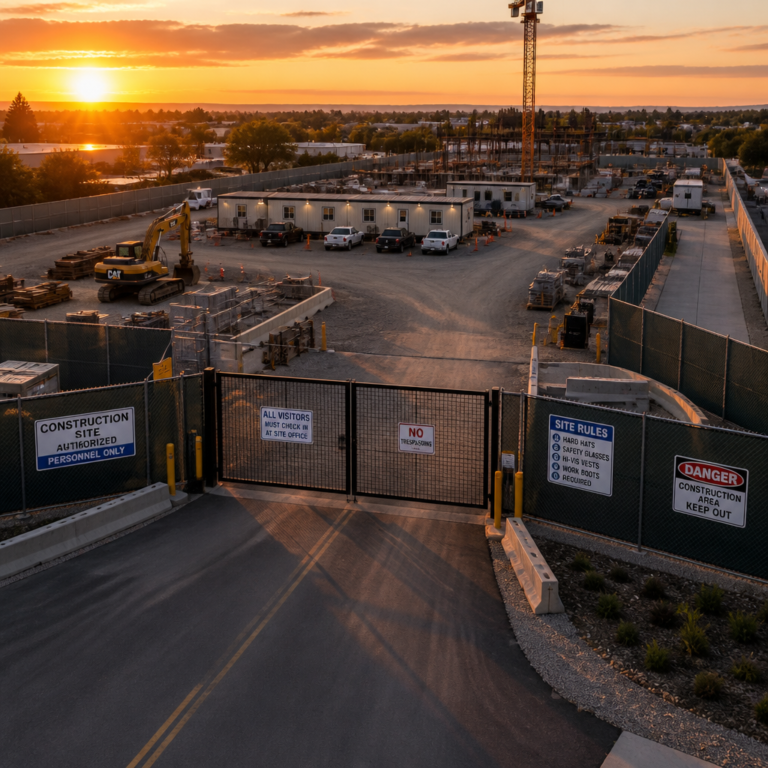
Construction site theft, vandalism, and unauthorised access are not marginal concerns for UK site managers. The CIOB estimates tool theft alone costs the UK construction industry approximately £800 million annually, and industry data indicates that over 45 per cent of construction theft occurs outside working hours, with the midnight-to-4am window carrying the highest risk. Beyond financial loss, a security failure on a live build carries direct regulatory consequences: under CDM 2015, security is a statutory duty, not a discretionary overhead. This construction site security UK checklist gives site managers and principal contractors a structured, compliance-anchored framework for closing every common gap before an HSE inspector or an incident reveals it first.
Table of Contents
- Quick Takeaways
- CDM 2015: The Legal Baseline for Site Security
- 1. Perimeter Security and Fencing
- 2. Access Control and Gatehouse Procedures
- 3. CCTV, Alarm Systems, and Site Lighting
- 4. Manned Guarding and Mobile Patrols
- 5. Asset and Materials Protection
- 6. Construction Phase Plan Security Section
- 7. Out-of-Hours and Vacant Site Protocols
- 8. Hazardous Materials and Plant Security
- 9. Incident Reporting and Escalation Procedures
- 10. Security Review and Audit Cycle
- Comparing Security Approaches for UK Construction Sites
- Frequently Asked Questions
- References
Quick Takeaways
| Key Insight | Explanation |
|---|---|
| CDM 2015 makes security a statutory duty | Regulation 13(4) requires principal contractors to take reasonable steps to prevent unauthorised access. Regulation 15 requires the construction phase plan to document how security is managed. Non-compliance can trigger HSE improvement or prohibition notices. |
| Over 45% of theft occurs outside working hours | Static guarding or remote monitored CCTV during overnight and weekend periods is the single highest-impact control for reducing material and plant losses. |
| CCTV is a recording tool, not a deterrent in isolation | Camera systems must be combined with perimeter fencing, lighting, access control, and either manned response or a monitored alarm to produce a functional deterrent. CCTV alone does not prevent entry. |
| A security record is a compliance record | Access logs, patrol reports, and incident documentation serve as evidence in HSE inspections, liability claims, and insurance settlements. A security arrangement that cannot produce this paper trail is not meeting its CDM function. |
| The construction phase plan must specify security | Under CDM 2015 Regulation 15, security arrangements must be written into the construction phase plan before work begins, not added retrospectively after a breach. |
| Perimeter checks must be assigned to a named individual | A common gap is assuming a shared responsibility for perimeter integrity. If nobody owns the final check at end-of-shift, the check does not reliably happen. |
| Layered controls outperform single-measure solutions | A site-specific risk assessment should drive a layered combination of physical barriers, electronic surveillance, access control, asset marking, and trained personnel, not any single control in isolation. |
CDM 2015: The Legal Baseline for Site Security
Site managers sometimes treat security as a facilities matter rather than a health and safety obligation. That framing creates compliance risk. Under the Health and Safety at Work etc. Act 1974, Section 3 requires employers and self-employed persons to conduct their undertaking without exposing non-employees to health and safety risks. That scope covers neighbours, pedestrians, delivery drivers, and any member of the public who could be affected by site activities.
CDM 2015 sharpens this further. Regulation 18 covers good order and site security, specifying that where necessary in the interests of health and safety, the site perimeter must be identifiable through suitable signs and site arrangements, fenced off, or both. The threshold is risk-proportionate: a city-centre demolition project with pedestrian footfall on three sides demands more than a rural groundworks package on privately owned land, but neither is exempt from assessment.
The practical question CDM asks is not merely whether materials are locked away. It asks: could a child get in? Could a visitor enter a hazardous area? Could site operations harm someone who remains outside the boundary? If the answer to any part is yes, the site’s security is not adequate yet. The site manager security checklist below addresses each vector systematically.
Construction site security is a health and safety duty, not merely a way to prevent theft. The question CDM asks is whether the site arrangement could expose any person, including those who stay outside the boundary, to a health and safety risk.
1. Perimeter Security and Fencing
Hoarding and perimeter fencing are the first physical layer and the one most visible to HSE inspectors. The minimum standard for most UK construction sites is a solid, continuous barrier of sufficient height to deter opportunistic access. Anti-climb measures, such as palisade tops or proprietary anti-climb paint on scaffolding, should be considered proportionate to the site’s theft profile and proximity to housing or commercial areas.
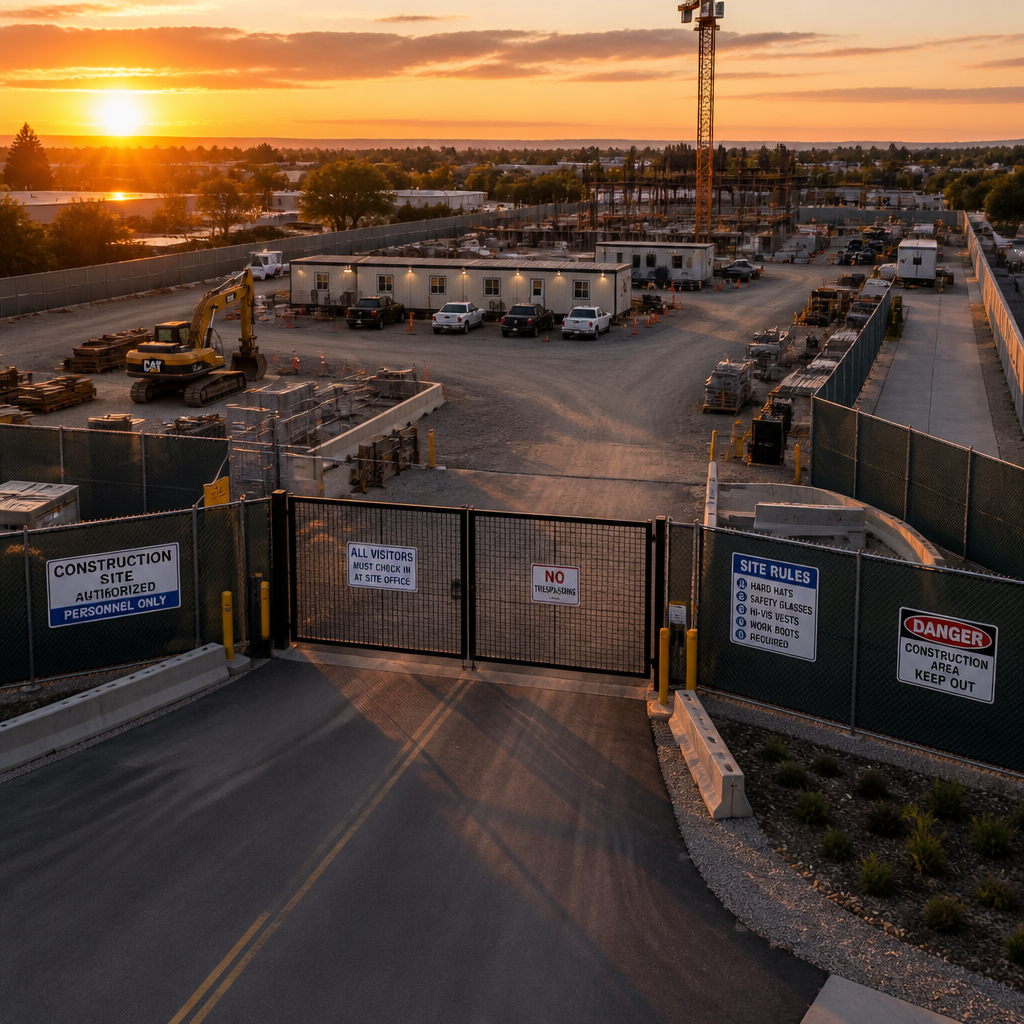
Key checks at this layer:
- Perimeter is continuous with no unintended gaps at tie-in points between hoardings and scaffold, or around site entrances when gates are open
- Signage is present and legible: restricted access warnings, CCTV notices, and emergency contact details visible from the outside
- Anti-climb measures applied where the barrier height alone does not deter access
- A named person is assigned responsibility for end-of-shift perimeter checks, with a signed record kept
Pro tip: Perimeter inspection should appear as a specific line item on the daily site diary, attributed to a named person. A shared team responsibility for perimeter integrity will, in practice, produce inconsistent checks. If nobody owns the final check, the check does not reliably happen.
2. Access Control and Gatehouse Procedures
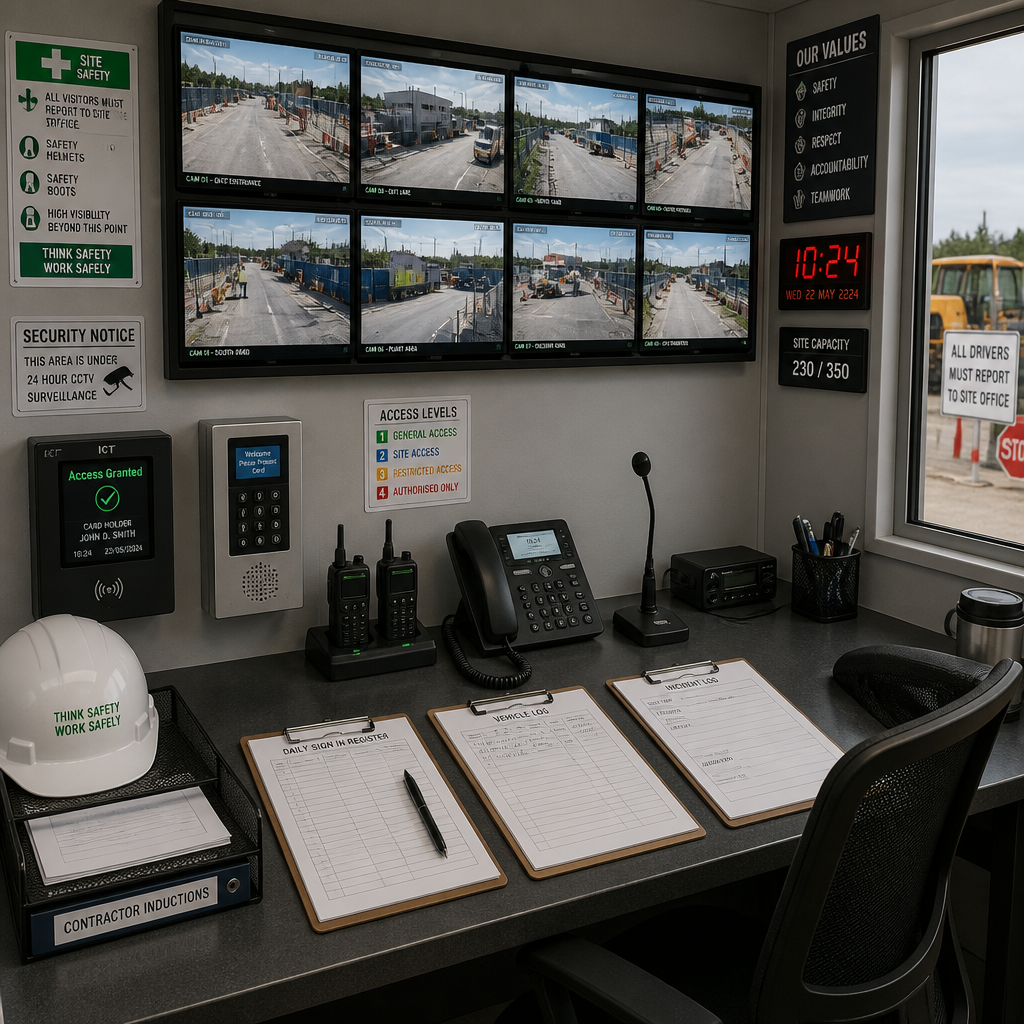
Controlling who enters and exits the site is both a CDM compliance requirement and the most direct method for preventing theft from subcontractors’ workers during shift changes, which is a consistently under-reported category on multi-contractor sites. Every person entering the site should be positively identified, their purpose logged, and their departure confirmed.
What an effective access log captures
At a minimum: full name, employer/company, time in, time out, and the area of site accessed. On higher-risk sites or where multiple subcontractors are operating, a vehicle registration record and verification of CSCS card status should be added. Delivery vehicles warrant a separate log capturing consignment details and a confirmation check against the materials schedule before acceptance.
Visitor induction at the access point
Any person unfamiliar with the site, including client representatives, inspectors, and delivery drivers, must receive a site-specific induction before they proceed past the gatehouse. This is both a CDM health and safety duty and a practical security control: it establishes that the site has a supervised boundary and that entry without authorisation is not tolerated.
Where a staffed gatehouse is not operationally feasible, a monitored intercom entry system combined with CCTV coverage of the access point provides a minimum viable alternative during working hours. Outside working hours, unmanned access points are a critical vulnerability and should be physically locked and alarmed.
3. CCTV, Alarm Systems, and Site Lighting
CCTV can deter offenders and provide evidence, but it does not operate as a standalone physical control. It is most effective when combined with secure fencing, adequate lighting, alarms, and a reliable monitoring or response process. A site manager who lists CCTV on a risk assessment as a primary control without addressing those complementary measures has not closed the risk.
Modern construction site CCTV systems provide features including motion detection, night vision, and real-time alerts, enabling remote monitoring of the site at all hours. However, the value of this capability depends entirely on whether a monitored response is in place. A recording that identifies a theft after it has occurred is evidential value only. The deterrent and prevention value requires someone to see the alert and respond to it in time.
For site lighting, motion-activated systems covering perimeter fence lines, storage compounds, and plant areas reduce the utility of the low-risk overnight window. Strategic lighting placement also improves the quality of CCTV footage captured at night, which directly affects the usability of that footage for police and insurance purposes.
Pro tip: Position CCTV cameras to cover fence lines and gate approaches, not just the interior of the site. Footage showing a breach of the perimeter, rather than only activity inside the site, is significantly more useful for prosecution and insurance claims because it establishes the point and method of entry.
4. Manned Guarding and Mobile Patrols
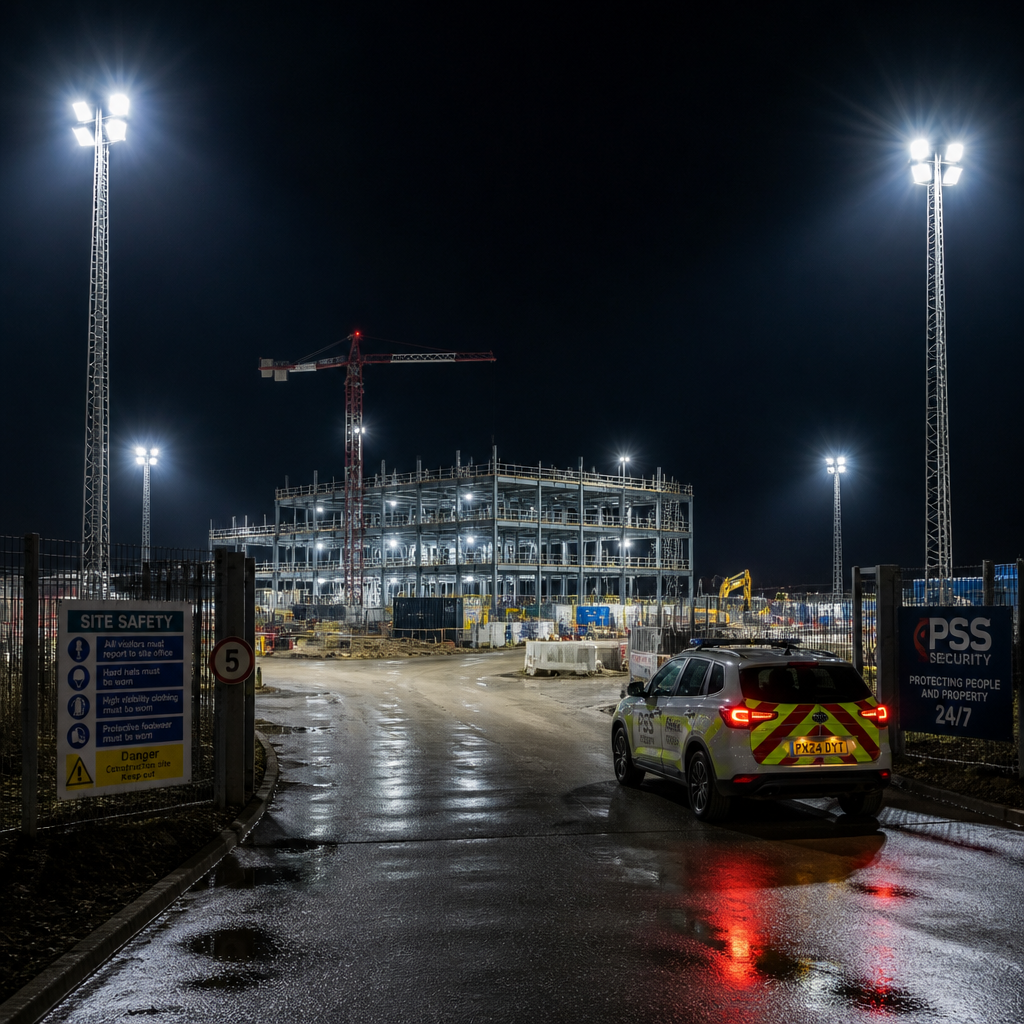
A trained security officer provides capabilities that electronic systems cannot replicate: real-time situational judgement, physical deterrence through visible presence, the ability to challenge and remove unauthorised persons, and an auditable patrol record. For UK construction sites, SIA-licensed officers are the required standard under the Private Security Industry Act 2001. Any provider deploying guards on a UK commercial site must hold a valid SIA Approved Contractor Scheme (ACS) status, and each officer must carry a valid SIA licence.
Static guarding versus mobile patrols
Static guarding, with an officer permanently positioned at the site, is appropriate for high-value sites, those with extensive materials or plant on site overnight, or projects in high-crime locations. Mobile patrols, where an officer makes scheduled and randomised visits across one or more sites, are a cost-effective alternative for lower-risk sites or during phases of a project where the on-site value is reduced. The key word is randomised: predictable patrol patterns can be observed and worked around by experienced offenders.
On larger sites with multiple access points and subcontractor operations, a combination of both is the most robust configuration. A gatehouse officer manages access control during working hours; a patrol officer or remote monitoring arrangement covers the overnight period when the BSIA reports theft risk is highest.
5. Asset and Materials Protection
Tools and materials should be stored out of sight in a robust, locked container or secure building. An issue-and-return system for high-value tools reduces opportunity for incremental removal and creates an auditable record of what left the site, with whom, and when. Mark all valuable items with a permanent identifier and maintain a photographic inventory alongside serial numbers.
Copper cabling, cable drums, and other high-value materials that are difficult to mark should be scheduled for just-in-time delivery where the project programme allows, reducing the window during which they are present on site. Where overnight storage is unavoidable, these items should be stored in the most inaccessible part of the secure compound, not at the perimeter.
A common mistake is treating the locked container as sufficient protection on its own. A locked container that is placed close to a perimeter fence, or that is visible from outside the site, creates a clear target. The container should be positioned centrally, with its location not visible from the site boundary.
6. Construction Phase Plan Security Section
CDM 2015 Regulation 15 requires the principal contractor to prepare and maintain a construction phase plan before the construction phase begins. The plan must describe how security will be managed. This is a specific, documentable requirement, not a general reference to site safety. HSE inspectors are entitled to review the construction phase plan and to assess whether the security section reflects the actual arrangements on site.
The security section of a compliant construction phase plan should address: the method of perimeter control, access control procedures, out-of-hours arrangements, responsibilities for security management, and how changes to site conditions will trigger a security review. A plan that references generic security without specifying the named controls in place does not satisfy the Regulation 15 requirement.
Pro tip: Treat the construction phase plan security section as a live document. When the site moves from groundworks to superstructure, the value of materials on site and the access risks change. A security section written at mobilisation and never reviewed does not reflect current risk and will not withstand scrutiny following an incident.
7. Out-of-Hours and Vacant Site Protocols
The period between end-of-shift Friday and start-of-shift Monday represents the highest cumulative risk window for most UK construction sites. Specific end-of-day and end-of-week protocols should be formalised, not assumed.
End-of-day protocol minimum requirements:
- All gates, compounds, and storage areas locked and confirmed
- Perimeter checked for damage or signs of attempted entry
- Tools, equipment, and materials secured in designated storage
- Access ladders and temporary access equipment removed or secured to prevent their use by intruders to reach restricted areas
- CCTV, alarms, and remote monitoring systems activated and confirmed operational
- Fuel storage areas and hazardous substances secured and confirmed
- All visitors signed out and only authorised persons remaining confirmed
For sites at the vacant or near-vacant stage, such as those between phases or awaiting handover, the full security posture must be maintained. Vacant properties and sites carry specific risks including arson and squatter occupation that are distinct from active build risk, and the absence of daytime foot traffic removes the informal surveillance that working sites benefit from.
8. Hazardous Materials and Plant Security
Fuel storage, COSHH substances, and large plant represent security risks beyond theft. An unsecured fuel bowser is a fire and environmental risk; improperly secured plant creates a risk of injury to trespassers, which carries liability consequences for the principal contractor even if the trespasser had no lawful right to be on site.
Keys to all plant and vehicles should be removed and stored securely, not left in the cab. Unattended plant should be immobilised using steering wheel locks, fuel cap locks, or proprietary plant immobilisers. High-value plant should be fitted with GPS tracking, which serves both as a recovery tool if stolen and as a deterrent if its presence is made visible through signage.
COSHH substances and hazardous materials require controlled storage that satisfies both COSHH Regulations and site security requirements. The storage location should be secured, appropriately signed, and included in the out-of-hours check protocol. A breach that results in environmental contamination or a public injury from hazardous materials access carries consequences well beyond the value of any stolen item.
9. Incident Reporting and Escalation Procedures
A security arrangement that produces no written record is not meeting its CDM compliance function, regardless of what controls are physically in place. Every incident, including attempts, damage to perimeter, or discovery of unauthorised access, must be recorded in a site incident log with the date, time, description, and action taken.
The escalation procedure should be defined in the construction phase plan: who is the named security contact, what is the threshold for calling the police, what is the threshold for contacting the principal contractor’s senior management, and who is responsible for notifying the client if an incident affects programme or budget. Leaving these decisions to real-time judgement produces inconsistent responses and gaps in the documentary record.
Insurance claims following construction site theft require documented evidence of the security measures in place at the time of the incident. An insurer assessing a claim will ask for access logs, patrol records, and the security section of the construction phase plan. Sites that cannot produce these documents face either reduced settlements or outright rejection of claims on the grounds of inadequate precautions.
10. Security Review and Audit Cycle
Security risk on a construction site is not static. It changes as the project progresses, as the value of materials on site fluctuates, as the physical configuration of the site changes, and as local crime patterns evolve. A security review should be triggered at defined milestones: project mobilisation, completion of groundworks, installation of high-value materials such as copper and M&E plant, handover preparation, and any phase where the site will be left unoccupied for an extended period.
The review should reassess: whether the perimeter controls remain adequate for the current site footprint, whether the access control procedures match the current subcontractor population, and whether the CCTV and alarm coverage reflects the current layout. Document the review, record any changes made, and update the construction phase plan to reflect the revised arrangements.
Comparing Security Approaches for UK Construction Sites
The choice between security delivery models depends on site risk profile, programme phase, budget, and the density of the surrounding environment. The table below compares the three principal options for out-of-hours protection, which is where the majority of incidents occur.
| Security Approach | Best Suited To | Key Limitations |
|---|---|---|
| SIA-Licensed Static Guarding (e.g., Nexus Security Services on-site officer) | High-value sites, multi-phase city-centre projects, sites with significant plant and M&E materials overnight, or where CDM risk assessment requires a physical deterrent presence at all hours | Higher cost per site than electronic alternatives. Requires robust briefing, handover procedures, and a named supervisor to manage officer welfare and incident escalation |
| Mobile Patrol Service (scheduled and randomised visits) | Lower-value phases, rural sites, or multi-site portfolios where a single contractor needs proportionate coverage across several locations without the cost of a static officer at each | Response window between patrols remains a vulnerability. Patrol frequency must be genuinely randomised to prevent pattern exploitation. Less suited to high-theft-risk periods without supplementary electronic monitoring |
| Remotely Monitored CCTV with Alarm Response | Sites where physical access by an officer is not required continuously, or as a supplementary layer to manned guarding for extended perimeter coverage | Response time to a monitored alert is site-distance-dependent. Does not provide the physical deterrent or challenge capability of a present officer. Requires reliable power supply and communications infrastructure on site |
Frequently Asked Questions
What does CDM 2015 specifically require from a principal contractor on construction site security?
CDM 2015 Regulation 13(4) requires the principal contractor to take reasonable steps to prevent access to the construction site by unauthorised persons. Regulation 15 requires the construction phase plan to describe how security will be managed. Regulation 18 covers good order and site security, specifying that perimeter arrangements must be adequate to prevent unauthorised access in line with the risk posed. These are statutory duties; an HSE inspector has authority to issue improvement notices or prohibition notices where arrangements are assessed as inadequate.
Does a construction site need SIA-licensed security guards?
Any person providing manned guarding on a commercial site in the UK must hold a valid SIA licence under the Private Security Industry Act 2001. Any security provider deploying those officers on a contracted basis must hold SIA Approved Contractor Scheme (ACS) status. Unlicensed guarding on a UK construction site is not a minor administrative gap: it exposes the principal contractor and the client to regulatory liability and may invalidate insurance cover for incidents during which unlicensed personnel were the primary security control.
What are the highest-risk periods for construction site theft in the UK?
Industry data indicates that over 45 per cent of UK construction theft occurs outside working hours, with the period between midnight and 4am reported as the highest-risk window. Weekends and bank holiday periods, when the site is unstaffed for extended consecutive hours, represent the greatest cumulative exposure. Security arrangements that do not specifically address out-of-hours coverage are therefore leaving the largest portion of theft risk unmitigated.
What should the security section of a construction phase plan include?
The security section must describe the specific controls in place: perimeter fencing type and standard, the access control procedure, who is responsible for security management, the out-of-hours arrangements (whether static guard, mobile patrol, remote monitoring, or a combination), asset protection measures, and the incident reporting and escalation procedure. It should also specify how and when the security arrangements will be reviewed as the project progresses. Generic references to security without specifying the named controls do not satisfy the CDM 2015 Regulation 15 requirement.
How should a site manager document security for insurance and liability purposes?
The documentary record that satisfies both CDM compliance and insurance requirements includes: the construction phase plan security section, daily access logs signed by the responsible person, patrol records with times and findings, a site incident log capturing all security-related events, and records of security reviews carried out at project milestones. An insurer assessing a theft claim will request this documentation. A site that cannot produce it faces the risk of a reduced settlement or rejection of the claim on the basis that inadequate precautions were in place.
At what project stages should a security review be carried out?
Security reviews should be triggered at a minimum at the following milestones: project mobilisation, completion of groundworks (when the above-ground structure begins to take shape and the site profile changes), installation of high-value materials such as copper cabling and M&E plant, any extended unoccupied period, and handover preparation. A security arrangement that was adequate at mobilisation may not be adequate when the site contains significantly more valuable materials or when the physical configuration of the perimeter has changed due to scaffold or demolition progress.
If you manage construction site security across multiple UK projects and have found a particular control or protocol that changed your risk profile significantly, share it in the comments below.
We would love your feedback and any insights you would share with others. What perspective would you add?
References
- CDM 2015 construction site security duties: HSE regulation and public protection explained
- Construction site security in the UK: reducing theft, trespass, and programme delay
- UK construction site theft statistics and how to avoid becoming one
- Preventing theft on UK construction sites: layered controls and best practice
- Construction site security checklist: essential measures for UK principal contractors


0 Comments