

Event Security Services: What UK Organisers Need
Planning an event in the UK means balancing guest experience with legal duties, site safety, crowd behaviour, access control, and contingency planning. Whether you are running a corporate function, live performance, exhibition, community gathering, or ticketed public event, effective event security is not just about placing guards on doors. It is about building a practical system that protects people, property, staff, contractors, and the reputation of the organiser.
Too many buyers leave security until late in the planning cycle and then discover avoidable problems: unclear stewarding roles, under-resourced entry points, poor radio coverage, no escalation process, and uncertainty over who is actually licensed to do what. Good event security management solves these issues before the first guest arrives.
At Nexus Security Serviceses Ltd, we approach event security services as an operational discipline. That means risk-led staffing, clear role separation, dependable on-site supervision, and UK-focused planning that reflects real conditions on the ground.
What event security services should actually cover
A credible event security plan should cover more than a visible presence. Buyers often compare providers on headcount alone, but that misses the real question: what tasks must be delivered, by whom, and under what procedures?
At a practical level, event security services should cover:
Access control at public, staff, supplier, and VIP entry points
Queue management and safe ingress procedures
Bag checks and prohibited item control where required
Crowd observation and intervention capability
Protection of restricted areas, cash points, equipment zones, and backstage spaces
Emergency response and evacuation support
Incident logging, radio coordination, and supervisor oversight
Liaison with venue teams, organisers, medics, and where relevant, emergency services
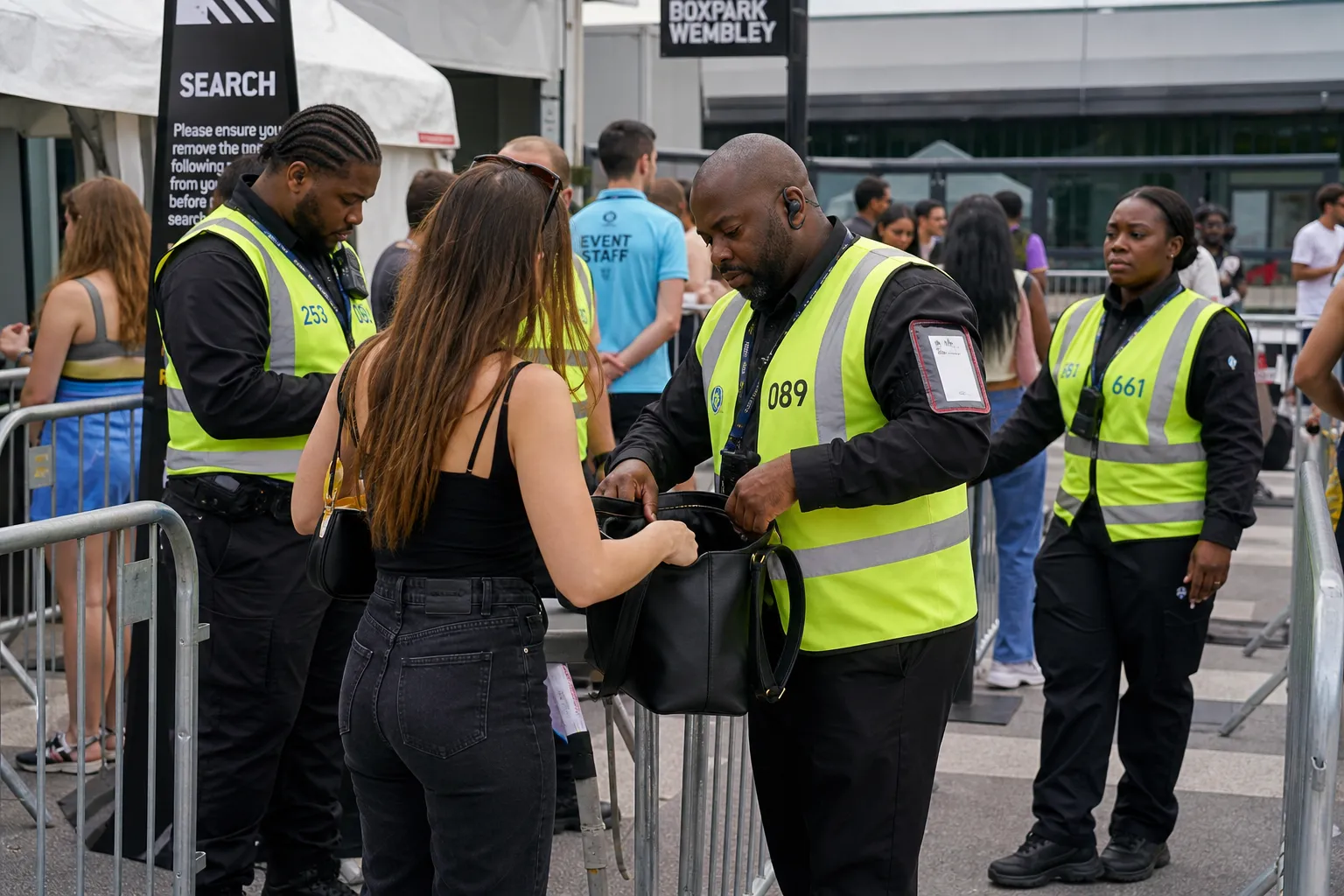
This is why organisers should treat event security services in the United Kingdom as part of event operations, not as a last-minute procurement line.
Why organisers get event security wrong
Across competitor content, a few repeated themes appear: guard numbers, SIA licensing, crowd management, and emergency response. Those are important, but many guides gloss over the buying mistakes that create operational risk.
The most common failures are:
Issue | What it looks like on the day | Likely consequence |
|---|---|---|
Buying by headcount only | Plenty of staff but unclear deployment | Gaps at critical points |
Confusing stewards with guards | Unlicensed staff asked to manage conflict | Compliance and safety risk |
Weak ingress design | Long queues, poor bag check flow | Bottlenecks and agitation |
No zone ownership | Nobody clearly responsible for areas | Slow response to incidents |
No comms discipline | Mixed messages over radio | Delayed escalation |
No fallback plan | Security reacts without structure | Disorder, confusion, reputational damage |
A better approach is to assess the event in terms of pressure points: entrances, exits, alcohol service areas, stage fronts, cash or stock zones, vehicle access, and any place where public movement compresses.
Stewarding vs guarding: buyers need to understand the difference
One of the biggest content gaps in competitor pages is the real distinction between stewarding and guarding. For organisers, this matters because it affects compliance, capability, and incident handling.
What stewards typically do
Stewards are often appropriate for customer-facing support tasks such as:
Greeting attendees
Wayfinding and directing people to seats or zones
Ticket scanning where no physical searching or enforcement is involved
Monitoring queues visually and reporting concerns
Assisting with general information and accessibility support
What security guards or door supervisors typically do
Licensed security staff are usually required where duties include:
Searching persons or bags
Managing confrontational situations
Controlling access to restricted or licensed areas
Removing unauthorised persons
Protecting property against theft or deliberate damage
Responding to disorder or suspected criminal activity
For many events, the right answer is a blended model: professional stewards for customer flow and guidance, with licensed event security guards positioned where enforcement, searching, access restriction, or incident response may be necessary. If your event includes public entry pressure, alcohol, cash handling, valuable equipment, or VIP attendance, the distinction becomes even more important.
For venues where entrances need closer control, door supervisor services in the United Kingdom can form a key part of the deployment plan.
The core pillars of event security management
Strong event security management usually rests on six connected pillars.
1. Risk assessment
Everything starts with a site-specific risk assessment. Not a generic document, but a live operational review covering:
Event type and audience profile
Expected attendance and crowd density
Indoor or outdoor layout
Entry and exit routes
Lighting, fencing, and perimeter limits
Alcohol service
VIP presence
Protest risk or public sensitivity
Vehicle movement and delivery schedules
Weather exposure
Medical and welfare interfaces
2. Access control
Most incidents start or intensify at entry points. Access control needs to answer simple but vital questions:
Who is allowed in?
How is eligibility checked?
What items are prohibited?
What happens when someone refuses a check?
How are staff, performers, contractors, and suppliers separated from public flow?
3. Crowd management
Crowds are dynamic. They change with weather, delays, alcohol, performance schedules, transport arrivals, and social media activity. Security should be tasked to monitor flow, friction, density, and mood, not just stand post.
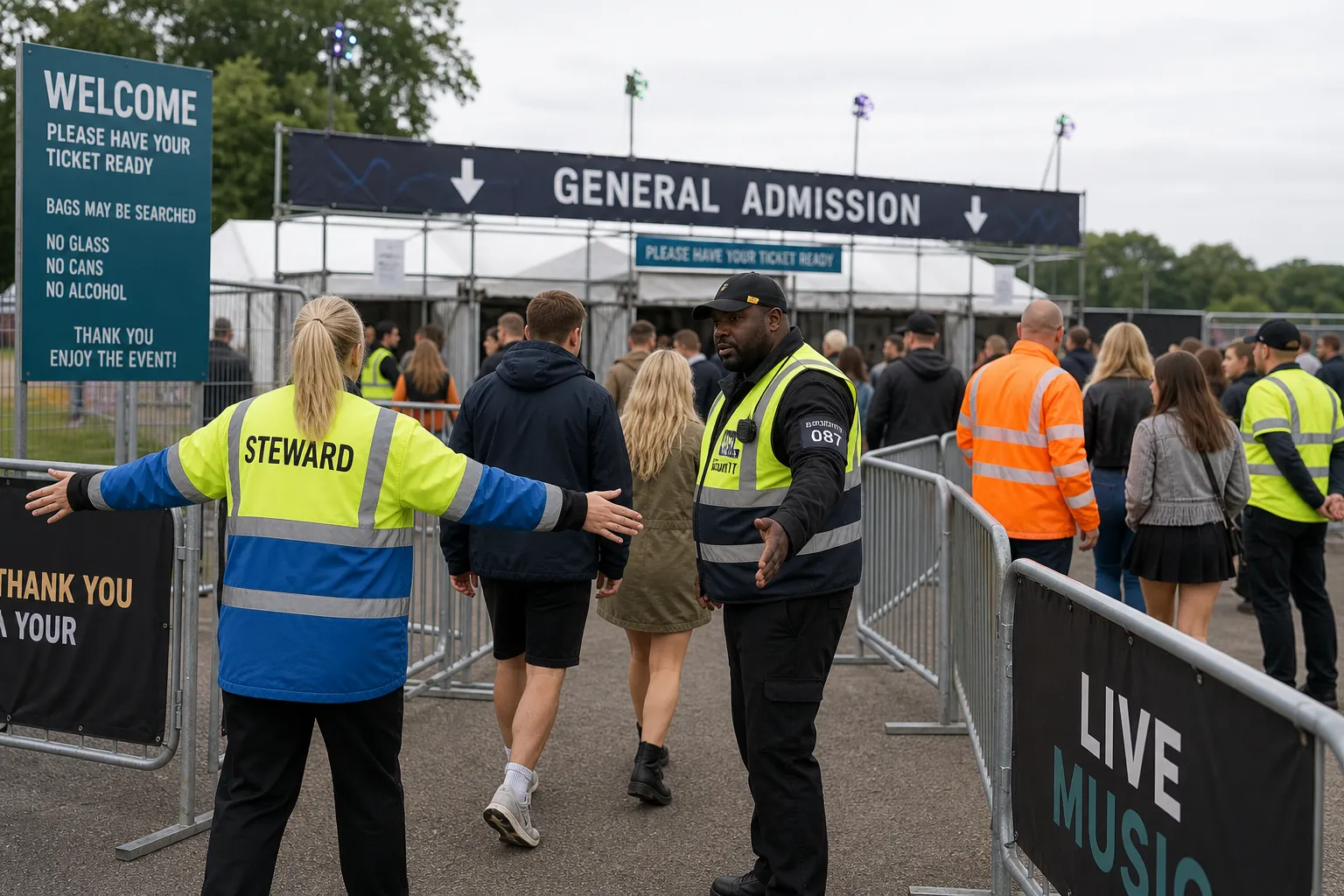
4. Incident response
Security teams need clear thresholds for intervention. Who deals with refusal at the gate? Who escorts an intoxicated guest out? Who locks down a restricted area? Who speaks to police or emergency services if needed?
5. Communications
Radios, call signs, escalation paths, and reporting discipline matter more than many buyers expect. A capable team with poor communications can still underperform.
6. Post-event reporting
A professional provider should produce usable incident records, debrief notes, and operational observations. That is especially valuable for repeat events, procurement reviews, insurance queries, and venue improvement planning.
How to estimate staffing without relying on guesswork
Competitor articles often mention rough guard-to-attendee ratios. These can be useful starting points, but they are not enough on their own. An event of 500 seated delegates is not the same as 500 standing guests with alcohol and live entertainment.
Factors that affect staffing levels
Your staffing model should reflect:
Attendance numbers
Standing versus seated format
Event duration
Number of entrances and exits
Search requirements
Alcohol availability
Time of day
External queue exposure
Public profile of guests or speakers
Cash handling or merchandise presence
Venue layout complexity
Temporary structures or fencing
Nearby transport links and public footfall
Practical staffing lens
A buyer should ask not only “How many?” but also:
How many at ingress?
How many roving?
How many supervising?
How many protecting restricted areas?
How many in reserve for response?
How are breaks covered?
Here is a more useful planning view:
Event feature | Security impact | Likely staffing effect |
|---|---|---|
Single controlled entry | Easier screening and flow control | Lower complexity |
Multiple public entrances | Harder to maintain consistency | More staff and supervision |
Alcohol service | Increased behaviour and welfare risk | Higher response capability |
Live performance or headline act | Surges at peak moments | More crowd monitoring |
VIP or speaker movement | Route protection and access restrictions | Specialist allocation |
Outdoor venue | Perimeter and weather complications | Extra patrol and flexibility |
Mixed public and contractor access | More identity and zone control issues | Additional access staff |
Crowd management is not just about numbers
A recurring weakness in competitor pages is the assumption that crowd management means simply adding more guards. In reality, poor layouts can defeat large teams.
Well-run crowd management should consider:
Queue lane design
Visibility of signage
Search table placement
Barrier positioning
Crossing points between staff and public
Release rates at entry
Safe holding areas
Exit dispersal planning
Toilet, bar, and concession pinch points
A smaller, well-positioned team with clear zone ownership is often more effective than a larger but poorly directed deployment.
Entry checks: what good looks like
Entry checks need to be lawful, proportionate, clearly briefed, and consistent. Buyers should expect the provider to define:
Search scope
Search consent process
Refusal procedures
Prohibited item list
Escalation path for suspicious items or aggressive behaviour
Same-sex search arrangements where needed
Evidence or incident recording process
The quality of the entry plan has a direct effect on guest experience. If checks are too loose, risk enters the venue. If they are badly designed, queues back up and tension rises outside.
Emergency planning before the event goes live
Many articles mention emergencies but stop at broad statements. Buyers need more detail. A workable emergency plan should identify foreseeable scenarios and assign roles in advance.
Scenarios to plan for
Depending on the event, these may include:
Medical emergency in a public area
Fire alarm or localised fire
Disorder or assault
Suspicious package
Missing child or vulnerable person
Overcrowding in a specific zone
Power loss
Weather disruption
Protest activity
Evacuation or partial lockdown
Questions your provider should already be asking
Where are the assembly points?
Who has authority to pause entry?
How is an evacuation message delivered?
Which roles stay at exits and which redeploy?
What is the rendezvous process for emergency services?
How are vulnerable persons supported during movement?
What is the fallback if radios fail?
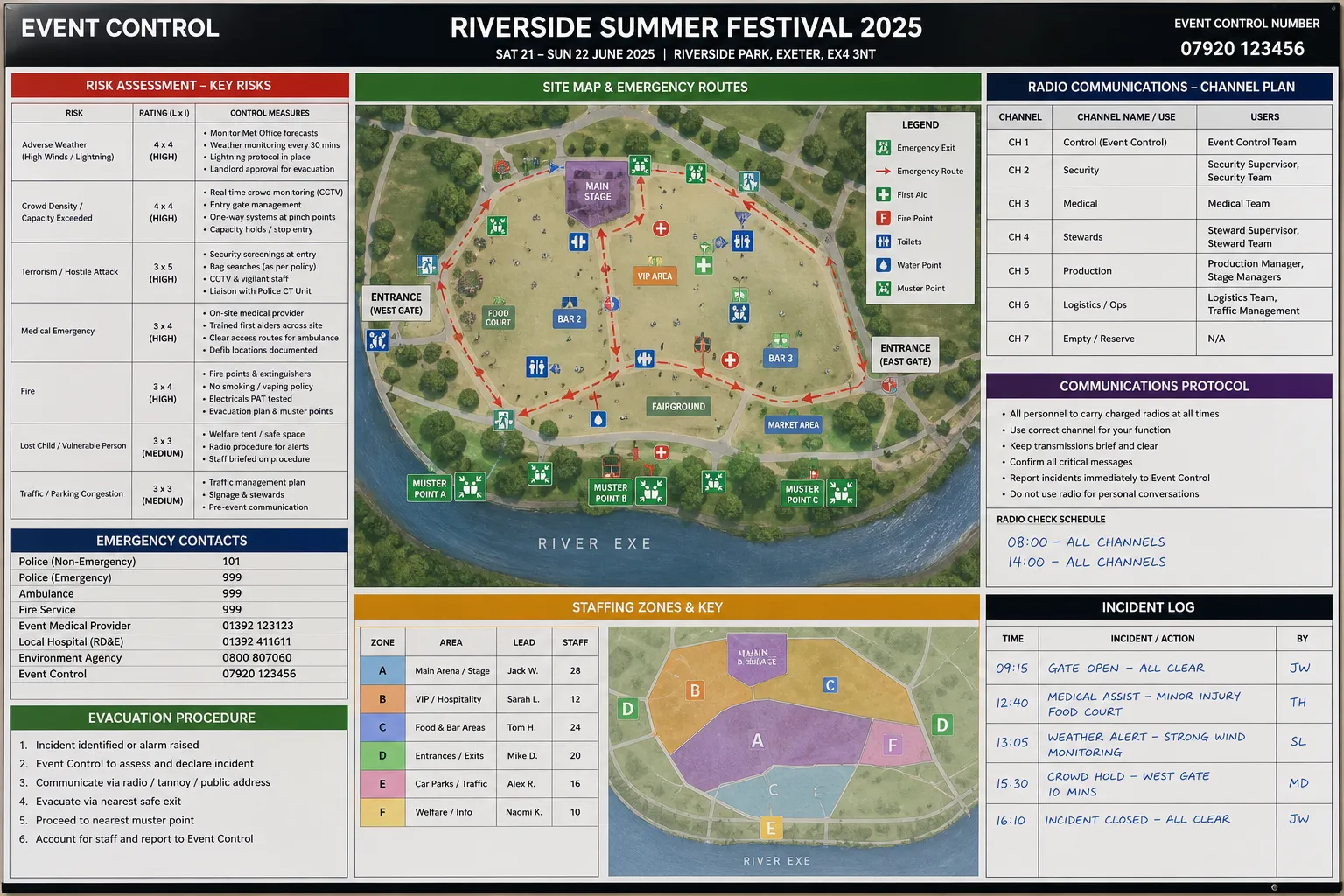
At Nexus Security Serviceses Ltd, we recommend documenting these issues before deployment, not improvising them on the day.
Licensing and compliance: what buyers should check
A professional provider should be clear on what tasks require licensed personnel and what can be carried out by non-licensed support staff. Organisers should verify:
Relevant SIA licensing for the roles being filled
Public liability and employer’s liability cover
Assignment instructions or event-specific briefing process
Supervisor structure
Incident reporting method
Experience with similar event formats
Understanding of venue rules and local conditions
This is especially important when buyers compare multiple event security companies and receive quotes that appear similar on paper. A cheaper quote may hide weaker supervision, vague role definitions, or overreliance on staff who are not matched to the risk profile.
What to ask before booking event security services
If you are buying event security services uk-wide or for a single venue, ask direct operational questions. Good providers should welcome them.
Questions for your shortlist
How do you determine staffing levels for this type of event?
Which roles will be filled by licensed security personnel and which by stewards?
Who will supervise the team on site?
What is your ingress and queue management approach?
How do you handle refusals, disorder, or ejections?
What is your incident reporting process?
How do you brief staff on the event layout and risks?
What is your plan for emergencies or partial evacuation?
How do you coordinate with venue operations, medics, and organisers?
Can you adapt the deployment if attendance or risk changes?
The quality of the answers will often tell you more than the quote.
Common gaps in competitor advice – and what organisers really need
After reviewing competing content, several gaps stand out:
They over-focus on generic benefits
Many articles say security creates a safe environment, but they rarely explain how. Buyers need operational detail, not broad reassurance alone.
They mention staffing ratios without context
Ratios are only a starting point. Layout, alcohol, queue design, event duration, and audience behaviour are often more important.
They gloss over the stewarding vs guarding boundary
This is one of the most important practical distinctions for event buyers, yet it is often treated lightly.
They do not explain post-event value
A strong security provider helps you improve future events through reporting, debriefs, and better control planning.
They rarely discuss overlap with wider site protection
Many events also need parking oversight, perimeter checks, equipment security, and out-of-hours presence before or after the public phase. In some cases, this overlaps with broader security guard services in the UK rather than event-only staffing.
A practical pre-event checklist for organisers
Use this as a final pre-go-live review.
Area | Key question | Status |
|---|---|---|
Risk assessment | Has the event-specific risk assessment been completed and shared? | |
Roles | Are stewarding and licensed security duties clearly separated? | |
Entry | Are search procedures, prohibited items, and refusal steps defined? | |
Staffing | Are numbers, locations, supervisors, and reserves confirmed? | |
Comms | Are radios, channels, call signs, and escalation routes briefed? | |
Layout | Are barriers, queues, exits, and restricted areas mapped clearly? | |
Emergency response | Are evacuation, medical, and incident roles assigned? | |
Reporting | Is there a method for logs, incidents, and debrief notes? | |
Coordination | Have venue ops, medics, contractors, and organisers aligned? | |
Contingencies | Is there a plan for delay, weather, crowd surge, or no-show staff? |
Why a tailored security plan matters
No serious organiser wants a copy-and-paste deployment. A conference venue, music event, exhibition hall, private awards ceremony, and outdoor festival all present different risks. The right provider should shape event security solutions around the site, audience, format, and operating pressures of the day.
That is where Nexus Security Serviceses Ltd adds value: practical UK-focused planning, professional and reliable security personnel, stronger access control, better on-site oversight, crowd safety support, and flexible deployment through manned guarding or mobile patrol backing where required. The goal is not simply to place people in uniform. It is to reduce theft, vandalism, disorder, trespass, and operational disruption through a plan that works.
Final thoughts
If you are booking event security, do not stop at quote comparisons or broad promises. Ask how the provider will control access, manage crowd pressure, separate stewarding from enforcement roles, respond to incidents, and support the wider event team before the doors open.
The best event security services are calm, structured, and risk-led. They protect the public without disrupting the event, support organisers under pressure, and provide clear operational confidence from setup through close-down.
For organisers who need dependable UK event security backed by practical planning and professional personnel, Nexus Security Serviceses Ltd offers the clarity and operational focus that events genuinely require.
FAQ
What are the current legal requirements for an event organiser?
Event organisers must take reasonable steps to protect attendees, staff, and contractors through proper planning, risk assessment, emergency procedures, and competent staffing. Where security duties involve searching, access control, or dealing with conflict, organisers should ensure the personnel used are appropriately licensed and suitable for the role.
What are the 4 P’s in security?
The 4 P’s are commonly used to describe a structured security approach: Prevent, Prepare, Protect, and Pursue. In event settings, that means reducing risk before the event, planning for foreseeable incidents, protecting people and assets on site, and escalating concerns appropriately when incidents occur.
How much does event security cost in the UK?
Costs vary depending on event type, duration, staffing numbers, licensing requirements, venue complexity, and risk profile. Buyers should compare not just hourly rates, but also supervision, reporting, access control capability, and whether the provider is supplying the right mix of stewards and licensed security personnel.
What are the 5 C’s of security guards?
A useful way to assess security staff is through the 5 C’s: communication, competence, confidence, control, and courtesy. For event work, these qualities matter because teams must manage the public professionally while staying alert, compliant, and calm under pressure.
What are the 4 P’s of security guard work?
In day-to-day guarding, the 4 P’s are often understood as presence, prevention, protection, and prompt response. At events, that means visible deterrence, early identification of issues, safeguarding people and property, and reacting quickly using clear procedures.
What is the 10 code in security?
A 10 code is a radio shorthand system sometimes used to speed up communication between security staff. In practice, many event teams now prefer plain English or site-specific call signs to reduce confusion, especially when working with organisers, medics, and external responders.


0 Comments