

TL;DR
Choose manned guarding when you need constant visible protection, access control, visitor handling, or immediate intervention. Choose mobile patrols when you need flexible, lower-cost checks across larger or lower-risk sites, and use a blended model when your risk changes by time of day.
Security spend is wasted when the service does not match the risk. The practical choice in manned guarding vs mobile patrols is not which one sounds stronger, but which one fits your site layout, hours, assets, footfall, incident history, and response expectations. NEXUS SECURITY SERVICESES LTD helps UK organisations design that mix across static guarding, patrols, access control, and incident reporting, so the service is built around operational risk rather than guesswork.
Table of Contents
What is manned guarding?
Manned guarding: a trained security officer is stationed at one site for a defined shift to deter crime, control access, monitor activity, respond to incidents, and support staff or visitors.
Manned guarding gives a premises a continuous human security presence. In the UK, guards performing licensable roles usually need the relevant Security Industry Authority licence, and official SIA guidance explains licence requirements by role on GOV.UK.
A manned guard can sit at reception, patrol internally, check delivery areas, manage keys, challenge suspicious behaviour, escort contractors, monitor CCTV, and keep a live incident log. For high-footfall retail, office buildings, warehouses, logistics yards, events, and licensed venues, that human judgement is often the main value.
Key insight: If your site needs someone to make decisions in real time, speak to people, verify identities, and take immediate action, a fixed guard is usually the stronger baseline.
Where fixed guards add the most value
- Retail stores: visible deterrence, suspected shoplifting response, staff reassurance, and customer-facing support.
- Corporate receptions: visitor management, ID checks, contractor sign-ins, and front-of-house professionalism.
- Warehouses and depots: gatehouse control, vehicle checks, goods-in monitoring, and out-of-hours presence.
- Licensed venues: queue control, refusal support, incident de-escalation, and SIA door supervision.
- Events and conferences: access control, crowd movement, VIP areas, and emergency support.
For a deeper UK-focused explanation, the guide to the importance of manned guarding services in the UK is a useful next read.
What are mobile patrols?
Mobile patrols: a security officer visits one or more locations in a marked or tracked vehicle at scheduled, random, or alarm-triggered times to inspect premises, deter crime, and report issues.
Mobile patrols are designed for coverage rather than constant presence. Officers may lock and unlock premises, check doors and windows, inspect perimeter fencing, respond to alarm activations, look for trespass, and record proof of attendance through patrol software or digital reports.
The model works well where the main risk is after-hours intrusion, vandalism, fly-tipping, unauthorised parking, or perimeter breach. It is also useful when several nearby sites need periodic checks but do not justify one guard at each location.
Key insight: Patrols reduce blind spots across space and time, but they do not replace a person who must be permanently available at one entrance, till line, gatehouse, or control room.
Typical patrol tasks
- Arrive on site at a scheduled, random, or alarm-led time.
- Check external doors, shutters, gates, fences, windows, and vulnerable access points.
- Complete an internal walk-through if keys and instructions allow it.
- Record photos, timestamps, GPS data, and incident notes.
- Escalate urgent risks to the client, emergency services, maintenance team, or alarm receiving centre.
- Lock or unlock the premises when required.
Construction sites are a common patrol use case because risk shifts with project stage, materials on site, and working hours. For that setting, see mobile security patrols for construction sites in the United Kingdom.
Manned guarding vs mobile patrols: decision table
The fastest way to choose between fixed officers and patrol visits is to map the service against risk intensity, response need, site type, and operating hours. I would not start with price alone, because a cheaper model can become expensive if it leaves the wrong gap exposed.
Side-by-side security model comparison
| Decision factor | Manned guarding | Mobile patrols | Best choice |
|---|---|---|---|
| Cost drivers | Shift length, number of officers, SIA role, site complexity, unsocial hours | Visit frequency, travel distance, alarm response, keyholding, reporting needs | Patrols for lower-risk checks, guards for high-contact sites |
| Response speed | Immediate on-site response during the shift | Response depends on officer location, route, and call priority | Guards for immediate intervention |
| Visible deterrence | Strong constant deterrent at entrances, receptions, tills, and gates | Intermittent deterrent, stronger when patrol times vary | Guards for public-facing deterrence, patrols for perimeter deterrence |
| Site type | Retail, offices, events, warehouses, venues, occupied buildings | Construction sites, vacant property, industrial estates, car parks, multi-site portfolios | Depends on occupancy and risk pattern |
| Operating hours | Best where risk exists throughout opening hours or overnight | Best for after-hours, weekends, closures, or random checks | Blend for sites with different day and night risks |
| Reporting | Continuous log, handovers, incident reports, visitor records | Visit reports, GPS proof, photos, alarm attendance records | Guards for rich context, patrols for audit trails |
| Human interaction | High: staff, visitors, customers, contractors, emergency services | Low to moderate: site checks and escalation | Guards when people management matters |
| Scalability | More officers needed as sites increase | One patrol route can cover several nearby locations | Patrols for grouped locations |
Security companies such as Securitas AB operate across guarding, mobile patrolling, monitoring, investigation, and consulting, which reflects how the wider industry treats these services: connected options, not isolated products.
How do cost drivers differ?
Manned guarding is usually priced around labour hours, while mobile patrol pricing is driven by visit frequency, route time, keyholding, and response commitments. The right question is not which service is cheaper, but which one reduces the most meaningful risk per pound spent.
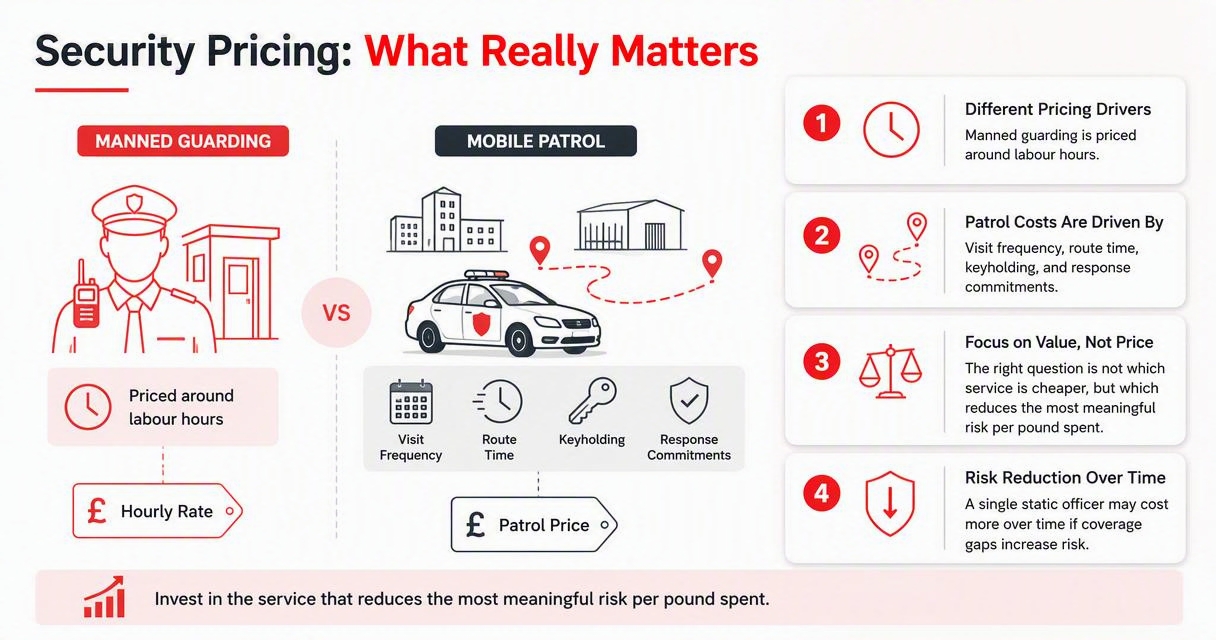
A single static officer may cost more over a month because the client is buying continuous availability. That cost can be justified when the officer prevents shrinkage, manages front-of-house duties, controls vehicle movements, or avoids disruption to trading.
Mobile patrols can control cost because the officer shares time across several premises. That makes them attractive for closed buildings, construction sites, yards, and lower-traffic locations where periodic inspection is enough.
Budget questions to ask before buying
- What incidents have happened in the last 12 months?
- Which losses would hurt most: stock theft, downtime, staff harm, trespass, vandalism, or reputational damage?
- Does the site need someone present at all times, or only at vulnerable points in the day?
- Can cameras, alarms, access control, or lighting reduce the number of human hours needed?
- Do you need a written report for insurance, landlord, facilities, or compliance records?
If you are already leaning toward a fixed officer, the guide on how to choose the right manned guarding UK provider covers vetting, supervision, and service quality checks.
Which service responds faster?
Manned guarding responds faster when the incident happens on the protected site during the shift, because the officer is already there. Mobile patrols respond well to alarms, suspicious activity, and out-of-hours issues, but response time depends on distance, routing, traffic, and current officer workload.
Speed is not only arrival time. A trained guard who already knows the site can identify the correct gate, isolate a risk area, guide emergency services, and protect evidence. A patrol officer may cover more ground, but must first travel, access keys, and understand the live situation.
For alarm response, patrols are often a strong match. They can attend when staff should not, verify whether an activation is genuine, and escalate only when needed.
Response fit by incident type
| Incident type | Stronger model | Why |
|---|---|---|
| Shoplifting in progress | Manned guarding | Immediate observation, challenge, and staff support |
| Alarm activation at a closed unit | Mobile patrol | Attendance without asking employees to visit after hours |
| Contractor access issue | Manned guarding | Identity check and live decision-making |
| Fence damage at night | Mobile patrol | Perimeter check, photos, escalation, and follow-up visits |
| Queue disorder at a venue | Manned guarding | On-site de-escalation and crowd control |
| Vacant property trespass | Mobile patrol or blend | Patrol checks plus escalation when activity rises |
Which service deters crime better?
Manned guarding usually provides stronger deterrence in busy, public, or targeted areas because offenders can see a trained person watching the site. Mobile patrols deter best when unpredictability matters, especially across car parks, yards, vacant buildings, and large external areas.
Deterrence works through visibility, uncertainty, access difficulty, and the chance of being challenged. A uniformed guard at a retail entrance changes behaviour immediately. A marked patrol vehicle arriving at random times makes planning harder for intruders.
I prefer a blended deterrence plan for sites with both public-facing and perimeter risks. For example, a warehouse may need a gatehouse officer during loading hours, then random external patrols after closure.
A useful deterrence principle
Key insight: Fixed guards create certainty for legitimate users and uncertainty for offenders at one location; patrols create uncertainty across a wider area.
Technology can strengthen both models. CCTV, alarms, access control, and visitor systems help officers verify events faster, but they do not remove the need for human judgement in every setting. For that broader comparison, read manned guarding vs automated security in the UK.
Which site types suit each model?
Occupied, high-contact, and high-value sites usually suit manned guarding, while closed, spread-out, and lower-contact sites often suit mobile patrols. Many UK businesses need both because the risk profile changes between opening hours, deliveries, closure, and weekends.
Best-fit scenarios by organisation type
- Retail manager: choose a guard for shoplifting deterrence, staff reassurance, and incident handling during trading hours.
- Facilities manager: use guards for receptions and contractor control, then patrols for out-of-hours perimeter checks.
- Construction manager: use patrols for nights and weekends, then add guards when plant, fuel, or high-value materials arrive.
- Event organiser: choose guards or door supervisors for access points, queues, backstage zones, and emergency routes.
- Licensed venue operator: use appropriately licensed personnel for door supervision, refusal support, and disorder prevention.
- Multi-site business owner: use patrols to cover smaller locations, and reserve fixed guards for flagship or higher-risk premises.
For businesses weighing static officers against vehicle-based patrols more broadly, static vs mobile security guards in the UK gives a helpful companion view.
How should reporting and accountability work?
Good security reporting should prove attendance, explain what happened, show what action was taken, and create a usable record for managers, insurers, landlords, or police. The report format matters as much as the service type.
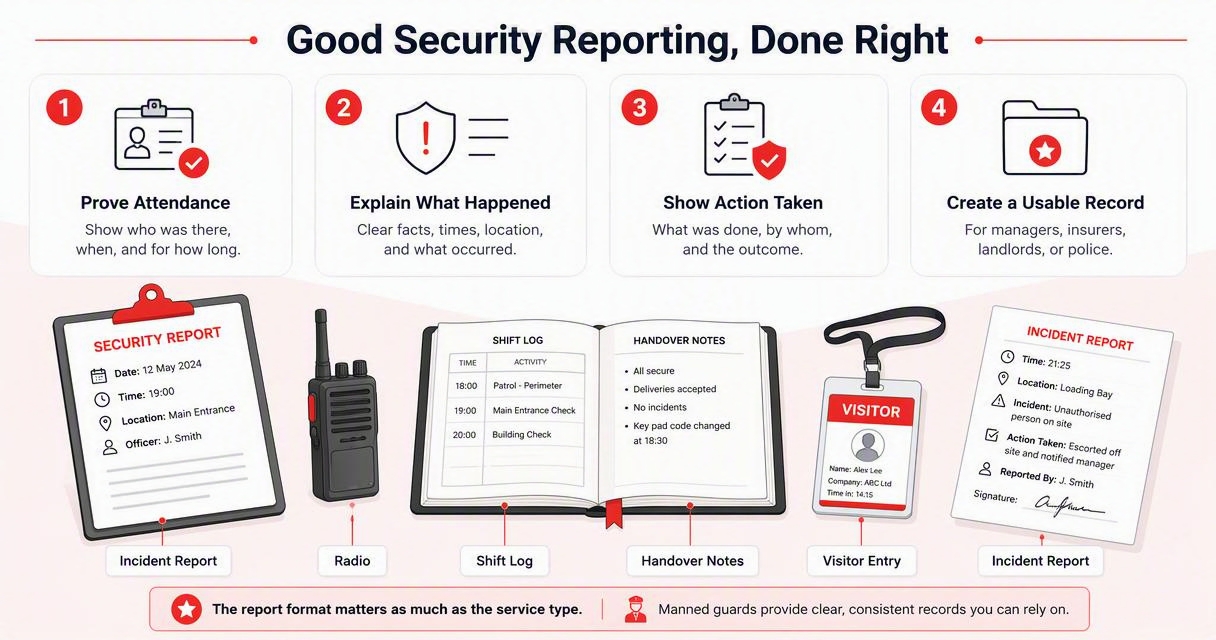
Manned guards should provide shift logs, handover notes, visitor entries, incident reports, maintenance observations, and escalation records. Mobile patrol officers should provide visit timestamps, GPS confirmation where available, checkpoint data, photos, and clear notes on doors, gates, alarms, and suspicious activity.
Weak reporting creates a false sense of protection. If a provider cannot show what was checked, when it was checked, and what changed, managers are left with assumptions rather than evidence.
Reporting checklist for both services
- Define the exact patrol route, post orders, and escalation contacts.
- Agree what counts as an incident, observation, defect, or urgent risk.
- Require timestamps and location evidence where practical.
- Ask for photos for damage, forced entry, hazards, and repeat issues.
- Review reports weekly, not only after major incidents.
- Update instructions when building works, stock levels, tenants, or opening hours change.
Mobile patrol security should always be judged by evidence of attendance and action, not by the promise of visits alone.
How NEXUS SECURITY SERVICESES LTD handles this choice
NEXUS SECURITY SERVICESES LTD approaches the guarding or patrol decision by matching the service to the site risk, not by pushing one default option. The practical review covers site layout, operating hours, asset value, staff exposure, visitor flow, previous incidents, alarm arrangements, and reporting needs.
For example, a retail site may need a visible officer during peak trading, while a nearby storage unit only needs lock-up, alarm response, and random inspections. A construction project may start with patrols, move to fixed guarding when expensive plant arrives, then return to patrols when the site is near completion.
That flexibility is often where value appears. A blended plan can reduce unnecessary static hours while keeping a trained person in place when interaction, judgement, or immediate response is required. You can also visit nexussecurityserviceses.com when you want a service conversation based on your actual premises rather than a generic package.
Useful explainer video on security decision-making
The video is not a commercial-building tutorial, but it shows a useful principle for any security operation: clear procedures, verification, and trained human judgement matter when risk is live.
What to expect in 2027
Security buying in 2027 will likely become more blended, more evidence-led, and more technology-supported. The strongest providers will not frame the choice as people versus systems, but as trained officers using better information at the right moments.
Expect more clients to ask for live dashboards, digital occurrence books, GPS-backed patrol evidence, body-worn video policies, lone-worker monitoring, and clearer escalation workflows. These tools will make both fixed guarding and patrol services easier to audit.
Academic work on autonomous navigation, such as the 2022 review of COLREGs-compliant autonomous surface vehicles by Hu, Hu, and Naeem in the Journal of Automation and Intelligence, is not about site security, but it reflects a wider direction: route planning, sensing, and decision support are becoming more sophisticated across safety-critical operations.
The human role will still matter. A camera can detect movement, and a route system can prove attendance, but a trained officer decides how to speak to a distressed employee, refuse unsafe access, or preserve a scene until police arrive.
FAQ
Is manned guarding better than mobile patrols?
Manned guarding is better when the site needs constant presence, visible deterrence, access control, visitor handling, or immediate response. Mobile patrols are better when the site needs periodic checks, out-of-hours attendance, lock-up support, or alarm response across a wider area. The better option is the one that matches the risk.
Are mobile patrols cheaper than static guards?
Mobile patrols are often lower cost because one officer can inspect several sites during a shift, while a static guard is dedicated to one premises. Cost should still be judged against exposure. If a site needs immediate intervention or people management, a cheaper patrol-only plan may leave the wrong risk uncovered.
Can a business use both services together?
Yes. A blended model is common for sites where risk changes by time of day. A business might use a fixed guard during trading, deliveries, or visitor hours, then switch to mobile patrols for nights, weekends, vacant periods, or perimeter checks. This can balance deterrence, response, and budget.
Do mobile patrol officers need SIA licences?
Mobile patrol officers may need an SIA licence when they carry out licensable security activities, such as guarding premises against unauthorised access or protecting property. The exact requirement depends on the role and activity. UK buyers should check provider compliance against current SIA guidance before signing a contract.
How often should mobile patrols visit?
Visit frequency should reflect risk, not habit. A low-risk office may need one or two checks after closure, while a construction site with valuable materials may need more frequent and random visits. Alarm history, location, lighting, access points, and recent incidents should guide the patrol schedule.
Conclusion
The right answer to manned guarding vs mobile patrols is usually clear once you map the service to real risk. Choose guards for constant presence, public interaction, access control, and immediate response. Choose patrols for flexible checks, closed premises, alarm attendance, and multi-site coverage. Choose both when your risk changes between operating hours and closure.
Before you buy, list your top five security risks, mark when and where each risk happens, then match each one to a fixed officer, patrol visit, technology control, or escalation process. If you want help building that plan, speak with NEXUS SECURITY SERVICESES LTD or head to nexussecurityserviceses.com with your site hours, floor plan, incident history, and reporting needs ready.
Generated by EarlySEO.com


0 Comments