

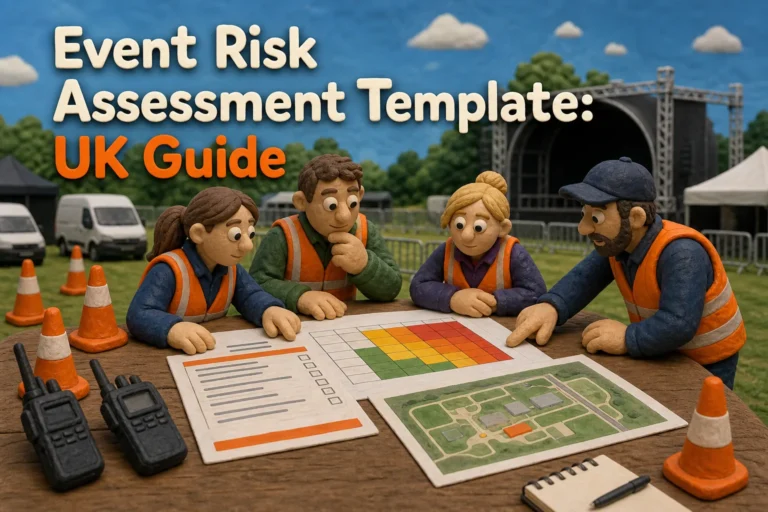
A weak risk assessment can leave a busy event team guessing when something goes wrong. A useful event risk assessment template gives each hazard an owner, a score, and a clear control that staff can check before guests arrive.
Use the structure below for meetings, public gatherings, concerts, markets, and festivals. It also shows when a security partner such as Nexus Security Serviceses Ltd can help turn written plans into action.
What an Event Risk Assessment Template Should Include
An event risk assessment template is a working record of hazards, who could be harmed, the level of risk, and the controls in place. It should describe the event as it will run, rather than copy a generic office form.
Start with the basics. Record the event name, venue, date, organiser, expected attendance, event hours, and the person who owns the assessment. Add a version number and review date. This matters when the plan changes after a site visit or supplier meeting.
Each risk entry should contain:
- Hazard: the thing that could cause harm, such as a blocked exit or loose cable.
- People at risk: guests, workers, contractors, performers, children, or disabled visitors.
- Possible harm: the injury, illness, loss, or disruption that could follow.
- Existing controls: what is already being done.
- Risk score: the agreed likelihood and severity rating.
- Further action: the control still needed, its owner, and its due date.
- Residual score: the rating after the extra control is in place.
Keep hazards and risks separate. A wet floor is the hazard. A guest slipping and suffering an injury is the risk. This distinction helps the team choose a control that deals with the cause, not only the outcome.
Organisers should consider who may be harmed, involve workers, record significant findings where required, and review controls when conditions change. Paperwork should not replace controls in practice. These are practical steps for managing risk.
For a crowded venue, add a simple communication plan. State who can pause entry, who speaks to emergency services, who checks toilets and exits, and who records incidents. The wider event security services uk plan should match the risk register, so staff know which controls they own.
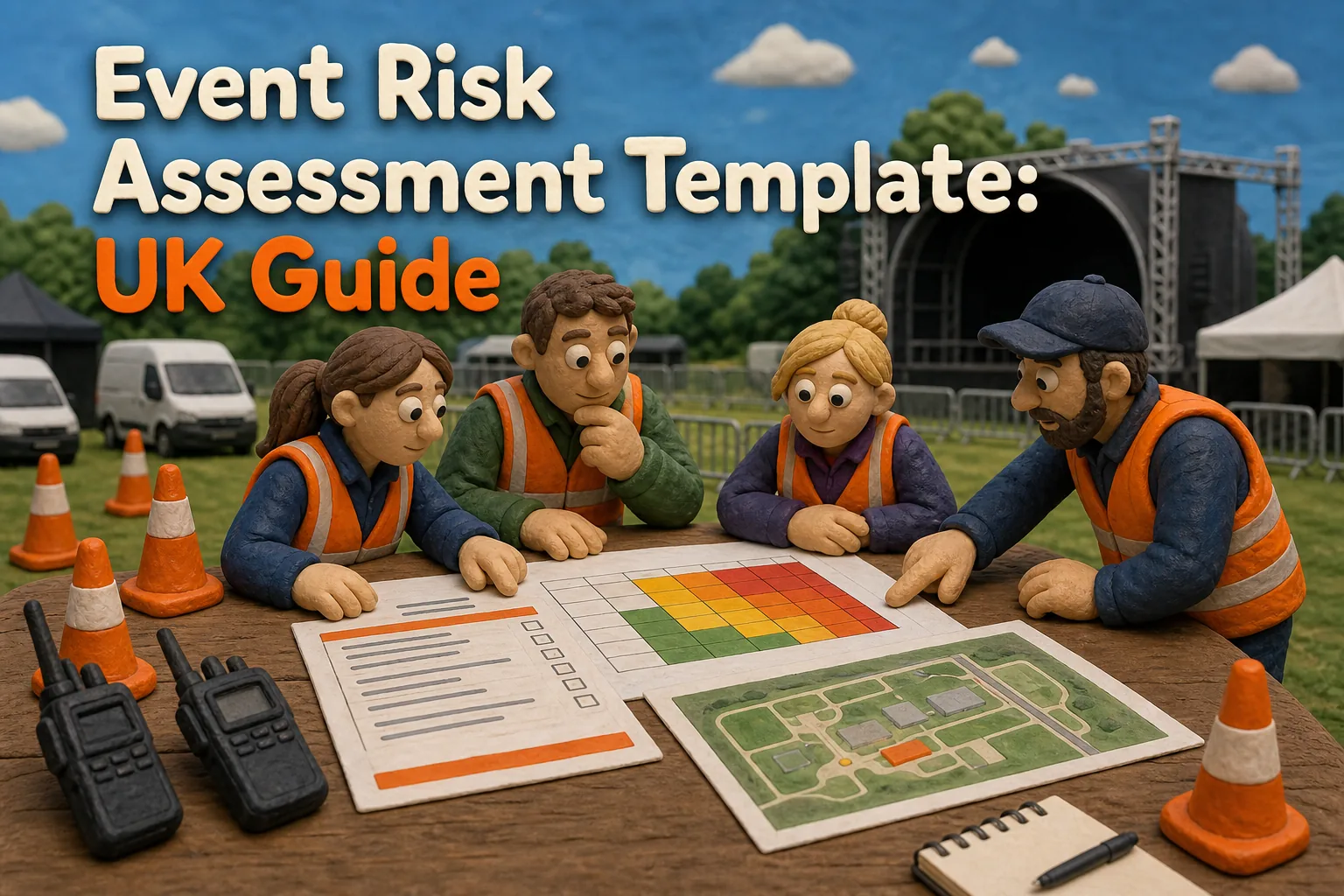
Sign-off should come from the person with authority to accept the remaining risk. That may be the event manager, venue manager, or appointed safety lead. A signature alone proves little, so include the date, comments, and any conditions attached to approval.
Template Formats for Different Event Types
The best event risk assessment template is the one the team will update and use. A short indoor meeting does not need the same form as a multi-day outdoor festival.
Small indoor meetings and private functions
Use a one or two-page document with fields for slips, trips, fire, first aid, access, food, lone working, and emergency contact routes. Add a room plan if furniture could narrow an escape path. A simple table is often enough when the venue has fixed controls.
Corporate events and conferences
Include registration queues, temporary staging, audio-visual equipment, guest access, contractors, deliveries, and evacuation. If senior guests or sensitive business information are present, add a section for access permissions and privacy concerns. An access control entry system guide can help organisers think through who should enter each area and how staff will check credentials.
Outdoor markets and community events
Build the form around weather, ground conditions, vehicles, temporary structures, generators, cables, food stalls, waste, and public access. Add a trigger for review. For example, high winds, heavy rain, or a change in the site layout should prompt a fresh check rather than a note in the margin.
Concerts, festivals, and large public gatherings
Use a workbook with separate tabs or pages for crowd movement, barriers, transport, stewarding, performers, trading, medical response, fire, weather, and security. Include a site map with entry points, exits, restricted zones, emergency access routes, and the control room.
A useful early-stage form can be completed before every supplier is appointed. Mark assumptions clearly. Later, replace each assumption with confirmed information, such as the final stage plan or the agreed steward position. This creates a planning trail and stops late changes from disappearing.
Keep a live version on site, but control printed copies. Write the document owner on each page and remove old versions from staff folders. A superseded plan can cause as much confusion as no plan at all.
Nexus Security Serviceses Ltd can review the security parts of a draft with UK organisers, especially where entry control, crowd movement, guarding, or incident response need named responsibilities. The aim is to make the form match the event, not to add pages for their own sake.
How to Score Risks and Record Control Measures
Most risk registers score likelihood against severity. The event risk assessment template should explain both scales before anyone rates a hazard.
Use a clear scoring method
A common 5 by 5 matrix gives likelihood a score from 1 to 5 and severity a score from 1 to 5. Multiply the two numbers to get the initial score. For instance, a likelihood of 3 and a severity of 4 produces 12.
The numbers are a comparison tool, not a prediction. Your team must define what each number means. A score of 1 might mean rare or minor. A score of 5 might mean very likely or fatal. Keep the wording beside the matrix so two reviewers do not apply different standards.
| Review point | Question to ask | Record in the template |
|---|---|---|
| Initial risk | What could happen before extra action? | Likelihood, severity, and score |
| Control choice | What will stop the harm or reduce exposure? | Action, owner, and due date |
| Residual risk | What risk remains after the control? | New likelihood, severity, and score |
| Acceptance | Who agrees the remaining risk is acceptable? | Name, role, date, and conditions |
| Review | What changed or went wrong? | New version and review note |
For a small event, a 3 by 3 matrix may be easier to use. Larger teams may need a 5 by 5 matrix because it gives more room to separate similar hazards. The choice matters less than consistent definitions and a clear escalation rule.
Controls should follow the cause. If queues may spill into a road, move the queue first. Then add barriers, a trained marshal, and a way to stop admission when the safe area is full. Do not write “monitor” as the only action. Say who monitors what, how often, and what they do when the limit is reached.
Review controls after a change, near miss, complaint, or incident. Command, emergency response, and a post-event improvement loop are important in event security planning. A low score is not enough if the control cannot work during peak arrival.
Event-Specific Hazards to Add Before You Publish the Assessment
An event risk assessment template becomes useful when it reflects the site and the programme. Walk the venue at the same time of day as the event where possible. Look at what people will do, not only what the room looks like when empty.
Access, queues, and crowd movement
Check entry width, queue length, ticket checks, bag searches, pinch points, barriers, and exit flow. Ask what happens if one entrance closes. Include a plan for lost children, separated groups, and guests who need extra help.
Do not treat crowd risk as a headcount alone. The layout, arrival pattern, attraction schedule, weather, and staff position can change pressure in one area. Record a trigger for opening another route or pausing entry.
Fire, structures, and temporary equipment
List blocked exits, combustible materials, hot work, cooking, candles, generators, cables, stages, marquees, and temporary seating. Assign checks to named people. The person who installs a structure may not be the person who checks it during public opening.
Weather and the ground
Outdoor events need controls for wind, rain, heat, ice, mud, poor visibility, and lightning. State who checks forecasts and when. Link each threshold to an action, such as stopping a performance, closing a tent, or moving guests indoors.
People who may need extra support
Consider children, older guests, disabled visitors, pregnant workers, young staff, and anyone working alone. Ask whether the control works for them. A steep route, loud alarm, or fast evacuation instruction may create a separate risk.
Include contractors and suppliers in the review. Their vehicles may arrive before guests. Their work may involve lifting, chemicals, heat, or temporary power. A sample event risk assessment can help show how event hazards may be set out in a usable form, but organisers still need to adapt any example to their own venue.
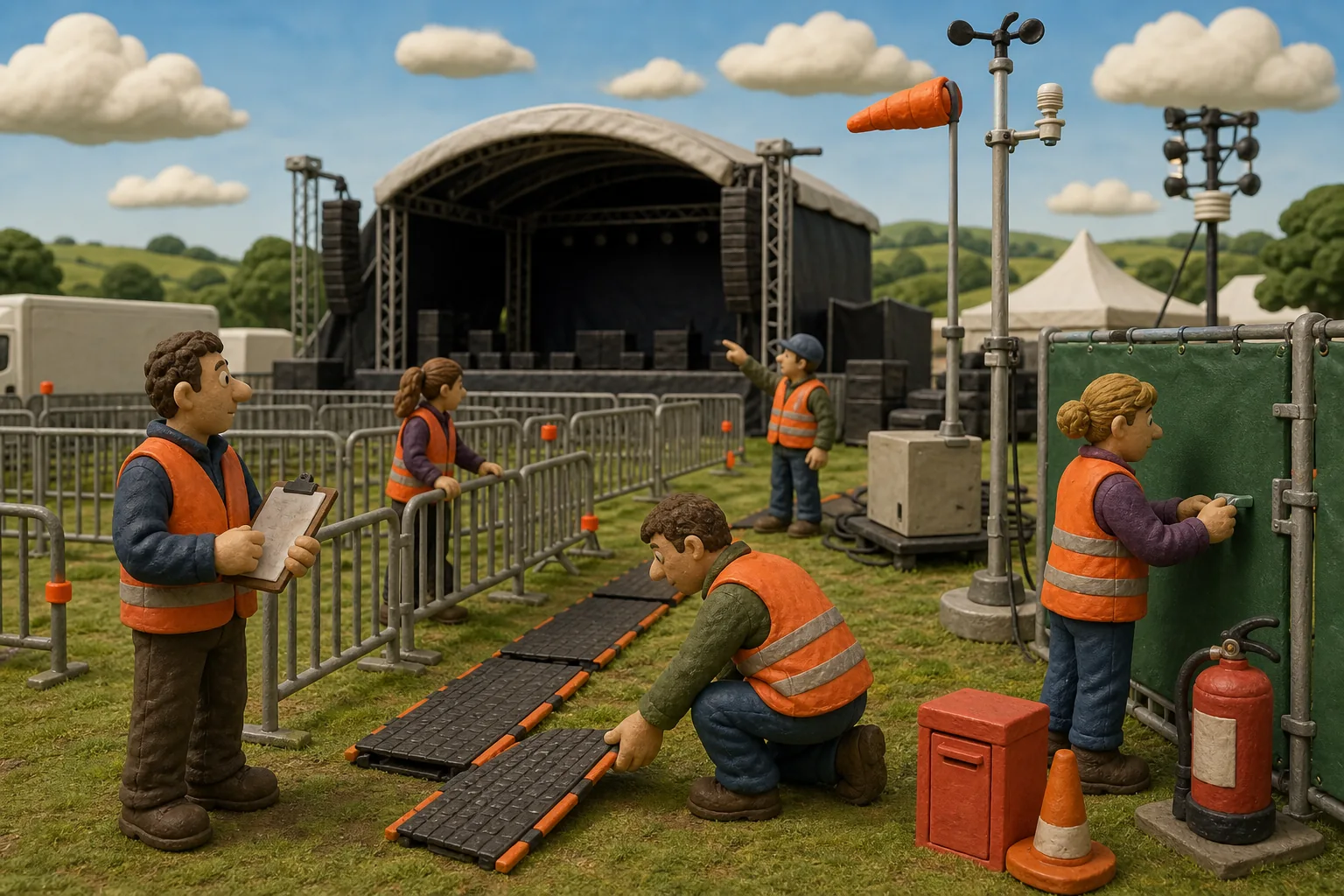
Before release, ask the venue, production lead, first aider, security lead, and event manager to challenge the assessment. A short review often finds gaps that one author misses. Responsibilities and arrangements should be written clearly rather than assumed.
When to Use Professional Event Security Support
Professional event security support is worth considering when the risk depends on trained people making fast decisions. This can include controlled entry, crowd pressure, theft, conflict, protest activity, high-profile guests, late-night trading, or a site with several public access points.
The assessment should define the task before a provider is appointed. State the number of posts only after identifying the work. A static guard watches a fixed point. A mobile patrol checks several areas. A steward may guide guests, while an SIA-licensed security officer may carry out a different security role under the agreed plan. Organisers assessing staffing needs can also review manned guarding services in the UK for context on fixed security presence.
Ask the provider to explain:
- Who leads the team during the event.
- How incidents move from a guard to the event manager.
- How staff receive the site briefing.
- How entry decisions and refusals are recorded.
- How breaks, shift changes, and late cover are handled.
- What information the client receives after an incident.
Security must fit the wider plan. A guard at an entrance cannot fix a queue that has no safe overflow area. A CCTV view cannot replace a person who can speak to a distressed guest. A written procedure also fails if the team has not rehearsed the handoff.
Nexus Security Serviceses Ltd provides security personnel for event management, theft prevention, and surveillance work in the UK. We can help organisers connect the risk register with entry control, guarding, and response duties, so the person listed against a control knows what action to take.
For smaller events, one trained lead and a clear escalation route may be enough. For a complex site, the plan may need several posts, a control point, radio discipline, and a formal incident log. The decision should follow the assessed risk and the venue’s limits, not a fixed package.
After the event, gather the security log, complaints, near misses, and staff feedback. Record what changed during the day. That review gives the next organiser better evidence than a blank sign-off box.
FAQ
What is an event risk assessment template?
An event risk assessment template is a structured form for recording hazards, affected people, risk scores, controls, owners, and review dates. It gives an organiser a repeatable way to assess a venue and event plan. The form should be edited for the site, audience, suppliers, programme, and likely changes.
Who should complete an event risk assessment?
The organiser remains responsible for making sure the assessment is suitable, but a competent person can help complete it. Venue staff, production leads, security staff, contractors, and workers should contribute where their tasks affect risk. The person who accepts the remaining risk should be named and should have authority to act.
How do you score risk at an event?
Score event risk by rating likelihood and severity against definitions agreed by the team, then combine the two ratings. A 3 by 3 or 5 by 5 matrix can work. The score should lead to an action, owner, and review date. Re-score the hazard after controls are added.
What hazards should an event risk assessment cover?
An event risk assessment should cover access, crowds, fire, first aid, weather, temporary structures, slips, trips, vehicles, contractors, electrical equipment, food, safeguarding, and security. The exact list depends on the venue and event. Walk the site and check the programme instead of relying on a generic list.
When should an event risk assessment be reviewed?
Review the assessment when the venue, layout, attendance, weather, supplier, programme, or security arrangements change. Review it after an incident, near miss, complaint, or failed control. A final post-event review should record lessons while staff still remember what happened.
Conclusion
Use a template that names the hazard, sets a shared score, assigns an owner, and records the control that will happen on site. Complete an early draft, test it with the people running the event, then review it after the day. For help linking the document to crowd and security duties, explore Nexus Security Serviceses Ltd and its Event Security Services: What UK Organisers Need resource.


0 Comments