

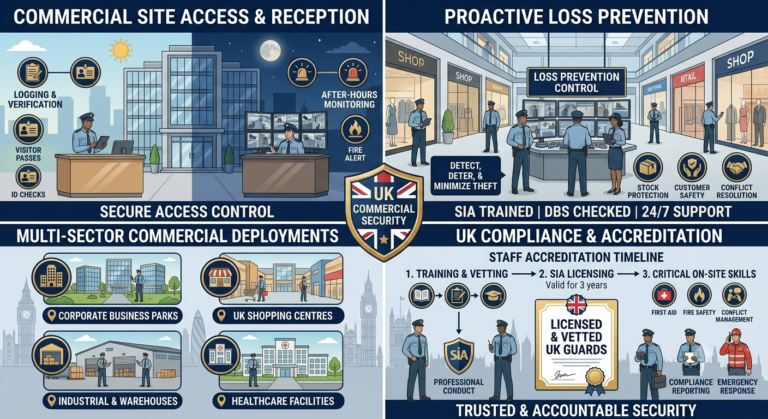
Introduction to Commercial Security Services
In contemporary society, the significance of safety and security has become increasingly paramount, particularly for businesses and organizations in the United Kingdom. Commercial security guard services play a crucial role in safeguarding various sectors, including retail, corporate offices, hospitality, construction sites, and public events. These services not only aim to prevent theft and vandalism but also to ensure the safety of employees, clients, and visitors, thereby fostering a secure environment conducive to productivity and success.
The primary function of security guards extends beyond mere observation; they act as a deterrence against criminal activities. Their presence alone can significantly reduce the risk of incidents, promoting a sense of security among employees and patrons alike. Trained security personnel are equipped to handle a variety of situations, including emergencies, disputes, and potential threats, often acting as the first line of defense for businesses.
Commercial security services encompass a wide range of offerings, tailored to meet the specific needs of businesses. These can include static guarding, where security agents are stationed at key locations, and mobile patrols that cover larger areas. Additionally, services may involve the installation of surveillance systems, access control, and alarm response, integrating technology with human oversight to enhance safety measures. Furthermore, event security is another critical component, ensuring the protection of attendees and assets during gatherings.
The demand for commercial security guard services has risen substantially, driven by factors such as increased awareness of security risks, the expansion of businesses, and regulatory requirements. Organizations recognize the value of investing in professional security solutions to mitigate potential threats and reassure stakeholders about their commitment to safety. As industries evolve, so too will the strategies employed by security services, adapting to new challenges and fostering a robust security culture in the UK.
Types of Commercial Security Services Offered
In the realm of commercial security in the United Kingdom, various types of services are available to meet the diverse needs of businesses. Each security solution is designed to address specific challenges faced by organizations, ensuring the safety and protection of assets, employees, and customers.
One of the most common types of security service is that of static guards. These professionals are stationed at designated locations, such as entrances, exits, or specific areas within a facility. Their presence acts as a deterrent against potential threats and provides immediate assistance in case of emergencies. Static guards are particularly valuable for businesses requiring continuous monitoring and a visible security presence.
Another key service is mobile patrols, which involve security personnel who regularly patrol a predetermined area in a vehicle. This service is efficient for large premises or multiple sites, as it allows for a wider range of coverage compared to static guards. Mobile patrols can quickly respond to incidents and are effective in discovering any suspicious activity or breaches of security.
Event security is also a critical specialization within commercial security services. It encompasses the management of security arrangements for public gatherings, corporate events, or private functions. Trained personnel ensure that safety protocols are adhered to, managing crowd control, and effectively handling any emergencies that may arise during the event.
Concierge security services bring an additional layer of security as they often combine traditional security roles with customer service. These professionals are strategically placed at reception areas, where they not only oversee security measures but also assist guests, providing a welcoming environment while maintaining a secure atmosphere.
Lastly, specialized security solutions cater to unique business needs, including surveillance systems, alarm management, and cybersecurity. These bespoke services ensure that companies receive tailored support, enhancing their overall security posture and mitigating risks associated with specific threats.
Training and Qualifications of Security Guards
In the United Kingdom, becoming a security guard requires adherence to specific training and qualification standards set by regulatory bodies, particularly the Security Industry Authority (SIA). The SIA is responsible for licensing individuals working within the private security industry, ensuring that they meet the necessary legal requirements and possess the essential skills for their roles.
The first step for anyone aspiring to work as a security guard is obtaining a relevant SIA license. This process involves completing an accredited training course, which covers several key areas, including the law in relation to security, conflict management, and health and safety protocols. Typically, these training programs are designed to equip candidates with both theoretical knowledge and practical skills required to perform security duties effectively.
Upon successful completion of the training course, candidates must pass an examination set by the SIA. This assessment tests the knowledge acquired during the training, ensuring that only those who are adequately prepared receive their license. It is imperative that security personnel possess strong communication skills, as they often interact with the public and work in diverse environments.
Continuing professional development is also a crucial aspect of a security guard’s career. Once licensed, security guards are encouraged, if not mandated, to engage in ongoing training to keep their skills sharp and stay updated with the latest industry practices and regulations. Such training may encompass advanced conflict resolution techniques, emergency response protocols, and the use of modern surveillance technology.
In conclusion, the training and qualifications of security guards in the UK play a vital role in maintaining safety and security across various settings. Compliance with SIA requirements not only legitimizes security professionals but also enhances their ability to respond to incidents effectively, thereby fostering a safer environment for all.
The Role of Technology in Security Services
The integration of technology in commercial security guard services has transformed the industry, enhancing both efficiency and effectiveness. In today’s fast-paced environment, the ability to quickly monitor and respond to potential threats is paramount. Security guards are increasingly reliant on advanced tools such as surveillance cameras, alarm systems, and electronic tracking devices to maintain safety and security for businesses and their assets.
Surveillance cameras serve as a critical component of modern security measures. These devices not only provide visual monitoring of premises but also enable real-time access to video feeds. With advancements in high-definition and night vision technology, security personnel are better equipped to detect suspicious activities, allowing for immediate intervention if necessary. Furthermore, many modern systems offer cloud storage solutions, enabling easy retrieval and management of recorded footage when required for investigations.
Alarm systems play an equally vital role in enhancing security operations. These systems can detect unauthorized access or unusual movements, triggering alerts that can be communicated directly to security teams. The installation of alarm systems ensures that security guards can take prompt action, potentially deterring criminal activities before they escalate. Moreover, integrating alarm systems with mobile technology allows security staff to receive instant alerts on their smartphones, ensuring that they are always connected, even when not physically on-site.
Another essential aspect of technological integration involves the use of electronic tracking devices. These tools enable security personnel to monitor the location and status of security patrols effectively. By utilizing GPS-enabled devices, security companies can ensure that guards adhere to established routes, thus increasing accountability and oversight. Additionally, these tracking systems can provide valuable data for improving future operational strategies and response protocols.
Overall, technology has become an integral part of commercial security services, enabling security guards to enhance their monitoring capabilities and foster safer environments for businesses. As these technologies continue to evolve, it is expected that their impact on the security landscape will grow, leading to even more sophisticated solutions to meet the demands of modern security challenges.
Legal Framework Governing Security Services
The regulatory landscape for commercial security services in the United Kingdom is multifaceted, encompassing various laws and regulations that dictate how security practices are to be implemented. Primarily, the Private Security Industry Act 2001 (PSIA) plays a pivotal role in establishing a comprehensive framework for the licensure of security personnel. Under this act, it is mandated that all individuals engaged in providing designated security services must hold a valid license issued by the Security Industry Authority (SIA). This licensing process ensures that security personnel meet specific training and ethical standards, thereby fostering accountability within the industry.
In addition to the PSIA, the Data Protection Act 2018 is crucial for security services, especially when handling personal data. Security firms must ensure that any data collected regarding individuals is processed in accordance with data protection principles. This includes obtaining explicit consent before collecting data, safeguarding data during transit and storage, and providing individuals with access to their own data upon request. Failing to comply with these legal obligations can result in severe penalties, highlighting the importance of adhering to data protection guidelines.
Moreover, security professionals are expected to comply with the Human Rights Act 1998, which emphasizes the rights of individuals, including their right to privacy and protection from unlawful interference. Security personnel are trained not only to prevent unauthorized access and safeguard property but also to respect the rights of individuals. This balance is critical in maintaining public trust and confidence in commercial security services.
Overall, understanding the legal framework governing security services is essential for both security providers and clients. Adequate knowledge of these regulations ensures that security operations are conducted lawfully, thereby protecting the rights of individuals while providing effective security solutions.
Benefits of Hiring Professional Security Services
Hiring professional security services for businesses offers a multitude of benefits that can significantly enhance overall safety and peace of mind. One of the primary advantages is crime deterrence. The mere presence of trained security personnel can dissuade potential wrongdoers from engaging in criminal activities, thereby protecting the property and assets of the business.
In addition to crime prevention, professional security services are adept at enhancing the safety of customers and employees alike. These professionals are trained to manage various security challenges and provide a secure environment, which is especially important in high-traffic areas. A safe business atmosphere not only promotes employee productivity but also builds trust with customers, encouraging them to return and recommend the service to others.
Another crucial benefit of hiring security services is their capability for quick incident response. In emergencies, time is of the essence; having trained security personnel on-site can mean the difference between minimal disruption and a major crisis. These professionals are trained to respond efficiently to incidents, whether they are medical emergencies or security breaches, ensuring that appropriate protocols are followed swiftly.
Furthermore, the presence of professional security can contribute to the overall peace of mind for business owners. Knowing that there are dedicated security personnel on the premises allows business owners to focus on their core operations without the constant worry of potential security threats. This peace of mind can lead to better decision-making and a healthier work environment.
In summary, the benefits of hiring professional security services are multi-faceted, ranging from increased crime deterrence, enhanced safety for all stakeholders, rapid incident response, to overall peace of mind. Businesses that invest in such services are likely to see not only a decrease in crime-related incidents but also an improvement in their overall operational climate.
Challenges Faced by the Security Industry
The commercial security industry in the United Kingdom faces a myriad of challenges that can significantly impede its effectiveness and operational efficiency. One of the most pressing concerns is the increasing rate of cyber threats. As businesses increasingly rely on technology and interconnected systems, vulnerability to cyber attacks has surged. Security services must not only protect physical assets but also guard against digital breaches, often requiring specialized skills that are continuously evolving.
Another major challenge is the necessity for continuous training and development. The dynamic nature of the security environment means that personnel must be well-versed in the latest technologies, security protocols, and legal obligations. Regular training programs are essential to ensure that security guards can respond effectively to incidents and adapt to new risks. However, providing comprehensive training can be resource-intensive, and many firms struggle to balance training demands with operational needs.
Adapting to changes in legislation also presents significant hurdles for commercial security services. The legal framework governing security operations is subject to frequent modifications, which can require immediate adjustments in policy and practice. Organizations must remain compliant with these regulations while ensuring that their practices are effective in safeguarding clients. This responsive adaptability can strain resources and necessitate ongoing consultation with legal experts, further complicating operational processes.
Additionally, the recruitment and retention of qualified personnel pose ongoing difficulties for many security firms. The industry suffers from a perception of high turnover rates, which can lead to gaps in service quality. Maintaining a stable and skilled workforce is essential for building client trust and ensuring operational consistency.
Overall, the commercial security industry in the UK is navigating a landscape marked by cyber threats, the need for continuous professional development, compliance with evolving legislation, and workforce retention issues. Addressing these challenges is crucial for the ongoing success and reliability of security services in safeguarding various sectors.
Case Studies: Success Stories from the Field
In examining the effectiveness of commercial security guard services in the United Kingdom, real-life case studies provide compelling evidence of their impact across various industries. In this section, we will highlight several notable instances that illustrate how security measures have successfully mitigated risks and enhanced safety for different businesses.
One prominent case is that of a retail company located in London, which had been experiencing a significant increase in theft and vandalism. After hiring a team of security guards, the company noticed an immediate drop in both incidents and the overall feeling of safety among patrons and employees. The presence of uniformed guards not only acted as a deterrent to potential criminals but also fostered a sense of security, allowing customers to shop without fear. The data collected over a six-month period highlighted a reduction in theft by over 30%, affirming the effectiveness of the security service implemented.
Another case study involves a manufacturing plant in Manchester that faced challenges related to employee safety and unauthorized access to sensitive areas. By integrating commercial security guard services, the plant not only improved access control but also enhanced emergency response capabilities. The security team conducted regular patrols and established a thorough security protocol, which included staff training on emergency procedures. Within a year, the plant reported a significant decrease in workplace accidents and unauthorized entries, showcasing the direct correlation between increased security measures and safer working environments.
Lastly, a financial institution in Birmingham implemented security personnel as a part of their overall security strategy. With threats of fraud and cybercrime looming, the physical presence of security guards at key locations proved instrumental in maintaining order. They performed risk assessments and collaborated with stakeholders to update existing safety measures. After their establishment, the institution experienced a noticeable drop in security breaches, which contributed to enhanced client trust and reassurance in their services.
These case studies demonstrate that commercial security guard services are not merely an additional expense for businesses; they represent a strategic investment in safety and operational resilience. By effectively addressing the unique challenges faced by each entity, security services have helped establish a safer environment conducive to growth and confidence in operations.
Conclusion and Future Outlook for Security Services
In conclusion, the landscape of commercial security guard services in the United Kingdom has undergone significant transformations in recent years. As discussed, the integration of advanced technology and innovative solutions has reshaped how security is delivered, ensuring that businesses remain well-protected against various threats. From the implementation of surveillance systems to the utilization of mobile patrols, the demand for versatile and adaptable security solutions has increased markedly.
Looking ahead, the future of commercial security guard services appears promising yet challenging. With the rapid advancements in technology, particularly artificial intelligence and automation, there is potential for security personnel to shift towards a more supervisory and strategic role. While traditional security methods remain essential, the incorporation of smart technology will enable security professionals to anticipate and respond to security incidents more effectively. This evolution is likely to enhance the overall efficiency of security services, ensuring greater safety for businesses and their clients.
Moreover, the expectations of clients are evolving, leading to a greater emphasis on personalized and proactive security approaches. As businesses seek to mitigate risks and preserve their reputation, security guard services must adapt by offering tailored solutions that align with specific industry needs. The focus on customer service within the security sector will become increasingly critical to maintaining competitive advantages.
Additionally, emerging trends such as remote monitoring, cybersecurity collaborations, and enhanced training programs for security personnel will further shape the industry. As threats diversify, especially in the digital realm, security guards will likely receive training to address these new challenges effectively. Ultimately, the commercial security services landscape in the UK is poised for dynamic growth, necessitating a commitment from both security providers and businesses to remain agile and responsive to future demands.


0 Comments